
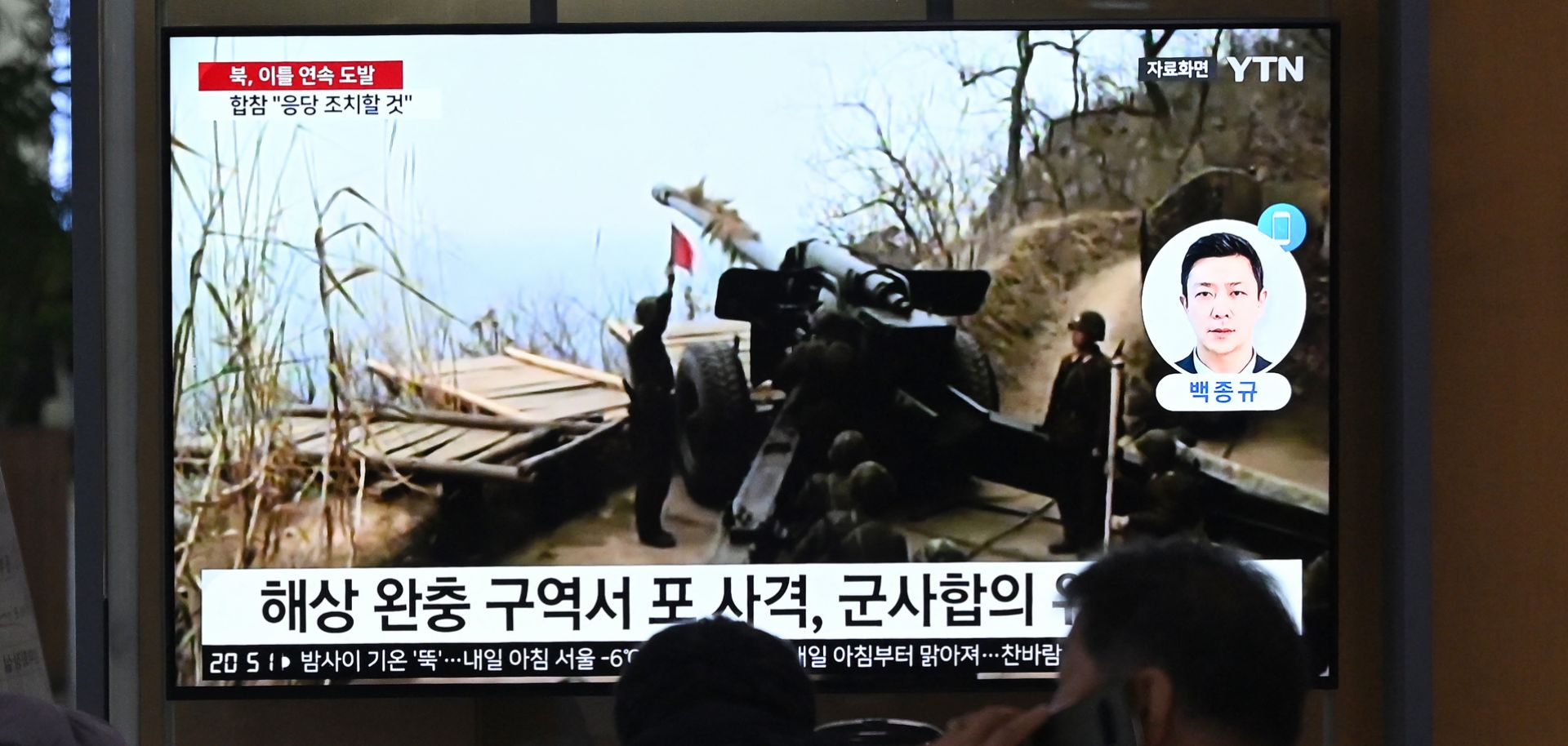
In recent months, North and South Korea have taken a wide variety of actions along their shared border that have increasingly threatened a long-standing, if unsteady, peace on the Korean Peninsula. These include military provocations and propaganda initiatives that, alongside longer-term shifts in national doctrine related to inter-Korean relations, have removed impediments to escalation. The Koreans are, of course, no stranger to fears of war, with the Korean War never technically concluded and the border area serving as one of the most heavily armed peacetime regions in the world for decades. Still, the recent trajectory of events on the peninsula brings a higher chance for military clashes that, even though they are likely to be limited and not escalate to full-scale war, would accelerate the formation of defensive blocs in Asia and create geopolitical ripple effects far beyond the Korean Peninsula.
Provocations and Shifting Stances
Recent months have witnessed escalating, dueling provocations in the physical and ideological realms along the North-South border. In May and June, North Korea sent thousands of balloons laden with bags of trash and human waste across the border into South Korea, with some landing in the streets of Seoul. The North claimed these balloons were retaliation for South Korean civilian groups sending balloons laden with propaganda leaflets into North Korea. In response to the trash balloons, South Korea resumed using large loudspeakers to broadcast propaganda denouncing the regime of Kim Jung Un across the border into North Korea, following a six-year hiatus on the practice. Other provocations include North Korea broadcasting on state TV its acquisition (likely from Russia) of attack drones in August, after which South Korea in October signed a hasty agreement to buy Polish attack drones and field them by December. More recently, Pyongyang accused South Korea of flying drones over the capital city and dropping leaflets on Oct. 11, with photos showing a drone profile that resembles a South Korean military stealth surveillance drone unveiled in September 2023. On Oct. 14, North Korea's military also issued a preliminary operation order to front-line units, including artillery, to be ready to open fire if the South again sends drones into its territory. And on Oct. 16, in a grand symbolic gesture, North Korean state media broadcast footage of the military blowing up roads connecting the North and the South. There have been numerous other incidents in recent months, including North Korean troops straying into the demilitarized zone and North Korean mining roads connecting the two countries. Moreover, both sides in late 2023 scrapped the 2018 Comprehensive Military Agreement, in which they had previously agreed to draw down military activity at the border.
These events take place in the context of two national leaders committed to rivalrous and provocative stances toward the other. Kim has in the past year altered North Korea's long-standing doctrine relating to South Korea, including abandoning the idea of unification with the South — which necessitates redrawing North Korea's borders to demarcate disputed territorial boundaries — and deeming Seoul as Pyongyang's principal enemy (as opposed to the United States). North Korea has also in recent years shifted its weapons testing schedule to focus relatively more on conventional weapons, intended to threaten and deter South Korea (as opposed to strategic weapons, intended to deter the United States or Japan).
Meanwhile, South Korea's conservative president Yoon Suk Yeol has made some of his own shifts since coming to office in May 2022. Yoon's stance toward North Korea is unique even among South Korean conservatives, which traditionally emphasize military deterrence while eschewing diplomatic engagement and the idea of eventual unification, unlike South Korea's liberal Democratic Party. Yoon, by contrast, supports unification, but he believes that maximum economic, political and military pressure on the North from the global community is necessary to isolate Pyongyang and trigger the collapse of the Kim regime; only then, his thinking goes, can unification occur. Yoon is also more extreme than his fellow conservatives on military deterrence, with his ''Three Axis'' response system to North Korea including the concept of ''Korea Massive Punishment and Retaliation (KMPR),'' which involves taking out North Korean political leadership in response to a nuclear or conventional strike attack on South Korea. This concept exceeds not only South Korean response norms, but also global norms of proportional retaliation and avoiding political leadership assassinations.
Engagement With Foreign Partners
Complementing their leaders' rivalrous views, the North and the South have looked to foreign partners to deepen military deterrence. North Korea signed an arms deal with Russia in late 2023 in which Pyongyang agreed to provide artillery and missiles for Russia's war in Ukraine in exchange for Russian defense industrial support. This was followed by a mutual defense treaty signed with Russia in June 2024, which was ratified by Russian lawmakers in the Duma on Oct. 25 and may soon be tested. To wit, South Korean, Ukrainian, U.S. and NATO intelligence agencies claim North Korea plans to deploy upwards of 10,000 elite troops to fight alongside Russia in its war against Ukraine, potentially in the Kursk region of Russia, where Moscow is trying to fend off an incursion by Ukrainian forces.
Meanwhile, South Korea has sought greater U.S. assurances on extended deterrence, namely clarifications on the conditions under which the U.S. nuclear umbrella would apply to South Korea, as well as greater input by Seoul into decision-making on the use of nuclear weapons. This culminated in the ''U.S.-ROK Guidelines for Nuclear Deterrence and Nuclear Operations on the Korean Peninsula,'' signed in July 2024, which both sides claimed provided ''principles and procedures'' for effective deterrence, though the exact details remain unknown. Yoon has also sought more demonstrations of said U.S. deterrence, as evidenced by a visit by a U.S. fast-attack submarine to Busan in September and the participation of two U.S. B-1 long-range bombers in South Korean military exercises in early October. More broadly, Yoon has sought to expand South Korea's role as a U.S. defense partner in a bid to deepen Washington's security engagement related to North Korea, Seoul's top foreign policy concern. These efforts included signing a trilateral agreement with Japan on intelligence sharing related to North Korean missile tests, providing artillery shells to fill U.S. stockpiles so Washington could send its own artillery stocks to Ukraine for use against the Russians, and Seoul making rare statements in support of U.S. regional concerns beyond the Korean Peninsula, such as preserving stability in the Taiwan Strait and in the South China Sea in the face of Chinese military provocations.
The Growing Risk of a Clash
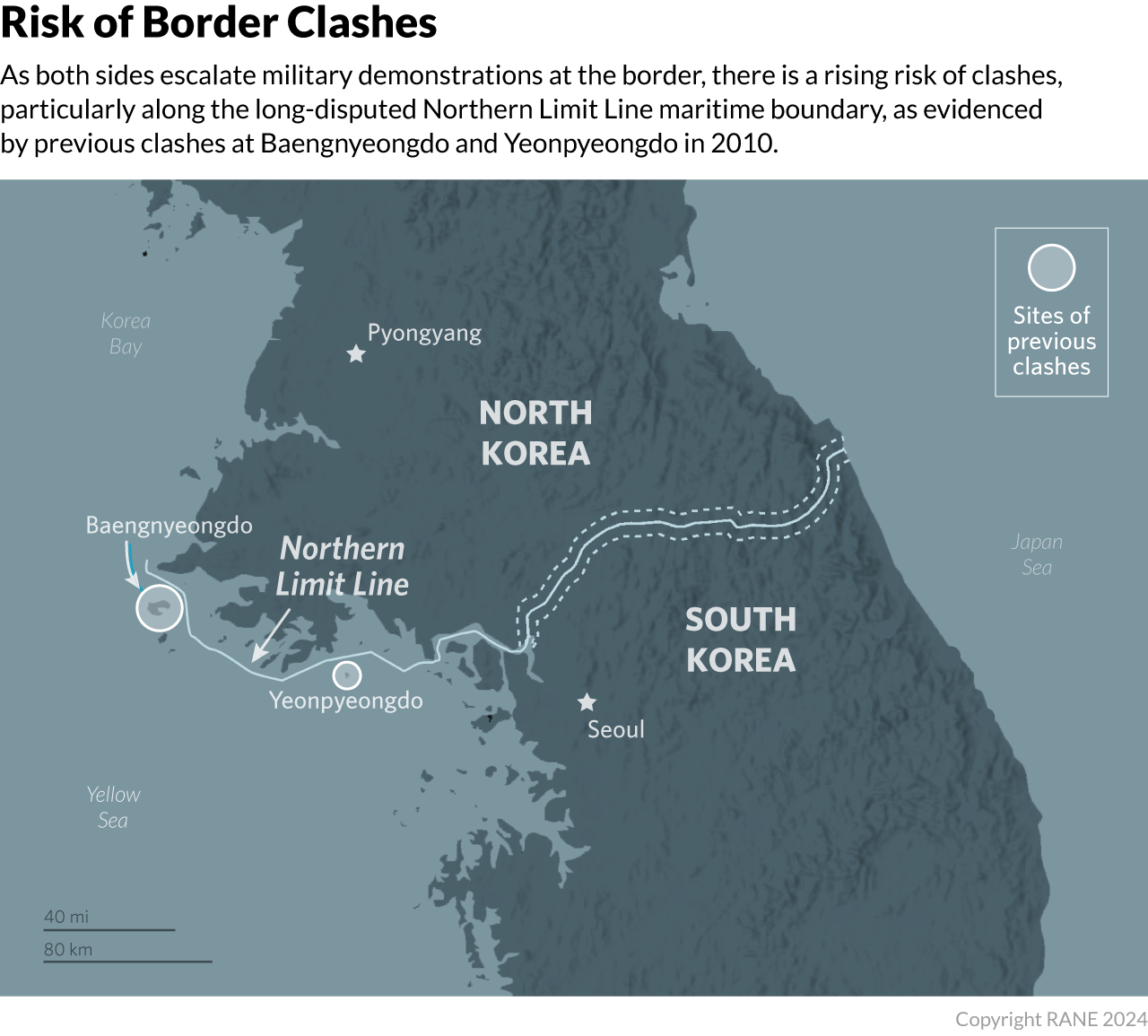
The provocative border actions of recent months, coupled with more aggressive leadership stances and growing foreign defense cooperation, suggest the chance is rising for a military clash at the Korean border, albeit one with limited civilian casualties and a still low risk of war. Such a clash would most likely take the form of exchanges at sea, such as naval vessels exchanging fire or artillery exchanges near uninhabited or poorly populated islands in the disputed waters west of the peninsula, known as the Northern Limit Line, as occurred in two separate incidents in 2010. An incident involving a run-in of each side's troops in the Demilitarized Zone, or DMZ, is also possible, given the previous norm of avoiding patrols in the area is eroding, especially after both sides scrapped their 2018 Comprehensive Military Agreement and resumed surveillance and defensive deployments at the border. Lower profile events (shy of producing casualties) could also trigger a kinetic clash, such as if North Korea shoots down a South Korean surveillance drone over Pyongyang (or vice versa) or if the South Korean navy forcibly inspects ships suspected of trafficking sanctioned materials (including weapons) between North Korea and Russia, as happened in June 2024. However, more escalatory drone strikes or artillery volleys in populated urban areas remain unlikely, given the difficulty of avoiding all-out war following mass civilian casualty events.
Previous Border Clashes
Two events in 2010 highlight possible forms and locations of future clashes between North Korean and South Korean forces along the border. In March 2010, an explosion sank the South Korean Navy corvette Cheonan near Baengnyeongdo, an island close to the Northern Limit Line, or NLL. The event killed 46 sailors in what South Korean and U.S. authorities later concluded was a North Korean torpedo attack. In response to the sinking of the Cheonan, South Korea imposed sanctions on North Korea and curbed economic ties. Seoul also sought to bolster its naval defense capabilities, including in anti-submarine warfare. Then, in November 2010, North Korean artillery bombarded Yeonpyeongdo, another island near the NLL, killing two South Korean marines and two civilians, and spurring South Korea to return fire with self-propelled howitzers on North Korean barracks and firing positions. Seoul also upped its retaliatory response protocols for future North Korean provocations. The incident came a day after South Korea's defense minister said the country would consider stationing U.S. tactical nuclear weapons in South Korea for the first time since 1991.
Whatever form the initial provocation takes, the risk of subsequent escalation is significantly higher than in previous periods, because both sides (as opposed to just Pyongyang) are threatening overwhelming retaliation, and because both sides also have more attack capabilities and revised doctrine to facilitate greater follow through on such threats than in the past. This risk of escalation is driven in the South by Yoon's ''Korea Massive Punishment and Retaliation'' strategy, and in the North by the amendment of the constitution to align with Kim's claims of South Korea's new status as Pyongyang's principal enemy — that any strike on the North will result in the utter destruction of the South. Though Kim, like his predecessors, is prone to hyperbole, he has more reason than usual to follow through on threats, with greater confidence in North Korea's conventional response capability — especially following Pyongyang's acquisition of Russian suicide drones and new defense treaty with Moscow. Given Russia is a world-leading nuclear power, this could embolden Kim to conduct more escalatory border activity than in the past, under the assumption that Seoul would be more hesitant to provoke Russian military engagement. Likewise, Seoul likely feels emboldened by greater shows of U.S. defense support, including new guidelines on extended deterrence and recent U.S. displays of nuclear weapon delivery platforms (e.g. the latest long-range bombers) far more advanced than the North fields. South Korea and North Korea are both highly unlikely to fulfill the full extent of their retaliation pledges: assassinating Kim or bombing the heart of Seoul, respectively. However, both sides are now much more likely to retaliate against new perceived provocations with kinetic responses that are at least proportional to the damage they incurred (i.e. roughly on par in terms of target type, if not casualty count), potentially paired with non-kinetic responses, like cyberattacks on government facilities. Moreover, there is a moderate risk that even retaliation originally intended as proportional could inadvertently breed escalation. Thus, one exchange between the Koreas could quickly turn into weeks or even months of small-scale clashes, of the likes previously described, as each side tries to land the last blow as a means to most honorably conclude hostilities. Still, fears of massive destruction in Pyongyang and Seoul, exacerbated by each side's large and readied arsenals, as well as the nuclear threats of their foreign partners, would likely see clashes end before they escalate to full-scale war.
Global Implications
A return of border clashes would produce geopolitical ripple effects well beyond the peninsula. In China, fears of a new Korean conflict and of ceding primary influence over North Korea — a border state and buffer zone with U.S.-backed South Korea — to Russia would likely spur greater Chinese cooperation with Pyongyang, including renewed military drills and greater economic aid (formal or otherwise, given U.N. sanctions on North Korea). This could spur greater Western sanctions and dual-use export restrictions on China amid the deepening perception in Europe and the United States that China is a facilitator of global security threats. Likewise, South Korea's defense ties with the United States and Japan would deepen, particularly related to modernizing South Korea's border forces (like its drone fleet and satellite surveillance capabilities) and cooperation in the tracking of and joint response to military threats from North Korea, Russia and China. This could also involve greater U.S. naval presence in the seas around South Korea to deter North Korean military action. Such a presence would also drive China to deepen its regional naval presence in coordination with North Korea and Russia, including potentially joint incursions around disputed Japanese territories like the Senkaku Islands. In Japan, this would add impetus to the ruling Liberal Democratic Party's efforts to raise defense spending, especially for maritime and missile defense capabilities, and revise the constitution to allow Japan's Self-Defense Forces to respond to threats farther afield, assuming the party is able to stay in power in the next vote for prime minister, due in mid-to-late November.
Finally, if former U.S. President Donald Trump returns to the White House in January, he could choose to reignite disputes with Seoul over the cost-sharing of U.S. troops in South Korea and/or reengage with Pyongyang in bilateral dialogues. Such U.S. actions, paired with border clashes, could deepen Seoul's sense that it needs greater military self-reliance and spur Yoon to publicly discuss or even actively pursue South Korea's own nuclear weapons. This would heighten China, Russia and North Korea's regional threat perceptions and hinder Seoul's relations with all three countries. It could also drive Japan to consider pursuing its own nukes for fear of being outgunned by yet another of its Asian neighbors, particularly given current bilateral security cooperation is not guaranteed to last beyond Yoon's tenure, which ends in 2027.
In the short term, kinetic clashes, cyberattacks and fears of a growing nuclear arms race emanating from the Korean Peninsula could raise foreign businesses' concerns about instability in South Korea and the need to diversify operations and investments toward perceived safe havens like Singapore. But barring a full-scale war or nuclear outbreak, these fears will likely subside, as they have following previous incidents along the North Korean border, assuaged by the prospect of profits in South Korea's high-tech economy and strong export industries. Still, the slowly changing security dynamic between the two Koreas threatens ripple effects in political, economic and security affairs across Asia and the world — especially if an isolated border clash snowballs into an accelerating series of incidents that test each side's capacity and willingness for de-escalation.
