
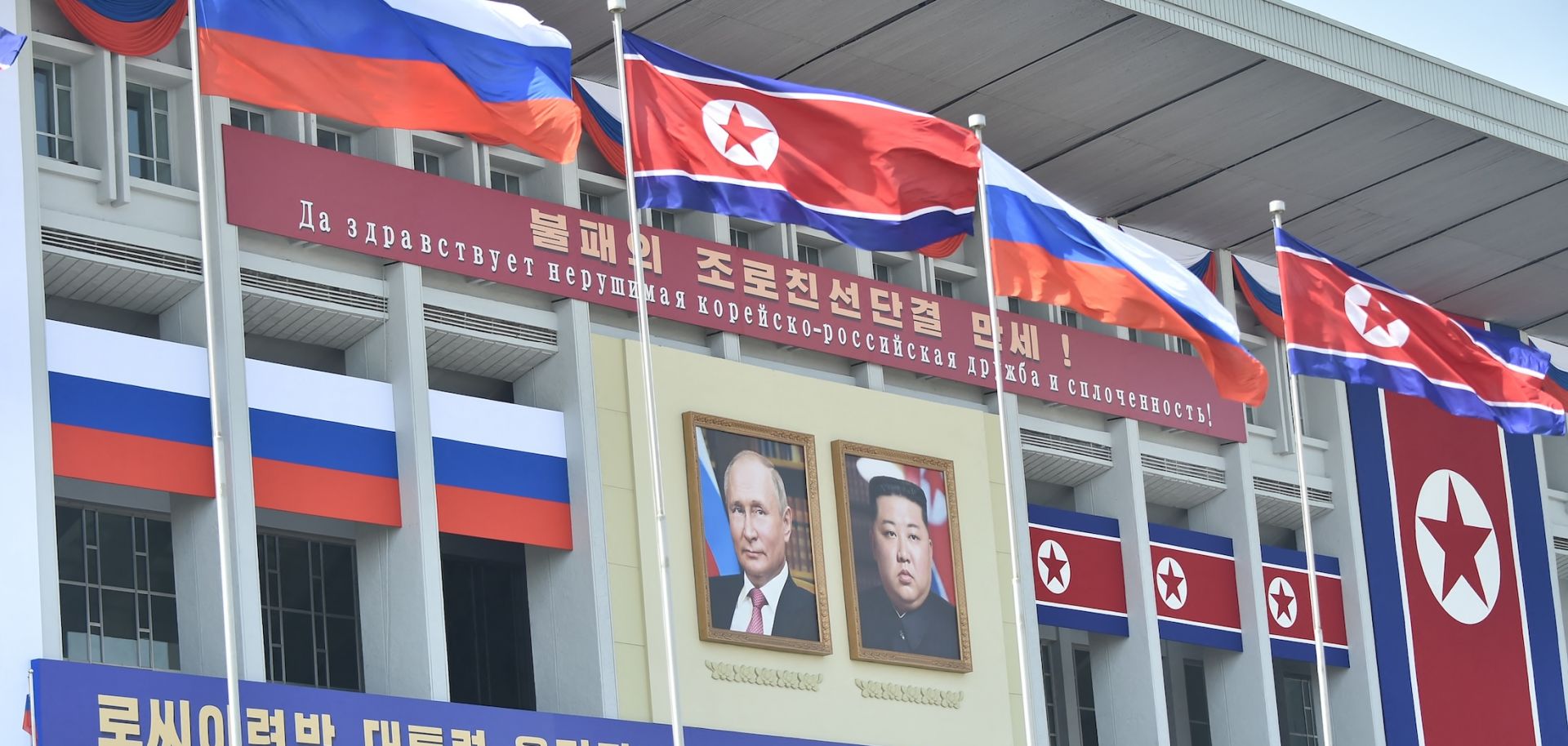
Russia's deepening ties with North Korea are meant to draw U.S. attention and resources away from Ukraine by increasing the threat of conflict in another region. On June 19, Russian President Vladimir Putin and North Korean leader Kim Jong Un signed a comprehensive bilateral strategic cooperation agreement that notably requires Moscow and Pyongyang to come to each other's aid in the event of ''aggression'' against either country. Both leaders described the agreement as a major upgrade to their relations, particularly their security ties, while also mentioning deepened trade, economic and humanitarian and cultural ties, as well as cooperation on nuclear energy, space exploration, and other topics.
- Kim underscored North Korea's ''full support'' for Russia's so-called ''special military operation'' in Ukraine (which implies Pyongyang expects similar support from Russia amid heightened tensions with South Korea and the possibility of various provocative operations by the North in the years ahead). Kim also expressed support for Russia's ''territorial integrity,'' which implies the recognition of Russia's annexations of Ukrainian territory.
- The June 19 agreement replaces a bilateral agreement that the two countries signed when Putin last visited North Korea in 2000. That agreement did not stipulate Russian military intervention or military aid in case of a security emergency on the Korean Peninsula, calling instead only for mutual ''contact'' if a security emergency were to arise. The 2000 agreement had replaced the 1961 Treaty of Friendship, Cooperation and Mutual Assistance Treaty between the Soviet Union and North Korea, which did contain a clause obligating the Soviet Union to immediately come to North Korea's defense.
Putin's visit to Pyongyang and his signing of the new defense pact are aimed at fueling fears about a new conflict in the Korean Peninsula, which could push the United States and its regional allies to reduce their support for Ukraine. Since Russia launched its Ukraine invasion in February 2022, North Korea has become a key supplier of munitions to Russia, which are essential to Moscow's war efforts in Ukraine. And in exchange, North Korea has received access to Russian food, refined fuel products and contracting for North Korean labor, as well as Russian support in upgrading its defense industrial capacity. But this deepening arms cooperation began in the fall of 2023 without requiring a visit by Putin and a new security pact. Therefore, what is of greater importance in Putin's visit and the new agreement comes by adding teeth to North Korea's move to abandon normalization efforts with South Korea in January amid enhancements in Pyongyang's military capabilities, which have enabled North Korea to pursue a more coercive deterrence strategy since 2022 as a way to force the West to engage in arms talks. And Russia is supporting North Korea's efforts to this end, as Moscow tries to respond to NATO's ongoing support for Ukraine by creating more strategic threats to the United States and its partners in geographies far away from Europe, like the Korean Peninsula. Indeed, Moscow likely believes growing tensions between North Korea and South Korea can work in its favor, just as the outbreak of the Israel-Hamas war in Gaza did in early October by increasing global competition for scarce military resources and fueling calls in the U.S. Congress to cut back on support for Ukraine in favor of Israel and other priorities. That said, the fact that Russia signed a pact obligating it to come to North Korea's defense indicates that Moscow believes tensions in the Korean Peninsula are unlikely to escalate to a nuclear or conventional war, as Russia's involvement in such a conflict would risk heavily diverting critical resources. But Russia nonetheless wants the United States to believe such a full-scale war is possible, which could raise calls in the United States to shift resources to South Korea, Taiwan and other Indo-Pacific priorities. To make the threat of such a conflict more credible, Putin could make more verbal agreements with Kim related to Russia's war in Ukraine and North Korea's preparations for conflict with South Korea. North Korea could also engage in provocative actions, including military maneuvers at the border, as well as missile and satellite tests and launches.
Trilateral cooperation between Russia, North Korea and China will also gradually increase as Beijing's perception of Western security threats grows. China, for its part, will remain constrained in its response to the new Russia-North Korea agreement, in order to avoid creating the impression that it is encouraging deepening ties between the two countries, which would risk further straining China's relations with South Korea and other Indo-Pacific states. But while Chinese President Xi Jinping has signaled that he has a personal aversion to Kim Jong Un, Beijing's efforts to put up appearances of distance with Pyongyang will likely be ineffective, as China is already North Korea's largest trade partner and remains the primary guarantor of the North Korean regime. Indeed, in April, Beijing signaled its own desire to more openly embrace North Korea by sending a member of its powerful Politburo Standing Committee to the country, marking the highest-level diplomatic visit to Pyongyang since 2019. In any case, compared with China, Russia is likely to endorse a more provocative posture by North Korea and push the envelope in support measures for the country in key military-technical areas. But in the long run, Moscow, Beijing and Pyongyang could steadily increase military and other cooperation in order to more effectively counter actions from the United States and its regional allies they view as provocative, in order to deter U.S. encroachment in the Indo-Pacific and amid their lack of other allies and policies through which to do so.
- In response to the new Russia-North Korea agreement, some policymakers in South Korea will likely advocate for restraint and sustained cooperation with Russia, because peeling Moscow from Pyongyang is foundational to Seoul's efforts to isolate North Korea. But the agreement will still deteriorate Russia's ties with South Korea, especially if it prompts Seoul to consider lifting its ban on direct weapon sales to Ukraine. Strained relations with South Korea would have a limited overall impact on Russia's foreign policy, which is driven by long-term strategic drivers to counter the West and deepen relations with China — something Seoul cannot counteract.
