
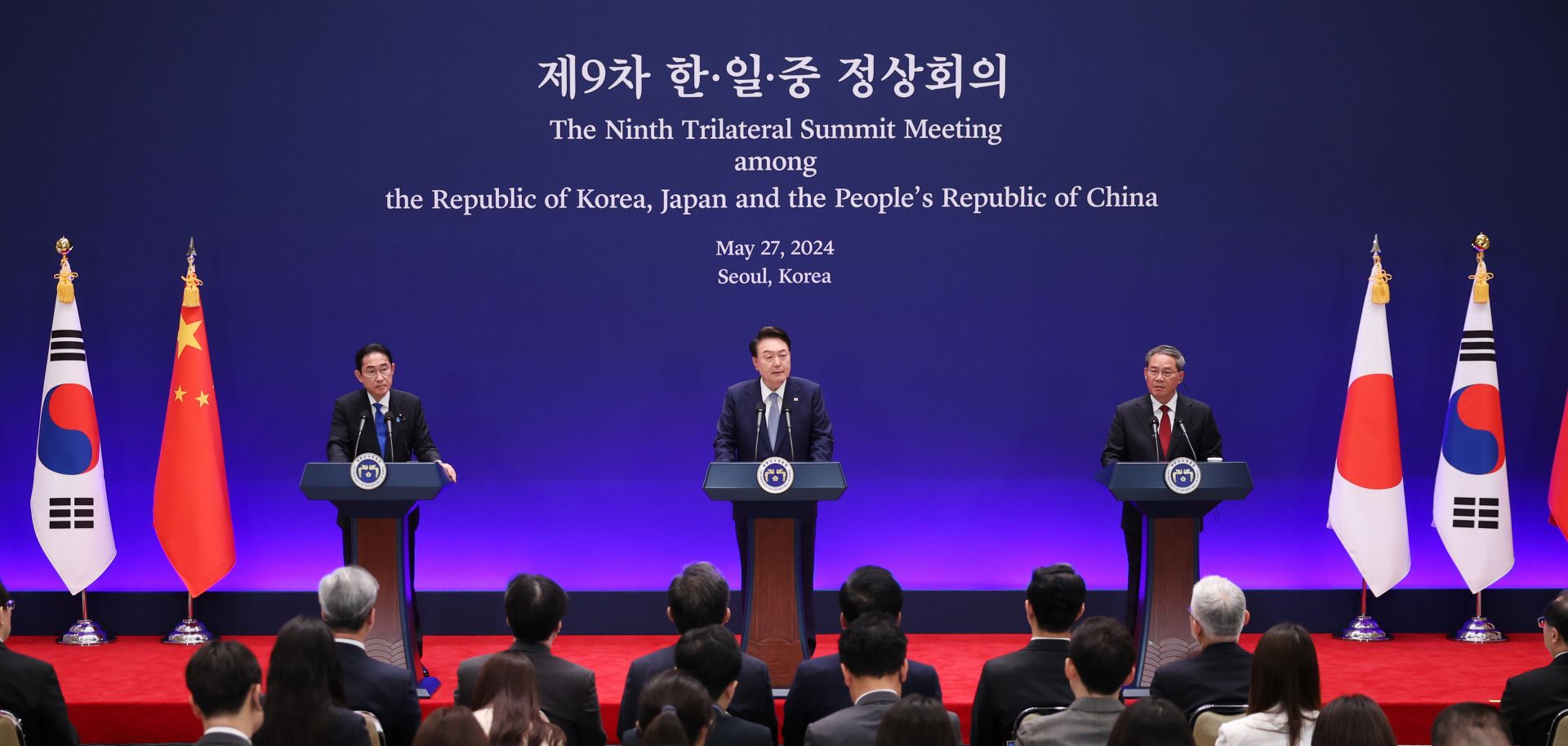
Despite ongoing efforts to improve trilateral ties, South Korean and Japanese economic and security interests will remain largely at odds with those of China, making progress on trade and military cooperation difficult. However, potential leadership changes in the United States and Japan, along with potential economic changes in South Korea, hold a small chance of improving this dim outlook for cooperation between the three countries. Chinese Premier Li Qiang, Japanese Prime Minister Fumio Kishida and South Korean President Yoon Suk-yeol met in Seoul from May 26-27 for their ninth trilateral leaders' summit since 2008 and the first since 2019, with the COVID-19 pandemic followed by Japan and South Korea's rising geopolitical tensions with China driving the hiatus. The trilateral meeting, as well as the bilateral meetings held on the sideline of the summit, saw the revival of some trade agreement negotiations, along with a new, if unambitious, dialogue on security matters.
- At the trilateral summit, the leaders agreed to launch a diplomatic and security dialogue (with few details about the focus and goals of this mechanism) and to accelerate talks on a free trade agreement. They also made agreements on expanding people-to-people exchanges (e.g. student exchanges), sustainable development, managing aging societies, disaster relief, and pandemic management. In the joint statement released after the summit, Li, Kishida and Yoon reiterated their governments' stances on Korean Peninsula denuclearization and the long-standing issue of North Korean abductions of South Korean and Japanese citizens.
- At the Japan-China summit, Kishida requested that China end various restrictions on Japanese imports, including beef, rice and seafood, flows of which China cut off following Japan's release of Fukushima wastewater into the Pacific Ocean in mid-2023. Kishida also reiterated concerns about Chinese maritime activities around the disputed Senkaku Islands, China-Russia security cooperation, and stability in the Taiwan Strait. He called for Beijing to release Japanese citizens detained in China as well.
- At the South Korea-China summit, Yoon and Li agreed to resume diplomatic and national security dialogues between their countries, and to reinstate a joint investment cooperation committee. They also agreed to hold a meeting in early June on reviving talks on a free trade agreement.
- At the Japan-South Korea summit, Kishida and Yoon agreed to deepen ongoing cooperation between their administrations on defense, economic security, and science and technology development, including hydrogen energy, quantum developments and critical minerals. They also welcomed greater U.S.-Japan-South Korea cooperation on security matters in the Indo-Pacific and reiterated their support for a free and open Indo-Pacific, a veiled critique of China's military brinkmanship near Taiwan and in the South China Sea.
Though the summit marks a small step toward mitigating tensions, prospects are still dim for South Korea, Japan and China's nascent efforts at greater economic and security cooperation. By reviving trilateral cooperation, South Korea and Japan are looking to mitigate the spillover effects from their roles in the U.S.-led campaign to restrict China's access to key high technologies and bolster supply chain resilience against Chinese economic coercion on their broader trade relations with China. Beijing, similarly, is trying to prevent Seoul and Tokyo from aligning completely with U.S. and European efforts to ''de-risk'' trade with China and deter Chinese threats to peace and stability in the Taiwan Strait and the South China Sea. In this way, the recent trilateral and bilateral talks marked a small step of progress, as diplomatic meetings beget more meetings, providing future opportunities for the three countries to hash out their differences. However, the trajectory of events — with Japan participating in U.S. and Dutch chip sector restrictions on China, and South Korea and Japan bolstering high-tech trade with the United States and its partners — suggests these future dialogues will see minimal returns in terms of stemming the reduction in Japanese and South Korean trade with China. On security matters, the three countries' strategic objectives also remain diametrically opposed: China wants to push the United States out of the Western Pacific and steadily realize Beijing's sovereignty claims over Taiwan and the South China Sea, while Japan and South Korea want to maintain U.S. military power in the region, as well as that of their own, to hedge against Chinese dominance. Thus, though China may, for example, modestly expand crisis hotlines with South Korea and Japan in the event of a coast guard stand-off over disputed islands, such actions will not meaningfully reduce the pace of Japanese and Chinese deployment of naval and missile assets in the islands and waters near Taiwan for conflict contingencies. South Korea will also fail to secure China's support in curbing North Korea's expansion of conventional and nuclear weapons and ending Pyongyang's arms trade with Moscow, which is both perpetuating the war in Ukraine and allowing North Korea to expand the scope and raise the credibility of military threats against South Korea.
- South Korea's exports to China decreased by 20% from 2022 to 2023, with reduced electrical machinery shipments comprising about two-thirds of that dip. This contributed to the 9% drop in South Korea's total global exports in 2023, though its exports to the United States increased by 6% last year.
- Japan's exports to China decreased by 13% from 2022 to 2023, with over 70% of this dip due to reduced machinery and electrical equipment shipments. This contributed to the 5% drop in Japan's total global exports in 2023, though its exports to the United States increased by 3% last year.
There is, however, a small chance that future political events in Japan and the United States and economic events in South Korea improve Tokyo and Seoul's ties with Beijing. In Japan, Kishida's poor polling numbers ahead of the ruling Liberal Democratic Party's leadership elections in September raise the possibility of him either resigning before the vote or not being selected to lead the party in said elections (which would, in turn, remove him from office as prime minister). Most potential replacements in the LDP would continue Kishida's policy of warming military and trade relations with Washington at the expense of relations with China. However, there is a small chance that one of the LDP's more dovish leaders, like former Prime Minister Yoshihide Suga, comes to power and focuses more on domestic economic policy and seeks to ease tensions with China while scaling back Japan's military modernization efforts. But after the death of former Prime Minister Shinzo Abe in July 2022, there are few signs that Suga still has the political clout and elite support within the LDP to win a second election. Meanwhile, in the United States, the November presidential election could see Donald Trump return to the White House, which would prompt South Korea and Japan to modestly increase diplomatic efforts to reduce trade tensions with China for fear of capriciousness in Trump's trade policy. However, the extent of South Korea and Japan's ability to meaningfully boost trade with Beijing will still be limited by potential new U.S. tech restrictions on China, as well as Tokyo and Seoul's continued security concerns with Beijing. As for South Korea, Yoon is in office through 2027, and so Seoul is not expected to make any major shifts in foreign policy toward China, Japan or the United States anytime soon. If, however, South Korea encounters economic difficulties — i.e. if its export-driven economic growth starts contracting again for multiple quarters — Seoul's willingness to pick and choose its trade partners may ebb, increasing South Korea's efforts to expand diplomatic and trade dialogues with China, despite security concerns.
