
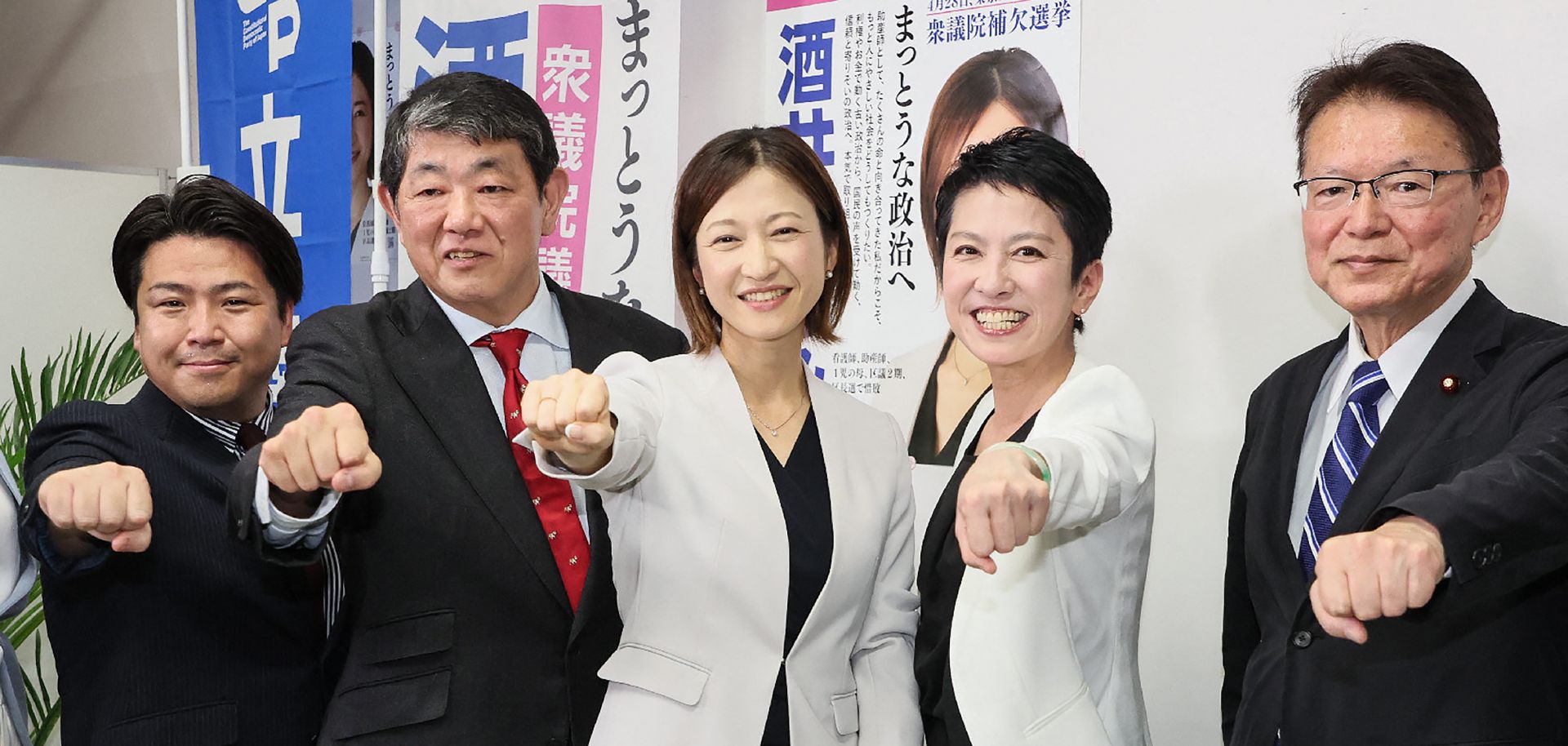
By-election losses signal low support for Japan's ruling Liberal Democratic Party, or LDP, ahead of the 2025 general election, but Prime Minister Fumio Kishida will likely remain in power at least through September, maintaining Japan's domestic and regional military strengthening efforts. The opposition Constitutional Democratic Party of Japan, or CDPJ, won all three lower house parliamentary seats from the ruling LDP in the country's April 28 by-elections. The LDP chose not to field candidates for the Tokyo No. 15 and Nagasaki No. 3 district seats rather than lose the races outright, but the party still fielded LDP politician Norimasa Nishikori for the Shimane No. 1 district seat, which had been an LDP stronghold since 1996. The loss in Shimane came despite Kishida's two visits to the district after the campaign season began on April 16.
- Hiroyuki Hosoda, leader of the LDP's Abe faction, had long held the Shimane seat, but Hosoda died in November 2023, around the time the Abe faction became engulfed in a slush fund scandal involving the misuse of campaign funds by party members. An LDP lawmaker vacated the Nagasaki seat after resigning in January over the same scandal, and an LDP lawmaker vacated the Tokyo seat after being arrested in December 2023 over a separate campaign finance scandal.
- Exit polls for the Shimane election showed 77% of voters decided which party to back based on considerations of the LDP's recent slush fund scandal. All three elections showed record-low voter turnout, possibly due to general voter disillusionment with politics and/or because many LDP voters stayed home amid the scandal.
These by-elections followed a recent slush fund scandal that has plagued the LDP and Kishida, and they precede party and national elections, prompting talk from within the LDP and the opposition about Kishida's ability to stay in office. Starting in November 2023, news arose that numerous powerful factions of the LDP — including the Abe faction, the Kishida faction (then led by Prime Minister Fumio Kishida) and the Nikai faction — were implicated in a slush fund scandal involving kickbacks from political event proceeds. Kishida subsequently dissolved these three factions and submitted to a parliamentary inquiry. However, few LDP lawmakers have been arrested as a result of the scandal, despite ample evidence of fund mismanagement, prompting public outrage. Against this backdrop, public support for Kishida and the LDP plummeted. These events come ahead of the LDP's regularly scheduled leadership elections in September, which will select the party's president and de facto Japan's prime minister, given the LDP's majority coalition in the Diet. Additionally, Japan is due to hold general elections for the upper and (more powerful) lower house by July and October 2025, respectively. As these elections approach, some LDP lawmakers, including potential prime ministerial contenders, have called for Kishida to step down. However, the day after the April 28 elections, Kishida stated that he did not plan to step down, despite the disappointing election results, and would instead push to reform political finance laws. He added on May 4 that he also had no plans to call a snap election.
- The public approval rating for Kishida's Cabinet dropped from 30% in mid-October 2023 to 21% in late February 2024 and has since risen to around 24% as of the end of April, according to a moving average of polls from 13 Japanese news outlets. Meanwhile, Nikkei polls on April 29-30 showed public party support at 28% for the LDP, 18% for the CDPJ, 9% for Nippon Ishin no Kai, 5% for LDP coalition partner Komeito, 4% for Reiwa and 3% for the Japanese Communist Party.
- On April 4, Kishida published a list of LDP members to punish for the slush fund scandal, which included the head of the Abe faction's executive board, Ryu Shionoya. Shionoya derided Kishida's "dictatorial management" of the LDP and called for him to take political responsibility for the scandal.
- In a Dec. 11, 2023, television interview, longtime prime ministerial aspirant and former LDP Secretary General Shigeru Ishiba called for Kishida to step down in return for support to pass the 2024 budget in March. Although Kishida did not step down, his budget passed after he agreed to subject himself to a parliamentary inquiry, becoming the first sitting prime minister to do so, and his approval rating has modestly climbed since March.
Kishida will face rising pressure to resign over the slush fund scandal but is unlikely to resign or call for a snap general election before the September LDP leadership elections. Japanese prime ministers tend to resign when their popularity wanes or party elders withdraw their support, and they usually take responsibility for poor election showings or scandals that impede parliamentary proceedings. As a result, Kishida — who has seen monthly approval ratings below 30% since November, losses in the April by-elections, and parliamentary proceedings dominated by debate over the slush fund scandal — will face rising pressure to leave office. This pressure could include LDP leaders refusing to work with Kishida's Cabinet. However, barring a mutiny by LDP elders, Kishida will likely retain his party leadership in September if the slush fund scandal persists, as his actions to address public concerns have stemmed the slide in public support for the LDP over the last several months, despite the by-election losses. Furthermore, Kishida himself is relatively blameless in the scandal, so ousting him would not resolve public anger toward the LDP, but instead place the issue at the feet of the next party leader ahead of the 2025 general election. Kishida could attempt to guarantee his reelection as party head in September by calling a snap election in hopes of securing a parliamentary majority. However, Kishida pledged not to call a snap election, and the LDP's low polling numbers suggest the party might not secure a majority in an early election, making this scenario unlikely. Ahead of September, gubernatorial elections in Shizuoka on May 26 and Tokyo in July will serve as additional indicators of public support for the LDP and of Kishida's prospects in the leadership elections.
- Former Prime Minister Yoshihide Suga, who governed from September 2020 to October 2021, became unpopular after he flouted COVID-19 policies at a dinner outing. Days before his resignation announcement, Suga's approval rating fell to 26%, and it was later revealed that LDP elders Shinzo Abe and Taro Aso had begun refusing to work with him.
- Former Prime Minister Yoshihiko Noda, who governed from September 2011 to December 2012, called a snap election, despite the disapproval of his elders in the Democratic Party of Japan, DPJ. These elections led the DPJ to lose the lower house and Noda to be replaced by an LDP prime minister.
- Public approval of former Prime Minister Naoto Kan, who governed from June 2010 to September 2011, dropped below 20% over his handling of the March 2011 Fukushima nuclear incident, with support hitting 16% by August. As a precondition for his resignation, Kan requested that the Diet pass two bills — including a renewable energy plan that faced resistance from lawmakers calling for his resignation — a request that was granted.
- Former Prime Minister Shinzo Abe's first term, which lasted from September 2006 to September 2007, ended in resignation after a political funding scandal drove his agriculture minister to suicide and Abe led the LDP to a poor showing in the July 2006 upper house elections.
Under an LDP prime minister, Japan would maintain its steady military buildout, defense policy in the Indo-Pacific and tech restrictions against China, while an opposition leader would reverse this military strengthening and seek to mend ties with China. If Kishida does not resign and is reelected as LDP leader in September, Japan will experience policy continuity regarding military cooperation in bilateral and multilateral groups in the Indo-Pacific, domestic military strengthening, and technological restrictions against China. However, if former U.S. President Donald Trump wins the country's presidential election in November, U.S.-Japan-South Korea security cooperation on North Korea could ebb, despite Kishida's diplomatic efforts, as Trump attempts to reengage with Pyongyang. If Kishida resigns and another LDP leader becomes prime minister, Japan's foreign policy will remain largely the same, though a potentially more hawkish prime minister, like Shigeru Ishiba, could further accelerate Japan's military strengthening. For instance, such a prime minister could attempt to amend Japan's pacifist constitution or even pursue nuclear weapons technology, which would significantly heighten Japan-China military tensions in the East and South China seas. An LDP government would also continue to lean on unions and Japanese employers to raise wages voluntarily, a strategy that has failed to end real wage deflation so far. If the LDP does not manage the slush fund scandal well, the 2025 general election or earlier (less likely) snap election would likely result in a fragile coalition government of opposition parties led by the CDPJ. This coalition would likely reverse many of the LDP's leading policy initiatives by pausing the nuclear energy buildout, improving trade ties with China, slowing or reversing Japan's domestic military development, and weakening Japan's growing regional military ties. An opposition prime minister would also likely offer more economic stimulus to Japanese households, which are facing a cost-of-living crisis.
- Under Kishida, Japan has committed to raising military spending to 2% of gross domestic product by 2027, stationed more and diversified missile assets in Okinawa to bolster response capabilities in the event of a Chinese invasion of Taiwan, and amended defense export laws to allow Japan to jointly develop next-generation fighter jets with the United Kingdom and Italy.
