
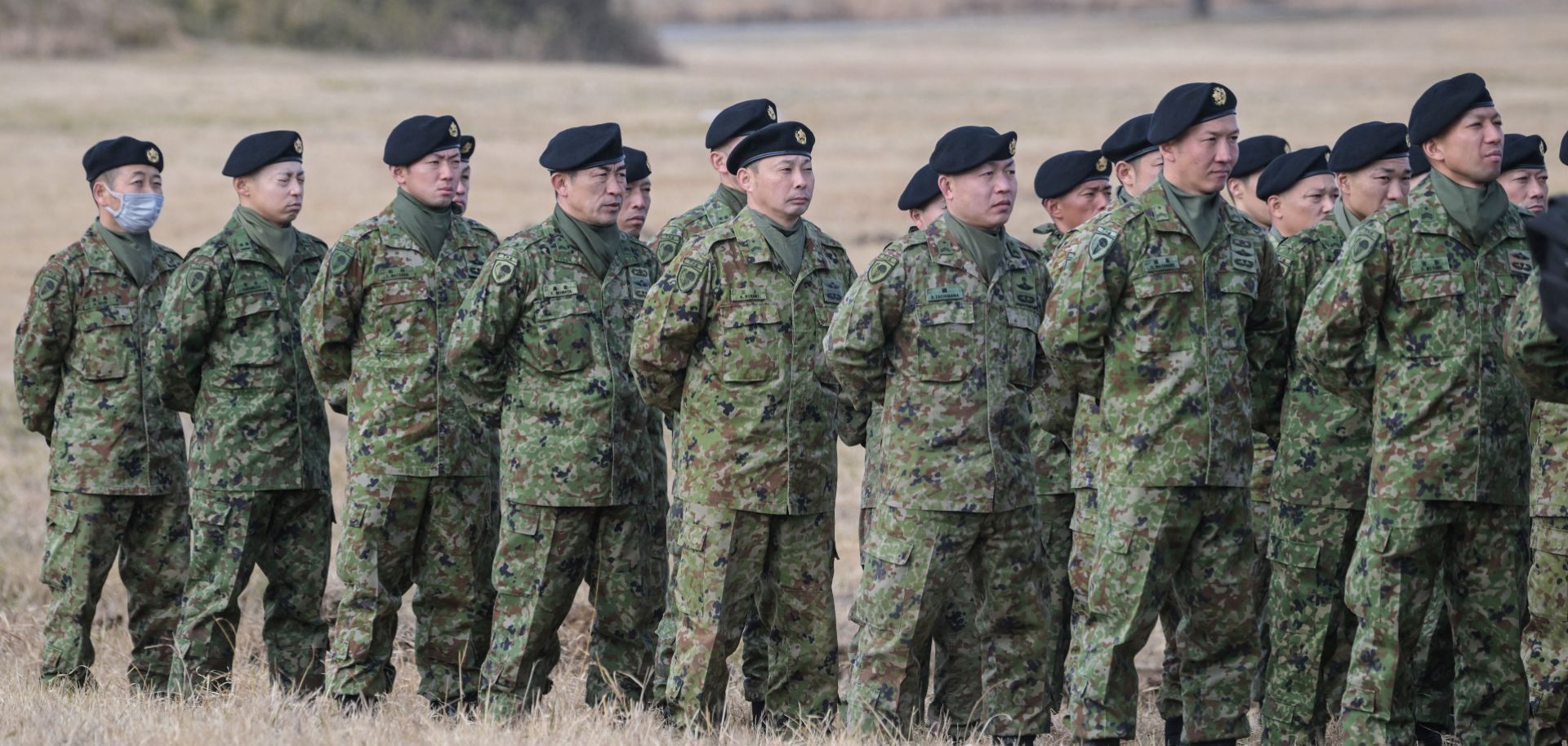
Japan's high public debt will not significantly constrain its plans to expand defense spending, but its economy's modest growth potential means the country will still struggle to keep pace with the booming military budgets of its adversaries like China, which will compel Tokyo to seek greater defense cooperation with its allies in the coming years. In the context of increasing geopolitical tensions in East Asia and beyond, Japan is undergoing a very significant shift in defense policy and spending. China's increasing assertiveness in the region, in particular, has sounded alarm bells in Tokyo, with the government of Prime Minister Fumio Kishida referring to China as an ''unprecedented strategic challenge'' in the new national security and defense strategy it published in 2022. North Korea's enhanced military capabilities and, more recently, Russia's war in Ukraine, have also accelerated Japan's shift toward a more resource-intensive defense policy that involves higher defense spending, the acquisition and enhancement of critical weapons systems (such as counter-strike capabilities), and inter-service integration. As part of this strategy, the government plans to spend $300 billion on defense between 2023 and 2027 — which will translate to a 60% increase in annual defense spending by 2027 compared with 2022 — despite the country's very large public debt, which stands at a whopping 260% of GDP.
- Japan's broader national security spending (which includes expenditures not just controlled by the defense ministry, like the coast guard) is also set to roughly double from historically 1% of GDP to 2% of GDP over the next decade. This would make Japan's defense budget the third-largest in the world after the United States and China (or fourth-largest, depending on whether Russia will sustain its increased defense spending). But even at these higher levels, Japan's defense expenditure in dollar terms will remain much smaller than China's and barely keep up with projected Chinese spending increases over the next few years.
Japan's high government debt levels will only moderately constrain its defense spending in the short-to-medium term, thanks to very low borrowing costs and ample domestic savings. Japan's government debt is extremely high in gross terms, standing at 250% of GDP, but much less so in net terms (that is, after accounting for the government's holdings of financial assets), which is 160% of GDP. Importantly, the bulk (86%) of Japanese government debt is owed to residents, and it is denominated in local currency. This sharply reduces the risk of sovereign debt distress and provides the government with greater fiscal flexibility than what such a high gross government debt may imply. Moreover, nominal and real interest rates are near zero in Japan, which suggests the government retains significant room to borrow. Japan would need to see a significant widening of the real interest rates/real GDP growth differential for public debt to move onto an irreversibly unsustainable path. Finally, if the Bank of Japan is forced to sell government bonds at a loss or if the amount of interest paid on its liabilities (reserves) exceeds what it earns on its assets (e.g. the bank's net interest margin turns negative), this would translate into losses and reduced central bank transfers to the government budget. But a sharp increase in nominal interest rates, as opposed to a normalization of the policy rate, is becoming less likely as inflation has been steadily declining. More importantly, as long as the increase in nominal interest rates does not translate into higher real interest rates, government debt dynamics will remain unchanged. In this context, raising annual defense expenditure by one percentage point of GDP is not going to break the bank.
- The Japanese government projects interest payments to increase 2.5 times in yen terms over the next decade, but the real interest payments will be far lower due to likely higher inflation. Higher returns on public sector assets will also help offset some of the rise in nominal interest service.
- The International Monetary Fund forecasts Japan's fiscal deficit to fall to 3.7% of GDP this year and 3% of GDP next year in the context of a slight decline in the country's gross debt-to-GDP ratio. The Bank of Japan's budget contribution to the government is only 0.3% of GDP. If the central bank were to suffer financial losses amid higher interest rates, the direct fiscal impact would be limited.
- After hitting a 40-year high of 4% in December 2023, inflation in Japan is set to fall to the central bank's goal of 2% sometime in 2024-25, thus limiting the need to make major adjustments to nominal interest rates. The Bank of Japan may yet decide to raise its policy rate from -0.1% to zero, but this will have virtually no effect on government debt service or debt dynamics. The bank has also made it clear it is looking for a sustained acceleration of nominal wages before it raises interest rates above zero.
Japan's strong international creditor position will also enable it to draw on international resources to support defense spending. In addition to running a large current account surplus of 2-4% of GDP, which translates into a roughly equivalent increase of net foreign assets, Japan is the world's largest net international creditor in dollar terms. This provides it with significant leeway to draw on foreign resources, if necessary, to support defense spending without jeopardizing its international financial position. In principle, the Japanese government could purchase 4% of GDP worth of foreign defense equipment annually without jeopardizing the country's international financial position, though this would add to its debt levels unless the purchases were funded through higher taxes or reduced expenditures elsewhere.
- Japan's net international credit position is equivalent to 70% of GDP. While some smaller economies have a stronger net external position as a share of GDP, Japan is the greatest international creditor in dollar terms with net international claims exceeding $3 trillion (or 50 times annual defense spending). The Bank of Japan alone holds $1.3 trillion of high-grade foreign assets.
- Japan's current account surplus has averaged more than 2.5% of GDP annually in the past four decades, and it is set to account for 3-4% of GDP this year, or more than $100 billion annually. As far as the balance-of-payments constraint is concerned, Japan has ample scope to tap external resources to support defense spending increases.
- Large net external assets and a large current account surplus also give Japan significant scope to engage in international financial diplomacy in support of its alliance and security policies. While external lending would add to the government's gross debt burden, its net debt would remain unchanged as long as it creates a repayable loan. Moreover, if the government provides loans in Japanese yen, it can provide very attractive financing terms to borrowers, not least given the lower yen funding costs.
But Japan's modest growth potential could serve as a significant economic-financial constraint on defense spending in the longer term. Japan's nominal GDP at purchasing power parity is a very rough proxy for the broader resource base from which defense spending is sourced. Japan has the world's fourth-largest economy in terms of purchasing power after China, the United States and India. Naturally, a country's economic resource base does not translate one-for-one into actual mobilization, let alone defense spending that is effective in military terms. The government bureaucracy also needs to spend the resources efficiently and effectively. As for Japan, it is financially well-positioned to raise medium-term defense expenditure as a share of GDP. However, Japan's long-term growth outlook remains modest due to limited productivity growth and adverse demographic dynamics. The country's relatively stagnant economic resource base will thus nevertheless limit the extent to which it can increase the resources allocated to security in absolute yen or dollar terms. This will not prevent Tokyo from mobilizing very significant resources in an emergency, but it will put a greater limit on Japan's long-term defense spending compared with other countries with faster-expanding resource bases, like China.
- At $35 trillion, China is the world's largest economy in terms of purchasing power parity, followed by the United States with $28 trillion, India with $14 trillion, and Japan with $6.7 trillion.
- Japan's real economic growth has averaged 0.6% of GDP over the past decade. This compares with 1.8% in the United States. Chinese real economic growth averaged 10% over the past four decades, but is projected to decline to 3.5-4.0% over the medium term. However, Chinese growth will continue to exceed Japan's growth rate by a factor of four.
- In nominal dollar terms at market exchange rates, Japan spent $46 billion in 2022. The United States and China, by comparison, spent $880 billion and $290 billion that year. If the Chinese, U.S. and Japanese economies grow 4%, 2% and 1%, respectively, in real terms over the next decade — and if military spending as a share of these countries' GDP remains unchanged — the financial resources directed toward China, the United States and Japan's defense will be 50%, 20% and 10% higher by 2034, respectively. To match the increase in Chinese spending, Japan would need to increase defense spending as a share of GDP from 1% (roughly the current level) to 4% over the next decade. While Japan has some scope to raise defense expenditure, such a significant increase would be challenging to implement from an economic, financial and political standpoint.
As it struggles to match China's military spending, Japan will continue to seek greater strategic defense cooperation with its allies in Asia and beyond. While the economic and financial constraints on a significant increase in Japanese defense spending are manageable, Japan will still not be able to match increasing Chinese defense expenditure due to its much more modest economic growth potential. Compared with China, Japan's defense budget is not only much smaller but is expanding at a much slower rate in dollar terms. This is providing Tokyo with greater incentives to strengthen its alliance with the United States in the military and economic realm, as well as with other countries in Asia and further afield, including Europe and Australia.
- Japan and the United States have been treaty allies since 1951. U.S.-Japanese defense cooperation has intensified over the years, which has provided the Japanese Self-Defense Forces with greater operational flexibility. This has also allowed for greater coordination and interoperability with the U.S. forces in case of an attack, as well as in case of U.S. forces engaging in military action near Japan. In 2017, the Japanese government helped revive the Quadrilateral Security Dialogue (Quad) alongside Australia, India and the United States, which is committed to a Free and Open Indo-Pacific and is meant to counter China. In the economic realm, Japan joined the administration of U.S. President Joe Biden's Indo-Pacific Economic Framework (IPEF), which is focused on non-market access trade issues but is also currently in limbo due to opposition in the U.S. Congress Japan was also the driving force behind saving the Trans-Pacific Partnership (TPP), a high-quality free-trade agreement among countries in Asia and the Americas, after the administration of then-U.S. President Donald Trump pulled out of TPP negotiations in 2017.
- In addition to deepening its ties with the United States, Japan has also pursued closer defense cooperation with other countries in the region and beyond. In recent years. Tokyo has signed ''Reciprocal Access Agreements,'' which provide for shared military training and cooperation, with fellow Quad members Australia and the United Kingdom, and is in the process of negotiating similar pacts with the Philippines and France. Japan has also signed agreements with Canada, France, Germany and Italy that give reciprocal access to each other's military equipment and supplies. In addition, Japan, the United Kingdom and Italy have agreed to develop a next-generation fighter jet. Tokyo has been seeking to foster closer economic and defense ties throughout Southeast Asia as well, most notably with Vietnam.
