
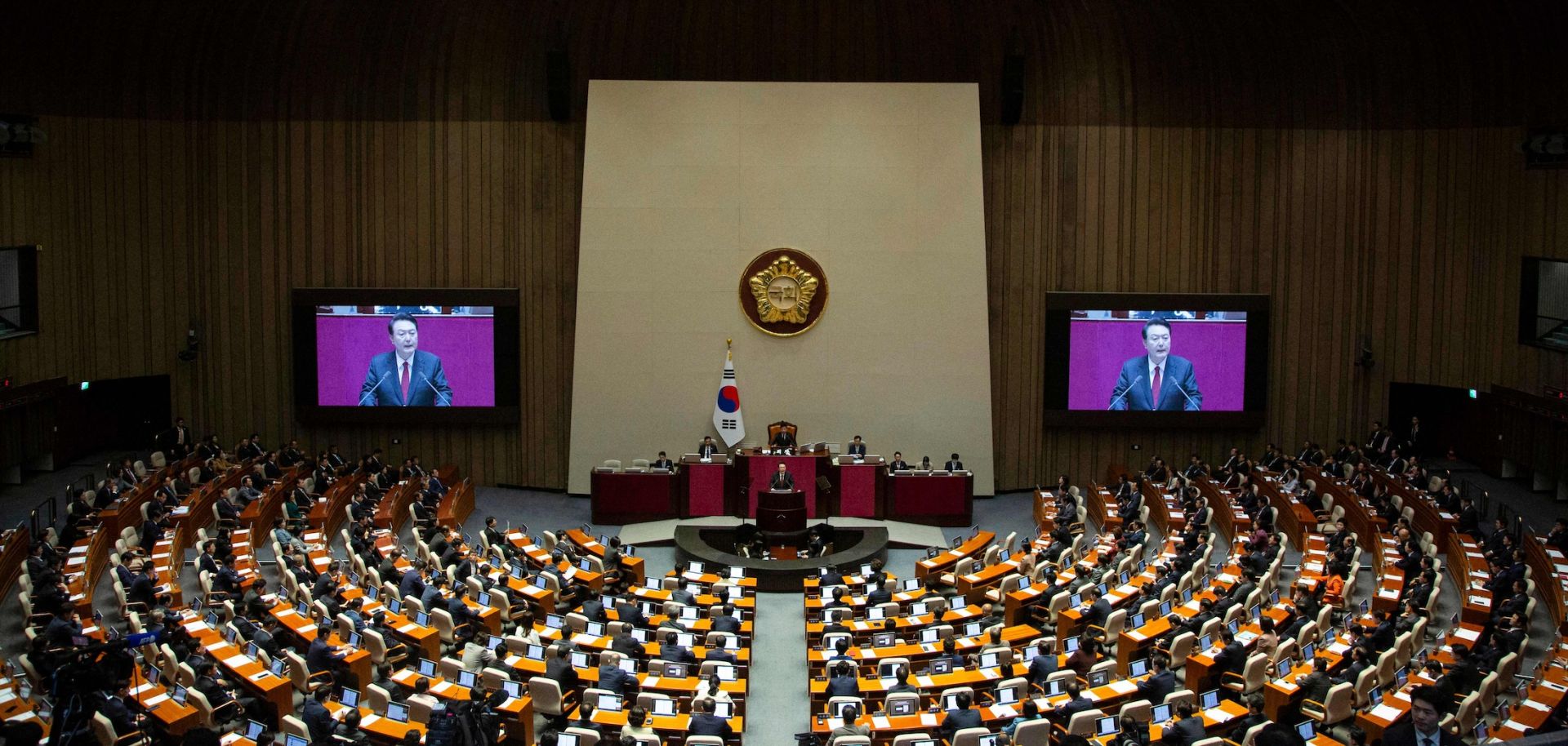
A conservative victory in South Korea's April 10 legislative elections would accelerate pro-business policies and boost the country's arms industry, while a victory by the liberals would perpetuate pro-labor and green transition policies, though neither scenario would portend major changes to Seoul's foreign policy, which is largely driven by the president. On April 10, South Korea will hold elections for its unicameral legislature, the National Assembly. The ruling People Power Party (PPP) is ideologically aligned with South Korea's conservative President Yoon Suk-yeol, holds just 114 out of 300 legislative seats, and aims to upset the liberal opposition Democratic Party of Korea's (DPK) simple majority of 156 seats. Numerous splinter parties are also seeking to challenge the PPP and DPK for seats, including the Rebuilding Korea Party (RKP), which aims to end the ''prosecutorial dictatorship'' of Yoon's presidency (a reference to Yoon's use of prosecutor's office connections to target political rivals); the New Reform Party (NRP), an offshoot of the PPP that aims to attract young conservatives; and the New Future Party, which split from the DPK over differences with DPK party leader Lee Jae-myung. South Korean legislative elections also serve to build momentum for the presidential elections, with the next one due in 2027.
- National Assembly elections will decide on 46 proportional representation seats (by party vote) and 254 constituency seats (by first-past-the-post voting).
Internal disputes within the two largest parties and an ongoing doctors' strike have set the stage for a tight race. Since August 2023, both the PPP and the DPK have been polling around the mid-30s, though the ongoing doctors' strike in the country could weigh on the two main parties' performance in the legislative ballot. Since mid-February, 13,000 trainee doctors have staged walkouts in Seoul to protest a government plan to raise medical school enrollment quotas, causing widespread disruptions in healthcare services across the city. The strike initially elevated public support for Yoon — who has taken a hard-nosed stance against unions since coming to office in May 2022 — and his conservative PPP, as most South Koreans oppose the demonstrations that are depriving them of healthcare services. But this tailwind may turn into a headwind if strikes persist and the public begins to blame Yoon (and, by proxy, the PPP) for failing to resolve the healthcare shortage (e.g. by compromising with the striking doctors) — a shift that recent polls suggest may already be underway. Beyond recent events, long-standing party rifts in the PPP (between pro- and anti-Yoon factions) and the DPK (between pro- and anti-Lee factions) raise the possibility that disaffected party-line voters stay home or throw constituency votes away on third-party candidates. These dynamics, combined with highly variable polling results (influenced partially by partisan media), make the April 10 elections too close to call. That said, most splinter parties are not expected to make significant gains in the National Assembly, with the potential exception of the RKP, which may take a sizable minority of the proportional vote.
- As of mid-March, South Korea's National Election Survey Deliberation Commission showed recent polls giving the RKP an average of around 27% of support in the proportional vote, versus the DPK's 16% and the PPP's 32%. However, in the constituency vote, all third parties (including RKP) were polling around 5% or lower, while the PPP and DPK had around 37% and 41%, respectively.
- In the third week of March, Gallup Korea polls showed that public support for the PPP, which had hovered around 37-40% from mid-February to mid-March, had dropped to 34%, with support for the DPK remaining steady at around 33%.
A PPP win could empower Yoon's pro-business domestic policies and enable the conservatives to try their hand at addressing the longstanding housing affordability issue. If the PPP gains a majority, it would be able to pursue a more pro-business agenda, such as Yoon's proposals to bolster industrial development in greenbelt areas and enable mid-sized cities — like Yongin, Suwon, Goyang and Changwon — to pursue their own strategic industries and urban development plans by granting them greater administrative autonomy. A PPP majority would also curb the power of South Korea's unions, famous for their large street demonstrations and long walkouts in key industries like shipping and transportation. In addition, it would empower Yoon and the PPP to finally try their hands at housing reform, a key issue for young South Koreans along with other cost-of-living issues like food inflation. To that end, Yoon has promised to reverse a tax hike on housing that his liberal predecessor, former President Moon Jae-in, imposed in 2020 in a bid to curtail soaring home prices. Yoon has also pledged to have the government buy 100,000 homes for use by low-income families. But South Korea's housing affordability issue has long evaded resolution, and the opportunity to try would also expose Yoon to the political perils of policy failure.
- Under South Korea's presidential political system, the executive, legislative and judicial branches have constitutionally separate powers. However, President Yoon is a major leadership figure for South Korean conservatives, given the PPP selected him as its 2022 presidential nominee. Thus, Yoon will likely coordinate closely with PPP legislators on conservative policy priorities if the PPP takes the legislature.
By contrast, a DPK win (potentially with RKP support) would see policy continuity in pro-labor and green transition legislation, as well as further (likely unsuccessful) corruption probes and impeachment attempts against Yoon. The DPK's simple majority in the National Assembly has enabled it to pass legislation regardless of PPP opposition, including policies that improve bargaining rights for unionized employees and hold employers criminally liable for their treatment of workers. If the DPK maintains its simple majority or if the RKP's proportional seat gains give it and the DPK a combined majority, it would pose a minimal impact on policy, as the DPK remains focused on pro-labor and green transition industrial policies, as well as rehashing historical grievances with Japan, which runs counter to Yoon's pro-Japan stance. The RKP's top policy priority is pursuing impeachment to curb Yoon's ability to wield the prosecutor's office against political rivals, a goal that the DPK holds as well. However, without a two-thirds majority in the legislature, impeachment efforts against Yoon — at which the DPK has already failed in the last two years — would very likely remain fruitless. And as long as Yoon is president, his deep ties to the prosecutor's office will also likely protect him from opposition-launched corruption probes.
- The DPK has accused President Yoon of using his ties to the prosecutor's office (Yoon was Prosecutor General of South Korea under former President Moon Jae-in) to levy corruption charges against DPK leader Lee Jae-myung and to bust strikes, including by accusing leaders of major unions of spying on behalf of North Korea.
In terms of foreign policy, Seoul's stances toward the United States, Japan, North Korea and China will remain the same regardless of the election outcome, though a PPP majority could help accelerate South Korea's defense industry exports. Yoon and his cabinet appointees have largely driven South Korea's foreign policies over the past two years, with modest success despite the PPP's legislative minority. Seoul has warmed trilateral military ties with Washington and Tokyo as part of Yoon's plans to counteract growing security threats in the Korean Peninsula and around Taiwan. Yoon's balancing act with China, meanwhile, has focused on curbing the economic and regional military threats posed by Beijing, without imposing ever-expanding economic restrictions on China (like those of the United States and Europe) that could capsize the bilateral relationship. When it comes to North Korea, Yoon has pursued a maximum deterrence strategy that has succeeded in raising discussions of Pyongyang's human rights abuses on the world stage, but it has also accelerated North Korea's pursuit of conventional weapons advancement and risks limited border skirmishes. These foreign policies will change little after the April 10 legislative elections, given the president's leading role over foreign policy in South Korea's political system. A PPP win, however, could enable Yoon to accelerate South Korea's growing arms export industry by easing the legal restrictions on the recipients, uses and terms of arms sales, which could empower South Korea to accelerate its own military buildout. Still, an arms industry and military buildout would not entail a rapid uptick in South Korean military entanglements abroad, as Seoul remains heavily focused on Korean Peninsula developments, even if the country is slowly trying to expand its role in countering threats from China.
Yoon and DPK leader Lee face political irrelevance if their parties lose in April, with both the PPP and DPK likely to shift focus after the legislative election toward kitchen table issues important to younger voters, like housing, as the 2027 presidential race approaches. For Yoon, his first two years as president have already come at a steep political cost, with growing PPP skepticism about his leadership. Yoon has focused on preserving his role at the PPP's helm and has openly feuded (in the media) with party leaders whose policy views contradict his. Against this backdrop, the April election will heavily impact the future direction of the PPP, as a legislative win could give Yoon the institutional bandwidth to spearhead domestic economic policies that have so far been stonewalled by a DPK legislature, thus enabling him to cement his political legacy as a PPP elder long after he steps down from his constitutionally mandated, single-term presidency in 2027. But a legislative loss could highlight the pro- and anti-Yoon rifts in the PPP — exacerbated by Yoon's (partly structural) inability to address key economic issues critical to voters — which could, in turn, see Yoon become a lame-duck president, even within his own party, as the PPP rebrands itself in preparation for the next presidential race. The outcome of the legislative election may also prove pivotal for DPK leader Lee Jae-myung, whose image has been marred by corruption allegations, and whose strongman party leadership has nurtured anti-Lee factions within the DPK. A loss by the DPK in April could ruin Lee's presidential ambitions and similarly trigger a rebranding of the DPK. In both cases, the PPP and DPK would likely focus more on housing and other kitchen table issues important to younger voters, a key swing constituency in Seoul, as they turn their attention to the 2027 presidential election.
- During his 2022 presidential election campaign, Yoon ignored the campaign staffing preferences of then-PPP leader and political wunderkind Lee Jun-seok, despite Lee's indispensability to Yoon's youth vote appeal. Lee eventually went on to co-found the PPP splinter party NRP. Similarly, Yoon butted heads with current interim PPP leader Han Dong-hoon in December, just days after Han took office, over his failure to corroborate Yoon's off-hand dismissal of corruption allegations against his wife.
