
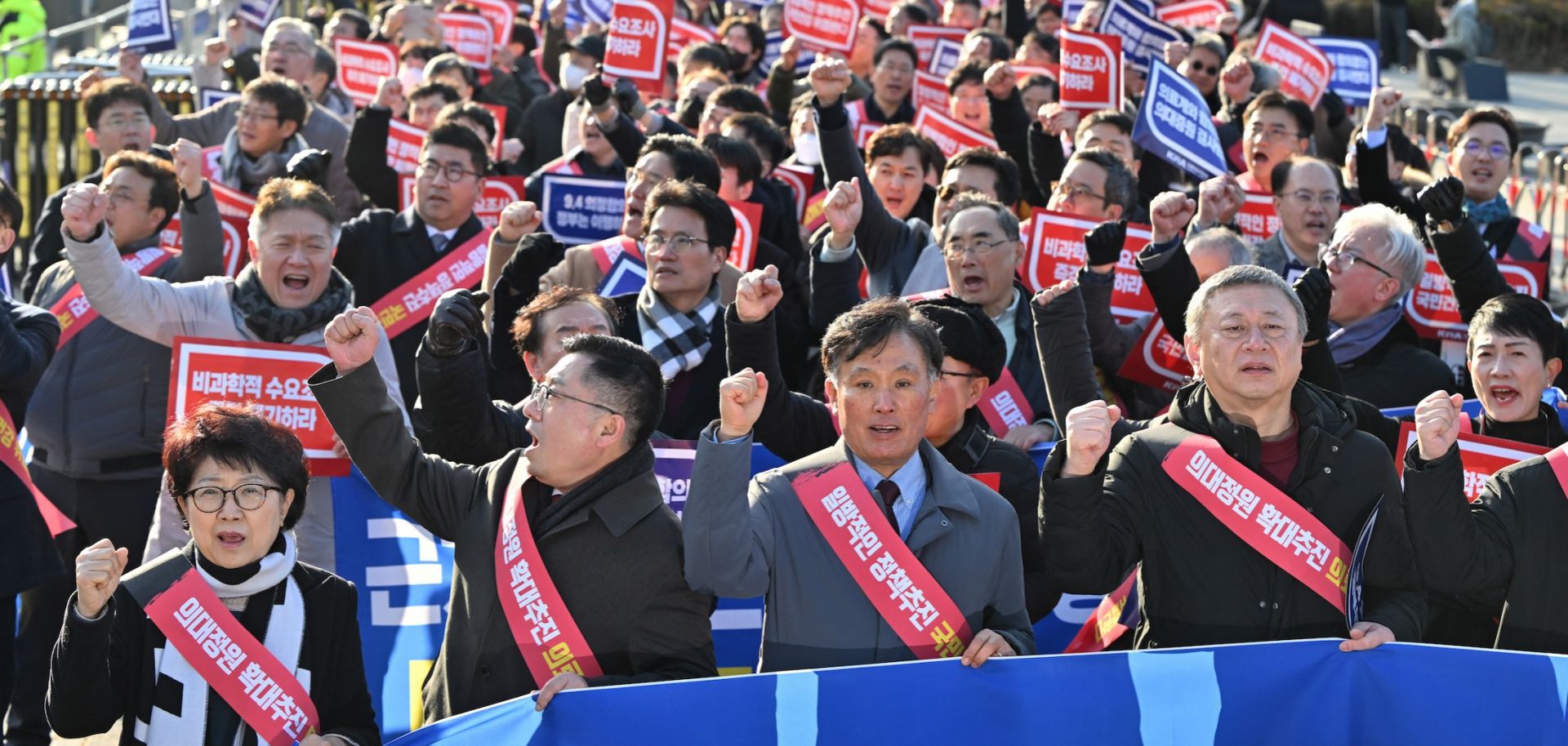
In South Korea, growing frustration with an ongoing doctors' strike could bode well for President Yoon Suk-yeol's conservative party in April legislative elections, which may embolden his government to curb the power of unions at home, ramp up its deterrence strategy against North Korea, and even send weapons to Ukraine. As of March 1, around 9,000 trainee doctors in South Korea were still on strike despite warnings by the health ministry that they could be indicted or lose their certification if they didn't return to work by Feb. 29. In response to the Feb. 29 deadline passing, the ministry posted on its website a back-to-work mandate for 13 trainee doctors from 12 top medical institutions as a last step (akin to serving a legal notice) before punishment. For the past 10 days, thousands of South Korean doctors have been on strike to protest a government plan to increase the annual medical school enrollment quota from approximately 3,000 to 5,000, with strikers saying the government should instead improve working conditions (e.g. fewer hours, more protection from litigation) for existing doctors, which they claim will attract more workers in the field of medicine. Since the strikes began, public approval has risen for President Yoon, who has taken a hard-nosed stance against unions since coming to office in May 2022, and his conservative People Power Party (PPP), as the South Korean public is generally opposed to the strike, which is causing many hospitals to turn away patients for treatment, including for surgeries. These events also come roughly a month before South Korea's legislative elections on April 10, in which the PPP is hoping to expand its 113-seat minority in South Korea's 300-seat unicameral legislature, the National Assembly, and potentially even overturn the opposition Democratic Party's 161-seat majority.
- According to a Feb. 19-23 Realmeter poll, Yoon's support reached 41.9%, surpassing 40% for the first time in eight months. Support for the PPP, meanwhile, rose to 43.5%, up from 39.1% in the previous week, while support for the Democratic Party (DP) dropped in that same time from 40.2% to 39.5%.
- Working conditions in South Korea's healthcare system are difficult, with doctors and nurses working long hours and families of patients frequently suing doctors for failing to heal their loved ones. This has led to shortages of medical staff in areas outside the major cities and in highly risky fields, like pediatrics and emergency medicine.
Yoon will likely take action against the strikers and try to use the related boost in public support for his PPP to secure a majority in the National Assembly, or at least weaken the DP's majority, in what is poised to be a very close legislative election. Yoon's cabinet has both the capacity and motive to carry out punitive actions against the protesting doctors. Before becoming president, Yoon spent most of his career in the prosecutor's office, culminating in his role as chief prosecutor under South Korea's liberal former president Moon Jae-in. Yoon's connections to the prosecutors' office have enabled him to pursue criminal cases against his political rivals, including trade union leaders and DP leader Lee Jae-myung; these same connections will also enable Yoon to pursue strong action against the doctors on strike. His party is also motivated to take any political win it can get ahead of the April legislative ballot, as the PPP and the DP have been polling neck-and-neck, and Yoon himself has been in hot water recently over a bribery scandal related to his wife. Yoon's cabinet will thus likely take strong action against the striking doctors — e.g. by following through on license suspensions and indictments — to capitalize on public discontent with the recent lack of medical services. He may do so piecemeal to draw out the duration of this dispute with the doctors and thus prolong his electoral bump closer to April 10. However, this will be a delicate balancing act because if the public perceives Yoon has failed to address the strike quickly enough, they could start to blame him for the healthcare shortage. In addition, a prolonged legal fight with the doctors could spur more disruptive protests, which could turn the public against Yoon if he uses police to suppress the demonstrations. Lastly, if these actions motivate some trainee doctors to recant their demands and make a public apology to regain certification (and to ease criminal pressure against them), it could further deepen and prolong the popularity jump for Yoon and his PPP.
- The PPP and the DP have been nearly tied in Yonhap News polls since August 2023, with public support for both parties mingling around the low- to mid-thirties.
- Between August and September, DP leader Lee Jae-myung went on a nearly month-long hunger strike to protest against state prosecutors' pursuit of him for bribery charges related to illegal cash remittances to North Korea — a pursuit Lee claims was at President Yoon's behest.
- In May 2023, the Suwon District Court indicted and detained four leaders of South Korea's largest union umbrella group, the Korean Confederation of Trade Unions, on alleged North Korean espionage charges.
- A Feb. 29 National Assembly re-vote struck down a bribery probe into Yoon's wife for allegedly accepting luxury bags as political gifts. The investigation failed to obtain the two-thirds vote necessary after Yoon vetoed the original probe, which passed on a simple majority. The controversy nonetheless caused Yoon's public support to tank in December.
- In solidarity with the striking doctors, the Korean Medical Association says it plans to hold a protest with at least 25,000 participants demonstrating along the central street Yeoui-daero in Seoul on March 3. The police will deploy 54 units to monitor the protest.
Should the doctors' strike pay dividends for the PPP in the April elections, it would enable Yoon to more avidly pursue his anti-union agenda, continue his deterrence strategy toward North Korea, and potentially provide arms to Ukraine. In the lead-up to the legislative ballot, various corruption cases, party leadership disputes and economic issues have already caused multiple flips in public support for the PPP versus the DP, although rarely has either party held a sizable (e.g. greater than 5%) polling advantage over the other for more than a month or two. That said, if Yoon can maintain some electoral momentum from his handling of the doctors' strike, the PPP has a good chance of at least gaining seats relative to the DP. Moreover, if the PPP can outperform the DP in the critical Seoul metropolitan area in the April elections, it could cause the DP to lose its majority or even give the PPP its own simple majority. If the DP loses its majority but the PPP also doesn't gain a majority, due to the presence of small third parties, then it will still impede the DP's ability to unilaterally pass left-wing legislation, like a labor rights act passed in November 2023. If the PPP gains a majority, it could repeal DP-passed pro-labor legislation and/or pursue its own pro-business legislation to curb the disruptive capability of union strikers, especially in critical South Korean industries like medicine and shipping, reducing operational risks to businesses. On national security, the PPP could pursue legislative changes to allow South Korea to send Ukraine much-needed weapons (by, for example, altering the Foreign Trade Act that bars arms exports to war zones), which could help address severe war supply issues in Ukraine's defense against Russia's invasion. With a legislative majority, Yoon's party could also expand U.S. military cooperation in South Korea against threats from North Korea; this, however, would increase the risk of a border spat, raising concerns about potential business disruptions in nearby Seoul.
- Feb. 15-16 polling by Hankook Research showed the PPP with a slight lead over the DP — 37% to 33%, respectively — in the critical Seoul metropolitan area, though the result was within the margin of error.
- On Nov. 9, the National Assembly passed the Trade Union and Labor Relations Adjustment Act with 173 votes, despite the abstention of all PPP lawmakers, due primarily to the DP's simple majority in the legislature. The bill expands labor rights to indirect employees and curbs the ability of companies to sue employees and unions for damages from labor action.
- On Jan. 16, Yoon requested that the National Assembly delay enforcement against small businesses of a law that would hold employers criminally liable for workplace incidents. The National Assembly, led by DP votes, rejected Yoon's request on Feb. 1.
