
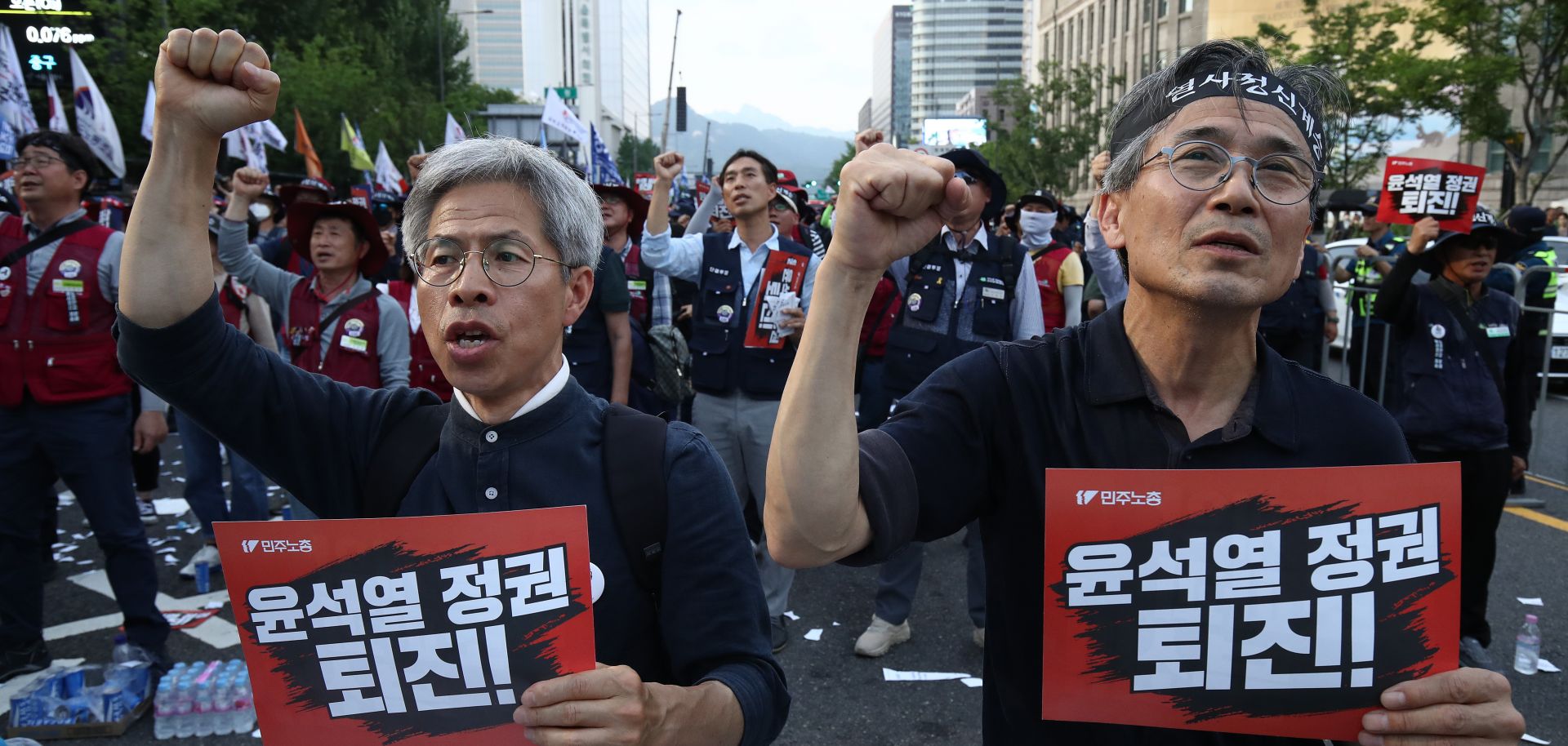
In South Korea, President Yoon Suk Yeol's anti-union policies could bolster conservatives in upcoming elections and help the economy weather a downturn, but they raise the possibility of violent clashes and supply chain disruptions. On Sept. 14, the Korean Rail Workers' Union (KRWU) launched a four-day strike, its first strike in four years, to demand better working conditions. The strike reduced passenger and freight train operations by 20-30% over the weekend, though national railway operator KORAIL mobilized labor to maintain 70% commuter train capacity during rush hours.
- South Korea has some of the most active labor unions in Asia, as it was founded on a centuries-old history of social movements catalyzed by the advent of the Korean alphabet (which rapidly increased literacy among the working class). Additionally, the country has adopted a syncretic mix of Christian beliefs in foundational human rights and Confucian beliefs that revolt against illegitimate rulers is justified. Labor unrest also has great political clout among South Koreans, as it was instrumental in the country's bloody transition from dictatorship to democracy in the 1980s.
The railway workers' strike took place amid tense relations between the South Korean government and trade unions, which has produced constant labor action. Since coming into office in May 2022, Yoon has taken a strong anti-union and pro-business stance. During previous strikes, Yoon has even demanded that union members return to work, which is uncommon in South Korean politics. Unions have also accused Yoon of using his connections with the country's prosecutor's office (Yoon was prosecutor general between 2019 and 2021) and the National Intelligence Service against union leaders. This has pushed unions to engage in many large-scale and joint strikes, with different degrees of impact on supply chains and industrial activity. The South Korean government's hawkish position on trade unions has proven popular among conservative voters, which means Seoul has little incentive to adopt a more conciliatory stance. With legislative elections scheduled for April 2024, Yoon will continue leveraging his anti-union policies to try to secure a majority for his conservative People Power Party (PPP).
- In June 2022, South Korean truckers went on an eight-day strike, prompting the Transport Ministry to reach a compromise with unions by extending minimum freight rates and considering extending fuel subsidies. This strike hit South Korea's automobile, cement and alcohol industries the hardest and caused an estimated $1.2 billion in unfilled deliveries and lost output.
- In late November 2022, truckers commenced another strike over government financial support, but Yoon refused to meet with union reps and issued an unprecedented "start work" order, which thinned the ranks of strikers. This move, along with dropping public support for the truckers, led the strike to disband on Dec. 9. A Gongjung poll on Dec. 8 showed that Yoon's public support rose from 32.5% to 41.5%, especially among elderly conservatives, amid the strike.
- In January 2023, the National Intelligence Service raided the Seoul offices of South Korea's largest union umbrella group, the Korean Confederation of Trade Unions (KCTU), and the Korean Health and Medical Workers' Union (KHMU) on suspicion of North Korean ties.
- In May, the Suwon District Court indicted four former KCTU leaders on allegations of North Korean espionage and other violations of the National Security Act, with authorities detaining the unnamed leaders under these charges.
- On May 1, former union leader Yang Hoe-dong of the Korean Construction Workers Union (KCWU) fatally self-immolated outside a court in Gangneung. Yang had claimed great shame from the Yoon administration's 200-day campaign against construction "irregularities" since December 2022, including the leveling of racketeering and corruption charges against the KCWU and the summoning of 950 union officials, including Yang, for questioning.
- From July 3-15, KCTU called for two weeks of labor action from over 400,000 workers, including from the KHMU, the Hyundai Motor union, and the Korean Metal Workers' Union. This was KHMU's first strike in two decades and Hyundai's first since 2018. In response, the government deployed 9,300 police officers to monitor the demonstrations. Though the strike resulted in some short-staffed factories and traffic jams, the strike does not seem to have borne any fruit in terms of labor concessions.
Yoon's anti-union campaign may boost business sentiment and provide some savings for companies amid a slow global economic recovery, but it also risks spurring more disruptive strikes. One of Yoon's justifications for his anti-union stance, from the campaign trail through his first year in office, has been promoting the business environment amid South Korea's post-COVID-19 recovery. Meanwhile, a tight monetary and fiscal policy under Yoon is weighing on growth, as is the South Korean economy's heavy reliance on semiconductor sales and the Chinese export market. This leaves Yoon with few policy tools to juice growth in the short term, aside from palliative measures like the fuel subsidies he has extended through October. Thus, anti-union moves enable Yoon to say he is doing something for the economy while whipping up political support among the anti-union conservative base. Furthermore, businesses in South Korea may save on labor costs due to Yoon's anti-union stance. However, Yoon's position may push unions to take more aggressive action that prompts longer supply chain disruptions.
- The Bank of Korea has focused on lowering inflation by hiking interest rates through January 2023 and has maintained rates since. Meanwhile, Yoon is aiming to cut deficit spending, with the Finance Ministry's 2023 budget just 5.1% larger than 2022's. This is considerably down from an average annual budget increase of 8.7% under former President Moon Jae-in. Seoul's proposed budget for 2024 is just a 2.6% increase from the 2023 budget.
- In August, South Korea's exports fell for the eleventh straight month, down 8.4% year on year. In particular, chip exports were down 21%, and sales to China were down 20%. Despite these dips, the International Monetary Fund (IMF) and the Organization for Economic Cooperation and Development (OECD) expect South Korea's chip exports and the Chinese consumer economy to slowly recover through 2024, with the OECD projecting that South Korea's gross domestic product growth will hit 1.5% in 2023 and 2.4% in 2024. The IMF also predicts that the country's inflation rate will approach South Korea's 2% target by the end of 2024, and both groups urged the Yoon administration to maintain fiscal and monetary tightness.
Yoon's hardline stance against unions increases the risks of violent clashes between workers and the police and will open the door to political turbulence. Given the popularity of his anti-union policies among conservative voters, Yoon is likely to continue with his hardline approach toward unions through April 2024 and likely through the remainder of his single-term presidency, which will end in 2027. The government's actions against union leaders and the presence of thousands of police amid growing demonstrations could be a recipe for violent clashes if unions perceive that they have exhausted all peaceful avenues for redress. Such clashes will grow increasingly likely if the anger surrounding Yang Hoe-dong's death continues to build or if new union deaths serve as rallying cries. Violence could severely reduce public support for the PPP and prompt human rights concerns among South Korea's foreign partners, especially the United States. Furthermore, Yoon's tactics against unions and the opposition Democratic Party (DPK) could lead opponents to bring legal charges or even impeachment proceedings against him, particularly if the DPK maintains its legislative majority in the April elections.
- The DPK, for its part, has been mired in corruption allegations against party leader Lee Jae-myung since Yoon came into office in May 2022. Lee is currently in the third week of a hunger strike at the National Assembly, protesting what he sees as politically motivated charges aided by Yoon's political connections to the state prosecutor's office.
- In November 2015, police in Seoul wielded water cannons and tear gas against around 80,000 protesters, including union members who opposed then-President Park Geun-hye's plans to make it easier for companies to dismiss workers. In the April 2016 legislative elections that followed, Park's conservative Saenuri Party lost 35 seats and its absolute majority in the National Assembly, resulting in the country's first hung parliament since 2000.
- In December 2016, the National Assembly impeached President Park on charges of influence peddling, resulting in her immediate ouster and eventual sentencing to 24 years in prison in April 2018, though President Moon pardoned her in December 2021. Park's predecessor, conservative Lee Myung-bak (president from 2008-2013) was also charged with corruption in March 2018, though President Yoon pardoned him in December 2022.
Barring any such violence or impeachment, Yoon's focus on improving ties with the United States and Japan will continue unimpeded. Yoon is less than two years into a five-year term and is constitutionally barred from seeking reelection. And despite outcries from South Korean labor activists and opposition politicians, the country's friends and allies have largely ignored Seoul's labor and political tactics. Thus, regardless of the legislative election results and barring violent clashes between strikers and the police that prompt Western opprobrium, Yoon will be free to pursue his primary foreign policy goal of deepening ties with the United States and Japan. An economic recovery and/or political sweep in the legislature for the PPP would provide Yoon with more political leeway to pursue this foreign policy agenda and could expedite economic and security agreements with South Korea's partners and allies that require the National Assembly's approval.
