
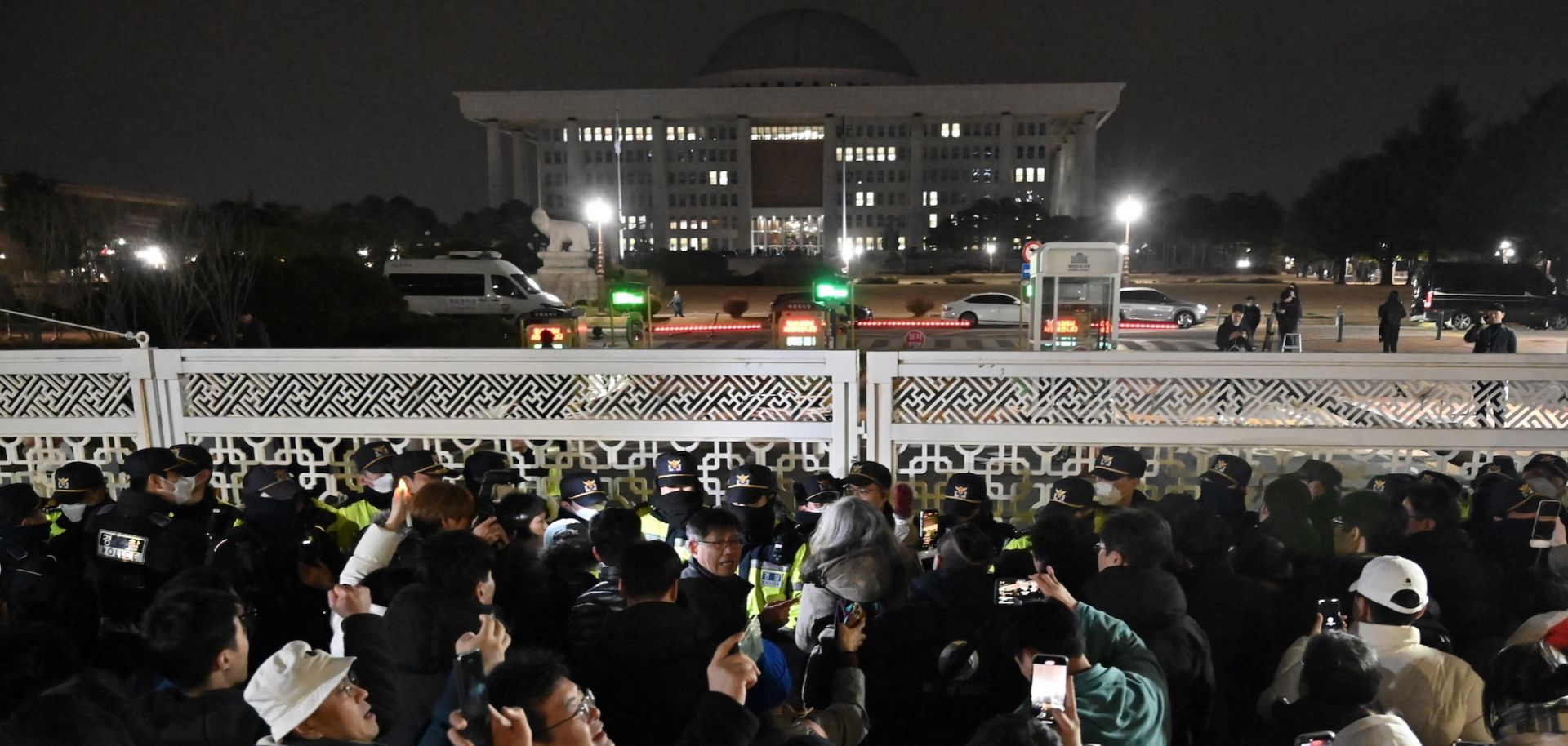
In South Korea, the president's surprise declaration of martial law followed by a quick reversal will likely permanently stall his agenda and eventually lead to his resignation or impeachment, putting into question defense cooperation with the United States and Japan given the opposition's skepticism of these initiatives. In the early morning hours of Dec. 4, South Korean President Yoon Suk Yeol announced that he would lift martial law, approximately six hours after he declared the emergency measure in a televised address late on Dec. 3. In his statement, Yoon accused the opposition Democratic Party of Korea, or DPK, which controls the National Assembly, of conducting anti-state activities, harboring pro-North Korean sympathies and instigating legislative paralysis. The declaration temporarily transferred significant administrative and judicial powers to the military, suspended certain civil liberties and led to the deployment of security forces to enforce order, particularly around the National Assembly building which police temporarily physically barred lawmakers from entering. However, lawmakers were eventually granted entry, and 190 of the 300 members who were able to convene unanimously voted to annul the martial law declaration, setting up a potential constitutional and political crisis between South Korea's legislative and executive branches. As it reports to the president and not the legislature, the South Korean military command had indicated that the martial law order would stay in place regardless of the National Assembly vote, but reports indicate security forces were standing down even before Yoon announced he was suspending the martial law order.
- Under Article 77 of South Korea's Constitution, the National Assembly can revoke a martial law declaration if a majority of legislators agree. However, the constitution does not stipulate a timetable for the president to respond, leading to uncertainty until Yoon voided the martial law order.
- Though a precise vote count is not yet publicly available, the 190 National Assembly votes generally align with the DPK's 170 seats and the 22 seats of smaller parties and independents. However, the leader of Yoon's People's Power Party, or PPP, Han Dong-hoon, characterized Yoon's decision as ''wrong'' and vowed to ''stop it with the people,'' strongly implying that Yoon does not have support from his own party.
- DPK leadership has already called for Yoon to step down immediately and is threatening treason charges.
- In the martial law declaration, Yoon declared a comprehensive ban on political activities, including the suspension of parliamentary functions, political party operations, public rallies and protests.
- Though used frequently in South Korea's history post-1948, martial law has not been imposed in the country since 1980 and never since the transition to democracy in 1987.
Yoon's declaration came amid a convergence of intense policymaking paralysis and pushback against his hard-line stance on North Korea. Domestically, Yoon has faced significant obstruction from the opposition DPK, which holds a near supermajority in the National Assembly and has blocked the 2025 national budget, including proposed defense spending increases to counter North Korea, among other critical measures. In its opposition, the DPK has accused Yoon of systematically overstepping his presidential powers and endangering the country with foreign policy priorities that elevate the risk of open conflict with North Korea. Impeachment motions targeting key Cabinet members have further paralyzed governance, with prolonged inquiries rendering officials ineffective for up to 180 days regardless of impeachment verdicts. This political dysfunction has severely undermined Yoon's ability to advance his policy agenda. Meanwhile, Yoon's hard-line approach to Pyongyang has also drawn criticism from the DPK, which supports a more conciliatory stance, with this divide being a key driver in a widening partisan chasm. Meanwhile, Yoon's efforts to strengthen trilateral defense cooperation with the United States and Japan have faced opposition from many DPK lawmakers who claim these actions increase South Korea's exposure to conflicts involving China and North Korea. Economic pressures have further exacerbated political polarization, as slowing global demand, particularly in the semiconductor and automotive sectors, has dragged on South Korea's export-driven economy. Labor unrest, public protests against Yoon's labor reforms and rising living costs have likewise cost him significant political capital.
- In September, discussions of martial law were reportedly raised by senior figures within the presidential office as a potential response to escalating tensions between Yoon and the DPK. These internal deliberations were leaked to the media and suggested that martial law could be used to counter legislative gridlock and what the administration views as threats to national stability and national security. While the government publicly and vehemently denied any immediate plans for martial law, opposition leaders and civic groups warned of its possible eventuality.
- Examples of gridlock include the DPK's refusal to nominate replacements for three vacancies on the Constitutional Court and its ousting of three Communications Commission chiefs over alleged media power abuses. On Oct. 18, the opposition party threatened to impeach Prosecutor General Shim Woo-jung over his failure to indict Yoon's wife, First Lady Kim Keon-hee, for alleged stock manipulation. On Oct. 30, DPK leaders threatened to impeach Defense Minister Kim Yong-hyun if Yoon proceeded with plans to send military advisers to Ukraine to assist against North Korean troops reportedly fighting alongside Russian forces.
- The dispute over the budget is largely about defense spending, as Yoon had proposed a 3.2% increase that the DPK would rather see allocated to social spending, and thus the DPK's counter-proposal slashed funding for missile defense, joint exercise support and new advanced weapons systems procurement.
- North Korea has also recently escalated provocations as Yoon has doubled down on an aggressive anti-North stance. For example, on Oct. 31, it launched a Hwasong-19 intercontinental ballistic missile, demonstrating improved capability to strike the U.S. mainland, followed by a barrage of short-range ballistic missiles on Nov. 4. On Oct. 17, North Korea intensified border tensions by destroying inter-Korean road and rail links and, on Nov. 8, by disrupting global positioning signals near the border, affecting flights and seagoing vessel operations.
Yoon's brief gambit will likely permanently stall his policy agenda and lead to either his resignation or impeachment. The president's quick reversal of his declaration of martial law appears to reduce the risk of a full-blown constitutional crisis that would have occurred had he ignored the National Assembly's order, but Yoon's gambit will likely permanently stall his administration's policy agenda and jeopardize his political career, with a less likely possibility of criminal treason charges being brought against him. By ordering martial law in the first place and initially defying the National Assembly's vote to revoke the order, Yoon has undermined his government's constitutional legitimacy and severely escalated already high tensions with the DPK. The DPK will likely quickly introduce impeachment proceedings on the basis that Yoon violated constitutional law and abused his executive authority. While a simple legislative majority is required to launch impeachment proceedings, a supermajority is needed to actually impeach the president; if this occurs, Yoon would be suspended from office for up to 180 days as the Constitutional Court deliberated on the final ruling, with Prime Minister Han Duck-soo, a political independent, filling in as president in the interim. With the DPK's near legislative supermajority and apparent pushback against the declaration from within Yoon's PPP, eventual impeachment is likely if Yoon does not resign first, which he will be increasingly pressured to do in the coming weeks. But even if impeachment proceedings fail, the legislature will likely continue obstructing his agenda, severely compromising Yoon's ability to govern effectively.
- A two-thirds majority in the National Assembly is needed to impeach the president. This threshold is attainable given the DPK's near supermajority and PPP leaders' indication that they did not back the martial law declaration, which means PPP lawmakers could join DPK counterparts in a vote to impeach Yoon.
- Formal impeachment proceedings would sideline Yoon for up to 180 days until the Constitutional Court renders a verdict. A confirmed impeachment would trigger a presidential election required to be held within 60 days.
- As of late November, Yoon's approval rating sat at a historic low of 19%.
- Protest risk will remain elevated in the coming weeks given popular opposition to Yoon's martial law declaration, exemplified by the Korean Confederation of Trade Unions calling for its more than 1 million members, including Hyundai autoworkers, to strike until Yoon is out of office. This risk will lessen as political uncertainty wanes, such as with Yoon's resignation or the initiation of impeachment proceedings.
South Korea's political instability will undermine trilateral defense coordination with the United States and Japan, and Seoul's likely upcoming DPK government will lean further away from these partners as Yoon's PPP struggles to recover. In the short term, South Korea's political turmoil threatens to prolong policy gridlock (including on critical defense issues like military spending, weapons procurement and strategy vis-a-vis North Korea) and broader uncertainty concerning South Korea's commitments to trilateralism with the United States and Japan. As a result, this instability may disrupt security ties with the United States and the recently cultivated U.S.-Japan-South Korea security arrangement at a time when trilateral initiatives such as integrated missile defense and supply chain diversification are critical to countering China and North Korea. Meanwhile, the political fallout from Yoon's short-lived declaration extends to his already unpopular PPP, which now faces an even more challenging environment to retain the presidency, either in the potential post-impeachment election or in the normally scheduled 2027 election, likely setting the stage for a DPK-dominated political scene. A DPK administration would look to recalibrate South Korea's foreign policy, prioritizing reconciliatory engagement with North Korea while taking a more cautious approach to cooperation with the United States and Japan to lessen the chance of open confrontation with China and North Korea, while also being much more sensitive to historical grievances against Japan. As a result, South Korea's trilateral security ties with the United States and Japan would likely deteriorate under a DPK government.
- Following Yoon's gambit, the already unlikely prospect of South Korea sending arms and/or military advisors directly to Ukraine — a highly contentious part of Yoon's aggressive defense agenda to combat the deployment of North Korean troops to help Russia's war effort — is now much slimmer.
- U.S.-Japan-South Korea trilateralism is a new arrangement brokered in 2023 with a comprehensive elevation of ties largely driven by Yoon personally.
