
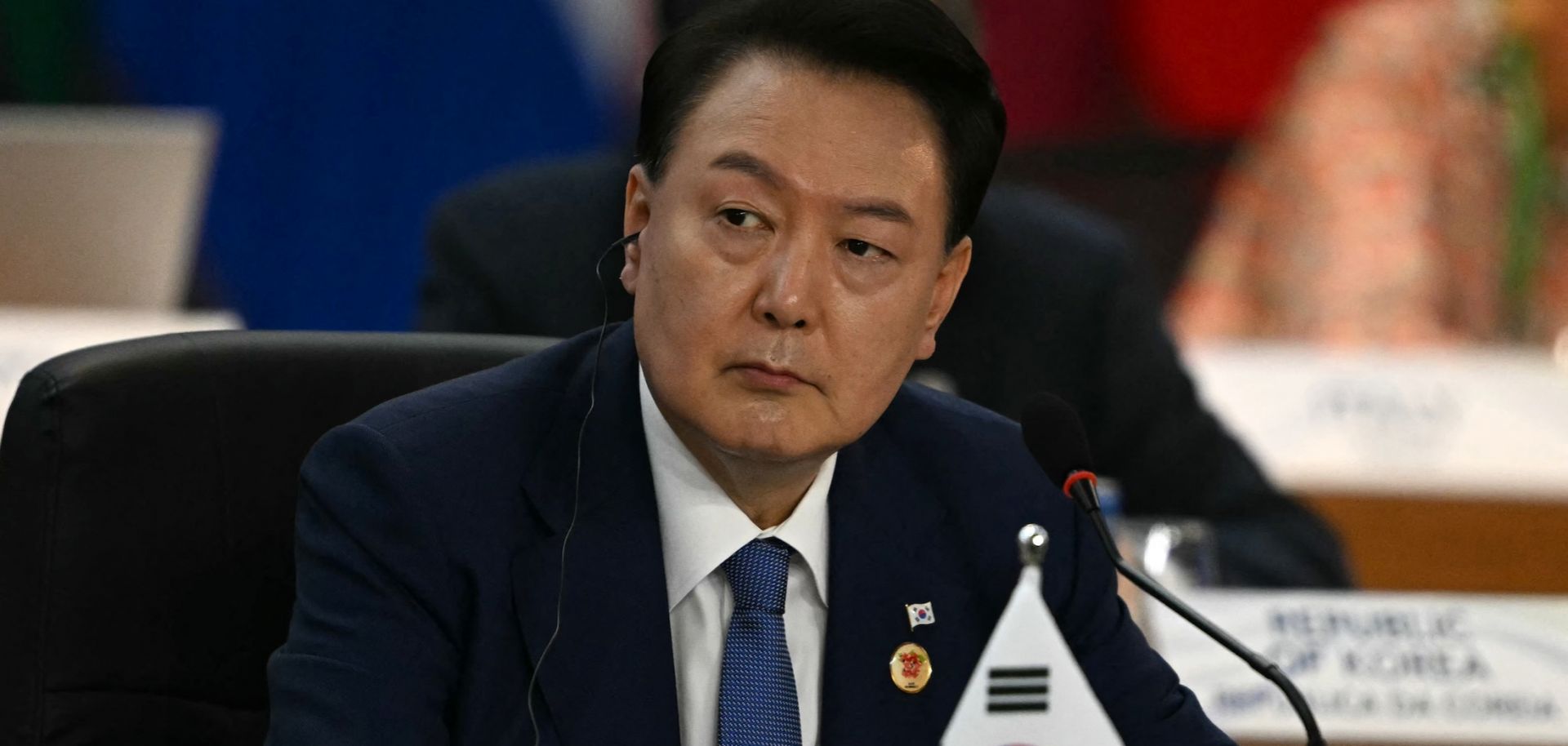
In South Korea, President Yoon Suk-yeol's multiple political disputes are impeding economic policy, risking his party's fragmentation and populist policymaking, while portending more aggressive arms exports and anti-union activities. On Nov. 15, a court convicted and handed a one-year suspended prison sentence to opposition Democratic Party leader Lee Jae-Myung on charges of making false statements ahead of the 2022 presidential election campaign. If upheld, the conviction would disqualify Lee from running in the March 2027 presidential election. The development is the latest in a long string of disputes between the liberal Democratic Party and the ruling conservative People Power Party of President Yoon, whom the Democratic Party accuses of weaponizing the prosecutor's office to go after Lee. The Democratic Party-led opposition holds a strong majority in South Korea's unicameral National Assembly with 192 out of 300 seats, giving the Democratic Party free rein to pass policies without legislative opposition. Yoon frequently uses his presidential veto to strike down those bills, however, and at just eight seats shy of a supermajority, the Democratic Party is unable to override his vetoes. This dynamic has left Yoon reliant on executive orders and regulatory adjustments to pass his preferred policies, and on negotiations with the Democratic Party following his vetoes.
- On Oct. 28, the People Power Party and the Democratic Party agreed to form a consultative body to discuss cost-of-living issues, industrial policy and demographic challenges. In it, each party proposes preferred policies and reviews the other party's proposals; the two then negotiate regarding which to pass. The agreement marked an initial step to resolve political disputes between the two sides that have been slowing progress on key issues like lowering the costs of housing and food and raising wages.
- Yoon took office in May 2022 in a surprise victory driven partly by youth conservatives in Seoul, a new constituency in this critical municipality for any would-be president. His pedigree was untraditional, as he was not a career politician but rather a career prosecutor, culminating in his serving as prosecutor general from 2019-2021 under liberal President Moon Jae-in. In office, he has pursued pro-business policies and sought to rebrand South Korea's role as a global (not just peninsular) defense partner for the United States.
- The liberals in South Korea, currently under the leadership of the Democratic Party, have held a majority in the unicameral National Assembly since 2016, capitalizing on public perceptions of corruption among South Korea's conservatives, the growing electoral significance of left-leaning cities like Seoul (with the swing of Seoul for Yoon in the 2022 presidential election being an aberration), progressive social and economic policies popular with the public, and the strong presidency of the left-wing Moon from 2017-2022.
This political standoff is impeding the functioning of the Constitutional Court and fueling Democratic Party efforts to impeach Yoon Cabinet officials to curb his executive powers. In early October, the nation's Constitutional Court — which rules on the constitutionality of laws, impeachments and competence disputes between government branches — was facing a potential crisis as it was set to see three of nine judges retire on Oct. 17. The Democratic Party was (and still is) refusing to cooperate with the People Power Party in the National Assembly to nominate replacements, which would have made the court unable to hear cases without a seven-person quorum. This potential institutional crisis prompted the court to pass its own emergency measure Oct. 14 to allow cases to be heard with only six judges, though to pass judgment, all six judges must now be in agreement. Meanwhile, since late 2023, the Democratic Party has been using its legislative majority to threaten — and in some cases, carry out — the impeachment of Yoon Cabinet members. The Constitutional Court has 180 days to hear the case, during which time the Cabinet members are suspended from office. This Democratic Party strategy has already taken down three heads of the Korea Communications Commission on allegations of abuse of power over the media: Lee Dong-kwan, who resigned in December 2023 ahead of a legislative impeachment vote; Kim Hong-il, who resigned under identical circumstances in early July 2024; and Lee Jin-sook, who was impeached in September 2024 and is awaiting a court ruling. In addition, the Democratic Party-led opposition threatened Oct. 18 to impeach Prosecutor General Shim Woo-jung for his failure to indict Yoon's wife, Kim Keon See, on stock manipulation charges. And again Oct. 30, Democratic Party leadership threatened to impeach Yoon's defense minister if the president followed through on plans to deploy military advisers to Ukraine to help the Ukrainian military track the activities of and interrogate North Korean troops, who are fighting alongside Russian soldiers.
- There are no clear guidelines in South Korea's National Assembly about how to select their three allotted Constitutional Court nominees, with the president and chief justice also allotted three judge slots each to fill at different times. Thus, the conservative and liberal parties usually agree each to nominate one judge and then cooperate on the third. The Democratic Party-led opposition, however, is demanding to appoint two of the three given it has almost a two-thirds legislative majority, a demand rejected by the People Power Party.
Yoon has also been feuding with his own party's leadership over bribery investigations into his wife and the implementation of his anti-union policies, impeding the People Power Party's economic agenda and disrupting medical services. The current People Power Party head, Han Dong-hoon, has pleaded with Yoon in multiple high-level meetings to allow the naming of a special counsel to investigate allegations against Yoon's wife, including for accepting a luxury handbag from a businessman when Yoon was South Korea's top prosecutor, presumably as a means to curry favor with the prosecutor's office, and for trying to influence policy through her ties to various Cabinet advisers. Han's aim is simultaneously to take some power away from the Democratic Party, which is currently driving legislative investigations, and to put to rest public concerns that are dragging down support for Yoon and the People Power Party. In Han's telling, these concerns are also impeding the People Power Party's implementation of economic policies — especially the so-called 4+1 pension, education, labor, health care, and demographic reforms — because the success of the People Power Party and Yoon in fulfilling economic policies is largely dependent on their ability to drum up public pressure on the Democratic Party, with its legislative majority, to make policy concessions rather than dismiss People Power Party initiatives outright. But Yoon has largely been cold to Han's pleas, urging Han and the People Power Party instead to help Yoon dismiss these allegations entirely. In addition, Yoon has taken a strong anti-union stance since coming to office in May 2022, which has involved accusing unions of illegal ties to North Korea and manifested most recently in a doctors' strike ongoing since February 2024. Yoon's plan to expand annual medical college recruitment quotas to alleviate medical care shortages triggered the strike, with doctors in Seoul claiming Yoon's move avoids addressing the real problem of poor working conditions and insufficient legal protections for doctors. The strike has caused medical service shortages across the Seoul metropolitan area, home to half of South Koreans. Until recently, the People Power Party leadership had repeatedly proposed delays in expanding the doctor's quota as well as new government consultation mechanisms with doctors, but Yoon rejected these requests for months. This stalemate partially broke Nov. 11, when the People Power Party announced a consultation group with medical school professors, but the nearly 10,000 striking doctors and the country's largest medical union are still boycotting the talks.
- In January 2023, South Korean police and intelligence officers raided the Seoul office of the Korean Confederation of Trade Unions, the country's largest union group, on allegations of connections to North Korean spies. Following investigations, four former heads of the KCTU were charged with instigating KCTU protests at the behest of North Korean agents. The Democratic Party, which is closer to unions given its pro-labor policies, decried these charges as politically motivated, citing Yoon's career ties to the prosecutor's office.
Yoon's disputes will make it harder for his administration to implement economic policies and increase the likelihood of another round of party splintering and a subsequent surge in populism. At home, Yoon has been relatively ineffective in making housing more affordable, a central issue for most Koreans, especially younger ones, who feel living and having children in the megacity of Seoul is financially untenable. Though Yoon has passed funding for some small-scale construction of affordable housing, he has failed to carry through housing price reforms as well as broader 4+1 economic reforms. These policy failures, plus the allegations against Yoon's wife and Yoon's fight with doctors, have caused Yoon's approval rating to plummet to 19%, according to an Oct. 29-31 Gallup Korea poll, while approval for the Democratic Party and People Power Party is tied at 32%. This widespread disapproval of Yoon and both political parties is partly behind the Oct. 28 agreement between the People Power Party and the Democratic Party to conduct fast-track consultations on economic issues. Though minor progress has occurred, with the Democratic Party and People Power Party agreeing to abolish a planned investment tax, broader progress on key economic issues like housing reform still seems a tall order amid the staunch interparty rivalry, as evidenced by the lingering dispute over judge appointments. This deadlock portends another round of internal fragmentation in the Democratic Party, particularly if Lee's appeal fails and a leadership struggle ensues, and (somewhat less likely) in the People Power Party if lawmakers seek to distinguish themselves from unproductive mainstream parties ahead of the March 2027 presidential election. Such fragmentation would drive more short-term and populist policymaking catering to household economic demands for wage and tax support, especially ahead of the next presidential poll. It would also impede long-term policymaking, including on housing affordability and demographic issues, as small parties pursue disparate interests.
- The People Power Party emerged in 2020 from a merger of eight conservative parties, including the Liberty Korea Party, which itself was formed from a merger of the Future Hope Alliance and other conservative groups in 2017 following legislative losses by the Saenuri Party in 2016. The Democratic Party was formed in 2014 from a merger of six liberal parties, and reconstituted itself again in 2022 when it absorbed two additional parties.
These disputes could push Yoon to start stretching the limits of his power as his term winds down, pushing anti-union activity and arms exports, though his efforts will face challenges from Cabinet impeachments and potential retaliation from a future Democratic Party president. Under South Korean law, presidents are limited to a single five-year term. Yoon's background as a prosecutor, not a politician, and his frequent disputes with the People Power Party suggest he will not seek legislative compromises to improve the People Power Party's electoral chances. Thus, as Yoon sees the end of his term in May 2027 looming, he is likely to attempt to maximize his use of executive and regulatory power to fulfill his policies, as evidenced by his use of the prosecutor's office to crack down on Korea's major union groups for alleged North Korea ties. This push against labor will likely deepen, presaging more major demonstrations like the doctor's strike, which can cause lasting disruptions to key goods and services — especially transportation, shipping, and electronics manufacturing — even if the policies that precipitate these strikes reduce some labor and compliance costs for businesses. Yoon may act similarly to retaliate against North Korea's troop deployment to Ukraine, reinterpreting South Korea's limits on exporting weapons to conflict zones (e.g., via reexports, stockpile backfilling for allies, etc.) under the dual expectations that the Constitutional Court will not overturn his actions and that the Democratic Party in the National Assembly will prevent more structural policy changes. In turn, the Democratic Party will continue impeaching Yoon officials in retaliation for policies they dislike, suggesting significant Cabinet instability. Foreign policy will persist along Yoon's preferences, particularly his efforts to deepen defense ties with Europe. This will include efforts to counter North Korean troops in Ukraine, engage Europe more in countering North Korea's peninsular military provocations, and expand South Korea's exports of nuclear power reactors and arms. But the churn of Cabinet officials will impede the management of diplomatic relations necessary to coordinate the implementation of these goals, particularly if the defense minister is ousted. Moreover, a future president could overturn any executive actions taken to facilitate these goals, undermining Seoul's reputation as a budding defense and energy industrial partner in Europe and elsewhere.
Yoon's go-it-alone course risks two less likely but more disruptive scenarios: His impeachment, and the destabilization of peninsular security if he revives the idea of pursuing nuclear weapons. In a low-likelihood, high-impact scenario, People Power Party lawmakers angered by Yoon dragging down public support for the party could join with the Democratic Party to achieve the two-thirds majority vote needed to impeach Yoon. This would suspend Yoon from his duties for up to 180 days until the Constitutional Court rules on the matter. If the court confirms the impeachment, it would trigger a presidential election within 60 days. Impeachment could follow cases against Yoon's wife resulting in charges, charges from which People Power Party leadership would seek to distance the party. It would also almost certainly bring a liberal to the presidency, reversing many of the Yoon's administration priorities like militarily deterring North Korea (as opposed to pursuing diplomacy), bolstering exports of nuclear energy and arms, and attracting foreign business and investment with anti-union, pro-business policies. Such an impeachment seems unlikely for now, however, as an ignominious end to Yoon's presidency would risk bringing a liberal candidate to office, depriving the People Power Party's legislative minority of the protection of the presidential veto and further setting back People Power Party policy priorities. Moreover, Yoon's heavy influence on the prosecutor's office will likely help his wife continue to elude charges, even if this raises the chance of Democratic Party-led corruption charges against Yoon after he leaves office, a fate familiar to many former presidents in South Korea. A final disruptive scenario pertains to Donald Trump's return to the presidency in the United States, which will likely see him reigniting a dispute with South Korea over cost-sharing for U.S. Forces Korea. This would impede bilateral cooperation on a strategic deterrent, and it would present the chance of a low-risk, high-impact scenario in which Yoon responds by reviving discussions about South Korea pursuing its own nuclear weapons as a deterrent against North Korea. This would significantly harm relations with China and Japan, always wary of being eclipsed by its neighbors in military capabilities. It could also risk significant border escalations with Pyongyang, which would fear Seoul's pursuit of nuclear weapons could help topple the Kim regime and bring about Yoon's vision of a reunited Korea.
