
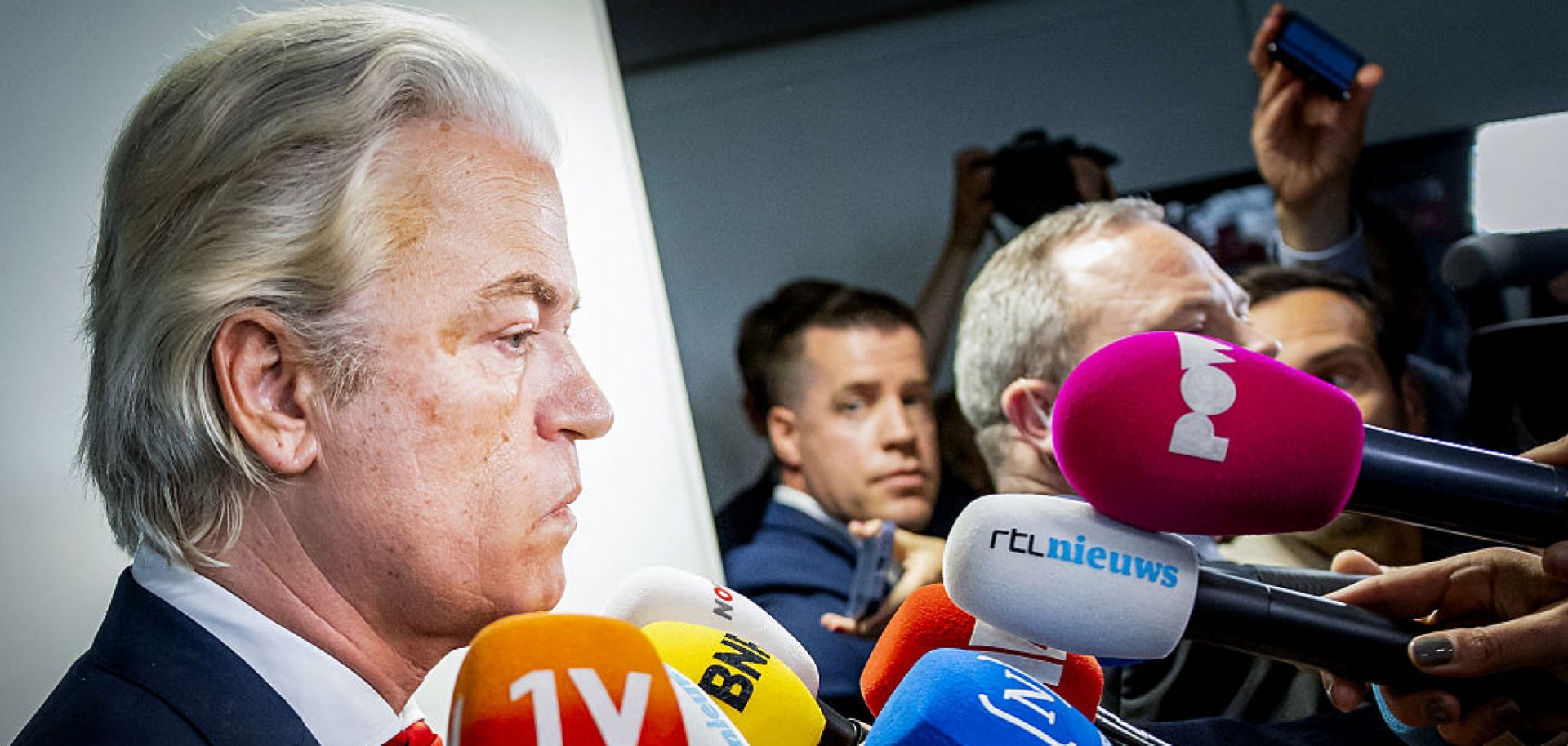
In the Netherlands, the collapse of the coalition government will likely trigger early elections, leading to a prolonged period of political uncertainty amid complex coalition-building and months of caretaker governance. The Dutch coalition government collapsed on June 3 after far-right Party for Freedom (PVV) leader Geert Wilders announced his party's withdrawal from the coalition over disagreements on migration policy. The move followed a breakdown in talks with coalition partners over Wilders' hard-line asylum agenda, which included shutting borders with military patrols, suspending refugee family reunifications, rejecting asylum claims at entry points, deporting Syrians on temporary visas and introducing automatic deportation for migrants convicted of violent or sexual crimes. Wilders had issued an ultimatum demanding that coalition leaders sign a binding commitment to his 10-point plan, arguing existing cabinet proposals lacked enforcement guarantees. After failing to secure consensus, he informed Prime Minister Dick Schoof he could no longer support government policy and withdrew his party from the coalition, leaving Schoof's government without a parliamentary majority.
- Later on June 3, Schoof offered his resignation to Dutch King Willem-Alexander, stating that he will continue to serve in a caretaker capacity until snap elections are held and a new government is formed.
While Wilder's decision to exit the coalition follows months of government infighting, its timing points to a calculated move to regain control of the political narrative, rally support around his hard-line anti-immigration agenda and reverse his far-right party's declining popularity ahead of likely early elections. Wilders' move to bring down a government where his party was the leading force but which he did not fully control is likely a high-stakes political gamble. Since taking office last July, the Dutch government alliance — which, in addition to the PVV, included the center-right People's Party for Freedom and Democracy (VVD) and the New Social Contract (NSC) party and the agrarian, anti-establishment Farmer-Citizen Movement (BBB) party — had struggled to reconcile diverging views on contentious issues, particularly over asylum and migration policy. Wilders was often at the center of these disputes, repeatedly threatening walkouts and coalition breakdowns if his governing partners did not yield to his maximalist demands and uncompromising ultimatums. But in polls, his PVV party has recently been losing ground to more centrist parties. Against this backdrop, Wilders probably saw collapsing the government precisely over asylum policy as a chance to simultaneously reenergize his far-right support base and trigger an early election that his party would, in turn, be better positioned to win. In the likely case that a snap ballot is held later this year, Wilders will thus seek to capitalize on the strong anti-immigration sentiment in the Netherlands to increase his PVV's presence in parliament.
- The PVV won 25% of the vote in the November 2023 elections, becoming the largest party in the Netherlands' 150-seat lower house of parliament, with 37 seats. The party's polling numbers, however, have dropped sharply over the past year, falling from 33% in April 2024 to 18% in June 2025. One of the PVV's former coalition partners, the centrist NSC, has also seen its support collapse from 13% in the November 2023 elections to under 2% in June 2025. This has contributed to the resurgence of center-left and especially center-right parties, with the center-left Greens-Labour alliance (GL-PvdA) and the mainstream center-right VVD and Christian Democrats (CDA) now polling at 19%, 18% and 12%, respectively.
Early elections in the fall would trigger prolonged political uncertainty, keeping the door open for several coalition scenarios amid volatile polls and political polarization, with the Netherlands set to remain under a caretaker government with limited powers for months leading up to and after the vote. Following the PVV's withdrawal, the current government could attempt to govern as a minority administration; parties may also explore forming an alternative coalition within the current parliament. However, early elections appear more likely given the PVV's position as the largest party in the legislature, and the growing incentive for other parties to capitalize on their recent gains in the polls by holding a new ballot. Such an election would likely be held after the summer, in either September or October. The Netherlands' three largest parties — the PVV, the VVD and the center-left Greens-Labour (GL-PvdA) — are currently polling at similar levels, but the long pre-election period could bring significant shifts in voter sentiment. A key dynamic to watch will be how different parties position themselves in terms of potential alliances. In 2023, for instance, the PVV gained ground partly because, on the campaign trail, the VVD had signaled it would be willing to eventually enter coalition talks with the far-right party. But with the collapse of the coalition, the VVD may now again seek to distance itself from the PVV, potentially regaining votes from the center, but risking defections further to the right, either to the PVV itself or smaller populist parties like the BBB or Right Answer 2021. This would significantly complicate coalition-building, as neither far-right nor center-right parties would be able to form a governing majority without support from the other. Alternative alliances could thus emerge, including a coalition of centrist parties, with the center-left Democrats 66 and the GL-PvdA potentially seeking to join forces with the center-right VVD and the Christian Democrats. Yet political polarization and entrenched party rivalries make such alignments uncertain. In the meantime, the Netherlands faces months of political gridlock under a caretaker government with limited executive powers. Political uncertainty will likely continue even after the early elections, as coalition negotiations in the Netherlands often take several months, delaying key decisions, such as on defense spending, as well as fiscal and economic policies.
- Previous Dutch ruling coalitions have occasionally been restored after collapsing, including in 1999 and 2005. However, those two instances required a level of compromise and flexibility among coalition partners that seems unlikely in the current climate, given the depth of tensions and mistrust between the parties, meaning early elections are the most likely scenario.
- Coalition formation is typically a protracted process in the Netherlands. It took a record nine months for the country to form a government after the 2021 elections and nearly seven months after the November 2023 elections. With the political landscape now even more fragmented, another lengthy and complex negotiation process appears likely.
- Comments by Wilders' coalition partners cast doubt on any future cooperation after likely early elections. Following the PVV's withdrawal from the coalition, VVD leader Dilan Yesilgoz accused Wilders of acting out of self-interest and irresponsibly, claiming he "never intended to govern" and is "letting the country suffocate." She emphasized there was no real disagreement on asylum, suggesting Wilders manufactured the crisis. BBB leader Caroline van der Plas echoed this sentiment, saying Wilders "holds all the cards and is deliberately pulling the plug," while NSC leader Nicolien van Vroonhoven called his behavior "incomprehensible" and "irresponsible."
