
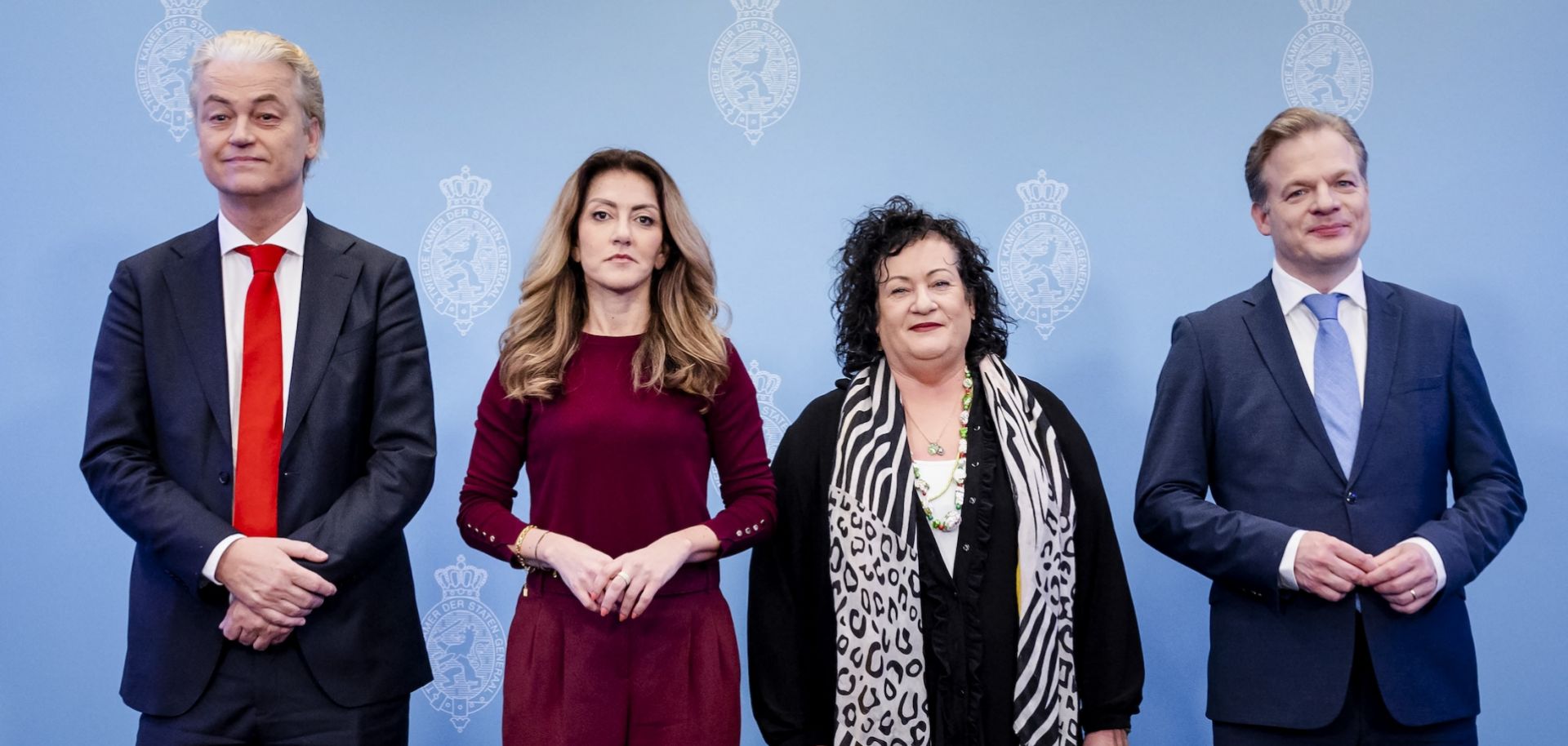
While some elements of the new Dutch ruling coalition's agreement, such as a tightening of migration policies and environmental measures, will likely cause friction with the European Union and the Dutch business community, the far right's need to collaborate with mainstream coalition partners has somewhat moderated the new government's agenda. On May 15, four Dutch political parties, the far-right Freedom Party, the center-right People's Party for Freedom and Democracy, the center-right New Social Contract party and the agrarian anti-establishment Farmer-Citizen Movement, announced an agreement for the formation of a coalition government following nearly six months of negotiations. The parties said that the new government will be a mix of political and technocratic figures. While the Freedom Party won the November 2023 general election, its leader, Geert Wilders, will not be prime minister. The parties said the new prime minister and Cabinet will be announced in the coming days. On May 16, the parties unveiled a 26-page plan highlighting the terms of their alliance and the new government's broad strategy.
- The Freedom Party won 25% of the vote in the November elections, becoming the largest party in the country's 150-seat lower house of parliament, with 37 seats. Negotiations to form a ruling coalition proved lengthy due to reservations among mainstream parties about governing with the far right.
- New Social Contract leader Pieter Omtzigt walked out of the negotiations in February, citing disagreements regarding spending and constitutional matters, making a so-called extraparliamentary Cabinet the only option for forming a government. In March, Wilders dropped his bid for the premiership as a compromise to allow government formation talks to move forward, allowing a breakthrough in negotiations.
The new Dutch government will be fiscally conservative, stricter on migration, less environmentally ambitious and more willing to challenge the European Union than its predecessor, but will not make major policy shifts on support for Ukraine and NATO. According to the coalition agreement, new government plans will include some tax cuts starting in 2025; a tighter admission regime for asylum and stricter migration policies; major investment in housing construction, infrastructure and the energy transition; reduced health care spending; and loosely defined support for the agricultural sector. On foreign policy, the document stresses support for the existence and security of the state of Israel, adding that the new government will explore relocating the Dutch Embassy in Tel Aviv to Jerusalem, and reiterates the country's strong support for NATO and Ukraine in its war against Russia. The agreement also includes a commitment to increasing EU strategic autonomy in defense production. On the other hand, the document confirms the new government's strong stance against further EU enlargement, and its intention to reduce contributions to the European Union by 1.6 billion euros (about $1.7 billion) starting in 2028 and opt out from EU migration and asylum policy. Finally, the new government aims to continue reducing dependency on "unreliable countries" for energy supply, boosting domestic natural gas production, investing in low carbon and renewable energy technologies like Carbon Capture and Storage and green hydrogen, and expanding plans to build two additional nuclear plants on top of two already planned.
- Government plans do not include overtly euroskeptic proposals — such as a referendum on leaving the European Union, something Wilders has called for in the past — and confirm the country's commitment to supporting Ukraine financially, politically and militarily despite Wilder's past anti-EU rhetoric and opposition to military support for Kyiv. This will be vital for the European Union to maintain unity in supporting Ukraine, particularly given the Netherlands' importance as one of the country's most significant contributors. The coalition agreement also includes a proposal to enshrine NATO's 2% of GDP military spending target into law.
- The new government plans to repeal legislation introduced by the previous government to ensure a more evenly distributed number of refugees across the country and reverse the outgoing administration's strategy for reducing nitrogen emissions, which has contributed to the sudden rise of the agrarian Farmer-Citizen Movement.
- The new coalition will seek to operate within the fiscal constraints enshrined by the EU Stability and Growth Pact, pledging not to have a budget deficit larger than 2.8% of GDP and public debt above 60% of GDP. For this reason, a planned 7.4 billion euro increase in spending to finance investment and tax cuts will be partly balanced with 4.7 billion euros in cuts.
- To ensure energy supply security, long-term contracts for natural gas will be established, and reserves will be built up for gas and critical raw materials. As planned, gas extraction from the Groningen gas field will cease; gas production in the North Sea will be scaled up instead. Meanwhile, the expansion of nuclear capacity will also include exploring investment in next-generation small modular reactors alongside four more conventional plants.
Government plans to significantly tighten migrant inflows into the Netherlands, including skilled workers and students, will likely cause friction with Dutch companies that heavily rely on foreign talent, possibly leading many to move investment abroad. The government is proposing investing in infrastructure and reducing taxes for listed companies, including a proposal to scrap a 15% tax on share buybacks that would have entered force starting in 2025. But plans to reduce legal migration into the Netherlands, including of international students and skilled workers — through measures such as tighter qualification requirements for visas to highly skilled expatriates and higher barriers for international students to study in the Netherlands — would negatively impact large Dutch companies reliant on international talent, which may prompt them to relocate overseas or expand operations abroad. If implemented, this could impact key companies such as semiconductor manufacturing equipment producer ASML, the Netherlands' largest company as well as Europe's largest tech group and the largest global supplier of chipmaking equipment. Meanwhile, proposals to significantly tighten asylum policies through emergency legislation and seeking an opt-out from the EU migration and asylum policy will likely trigger criticism from Brussels and may take years to materialize, if ever.
- The outgoing Dutch government announced plans at the end of March to spend 2.5 billion euros to improve transport and other infrastructure in the Eindhoven region — a booming technology hub where ASML is based — as part of a broader effort to convince ASML not to relocate its operations abroad. Dubbed "Operation Beethoven," the plan represents a response to ASML's public announcement that it was considering expanding abroad due to concerns about recent unfavorable policy changes in the Netherlands, including plans to end a tax break for skilled migrants that would impact its ability to attract vital foreign workers.
- ASML relies on skilled labor imports for about 40% of its workforce. This means that despite the other incentives, if legal migration is restricted, ASML could decide to slowly diversify away from its home country and boost investment into facilities abroad.
- The Netherlands is trying to prevent other major relocations following Shell's and Unilever's decision to move their headquarters from the Netherlands to the United Kingdom in 2018 over changes to the Dutch tax code and amid what the Dutch business community perceives as a gradual deterioration in the country's business environment.
- A majority of EU member states, including the Netherlands, gave final approval to reforms to the bloc's migration and asylum policies May 14. Collectively known as the New Pact on Migration and Asylum, the new rules are designed to redistribute costs and responsibilities of hosting migrants to the European Union more evenly across member states and to limit the number of new arrivals, seeking to streamline asylum procedures and reduce the number of people granted the right to stay in the bloc. Under the agreement, EU countries will be able to choose between hosting migrants or paying other member states willing to do so. Additionally, new border procedures will facilitate and expedite the return of migrants to what the agreement calls "safe countries" when they do not qualify for asylum.
