
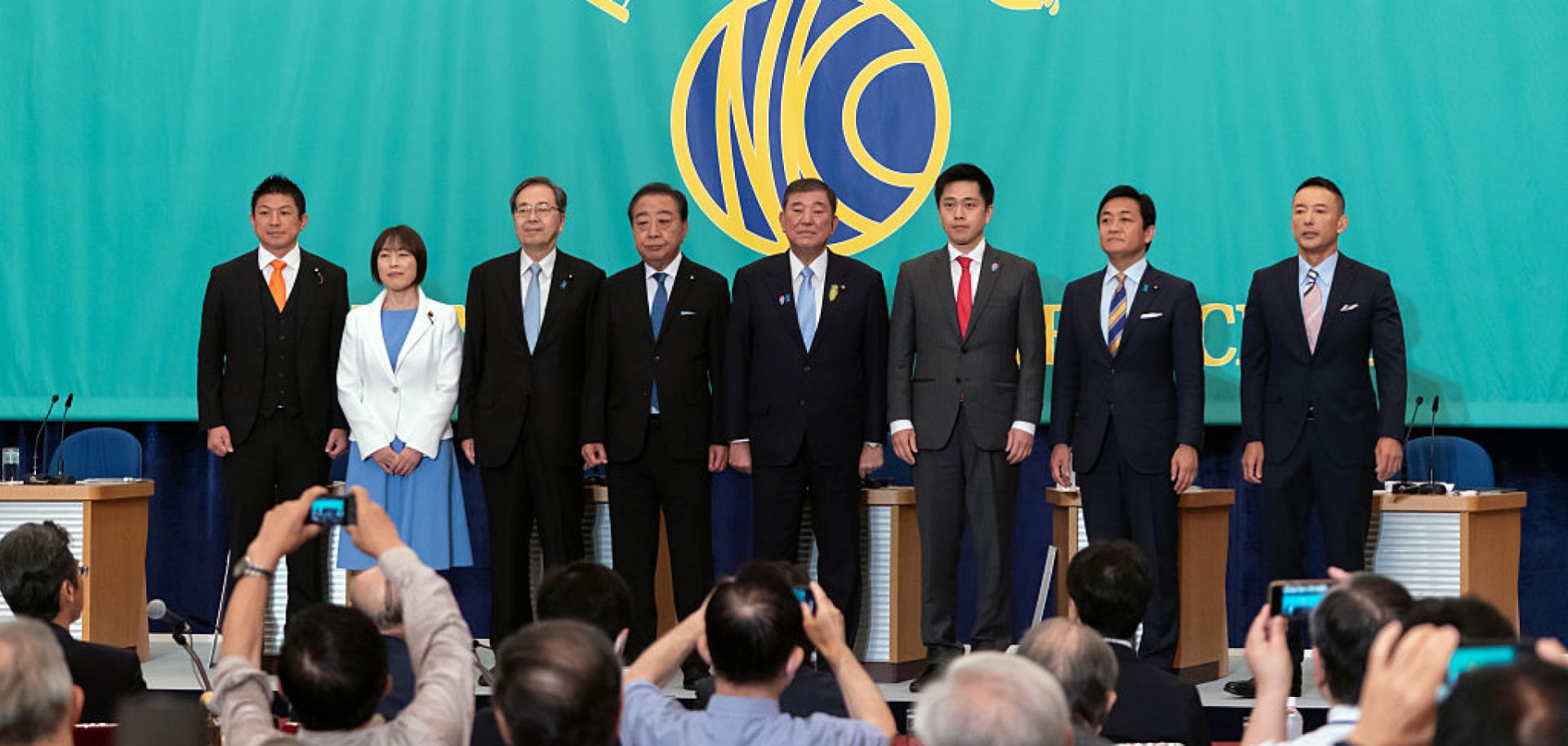
Editor's Note: For significant elections, RANE publishes a series of scenario analyses focused on different outcomes of major elections, describing how an election outcome might unfold with implications for each potential outcome. In 2025 so far, we have profiled Germany, Canada, Australia, Poland and South Korea. We now profile Japan.
Japan will hold elections for 125 of the 248 members of the House of Councilors — commonly referred to as the upper house of Japan's Diet — on July 20. The upper house is usually weaker than Japan's lower house, the House of Representatives, as the latter has final say on the budget and prime minister selection. However, the ruling Liberal Democratic Party, or LDP, and its coalition partner Komeito only have a minority government in the lower house, making the upper house more powerful and its elections more important than usual, as it is even harder for the lower house to reach the supermajority necessary to override upper house rejections of ordinary (non-budget) bills. The election will also influence whether Prime Minister Shigeru Ishiba remains in office and his LDP maintains leadership over the Diet.
If the LDP and Komeito maintain a comfortable majority of at least five seats in the upper house, Ishiba's government will largely continue to function as is, with no expansion of the governing coalition or threat to Ishiba's position as prime minister. Moreover, Ishiba could call snap lower house elections in an effort to capitalize on the LDP's strong performance and gain a majority in the lower house as well. With a stronger Diet standing and the prospect of favorable lower house elections, Ishiba would be more likely to pursue military modernization, including the constitutional reform necessary to expand Japan's regional security role. He would also be more likely to pursue regional revitalization and develop the urban and rural areas of Japan outside of the Tokyo metropolitan area.
If the LDP slightly loses its majority or retains a majority by only a handful of seats, Ishiba would likely stay in office, and the LDP would likely remain in power in the lower house. However, Ishiba could have to expand his coalition to expedite policymaking. If the LDP loses its majority, the upper house would also be more likely to function as a proper check on the power of the lower house on ordinary legislation, further reducing the LDP's ability to pass policy. A middling LDP performance would weaken Japan's hand in trade negotiations with the United States and keep Tokyo focused on short-term policymaking, delaying progress on long-term policies like military modernization and rural revitalization.
If the LDP suffers a major defeat and loses its majority by a large margin, Ishiba would likely either resign or fail a vote of confidence in the lower house. This would be particularly likely if the main opposition party, the Constitutional Democratic Party, or the center-right, populist Democratic Party for the People, gains a significant number of seats. Ishiba's downfall could lead to the arrival of a more conservative LDP leader and Japanese prime minister, or it could usher in an opposition government. In the latter case, Japan would be set for another period of weak governance and rapid leadership turnover, pushing its ally, the United States, to seek to strengthen alternative military partnerships in the Indo-Pacific.
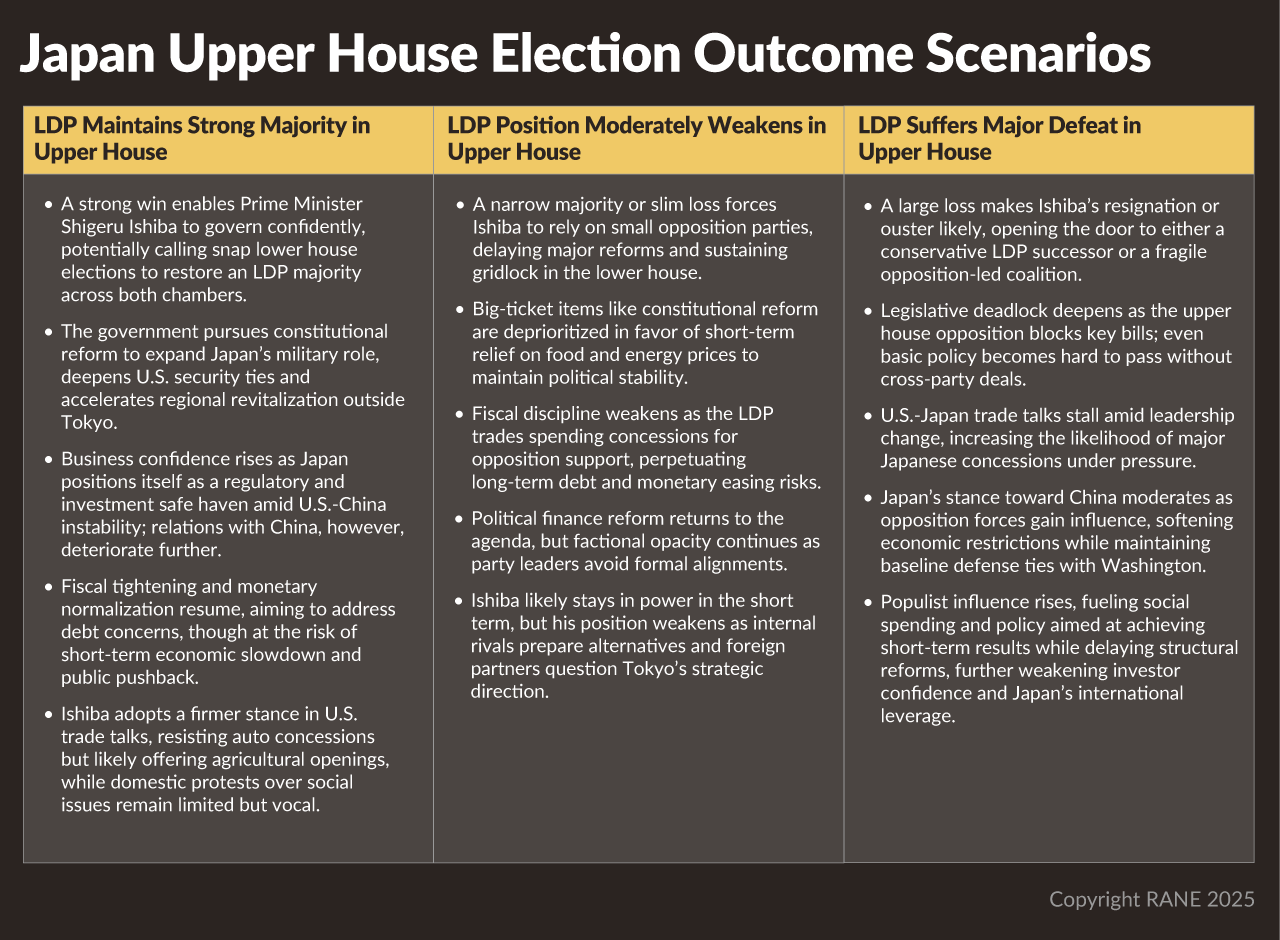
LDP Maintains Strong Upper House Majority
If the LDP maintains a strong upper house majority, Ishiba's government would press on with its current policymaking tactics, selecting individual opposition parties with which to cooperate to pass individual bills. Ishiba and the LDP would rely on the poor electoral performance and ideological diversity of opposition parties to forestall a no-confidence motion against him. Ishiba's ruling mandate would also be strengthened, especially given that he could claim the LDP's October 2024 lower house election defeat was primarily a holdover effect from former Prime Minister Fumio Kishida's leadership and that Ishiba has improved the LDP's standing despite these odds. A major win (the LDP-Komeito coalition retaining a majority plus five seats) would make Ishiba likely to capitalize on high support for his government by calling snap lower house elections in an effort to convert the LDP from a minority back to a majority government. The LDP may finally be able to pursue some of its loftier goals, like reforming the constitution to expand the military's foreign engagements and pursuing Ishiba's regional revitalization policies, aimed at increasing economic development in urban and rural areas outside of the Tokyo megacity. The business-friendly LDP's victory would also accelerate Japan's recent development into a global business and investment safe haven amid uncertainty about the U.S. and Chinese economies. In addition, it would deepen Japan's military and supply chain cooperation with the United States, worsening Japan's ties with China.
Implications
- The LDP will be in a better position to pursue constitutional reform to remove legal constraints on the structure and mission set of Japan's military. If successful, these reforms could see Japan take a more active role in coordinating militarily with the United States to deter a Chinese invasion of Taiwan and Chinese territorial aggression in the East and South China seas, risking retaliatory trade restrictions from China.
- The win will enable Ishiba to pursue his campaign promise of revitalizing industry and bolstering economic development outside the Tokyo metropolitan area, but incumbent industrial lobbies and industrial agglomeration in and around Tokyo will likely prevent the success of this initiative except in industries with the most direct government support (e.g., investment incentives, tax breaks or subsidies), potentially including automobiles and some consumer electronics.
- With or without a snap election, an ascendant LDP would be more demanding in Diet policy debates, making for more policy gridlock in the near term as long as the LDP's minority government in the lower house persists. However, gridlock would decrease if the LDP calls and wins snap lower house elections.
- The LDP will push more ardently for fiscal austerity and ending ultra-loose monetary policy, issues seen by the party as necessary for Japan's long-term economic health. These policies would reduce the long-term risk of a debt crisis but also increase the near-term risk of an economic slowdown.
- An ascendant LDP will be less compromising on progressive social issues — like LGBTQ+ issues and workers' rights — increasing the number of street demonstrations in Japan by unions, civil society groups and aggrieved citizens. However, Japan's generally peaceful social environment, in which acts of rioting or mass violence are rare, will persist.
- An upper house win, especially if coupled with a lower house snap election victory, would be a major win for more liberal voices within the LDP (including Prime Minister Ishiba and his predecessor and party elder Fumio Kishida) and, conversely, a loss for the conservative faction led by former prime minister and leading party elder Taro Aso. This would decrease the likelihood of a future return to ultra-loose monetary policy and a pragmatic stance toward economic relations with China, instead favoring greater strategic competition in partnership with the United States.
- Ishiba will be more resistant to offer major concessions on automobile tariffs to the United States in trade negotiations, given his greater confidence in the LDP's public support following upper (and potentially lower) house elections. Still, Ishiba would be more likely to offer some concessions on the agricultural sector (for example on rice imports), given his lowered reliance post-election on the support of agricultural lobbies and rural prefectures, increasing the chance of at least a limited U.S. trade deal and increasing his popularity with urban households that are fixated on the high prices of rice and other foodstuffs in recent years.
- An LDP victory would be taken as a signal that the party has moved past the worst of its political finance scandal, which drove the LDP's October 2024 lower house losses. This indicator would reduce the motivation for future political reforms and facilitate the formal return of political factions in Japan, increasing transparency into Japanese political developments versus the current dynamic by which factionless leaders meet for dinner, with public visibility of their talks.
- Businesses would see a resurgent LDP as a positive regulatory development, given the party's aversion to market intervention, conservative stance on labor issues and general distaste for higher corporate taxes, strengthening Japan's already growing position as a global safe haven for business and investment amid struggling economies in the United States and China.
- A victory by the LDP would likely come at the expense of numerous populist parties (like the Democratic Party for the People), reducing the likelihood of new social spending policies like tax breaks that populist parties tend to champion, supporting the LDP's fiscal austerity efforts.
LDP Position Moderately Weakens in Upper House
If the LDP barely loses its upper house majority — or wins a majority by only a few seats — Ishiba and the LDP would attempt to muddle through the next few years and not call snap elections unless the LDP's popularity recovers before the next general election, which is due by October 2027. In the meantime, Ishiba would have to forego such lofty policy ideas as constitutional reform and regional revitalization in favor of more practical, short-term goals, like supporting employment and providing price relief for household necessities like rice, making him more likely to make greater concessions on agriculture and automobiles in trade negotiations with the United States. A middling performance would likely still protect Ishiba from a failed vote of confidence in the lower house and prevent conservatives within his LDP from pressuring him to resign in the months following the election, but it would sustain long-term uncertainty about his tenure, as a mediocre upper house election performance would only add to his image as an ineffectual leader.
Implications
- Lacking a stronger mandate, the LDP will pursue small-scale, practical domestic policies — like reducing the prices of household commodities — rather than large-scale projects like rural revitalization and constitutional reform to expand the role of the military. The latter constraint will limit Tokyo's ability to cooperate with the United States to expand Indo-Pacific deterrence against China.
- A mediocre upper house performance would perpetuate the LDP's reliance on smaller opposition parties in the lower house for budgets and ordinary bills, maintaining a slow pace of policymaking as the LDP courts various opposition parties according to the needs of the legislative issue at hand.
- The LDP will be more likely to concede to opposition demands on tax cuts, greater social spending and other new fiscal expenses in order to pass LDP bills in the divided lower house. This will impede the LDP's efforts to pursue fiscal austerity and end ultra-loose monetary policy, perpetuating the long-term risk of debt crises for Japan.
- A middling electoral performance for the LDP would likely be driven by populist parties' electoral gains, keeping Japanese politics and policymaking subject to short-term and parochial policy interests rather than addressing long-term issues, like alleviating demographic pressures with pro-natalist policies and immigration reforms.
- Weaker political cohesion and greater LDP pressure on Ishiba to secure economic relief will reduce his negotiating power in U.S. trade talks. This will increase the chance of a comprehensive trade deal driven by Japanese concessions on automobile and agricultural tariffs and simultaneously reduce Japan's ability to follow through on such a deal in the face of pushback from various empowered opposition parties.
- A modest electoral performance will keep some pressure on the LDP to pursue political finance reform, increasing visibility on political spending. However, this would also lead top party elders to continue opting for "dinner meetings" in lieu of reviving controversial political factions, reducing visibility into political factions and leadership dynamics.
- Though Ishiba will likely stay in power in the months following a moderate upper house electoral performance, his long-term staying power will remain in question, as the conservative wing of the LDP (led by party elder Taro Aso) will continue to plan for Ishiba's eventual replacement, and opposition parties will maintain the threat of no-confidence votes in the future. This top-level leadership instability will weaken Japan's diplomatic efforts across the board, especially with Washington, which views political instability in Japan as an inhibitor of defense collaboration.
- Ishiba will be unlikely to call snap elections following a mediocre electoral performance by the LDP. This will solidify the LDP's need to cooperate with opposition parties in the lower house, raising the chance that the LDP expands its traditional political coalition with minor party Komeito to include either the Democratic Party for the People or the Japan Innovation Party. This would risk permanently instituting the new coalition partner's populist policies in the LDP's governance. The Democratic Party for the People would prioritize household tax relief, while the Japan Innovation Party would pursue greater education spending.
- An expanded LDP coalition would be seen as a sign of the party's long-term electoral decline and would introduce new intra-coalition frictions with long-time partner Komeito. This would increase the likelihood of a coalition collapse and of subsequent opposition governments, which tend to produce revolving door prime ministers and policy discontinuity.
- A weaker Diet position will put greater pressure on the LDP to make concessions on social issues like LGBTQ+ rights and dual surnames for households. This will exacerbate intra-LDP ideological factions between the old guard conservatives and the new moderates and left-wingers. However, it will also moderately improve relations between Japan and left-leaning governments like that of South Korean President Lee Jae-myung and of the United Kingdom's Prime Minister Keir Starmer.
LDP Suffers Major Defeat in Upper House
If the LDP loses its upper house majority by a large margin, Ishiba would likely resign or lose a vote of confidence in the lower house and be replaced by a new LDP prime minister. The loss would further weaken the LDP's negotiating power with opposition parties in the lower house, leading to slow and inconsistent policymaking. In a less likely scenario, a new prime minister could come from the opposition parties, portending a few years of even more fractious and dysfunctional policymaking driven by the many ideologically diverse opposition parties. Either way, the LDP's ability to pursue both ambitious policies, such as constitutional reform, and more modest policies, like alleviating cost-of-living challenges, will be hampered, hurting public support for the government and Japan's ability to pursue foreign policy goals, like regional military cooperation to deter Chinese aggression in the East and South China seas.
Implications
- An opposition-ruled upper house will further slow policymaking in Japan, as even if the LDP passes a bill through the lower house, the upper house would be more likely to reject it, with the LDP unable to secure a two-thirds vote to override this rejection in the lower house. Party discipline suggests parties will vote similarly in the lower and upper houses, but if the party composition of each house is different, the LDP may have to negotiate with different opposition parties in each house to pass each bill.
- A significant loss makes it likely that Ishiba will either resign or fail an opposition-proposed vote of confidence in the lower house. This would raise the chance of an opposition government, which would be characterized by fractious and inconsistent policymaking given the ideological diversity of Japan's many opposition parties and the necessity for a coalition made of at least three parties.
- If an opposition government does not come to power, Ishiba's replacement would likely come from the conservative wing of the LDP. Such a replacement would be less open to compromise with opposition parties in the Diet on issues like economic equity, such as wage hikes and tax cuts, and would be more likely to push for constitutional revision to rapidly expand the role of the military and Japan's security responsibilities in the region, despite the opposition of some other parties.
- New leadership in the Diet and/or the prime minister's office would delay resolution of U.S. trade tensions for a couple of months as the new leadership rebuilds negotiations from the ground up. Concerns about instability in the Japanese government would also likely push the United States to make greater demands, increasing the likelihood that Japan makes significant concessions, such as agreeing to voluntary export restraints on Japanese vehicles to the United States, significantly greater vehicle production in the United States and/or purchase agreements for U.S. goods.
- With the LDP on the back foot and the disunited opposition parties — some of which are pragmatic about relations with China — ascendant, Japan will be more likely to take a more balanced view toward relations with the United States and China. For instance, Japan could continue military engagement with Washington but seek to extricate itself from supply chain cooperation with the United States against China, as well as reduce economic restrictions on China in hopes of securing greater market access for Japanese companies there.
- An opposition government would be more likely to raise social spending and pursue fiscal expansion in general, exacerbating Japan's long-term risk of a debt crisis. Such a government would also be more likely to implement a loose monetary policy, endangering Tokyo's future ability to wield rate hikes and cuts to stimulate or cool off the economy and making Japan more susceptible to returning to structural deflation or experiencing lengthy periods of recession.
- An opposition victory in the upper house elections would likely be driven by surges in support for various populist parties. This would make the government more susceptible to short-term and parochial policymaking (such as the consumption tax cut discussed for months ahead of the election) and less able to implement long-term policies, like balancing the budget, which is often unpopular at the time of implementation.
- Two sequential election losses in the October 2024 lower and July 2025 upper house elections will revive within the LDP the hard question of whether to expand its traditional coalition with minor party Komeito. This will make future LDP governments more likely to share power with another party like the Democratic Party for the People or the Japan Innovation Party. Increased power sharing will reduce the LDP's unitary hold over politics in Japan and fuel the United States' plan to expand military partnerships with other Indo-Pacific partners, particularly South Korea and the Philippines, in light of the reduced reliability of its long-term political partner, the LDP.
- If the LDP stays in power under a new prime minister, the party would be more likely to have to continue with party reforms to restore public trust following its political finance scandals and election losses. This would reduce the likelihood that formal political factions return and thus decrease the transparency of political machinations and Cabinet-building dynamics within the LDP, exacerbating foreign perceptions of policy unpredictability in Japan.
- A new, more conservative LDP prime minister would be more likely to champion Japan's history, make controversial visits to the Yasukuni Shrine war memorial, and continue to withhold apologies or rhetorical concessions on World War II-era historical issues with South Korea. This would anger the government of new, progressive South Korean President Lee Jae-myung and make Seoul more likely to freeze or cancel its trilateral defense cooperation with Japan and the United States to track missile threats from North Korea.
