
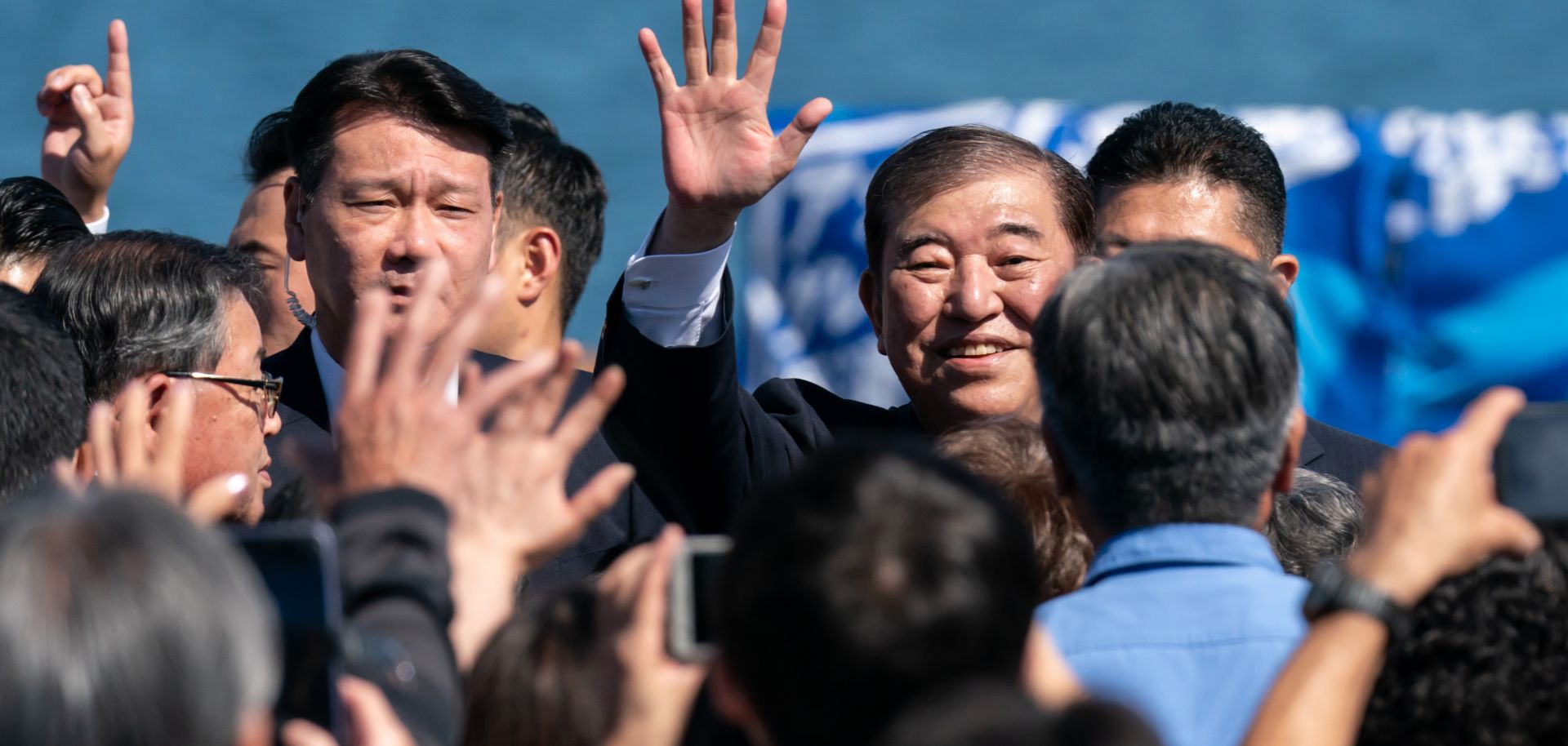
Snap elections will likely see Japan's ruling coalition lose seats but maintain a simple majority, slowing down economic policymaking and risking an eventual ouster of its prime minister, which would impede Japan's efforts to strengthen regional defense partnerships amid rising security threats from China and North Korea. Japanese citizens will go to the polls on Oct. 27 to elect members of the powerful lower house of Japan's Diet in a snap general election called by new Prime Minister Shigeru Ishiba on Sept. 30. In the election, all 465 seats of the House of Representatives will be up for grabs, comprising 289 seats allocated to single-member districts in first-past-the-post voting, as well as 176 seats for multiple member districts with proportional representation (party) voting. With the election, Ishiba aims to shore up his leadership legitimacy following a hotly contested, nine-way race to lead the ruling Liberal Democratic Party (LDP) and become premier on Sept. 27. To do so, Ishiba has set a goal of working with the Komeito party, its long-time minor coalition partner, to meet the 233-seat threshold for a simple majority in the lower house. The LDP aims to take advantage of a bump in public support coinciding with Ishiba's new leadership to win at the polls and overcome a slush fund scandal, which took down his predecessor Fumio Kishida and has dragged down public support for the party since November 2023. Meanwhile, Japan's opposition parties of varying ideological stripes aim to unseat the LDP, a task the opposition has only accomplished twice — from 1993-1996 and from 2009-2012 — since World War II.
- In Japan's bicameral system, the lower house is the more powerful legislative body because it has the ability to override opposition in the upper house (House of Councillors) on prime ministerial appointments and legislative decisions (including budget approval), and also holds the sole power to trigger votes of no confidence against the prime minister's cabinet.
- The slush fund scandal that emerged just under a year ago implicated dozens of LDP lawmakers in the misuse of party faction fundraising proceeds. Between October 2023 and June 2024, public approval for the LDP dropped from 36% to 26%, while approval for the Cabinet dropped from 36% to 20% between October 2023 and September 2024, according to polls from Japanese public broadcaster NHK. As of mid-October, approval ratings for the LDP and Ishida's cabinet have both risen to 31% and 41%, respectively, following Ishiba's elevation to prime minister on Oct. 1.
While it may lose seats amid the ongoing fallout from the slush fund scandal, the ruling coalition is still likely to stay in power, though this may require an expansion of its coalition. The LDP has been the dominant force in Japanese politics since World War II, in no small part due to early U.S. financial support. Today, the LDP remains an ideological umbrella group for a wide range of conservative views, while the seven opposition parties currently represented in the Diet have high ideological variance, ranging from the fringe Japan Communist Party to the more popular, center-left Constitutional Democratic Party and the right-wing, nationalist Sanseito party. This ideological diversity has constrained opposition victories in past elections and made their few periods leading the government short-lived. In this election, intra-opposition electoral competition will be even more intense, with most races featuring split opposition tickets that will favor LDP victories. Moreover, Nippon Ishin, the conservative opposition party that in the 2021 elections posed the fastest growing threat to the LDP-Komeito coalition — partly by stealing all LDP seats in Osaka — has recently lost multiple by-elections in Osaka (its main powerbase), suggesting the party's prospects are waning. These constraints, paired with the LDP's moderate post-Ishiba public support bump and the LDP's history of winning snap elections, suggest a ruling coalition victory is likely. Still, many Japanese voters believe the LDP has not sufficiently addressed the slush fund scandal. In response to these concerns, Ishiba revoked LDP endorsement for 12 lower-house candidates implicated in the scandal, preventing them from running for party vote seats in the Oct. 27 election and depriving them of party support in single-member districts. In addition, recent redistricting has removed several seats from conservative, rural areas and reallocated them to more liberal, urban areas like Tokyo. These factors suggest a loss of at least some seats is unavoidable for the ruling coalition, and that a loss of its majority, while less likely, is still possible. If the LDP and Komeito fall just short of a simple majority (e.g. by 1-20 seats), they could make up the difference by expanding their coalition to include a minor opposition party, like the conservative Nippon Ishin (whose leaders have expressed interest in such an arrangement), though this would bog down policymaking with horse-trading. But if their loss is even more severe, a loose coalition of opposition parties would come to power.
- In the upcoming election, opposition party candidates are competing against one another to defeat the LDP in 83% of the 289 single-member seats, up from roughly 70% in 2021 elections. Moreover, the opposition is fielding multiple candidates in 39 out of the 45 seats where the LDP is fielding a candidate implicated in the slush fund scandal, seats that otherwise should be easier for the opposition to win.
- Japan has had eight lower house elections since 2000, seven of which were snap elections. The LDP won these snap elections in all but one case, in 2009.
What's in a Legislative Majority?
Lawmaking in Japan's lower house is heavily influenced by 17 committees, which decide whether legislative issues will come to a vote before the lower house. The membership and chairperson of each committee are determined based on the proportion of lower house seats held by each party. Currently, the LDP-Komeito coalition holds 288 out of 465 seats, which puts them above the 261-seat line that represents an ''absolute stable majority,'' meaning they get to appoint the chairperson and a majority of members for all committees. This dominance allows the coalition to decide on nearly all legislative matters with little pushback from the opposition in committees. If the LDP-Komeito coalition falls below that 261-seat threshold but retains at least 244 seats, it will have a ''stable majority,'' meaning it gets to appoint all committee chairs, but will not necessarily have a majority of members in all committees; in this scenario, the coalition would thus have to make concessions with opposition parties on some matters, or see bills die in committee. If the two ruling parties win fewer than 244 seats and secure only a simple majority (233 seats), some committee chairs will be awarded to opposition parties, making it harder still to pass legislation. The LDP-Komeito coalition is currently only 22 seats shy of a 310-seat supermajority, which is required to pass legislation on certain issues, like constitutional amendments. But achieving a supermajority seems out of reach for the coalition, which is universally projected — by conservative, liberal and independent Japanese news outlets alike — to lose seats in this election.
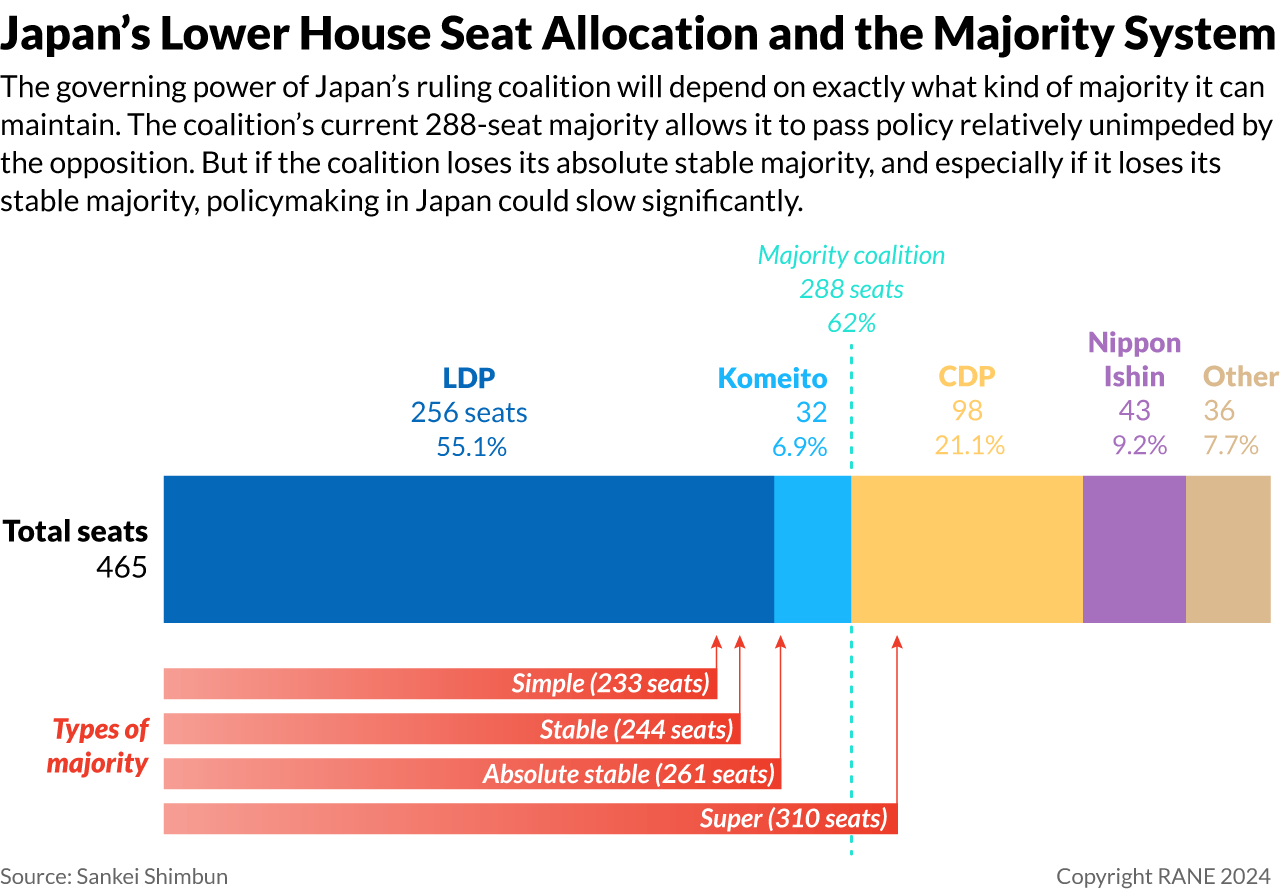
In the likely case that the LDP-Komeito coalition stays in power but loses at least its absolute stable majority, it would slow the coalition's efforts to pursue economic policies and military strengthening, and in the worst case, could lead to Ishiba's eventual ouster, impeding Japan's defense cooperation with regional partners. If the coalition loses its absolute stable majority (261 seats) — and especially if it fails to secure a stable majority (244 seats), which is slightly less likely — policymaking in Japan would be slow and arduous for the next few years, including on top LDP priorities (like an economic support package to ease cost of living concerns) and fiscal issues (like a long-deferred income and corporate tax hike to pay for rapidly rising defense spending). Moreover, Ishiba's ambitious policy objectives — like offering incentives to spur businesses to invest in smaller cities rather than Tokyo, and offering free education and other public services for childbearing households — will be much harder to implement. Even if the LDP-Komeito coalition maintains its absolute stable majority, some policies will remain uphill battles, like Ishiba's efforts to deepen political reform to clear the LDP's name from the recent slush fund scandal, which will face opposition from left-wing parties and the conservative wing of the LDP itself. Likewise, without a supermajority, which the LDP is extremely unlikely to secure, amending the constitution to expand the role of Japan's military in the Indo-Pacific in the face of a rising China — a process Ishiba pledged to commence within his three-year tenure as premier — will be highly difficult unless the LDP is able to secure support from conservative opposition parties, which has been a tall order in the past. In the months following the election, greater legislative gridlock, continually dipping public support for the LDP and/or losses in the July 2025 upper house elections could spur allegations in the LDP that Ishiba is a poor leader and failing to implement party policy goals, which could lead to a premature end to his premiership via an early election for a new LDP president. This would risk a dynamic of the LDP going through revolving door prime ministers, impeding long-term policymaking (e.g. economic reforms to bolster rural areas) and Japan's relations with key foreign partners, like South Korea and the United States, with whom Tokyo aims to bolster security cooperation in the face of a more belligerent North Korea and a rising Chinese threat to Taiwan.
