
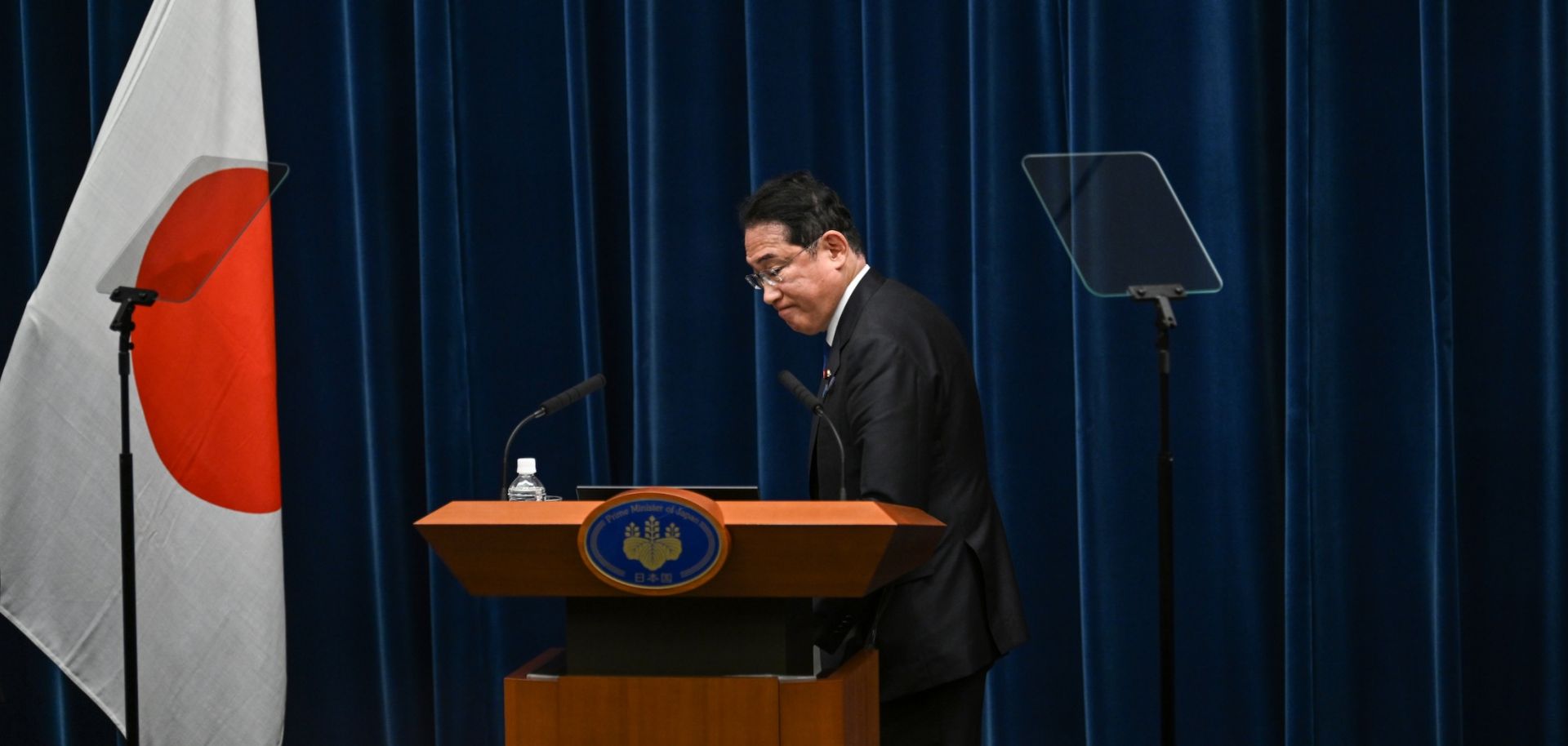
The prime minister's resignation raises the prospect for change in domestic economic policy, such as cost-of-living issues, but major changes are unlikely regarding Japan's pursuit of military partnerships in the Indo-Pacific, and a national policy turn toward the left is not yet imminent. Japanese Prime Minister Fumio Kishida announced at a press conference Aug. 14 that he would not seek reelection to head the ruling Liberal Democratic Party in September, and thus would be stepping down as prime minister of Japan at that time. In his speech, Kishida noted that "Politics cannot function without public trust" and said he had the "strong will to push political reform forward". This comes amid a slush fund scandal that has rocked the LDP since November 2023, and despite Kishida's efforts to resolve the issue — including an unprecedented sitting by the prime minister for a Diet investigation and his dissolution of key LDP political factions implicated in the scandal — public support for him and the LDP has plummeted, causing fears about the LDP's prospects in general elections due by October 2025. Foreign policy has primarily accounted for Kishida's public and political support so far, while economic policy has been a weak point of his administration, with Japanese citizens increasingly worried about cost of living as real wages have lagged rare inflation in Japan for much of the past two years.
- Support for Kishida fell from around 46% in May 2023, following Kishida's hosting of the G7 Summit in Hiroshima, to 26% in July 2024 amid the slush fund scandal. Meanwhile, support for the LDP fell from around 40% in early 2022 to 24% in July, its lowest in more than a decade.
- The dissolution of five of the six LDP top factions, which tend to drive Japanese policymaking and decide the winners of LDP leadership election, started when Kishida announced that his own faction would dissolve in January 2024. Other factions implicated in the scandal soon followed, including the Nikai, Abe and Moriyama factions, while the Motegi faction's leader announced that it would dissolve and reorganize as a policy group. Only the faction of former Prime Minister Taro Aso failed to dissolve, partly because its lawmaker members were not implicated in the slush fund scandal. With factions largely dissolved, there is greater uncertainty about elite support for LDP presidential candidates ahead of the September election.
- Japan's real wages rose for the first time in 27 months in July, growing 1.1%. This was partly due to recent labor negotiations and company efforts to attract labor in a tight market. Labor ministry polls from July show that 59.6% of households say rising prices are making life difficult, an increase of 8.3 percentage points from last year.
There's no clear front-runner to replace Kishida, but party elections favor long-term LDP lawmakers who balance factional interests; this will constrain the rise of politically unaligned, young or up-and-coming lawmakers and discourage major policy changes. Kishida's resignation announcement, which came roughly one month before LDP leadership elections, which are due in September and usually held late in the month, clears the way for alternative candidates to have their best shot at winning. But the election process is such that entrenched political interests still hold the advantage. Half the votes in first-round voting will come from Diet lawmakers and the other half from LDP party members, but if no candidate secures a majority (as commonly happens), second-round voting will ensue. In the second round, Diet lawmaker votes comprise about 90% of votes, and party member votes only around 10%. This means whoever holds the balance of power among Japan's political factions or has the favor of the most political elders tends to win the second round and the LDP presidency. And this elite balancing act means that general policy continuity is likely regardless of who succeeds Kishida, while political outsiders or up-and-coming politicians are disadvantaged in favor of senior, well-connected lawmakers. The context of these elections makes it particularly difficult to predict exactly who will win. First, Kishida's slush fund responses led to the dissolution of five of the six largest LDP factions, with the only one left standing being that of LDP elder and 83-year-old former Japanese Prime Minister Taro Aso. Hence, the normal calculations using LDP factional size and support as a proxy for candidates' electoral chances are less useful in this election, though whoever can secure Aso's support will have a clear advantage because of his elite stature and factional support.
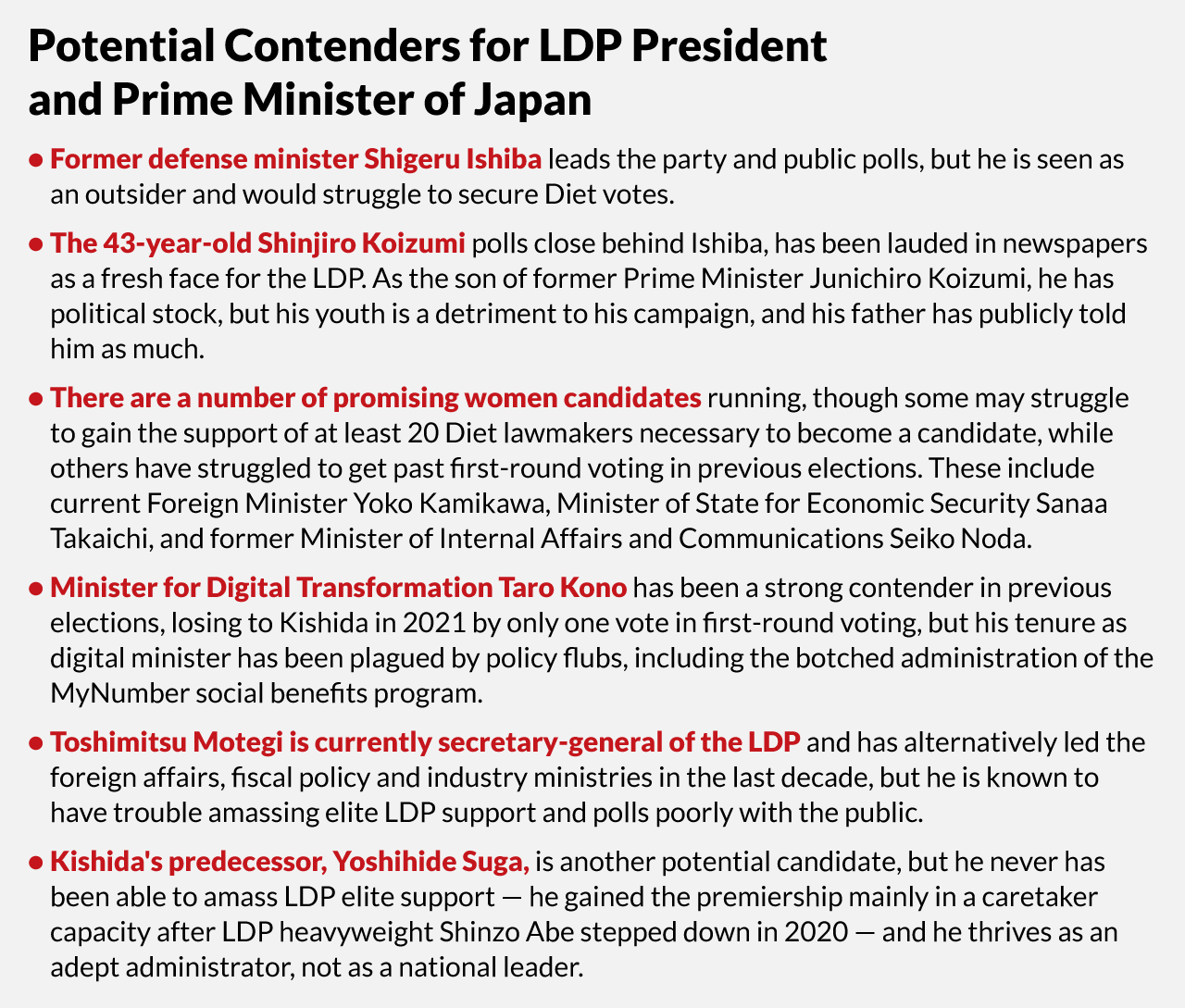
Kishida's resignation raises questions about domestic policy continuity, especially for cost-of-living issues, but major changes are unlikely on foreign policy vis-a-vis Indo-Pacific military cooperation. Kishida's inability to get the LDP out of scandals and win reelection increases the risk of a series of short-lived leaders that result in policy discontinuity on Japan's domestic economic recovery (especially its cost-of-living issues) as potential successors disagree on issues such as corporate taxes and monetary policy. That said, most potential successors agree with Kishida on strengthening Japan's military. Japan's warming military ties with South Korea will likely persist, so long as South Korean President Yoon Suk Yeol remains in power, as most LDP leaders hold these ties are necessary for addressing national security threats from China and North Korea. Continuity is also likely in Japan's trilateral security ties with the United States and South Korea and Japan's efforts to integrate itself more closely with international security groupings like NATO given long-term security threats from China, particularly those targeting Taiwan. Although most LDP leaders support economic competition with China like Kishida, some, like Suga, favor a more accommodating approach, which would weaken U.S. efforts to build a coalition of Indo-Pacific military partners — such as the Philippines and Australia — centered on Japan.
- A change of prime minister so close to lower house Diet elections due by October 2025 is risky for the LDP, as it needs a strong candidate to recover from recent political scandals. Luckily for the LDP, Japan's opposition remains heavily fragmented, so there is no imminent threat of a switch from a conservative LDP to a liberal Japanese government in the 2025 elections. But if the LDP's next prime minister fails to address economic affairs and political scandals more effectively, the opposition's chance of victory will rise, which could see Japan reverse course on military modernization and strategic competition with China.
