
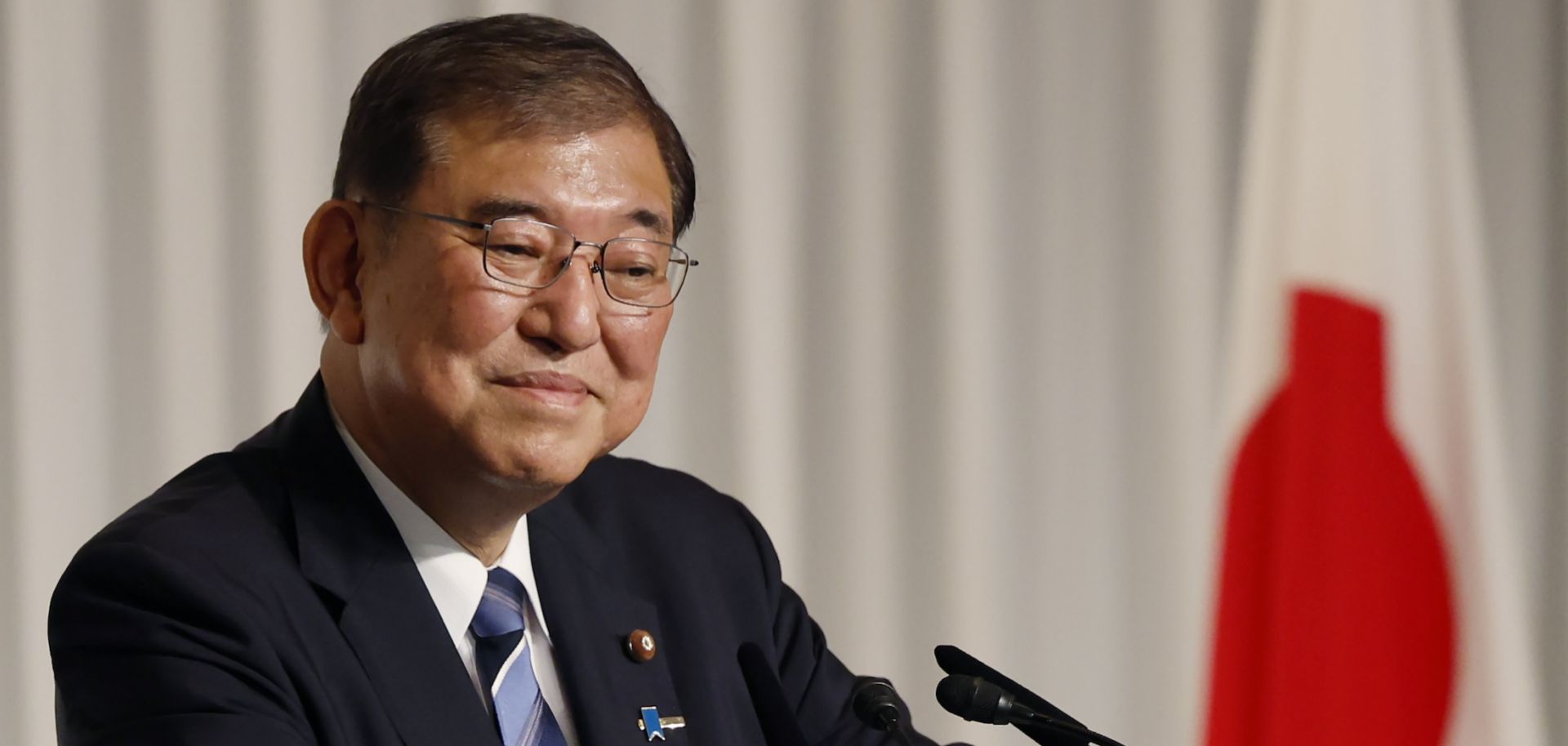
In Japan, an upcoming snap election could bolster the position of new Prime Minister Shigeru Ishiba, helping him implement pledges to strengthen the country's military and promote more equitable urban development. But the election also risks giving rise to an opposition-controlled government that would seek to reduce military spending, increase social spending and improve ties with China. Former Japanese Defense Minister Shigeru Ishiba won the election to become the president of Japan's ruling Liberal Democratic Party (LDP) on Sept. 27, beating out conservative nationalist candidate Sanae Takaichi and former environment minister Shinjiro Koizumi, who came in second and third place, respectively. The Japanese Diet will hold an extraordinary session on Oct. 1 to nominate the next prime minister, and the LDP's longstanding coalition with the minor party Komeito makes Ishiba's nomination all but certain. After that, Emperor Naruhito will officially appoint Ishiba as prime minister. On Sept. 30, Ishiba announced plans to call for a snap election on Oct. 27, with campaigning starting on Oct. 15, noting he believed it was ''important for the new administration to be judged by the people as soon as possible.''
Ishiba's balanced cabinet — drawing from the LDP's Suga, Kishida and Aso factions — suggests he has maintained a factional balance and is less likely to be ousted prematurely as head of the LDP, assuming the party's victory in the snap election. Ishiba won the LDP leadership race with the backing of outgoing Prime Minister Fumio Kishida, as well as factionally unaligned lawmakers in the Diet. Since the election, Ishiba has announced that Koizumi will serve as head of the Election Committee, a critical position ahead of a snap election. Japan's former technocratic prime minister, Yoshihide Suga, who was Koizumi's main backer in the LDP race, is also due to be appointed as the ruling party's vice president — replacing nationalist Taro Aso, who will now serve as a ''top advisor'' of the LDP. Other cabinet changes include the appointment of General Council chairman Hiroshima Moriyama — a key ally of both former Prime Minister Suga and former faction leader Toshihiro Nikai — as LDP Secretary General. Current Finance Minister Suzuki Shunichi (of the Aso faction) will also lead the LDP's General Council after Takaichi (also of the Aso faction) refused Ishiba's offer to take the position. These cabinet appointments strengthen the moderate Suga and Kishida factions relative to the nationalist Aso faction, though the latter will still have a strong presence through Taro Aso's new role as a top advisor. The growing influence of the moderate Kishida and Suga factions, along with Koizumi's role in the next election, will also help the LDP appeal to younger and centrist voters, critical for a party traditionally reliant on elderly and rural conservative votes.
An LDP victory in the upcoming snap ballot would bode well for Ishiba's staying power, reducing the risk of long-term political instability in the ruling party. Ishiba's announcement of a snap election suggests he and other LDP power brokers feel confident that, as low as LDP support has been in the wake of the slush fund scandal that emerged in November 2023, Ishiba's popular appeal and the concomitant bump in public support for the LDP following his election as party leader — combined with the continuing disunity of Japan's center-right and -left opposition parties — will be enough to secure an LDP victory. If this occurs, the relative balance of power in the Diet would likely persist, with the LDP maintaining a ruling coalition with minor coalition partner Komeito, whose new president Keiichi Ishii (appointed Sept. 28) has already stated the party cannot let the opposition take power, suggesting Komeito will continue to support the LDP. The chance of an LDP victory is further supported by the public's ongoing distrust in the opposition's ability to govern, despite corruption-related misgivings about the LDP. By bolstering Ishiba's ruling legitimacy, an LDP victory in the snap election would reduce the risk of the party returning to a period of revolving door prime ministers, thereby reducing the concomitant risk of leadership-related disruptions to Japan's many efforts to bolster foreign military and economic security partnerships with the West and like-minded Asian partners like South Korea.
- Ishiba's victory in the LDP leadership election comes after four unsuccessful bids to lead the LDP, largely due to his adversarial stance toward typical party power structures, including his lack of a faction alliance. However, these same anti-faction views may help him navigate a slush fund scandal tied to factional fundraising that has plagued the LDP since November 2023 and led to Prime Minister Kishida's decision not to run for another term.
- Japan has held eight general elections since 2000, seven of which were snap elections. Among those seven, just one led to an LDP loss, in 2009 following Taro Aso's leadership of the party.
If he remains prime minister after the Oct. 27 election, Ishiba will pursue military strengthening and even an ''Asian version of NATO'' in the face of a rising China. As a former defense minister and one of the few leading LDP officials who has met with Taiwan's president, Ishiba will likely continue his predecessor's efforts to bolster Japan's defense budget and accelerate the pace of military strengthening, while also improving Japan's partnerships with the United States and regional Asian partners to combat increasing security threats from China and North Korea. However, he will likely be more subtle about his nationalism than Takaichi would have been had she been elected prime minister, as Takaichi, unlike Ishiba, pledged on the campaign trail to continue visiting Yasukuni Shrine, a memorial to Japan's war dead that includes some World War II-era war criminals — visits that aggravate Japan's ties with formerly occupied countries like China and South Korea. Ishiba's more subtle nationalism will help preserve the growing Japan-South Korea partnership, which has so far manifested in information sharing to track North Korean missile threats. Nonetheless, Japan-China ties will continue to fray amid military competition. In an exclusive commentary published by U.S. conservative think tank Hudson Institute on Sept. 27, Ishiba said an ''Asian version of NATO,'' which he noted could include a shared pursuit of nuclear weapons, was ''essential to secure a deterrent against a 'nuclear alliance' between China, North Korea and Russia,'' citing the Ukraine war and China's military threat to Taiwan. Ishiba further cast doubt on the efficacy of U.S. extended deterrence in the face of China's expanding nuclear arsenal. Still, the establishment of an Asian security alliance would not see Japan cast aside its military alliance with the United States, but rather expand beyond it with like-minded nations like South Korea, though other countries in the region will be leery of the concept, especially any nuclear aspects.
- Ishiba visited Taiwan in August to shake hands with new Taiwanese President William Lai, showing Ishiba's interest in cooperating with Japan's partners and allies to push back against China's growing military coercion against Taiwan. Any Chinese invasion of Taiwan would pose direct economic and security threats to Japan.
Ishiba will also seek to ease the burden on Japan's middle class by prioritizing development outside of Tokyo and expanding social services. On the campaign trail, Ishiba pledged to make overcoming Japan's last three decades of deflation his top goal, and called for somewhat loose monetary policy to help fulfill this goal, although he also recognized the need for more interest rate hikes (if small) in the near term. To ease the burden of current inflation on households, Ishiba said he would soon draft up an economic support package focused on raising wages, providing subsidies for key goods, improving social services and offering tax relief. Additionally, Ishiba highlighted the need to continue increasing military spending, but still emphasized a desire to improve Japan's fiscal situation, which suggests he may look to corporate tax hikes to pay for this added household support. In regards to the tech sector, Ishiba is expected to be quite supportive with industrial policy; he has pledged to make Japan ''the world's most AI-friendly'' country with minimal regulations on the sector, and to bolster support measures for startups. Even more ambitiously, Ishiba pledged to ''drastically eliminate'' the ''concentration of people, goods, and money in Tokyo'' and to use government support (e.g. taxation and digital infrastructure) and incentives for businesses to expand into other regions. If carried out, most of these moves would initially irk foreign businesses, but Japan will nonetheless remain a top destination for companies fleeing geopolitical risks in China and Taiwan — especially given Ishiba's desire to also attract more investment to Japan and his need to sate his LDP backers, many of whom have pro-business leanings.
There is a moderate chance that the opposition will win the Oct. 27 snap election, which would result in a government more willing to bolster social spending, cut defense spending, impose greater corporate taxes, and improve Japan's economic relations with China. Given the LDP's lengthy struggle to overcome the impact of the slush fund scandal and the fact that the public remains even more concerned with the party's failure to address cost of living concerns, the opposition has a moderate chance of winning the upcoming election. The Japanese opposition is comprised of a loose set of center-right and -left parties that frequently clash with one another, but if these parties nonetheless come to power in next month's ballot, Japan's new government would likely be headed by Yoshihiko Noda, the new president (as of Sept. 23) of the largest opposition party, the center-left Constitutional Democratic Party. Under Noda, Japan's program of military strengthening and bolstering security partnerships in the region (e.g. with South Korea, Australia, and the Philippines) would likely ebb, as Noda has pledged to reexamine both Japan's move to bolster defense spending from 1% to 2% of GDP and the LDP's plan to impose new taxes to pay for that spending, though Noda has asserted he will maintain a strong U.S. military partnership. On socioeconomic policies, many of Noda's proposals overlap with those of Ishiba (i.e. bolstering social support measures amid cost of living concerns). But unlike Ishiba, Noda would not be as constrained by his own party in implementing such policies, suggesting more social transfers and more corporate taxes to pay for them. Compared with the LDP, Japan's opposition parties — particularly those on the left, like the Japan Communist Party — tend to be more open to improving relations with China in order to reduce risks to the Japanese economy (e.g. Chinese trade restrictions). An opposition victory in the Oct. 27 election would thus also portend warmer Japan-China ties and fewer trade tensions.
