
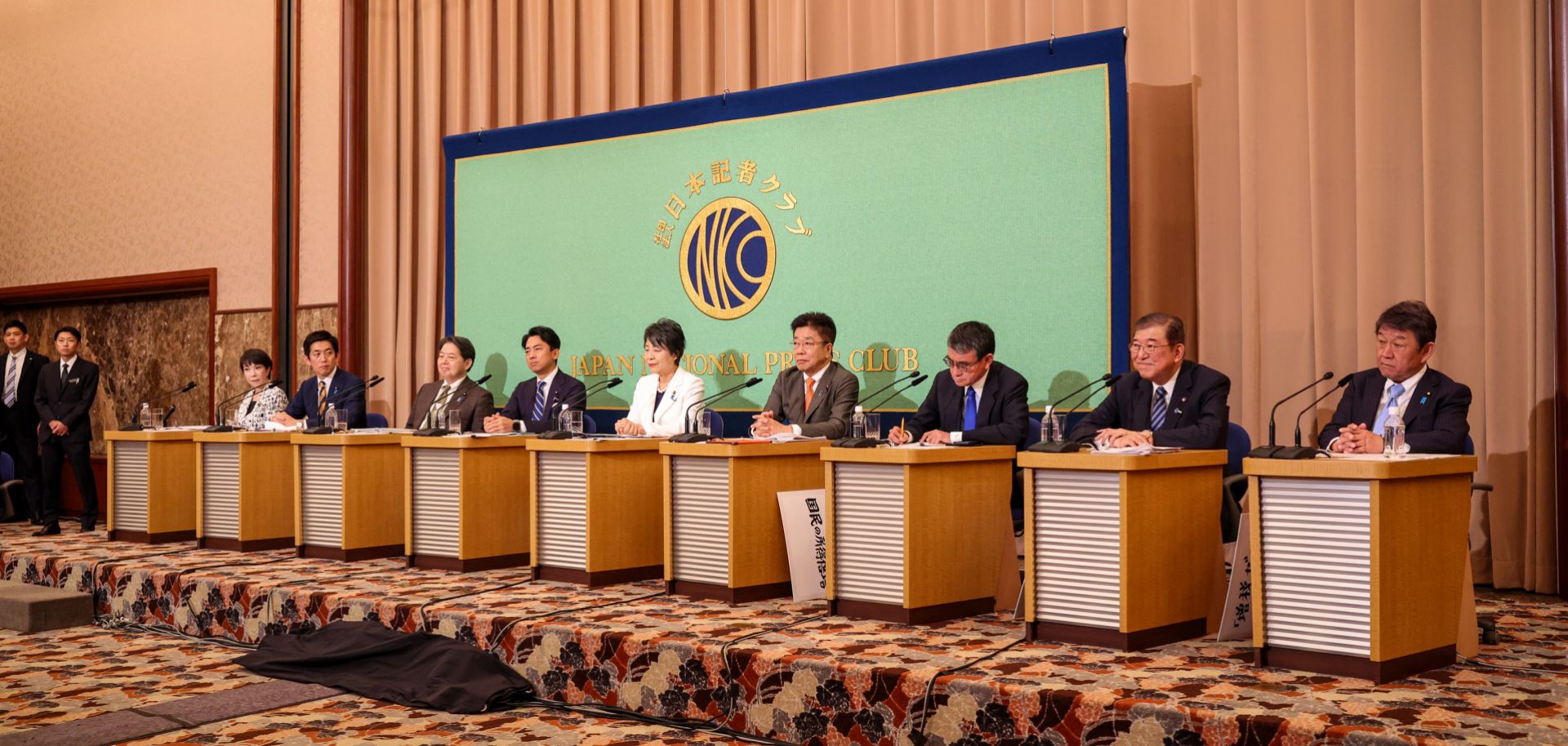
Japan's next leader will continue improving military ties abroad and focus on curbing cost-of-living challenges at home, but if he or she is replaced quickly after taking office, the rapid turnover would risk reducing Tokyo's preparedness for regional conflicts. On Sept. 27, lawmakers from and members of Japan's ruling Liberal Democratic Party will go to the polls to decide the next party president and, given the LDP's coalition majority in the parliament, Japan's next prime minister. This election is regularly scheduled — occurring once every three years — but it also follows an LDP slush fund scandal that arose in November 2023. Since then, public support for current Prime Minister Fumio Kishida and the LDP has tanked, driving Kishida to announce on Aug. 14 that he would not seek a new term as party president. With a general election fast approaching as well — due by October 2025 for the more powerful lower house of Japan's parliament — the LDP is keen to revive its public image or else see the opposition snag the premiership, an outcome that has only happened twice since World War II (from 1993-1996 and from 2009-2012). The Sept. 27 vote also marks the first LDP leadership election to take place with little influence from LDP political factions, whose horsetrading typically decides the election, as Kishida led the dissolution of top factions in January in a failed bid to sate public outrage about the slush fund scandal. Thus, Japanese lawmakers' and political elites' support for candidates is less predictable, which has contributed to a crowded electoral field, with nine candidates running in an extended campaign season that commenced on Sept. 12.
- In November 2023, news broke that several LDP lawmakers had falsely reported campaign funds raised during LDP faction events to the tune of $3.4 million. Four Cabinet ministers, including Chief Cabinet Secretary Hirokazu Matsuno, resigned over the scandal, but criminal punishments were primarily meted out to legislative staff, not lawmakers. After it was revealed that lawmakers from at least three of the six main LDP factions were involved, public complaints grew louder that corruption was endemic to the faction system.
- From October 2023, just before the scandal broke, to Aug. 5, 2024, just before Kishida announced he would not seek reelection, public support for Kishida's Cabinet dropped from 36% to 25%, while support for the LDP dropped from 38% to 30%, according to data from the Japan Broadcasting Corp. Though 30% is an improvement from the low of 25% that public support for the LDP hit in June, it still marks one of the party's lowest points in the last decade.
The LDP Leadership Election
The election will take place in two rounds, with 50% of first round votes allocated based on the ballots of LDP rank-and-file party members and 50% of votes cast by LDP lawmakers in Japan's Diet (parliament). If no candidate receives a majority of votes in the first round, as is usually the case, the second round will commence in which the LDP Diet members vote again, but this time their votes count for roughly 90% of ballots and rank-and-file party members' votes, which are held over from the first round, only count for around 10%. The campaigning season for the LDP election commenced on Sept. 12, an unusually long campaign period supported by Kishida, who claimed this lengthy period would give the LDP the best chance to pick a superior leader to revive the party after the slush fund scandal. In the last couple of days of the campaign season, there will be a media blackout period during which public surveys of voter intentions and exit polls are disallowed, so as not to sway the vote.
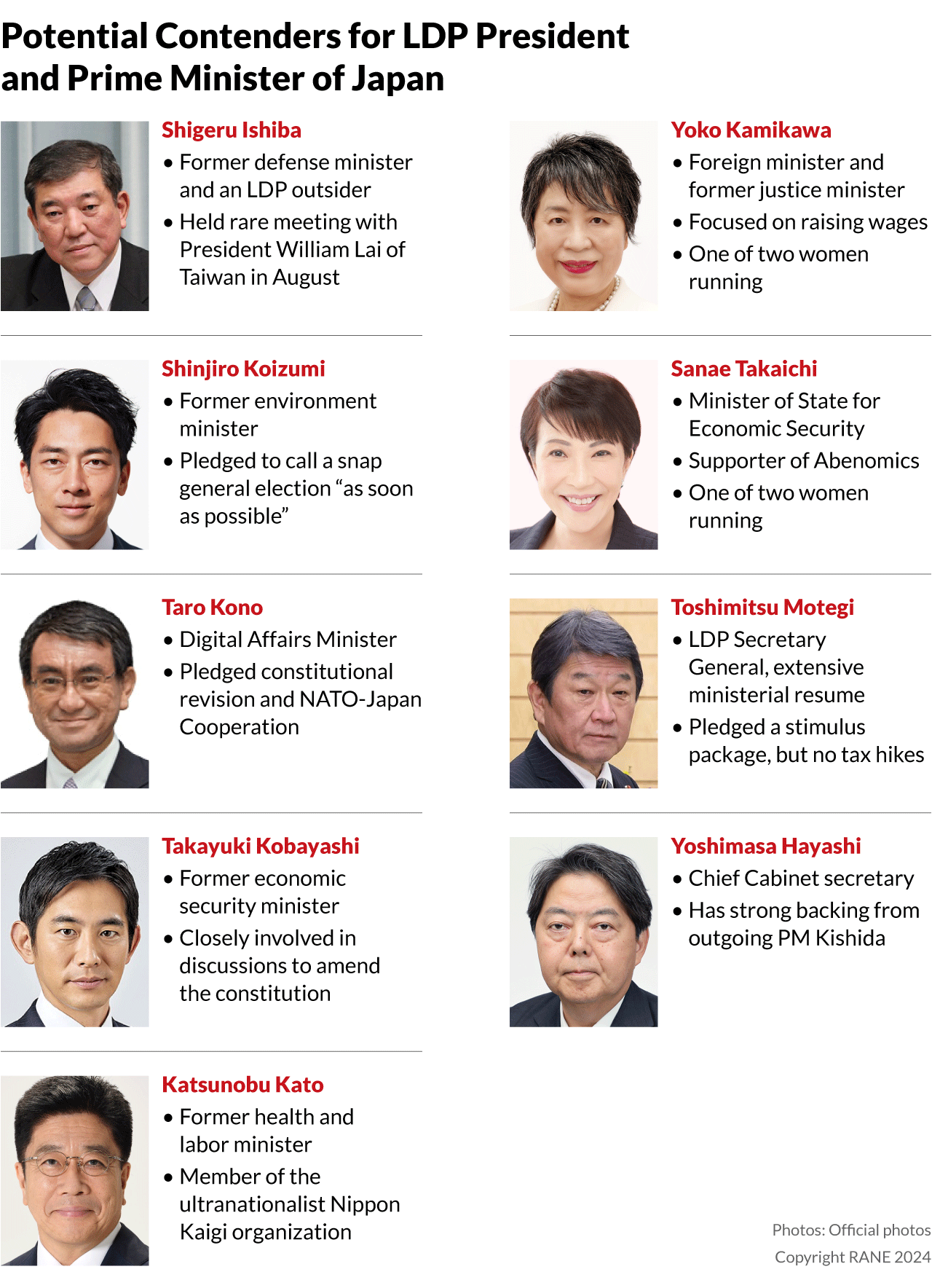
The crowded pool of candidates and unique features of this election give an edge to two less traditional candidates, though an establishment figure could still pull from behind given the strong influence LDP lawmakers have on the outcome. With nine candidates, two rounds of voting and the opaque, backroom dealing of LDP elder powerbrokers, there is significant uncertainty over who will eventually win. That said, polls of LDP party members show the most support for former Defense Minister Shigeru Ishiba and the young, former Environment Minister Shinjiro Koizumi — both of whom are candidates with less heft among the establishment — as well as Economic Security Minister Sanae Takaichi, a more traditional figure with deeper ties to the LDP elite. Given the mechanics of this unique election, those are the three candidates most likely to become prime minister, with Koizumi having a slight edge over the other two given LDP lawmakers' distaste for Ishiba — and thus his difficulty in winning the second round vote — and the public's lower support for Takaichi. Public polls matter more than in past LDP elections because the orthodox candidates who tend to win LDP leadership elections in the second round — older LDP members with deep ministerial profiles like Digital Minister Taro Kono or LDP Secretary General Toshimitsu Motegi — do not look like they will make it through the first round. Their support among party members is low, and support among lawmakers is currently heavily divided among candidates. There is also still time for campaigning to sink or float the prospects of some candidates, especially given the importance of public support in this election, though Koizumi, Ishiba and Takaichi have remained top public picks in polls for months. There is also a moderate chance that LDP elders will corral enough lawmakers to support an establishment candidate like Takaichi in the first-round vote to surpass popular candidates like Koizumi and Ishiba. However, as the campaign season gets underway, Takaichi could lose her spot as the top establishment figure, particularly to former Economic Security Minister Takayuki Kobayashi, who is contending with Takaichi for support from hardline LDP conservatives and has more support from LDP lawmakers, albeit in a crowded field.
- The most recent Asahi Shimbun poll of LDP party members, conducted from Sept. 14-15, showed that 32% support Ishiba for the next prime minister, followed by 24% for Koizumi and 17% for Takaichi. As for the LDP lawmakers, their support — based on the over 70% of Diet members who have publicly revealed their allegiances so far — is scattered across the nine candidates. As of Sept. 16, Kobayashi is tied with Koizumi, each with support from 38 of 367 LDP lawmakers, followed by Chief Cabinet Secretary Yoshimasa Hayashi — whose support primarily comes from Kishida's backers — with 35. Meanwhile, Ishiba has 26 backers, and Takaichi has 27.
- Former Environment Minister Koizumi is the son of popular former Prime Minister Junichiro Koizumi, whose legacy boosted his son's early start in politics. The younger Koizumi is a strong proponent of reform in the LDP, trying to broaden the party's appeal to urban Japanese with an eye toward equity-minded policies for the middle class. He is young, at just 43 years old, which in normal times would be a strike against him in the Diet, but with most leading factions dissolved and his main competitor also unpopular with the Diet, his youth is a comparatively minor inhibitor. Moreover, he is very popular with the public, especially those calling for a new face to the LDP, not another bland, elderly (and moderately corrupt) technocrat.
- Former Defense Minister Ishiba is most well-known for two things: his focus on strengthening Japan's military and regional security partnerships, and his maverick status outside of LDP factions, which makes him unpopular among the LDP political establishment but popular with the people. To the former point, Ishiba visited Taipei and shook hands with Taiwanese President William Lai on Aug. 13, suggesting he would support greater engagement with Taiwan, which would impede relations with China. On the latter point, this will be Ishiba's fifth time running in an LDP leadership election, and his unpopularity with the Diet will hurt his chances of winning in a second-round vote.
- Economic Security Minister Takaichi is the most ''establishment'' of the top three candidates, with the right age (LDP elders favor older candidates), diverse ministerial experiences, and connections to LDP faction leaders that would typically suggest a strong chance of victory. She also is the flagbearer for the policies of former Prime Minister Shinzo Abe, which gives her a certain degree of political cache within the LDP, given Abe was one of the most long-standing and popular LDP leaders in recent memory. However, she is a woman, which has been a disadvantage in previous LDP elections when it comes to gaining votes from Diet lawmakers.
On foreign policy matters, Kishida's successor will likely vary from him only slightly, with continued support for strengthening Japan's military and Western security partnerships in the face of a rising China and a provocative North Korea. The LDP's elders and most leadership candidates are broadly aligned on support for expanding the budget, arsenal and overseas remit of Japan's military (named the Self-Defense Forces in reference to Japan's post-World War II pacifist constitution). They also broadly support eventually revising the Japanese constitution, with the aim of more closely aligning the SDF's mission scope with the militaries of other great powers. That said, constitutional revision is controversial, both publicly for a population that has grown accustomed to pacifism (though this feeling is slowly waning, according to polls) and politically, with the LDP's long-time coalition partner — the pacifist Komeito party — and many opposition parties opposed to expanding Japan's military remit. Kishida's successor will also likely maintain Japan's foreign military partnerships, with most LDP candidates supporting the continued preeminence of the U.S.-Japan military alliance, as well as the budding South Korea-Japan security partnership and their trilateral cooperation with the United States, with China's military brinkmanship in the South and East China Seas (particularly around Taiwan) driving a sense in Tokyo of strategic encroachment by Beijing. These partnerships are likewise useful for addressing Japan's concerns about North Korea, especially the low but constant risk of North Korean missile launches aimed at Tokyo or missile debris landing on Japanese citizens. Similarly, economic security enjoys widespread support within the LDP, with candidates generally committed to strengthening supply chains for strategic goods to protect Japan from economic coercion from authoritarian states like China, and from the threat of severed supply chains in case of future conflict.
- Japan's defense budget is rising in line with a pledge in its National Security Strategy of 2022, which pledged to increase defense spending from 1% of GDP in 2022 to 2% of GDP by 2027 amid rising geopolitical competition. The defense ministry on Aug. 30 requested a 2025 defense budget of $59.1 billion (8.5 trillion yen), or roughly 1.6% of projected GDP.
- Public support in Japan for pacifism persisted long after the end of World War II, when U.S. occupation led Japan to renounce war as a sovereign right and the right to maintain a war-fighting force in Article 9 of its constitution. However, modern views are changing. In a May 2024 Kyodo News poll, 51% of respondents said they supported revising Article 9, but 65% also said there was no need to rush parliamentary debate on the matter.
On economic policy, LDP candidates are considerably more varied, but they generally agree that the next party leader must address cost of living concerns and continue the party's tradition of low interference in the market. Candidates are aligned in prioritizing fiscal support for households, but disagree on how best to do so. They have varying stances on whether to hike wages, reduce income taxes and other household expenses, issue subsidies or consumption vouchers, or raise or lower corporate taxes — all of which would have knock-on effects for employment and wages. Though most candidates agree that the time for Abenomics — Abe's program of monetary easing and fiscal stimulus — has passed, some like Takaichi still support the program despite its high costs and the inflexibility it imposes on the central bank regarding interest rate changes, which can be helpful for combating inflation. Compared with other Japanese parties, the LDP also tends to shy away from major intervention in the activities of corporations or the market, with an eye toward keeping Japan attractive to foreign businesses, especially as multinational corporations look to de-risk from China by moving some operations and investments to nearby countries like Japan. To this end, no candidate has policy proposals that would significantly waver from this tradition.
- In polls conducted in August by the major Japanese newspapers of Asahi Shimbun, Yomiuri Shimbun and Mainichi Shimbun, economics and social support measures (e.g. pensions, healthcare, and child-rearing support) were ranked as the first- and second-most important issues among voters, ahead of political controversies like the slush fund scandal.
There is a slim chance the next LDP leader could call a snap parliamentary election, especially if Koizumi is elected, which would risk bringing the liberal opposition to power. Of the nine candidates running in the LDP leadership election, Koizumi is the only one who has pledged to immediately call a snap election should he win. But the other eight candidates, upon winning, could also call a snap parliamentary election on the off-chance that he or she judges the opposition (including the leading Constitutional Democratic Party) to be more fragmented and unpopular than the LDP. Such a ballot would most likely be held shortly after the LDP leadership election so that the party can benefit from the public support boost of a new leader — potentially on Oct. 27, to coincide with Toyama and Okayama prefectural gubernatorial elections, and thus bolster voter turnout overall. However, Japan's next prime minister remains generally unlikely to call for a snap election in 2024, as it would inherently risk handing power over to the opposition given the LDP's low public support and the aforementioned concerns among voters about kitchen table issues, on which the ruling party has been perceived as negligent. Such a decision would also require backing from LDP elders, constraining the premier's ability to instigate a snap vote.
- Out of the eight general elections Japan has held since 2000, seven were snap elections. Among those, only one backfired on the LDP, with the 2009 election ushering in three years of opposition rule.
- If the LDP calls a snap election and loses, Japan's foreign and economic policy would likely see significant shifts under the opposition. An opposition prime minister, most likely from the Constitutional Democratic Party (CDP), would deemphasize military modernization (e.g. an expanded military budget and greater overseas remit for the Self-Defense Force) and shift Japan's foreign policy focus away from strengthening military ties with regional partners like South Korea, Australia and the Philippines, though the U.S. military alliance would remain central to national security. A CDP-led government would also lean toward improving relations with China for the sake of the economy, and would tone down the LDP's economic security policies aimed at bolstering supply chains with the West and Japan's like-minded Asian partners out of concern for China's brinkmanship around Taiwan and the low-level threat of war. On the economy, the opposition would lean hard into pro-consumer policies, such as lowering taxes on households, offering subsidies for household goods, and raising corporate taxes to pay for greater social services like free education and cheaper groceries and gasoline.
The LDP will continue to face internal divisions post-scandal, risking a return of revolving-door prime ministers, which would not threaten Japan's overall foreign policy priorities but would risk slowing down concomitant agreements, curbing Japan's preparedness for a potential conflict around Taiwan. Even without a snap election, and assuming the LDP wins the next general election, the ruling party will still be burdened with a long-standing predilection for short-term leaders as well as recent party unity issues. The dissolution of most leading factions, though likely impermanent, has at least for now taken away a key balancing mechanism for the wide spectrum of conservative views under the LDP umbrella. This internal imbalance — combined with ongoing debates on how to address the slush fund scandal and cost of living issues — suggests that if LDP support fractures, there is about a 50-50 chance the next premier will only serve 12-18 months in office before being replaced. A return to revolving-door prime ministers in Japan would not threaten major foreign policy change, though it could threaten instability in domestic economic policy, based on the aforementioned policy dynamics. Moreover, rapid leadership turnover would modestly threaten Japan's ability to strengthen regional military and economic security partnerships and related agreements — like the South Korea-Japan intelligence sharing agreement signed in April 2023 — which tend to be undergirded by frequent in-person summits between country leaders. Japan's frequently switching interlocutors would also undermine trust-building efforts in international negotiations, even if the policy proposals offered by Tokyo are consistent. This inconsistency and slower pace of agreements could, in turn, impede Japan's ability to deter and prepare for regional contingencies like a Chinese invasion of Taiwan.
- The possibility of another short-term leader in Japan is well informed by recent historical precedent: excluding Abe (who lasted eight years in his most recent stint) and the elder Koizumi (who lasted five years), the seven most recent LDP prime ministers served an average of 1.6 years in office, which is low compared with the single-term length of three years.
