
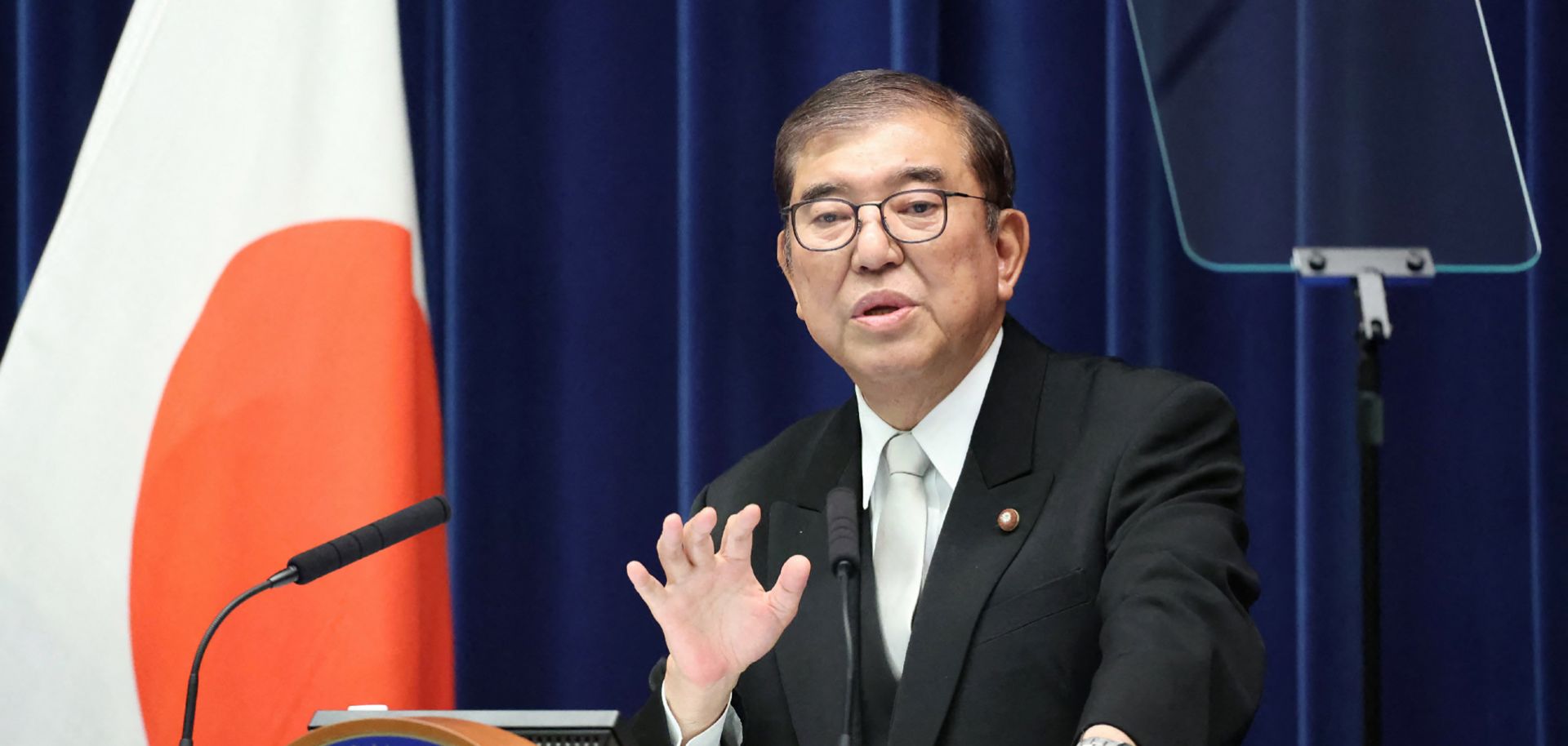
Though Japan's ruling party has survived another vote and its premier is unlikely to leave office anytime soon, the country's new minority government will face legislative delays in passing financial support for households, its annual budget and defense spending reforms, which could fray U.S.-Japan ties. On Nov. 11, Japanese Prime Minister Shigeru Ishiba won a vote in the lower house of the Diet to stay on as prime minister. Two small opposition parties, the Democratic Party for the People (DPP) and Nippon Ishin, voted for their own party leaders in a run-off election between the main opposition Constitutional Democratic Party's (CDP) candidate and Ishiba, invalidating their ballots and allowing Ishiba to win the run-off with only a minority of votes from his ruling Liberal Democratic Party (LDP) and long-time coalition partner Komeito. This vote came after Ishiba was first elected as prime minister on Sept. 27 by the LDP, and follows Japan's Oct. 27 snap elections, called by Ishiba on Sept. 30, which saw the LDP lose its majority but maintain a plurality in the lower house. Since then, both the LDP and CDP have been scrambling to form a majority coalition ahead of the Nov. 11 vote in the Diet for a prime minister. No such majority coalition has formed, nor has the LDP secured a confidence and supply agreement with the DPP or Nippon Ishin, which would have helped insulate the LDP from budget disputes and no confidence votes. Thus, the LDP now rules a simple minority government as both of these smaller parties have only pledged to negotiate with the LDP on a case-by-case basis to maximize policy concessions.
- The Oct. 27 lower house elections saw the LDP-Komeito coalition secure just 215 out of the body's 465 seats (a loss of 76 seats); the CDP secured 148 seats (a gain of 52), while Nippon Ishin secured 38 (a loss of 5), and the DPP secured 28 (a gain of 21), with the remaining seats split among various smaller parties and independents. With the help of six pro-LDP independents, the LDP needs to secure just 12 opposition votes on any lower house measure to reach a 233-vote majority, while the CDP needs support from Nippon Ishin, the DPP and at least two other opposition parties to reach 233.
- According to ongoing Diet discussions, the CDP will likely secure the chairmanships of eight out of 17 lower house committees (including the Budget Committee), which have a large say over which issues come to vote in the lower house.
- All parties are already preparing for upper house elections in July. Normally, the upper house of Japan's Diet is considerably weaker than the lower house, which alone can pass a no-confidence vote and override upper house objections to legislation with a two-thirds majority. However, with the lower house now heavily divided and a two-thirds majority very difficult to obtain, the importance of the upper house for policymaking has grown. Currently, the LDP-Komeito coalition holds 143 out of the upper house's 248 seats.
Despite numerous threats to his power, Ishiba will likely remain prime minister at least through upper house elections in July 2025, but policymaking on domestic issues, especially economic and political reforms, will be slow and contentious. Post-election dynamics suggest internal constraints and self-interest will prevent the LDP or opposition parties from ousting Ishiba. Within the LDP, the political faction most opposed to Ishiba's leadership lost 39 of its 59 lower house seats on Oct. 27, reducing its power to oust Ishiba in an LDP leadership vote. Moreover, after the LDP's losses on Oct. 27, the party is unlikely to call another snap election and risk losing more seats. Among the opposition, Nippon Ishin would also likely lose seats in a snap election and thus is ill-motivated to support a no-confidence motion against Ishiba, even if it was supported by the CDP and DPP, both of whom would stand to gain in snap elections. Thus, Ishiba will likely stay in office through at least July upper house elections, when party perceptions of public support may change. While this reduces the near-term risk of political instability in Japan, policymaking will still be slower on most issues, given the LDP's minority government status and the CDP's greater hold over lower house committees. Near-term indicators for the severity of policy gridlock include Diet deliberations on a supplementary budget, meant to fund an economic support package for households, which the LDP aims to pass in 2024. The priority issues in these deliberations will likely be tax breaks, fuel subsidies and tweaks to wage regulations, all to support households. Supplementary budget negotiations will be an early indicator of the tenor of deliberations for the annual budget, due by the end of March. Prior to July, the Diet will also deliberate on political reforms, as the LDP attempts to assuage public concerns about a lingering slush fund scandal. The opposition will push for hefty reforms and the LDP will be motivated to concede just enough to burnish (not harm) its image ahead of July elections. If the LDP loses big in those elections, the upper house will be empowered to veto lower house bills, exacerbating legislative gridlock.
- In Japan's legal system, if the Diet can't agree on a budget, the budget from last year does not simply roll over, as it does in other parliamentary democracies. Instead, the Diet would have to debate on a provisional budget for short-term, essential government spending until a formal budget is passed for the April 1 fiscal year.
A minority government could impede Japan's efforts to bolster its military and strengthen security cooperation with Washington under a new U.S. president. Once former President Donald Trump returns to the White House in January 2025, Washington will likely pressure Tokyo to contribute more to regional security, e.g. by paying more to maintain the roughly 54,000 active duty U.S. troops in Japan and accelerating defense industrial cooperation in ship and aircraft maintenance and missile production. To preempt these pressures, Tokyo will likely push for new defense spending on U.S. arms deals as a show of goodwill to the incoming Trump administration. However, greater Japanese engagement on these defense issues could run up against budgetary or legal constraints, given that the CDP — which is traditionally less enthusiastic than the LDP about expanding U.S. defense ties — will likely control the lower house Budget Committee. Plus, Japan's constitution has long constrained the remit of its military action, a constraint that would require a two-thirds majority in the Diet to amend. Moreover, ahead of the July elections, all parties are less motivated to pass long-delayed, controversial tax hikes intended to fund growing defense spending. These domestic constraints could cause the U.S.-Japan security partnership to fray as Washington pushes its regional allies to commit more resources to the military and the economic containment of China, impeding broader diplomatic and economic cooperation as the Trump administration rails against free-riders in the U.S. security network. On defense issues, one saving grace for the LDP is that the DPP and Nippon Ishin are both generally in support of LDP policies; this means that while the CDP may try to extract concessions on defense matters, it remains unlikely to try to outright stop LDP defense policy efforts, which would risk angering two swing bloc opposition parties that the CDP would otherwise prefer to keep on its side for votes on myriad other issues. Thus, Diet tensions are more likely to delay than permanently forestall both military strengthening and security cooperation with the United States.
