
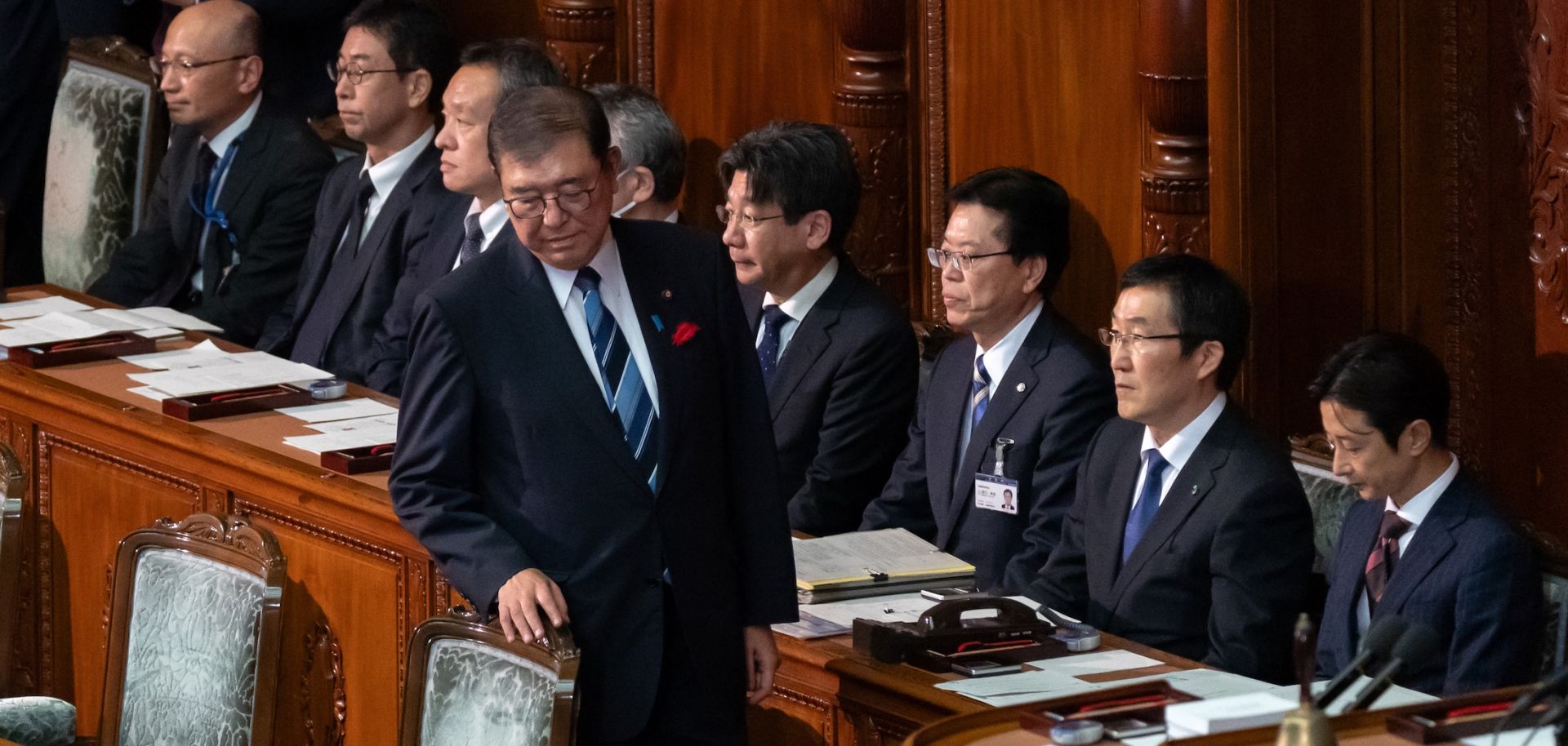
Despite losing its parliamentary majority in snap elections, Japan's ruling coalition will likely stay in power but will face greater legislative gridlock and a higher probability for rapid turnover in the role of premier in 2025, while in a low likelihood scenario, an opposition government would result in even more legislative gridlock and could strain U.S. defense and economic ties. The Oct. 27 snap elections for the powerful lower house of Japan's Diet saw the ruling coalition of the big-tent, conservative Liberal Democratic Party (LDP) and its center-right minor coalition partner Komeito, lose its majority, dropping from a combined 288 seats to 215 seats in the 465-seat House of Representatives. Within that total, the LDP dropped from 255 to 191 seats and Komeito from 32 to 24. Meanwhile, the main opposition party, the center-left Constitutional Democratic Party (CDP), gained 50 seats, rising to a total of 148, while the right-wing populist Nippon Ishin party dropped from 43 to 38 seats and the center-right Democratic People for the Party (DPP) jumped from 7 to 28 seats. Various smaller opposition parties and 12 independents (six of which are likely aligned with the LDP) won the rest of the seats. Prime Minister Shigeru Ishiba of the LDP, newly elected on Sept. 27, called the election ''a very harsh judgment'' from the public, in reference to a fall in public support for the party following a slush fund scandal that broke out in November 2023. But he also expressed his intention to stay on as premier, noting ''I want to continue to carry out my duties.'' The lower house is expected to hold a vote for the next prime minister within 30 days of the snap election, as is Diet custom, though often these post-election votes happen sooner. During this period, the LDP-Komeito coalition and CDP will each attempt to build a coalition to win that vote. If the lower house cannot select a prime minister candidate by an absolute majority after many rounds of voting, another snap election could be held, though parties that lost big in this election (e.g. LDP, Komeito and Nippon Ishin) would be ill-motivated to worsen their lower house standing.
- Nippon Ishin fell far short of its leader Nobuyuki Baba's stated goal of becoming the largest opposition party in the lower house, mainly winning seats in its local constituent powerbase of Kansai. In response to this loss, the party's deputy leader Hirofumi Yoshimura called on Oct. 28 for Nippon Ishin to have its own leadership election, a topic due to be discussed at a meeting among party leaders on Oct. 31.
An LDP coalition government or LDP minority government in cooperation with an opposition party is the most likely outcome of party talks in the coming weeks. The longtime coalition of LDP and Komeito, which now has 215 seats plus likely support from six independents, is much closer to a majority (233 seats) than the main opposition CDP (148), which would have to work with at least four other parties to get to 233 seats. Moreover, the swing-vote parties Nippon Ishin and DPP are both decently aligned with the LDP, Komeito and center-right populist Prime Minister Ishiba on most policy issues, and the LDP would only need to secure one of them to reach 233. In contrast, the policy platforms of these swing-vote parties are deeply incompatible with the center-left CDP, and especially with the Japan Communist Party (eight seats) and youth-oriented left-wing party Reiwa (nine seats), one of which would also need to join a CDP-led coalition (in addition to both Nippon Ishin and the DPP) to reach 233 seats. That said, as the party leaders of both swing-vote parties have stated, they could also refuse to join any coalition and instead enter either a supply and confidence agreement (to provide support on budgets and no-confidence votes) or ad hoc policy coordination (basically, only provide support on the prime minister vote) with the LDP or the CDP. This would require the LDP or CDP to approach the swing-vote parties with policy concessions on every single issue, a prospect that would also be more attractive (from a policy success standpoint) in coordination with the LDP, given their policy alignment. An LDP coalition with Nippon Ishin would be more advantageous to the LDP than a DPP partnership, as the former would put the ruling coalition above the 244-seat mark for a ''stable majority,'' portending smoother legislative committee deliberations. Lastly, Nippon Ishin's poor electoral performance, and thus its aversion to another snap election should the governing coalition fall apart, makes Nippon Ishin more likely to partner with the LDP than the opposition parties, which are notorious for fractious, bloated coalitions and short-lived governments. These factors together make a government led by the current LDP-Komeito coalition (whether in the majority or in the minority) the most likely outcome from the upcoming vote for prime minister.
- LDP leadership has already signaled the party is in contact with Nippon Ishin and the DPP regarding a coalition, though both parties have denied considering a LDP coalition. On Oct. 28, Nippon Ishin head Baba said he could not work with the LDP if political reform (related to the slush fund scandal) remained unresolved, but he also said a coalition with the CDP would ''throw the country into chaos'' given their vast policy disagreements. That same day, the leader of the DPP head stated he would not join either coalition and also cited significant policy differences with the CDP, noting the DPP would instead seek to work with a larger party on a case-by-case basis.
- There is also a low probability that the LDP itself will call another snap election if its ruling coalition or minority government agreement does not live up to its expectations. However, given that the LDP most likely called the Oct. 27 snap elections due to a perception that Ishiba's bump in public support following his appointment to premier would wane quickly, and given the LDP still hasn't sufficiently addressed political reforms related to the slush fund scandal in the public's eye, LDP leadership likely perceives that its chances in a second snap election would be even worse, at least in the next 12 months.
A weaker LDP government presages slow policymaking on issues like the economy and defense spending, and will also highlight intra-LDP disputes, raising the likelihood that Ishiba is ousted and Japan enters a period of rapid leadership turnover. Whether by coalition or by minority governance, an LDP-led government would still see considerably more policy gridlock than before the election, when the LDP-Komeito coalition held an ''absolute stable majority'' (at least 261 seats). This larger majority required minimal legislative coordination with opposition parties in the Diet's powerful committees, which can delay or kill a bill before it comes to a vote. Even assuming the LDP-Komeito coalition takes on Nippon Ishin and has minimal policy differences, a stable majority would mean the other opposition parties (e.g. CDP) could still delay or forestall policymaking on key issues, depending on which of the 17 lower house committees they hold the most sway, with committee membership yet to be determined. To the extent they can pass policy, the LDP (especially under Prime Minister Ishiba) and Nippon Ishin are generally aligned on issues like bolstering economic development outside of Tokyo, supporting households with free education, and upholding free market policies. On that latter point, however, the LDP and Nippon Ishin could clash on the specific issue of corporate taxes, as Ishiba has pledged to pursue a long-delayed rise in corporate and income taxes to pay for rising defense spending, whereas Nippon Ishin supports lower corporate taxes. Policy alignments aside, both Nippon Ishin and the DPP would demand more progress from the LDP on campaign finance reforms, a contentious issue within the LDP's factions, to extract policy concessions. This suggests that even within the LDP, factional differences over how much to punish LDP members associated with the slush fund could delay resolving the issues on which swing-vote parties are demanding political reform in return for policy concessions. This intra-LDP disagreement is unlikely to bring early LDP leadership elections for now, given the Abe faction — which is named after former Prime Minister Shinzo Abe, and is most opposed to political reforms and to Prime Minister Ishiba's leadership — suffered a massive defeat in the Oct. 27 elections. However, if the LDP cannot turn around its prospects in the July 2025 upper house elections, these intra-LDP disputes could boil over and lead to Ishiba resigning or being forced by his former supporters in the LDP to take the fall for the party's repeated election losses. This would risk the LDP returning to a period of revolving-door prime ministers, introducing greater policymaking uncertainty on both domestic issues (e.g. supportive policies to maintain healthy inflation) and foreign issues (e.g. military cooperation with regional allies to counter growing military threats from China and North Korea).
- Within the LDP, the Abe faction is most closely associated with the slush fund scandal and, in turn, suffered the biggest losses in the Oct. 27 elections. The faction's number of representatives in the lower house dropped from 54 to 22, a net loss of 32 seats, equal to half of all seats lost by the entire LDP in this election.
In the unlikely event that the opposition forms a government, it would heighten the probability of policymaking slowdowns and leadership uncertainty, while U.S.-Japan defense and economic cooperation could weaken. Though it remains unlikely given the previously mentioned constraints, there is still some precedent for opposition parties collaborating in grand coalitions (despite their ideological differences) to unseat the LDP. But this has only happened twice since the LDP was established in 1955: once from 1993-1996 and another time from 2009-2012. In both instances, the coalition of former opposition parties was characterized by rapid leadership turnover, with six premiers in six combined years of opposition rule. These coalitions were also replete with internal policy disagreements, which in the current context would combine with committee-level gridlock from the LDP in opposition, severely slowing down policymaking. As with previous periods, an opposition government would likely last no longer than a few years before the unsteady coalition falls apart, triggering new snap elections and likely bringing an LDP-led coalition back into power. Still, during this short period of opposition rule, the diverse coalition would generally be further left than the LDP coalition on most issues. Though CDP leader Yoshihiko Noda, the most likely candidate for prime minister under a liberal coalition government, has stated he would not reverse the LDP's push for rising interest rates or the LDP's defense spending hikes, minor opposition partners — especially the JCP and Reiwa — would demand concessions from the CDP on matters like raising corporate taxes, lowering household taxes and bolstering household economic support measures, or else threaten to dissolve the coalition. Center-right coalition partners Nippon Ishin and the DPP would contest such measures if they strayed too far from pro-market ideas. Thus, the CDP would be stuck in a position of needing to make concessions on every issue and always angering some minor party that could topple the coalition in retaliation. Lastly, even if it doesn't radically change defense policy, a CDP-led opposition would likely also seek to improve Japan's economic relations with China, straining U.S. ties as Washington seeks greater regional defense partnerships to contain a rising China and greater engagement with its allies in supply chain resilience efforts (e.g. to bolster supply chains of key minerals and manufactured goods that exclude China) to the same end.
