
Editor's Note: For significant elections, RANE publishes a series of scenario analyses focused on different outcomes of major elections, describing how an election outcome might unfold with implications for each potential outcome. In 2025 so far, we have profiled Germany, Canada, Australia, Poland, South Korea, Japan, Guyana and Norway. We now profile Moldova.
Moldova, one of the poorest countries in Europe and a central target of Russian hybrid warfare, disinformation, vote-buying, oligarch financing, diaspora suppression and energy leverage, will hold parliamentary elections on Sept. 28 for 101 seats allocated proportionately. Fifteen political parties, four electoral blocs and four independents have been registered. Parties must win at least 5% and blocs 7% to enter parliament. Polling indicates that no single party is likely to win an outright majority and that coalition-building will therefore be necessary to form a government.
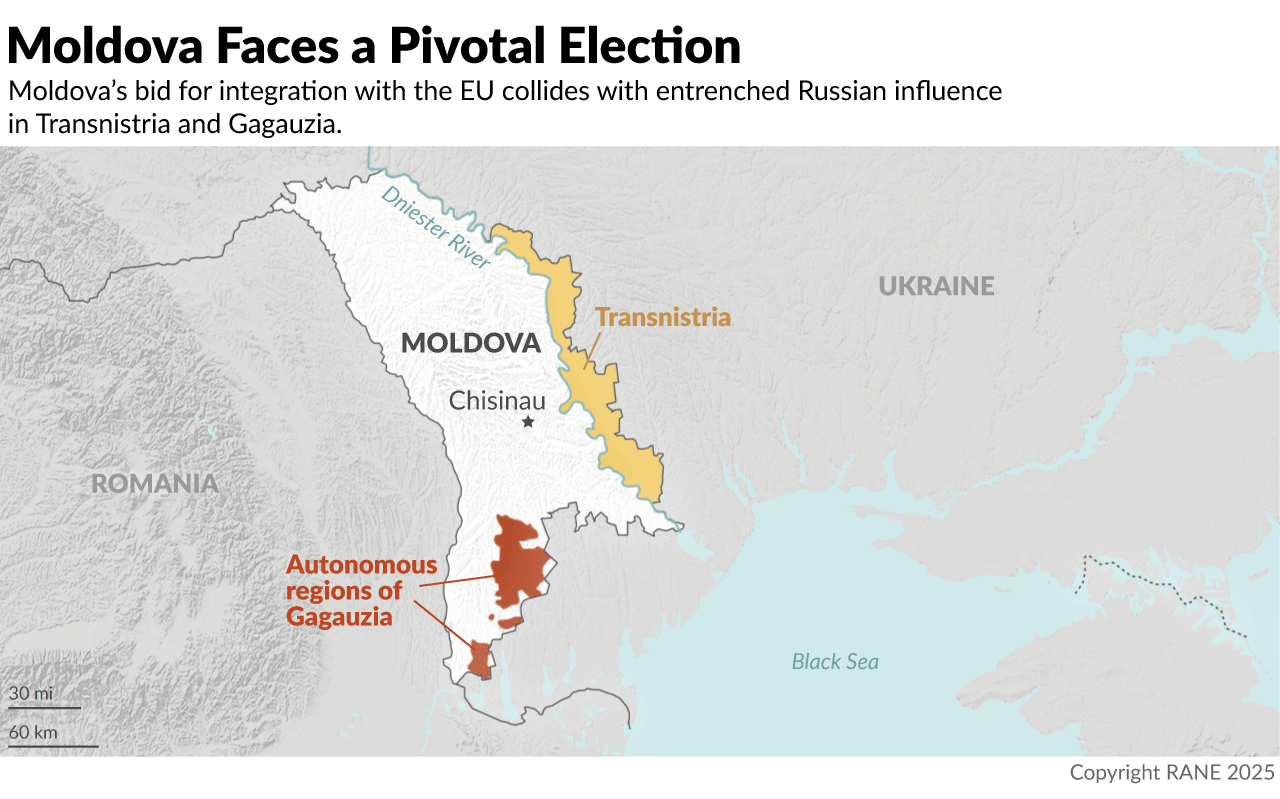
The election will oppose two primary groupings, President Maia Sandu's pro-European Party of Action and Solidarity (PAS) and the pro-Russian Patriotic Bloc, led by former President Igor Dodon. The Patriotic Bloc is composed of the Party of Socialists of the Republic of Moldova (PSRM), the Party of Communists of the Republic of Moldova (PCRM), the Heart of Moldova Party and the Future of Moldova Party. Other smaller parties include the center-left Alternativa Bloc and populist Our Party. These could be crucial in the event of a tight outcome in which no bloc has won a clear majority.
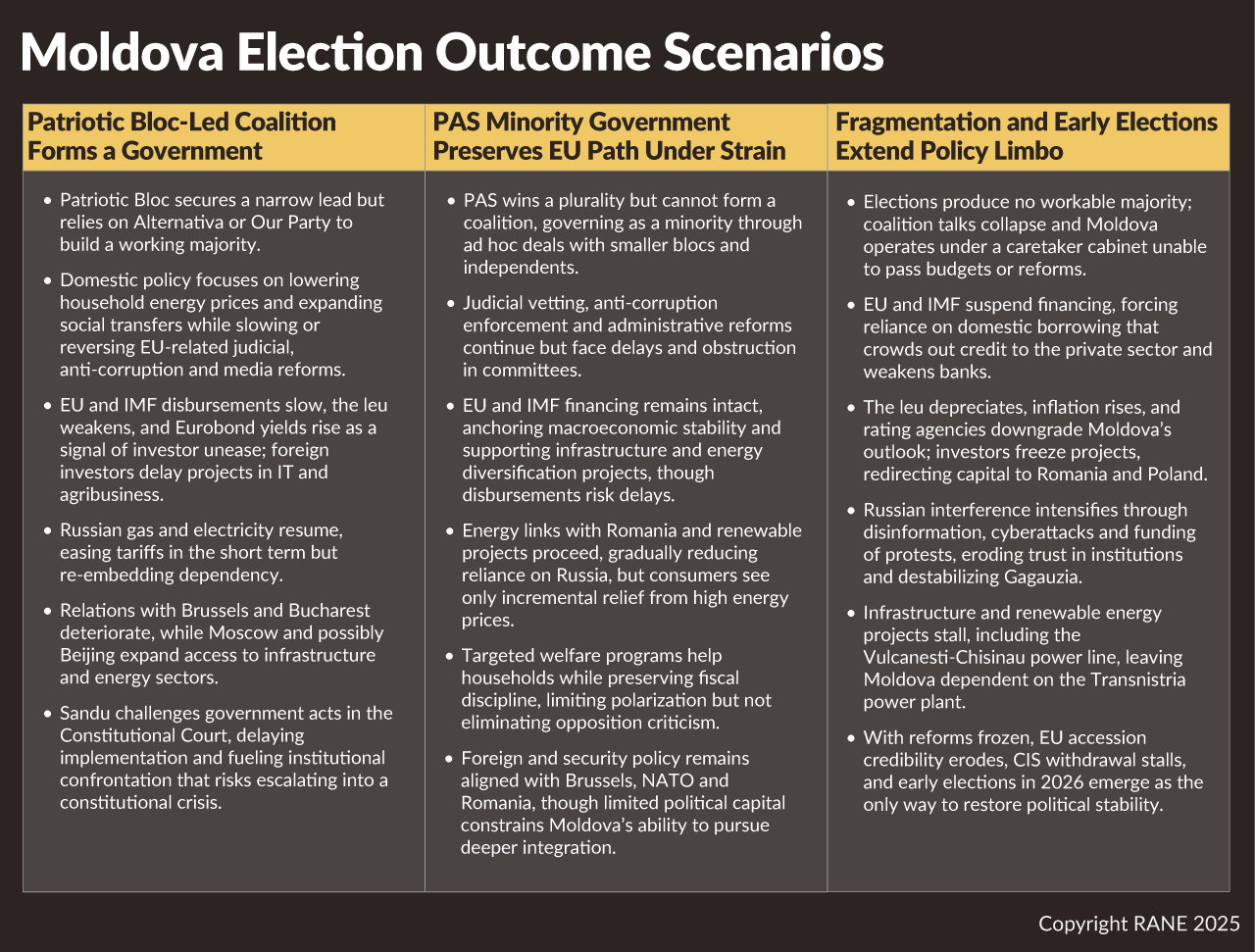
In the most likely scenario, the Patriotic Bloc performs strongly but falls short of an outright majority. To govern, it forms a formal coalition or informal pact with either the Alternativa Bloc or Our Party. This alliance would tilt Moldova's policy trajectory toward Moscow, slow EU-mandated reforms and increase fiscal, regulatory and security risks, while re-embedding energy dependency on Russia. EU and IMF financing slows or is suspended, depriving the government of external anchors for fiscal stability and delaying infrastructure and energy diversification projects. Clashes with Sandu are likely to arise if she challenges legislation or takes executive actions that undermine pro-EU reforms, setting up a prolonged institutional standoff.
In the second scenario, Sandu's PAS remains the largest parliamentary force but falls short of a majority. It forms a minority government, relying on ad hoc support from smaller centrist groups or independents to survive confidence votes and pass budgets. This outcome preserves Moldova's EU integration track, as PAS would continue to push reforms required by the EU and defend judicial and anti-corruption measures. However, legislative progress would be slow and fragile, with constant risks of obstruction in committees. Financing from the EU and IMF would remain intact, underpinning macroeconomic stability and allowing infrastructure and energy diversification projects to continue. While this scenario avoids a sharp policy reversal, it would produce political instability and complicate medium-term planning. The path toward Moldova's EU accession ambitions would be narrower but still viable. Instability would be episodic, though the risk of intensification would grow if economic strains worsen and opposition parties exploit anti-government sentiment.
Finally, in a less likely but highly disruptive scenario, a fractured parliament emerges, with no viable coalition securing a durable majority. Coalition talks stall, delaying budgets and appointments. The leu weakens, borrowing costs rise and growth stalls as suspended external support and weak investment push the economy toward stagnation. Hybrid interference from Russia intensifies, while social unrest grows in the Gagauz Autonomous Region and Chisinau. Energy security deteriorates, investor sentiment sours and companies will hesitate to invest in projects in Moldova. Early legislative elections in 2026 become the most probable recourse, extending policy limbo and undermining EU accession credibility.
A Patriotic Bloc-Led Coalition
In this scenario, the Patriotic Bloc emerges narrowly ahead but without a parliamentary majority. To form a government, it relies on support from either the Alternativa Bloc, which includes the National Alternative Movement and other centrist-branded but Russia-linked actors, or from Our Party, a populist movement. This arrangement gives pro-Russian forces a working majority. The government's domestic policy centers on cutting regulated household energy prices and expanding social transfers, reopening Russian energy imports while slowing or reversing reforms tied to the EU accession process in areas such as the judiciary, anti-corruption and media oversight. Externally, it officially promotes a more balanced foreign policy but in practice tilts toward Moscow. Moldova maintains its place in the Commonwealth of Independent States (CIS), reduces its support for Ukraine and allows relations with Brussels and Washington to deteriorate. EU and IMF disbursements slow, the leu weakens and although Moldova issues little debt abroad, the yields on its outstanding eurobonds widen as a clear indicator of investor unease. Foreign investors postpone commitments in IT and agribusiness, while heavier reliance on domestic borrowing raises costs for local banks. Lower household energy bills provide short-term relief, but dependency and fiscal fragility deepen, leaving Moldova less predictable for partners.
Implications
- The overarching implication of a Patriotic Bloc-led coalition is a fundamental change in Moldova's trajectory. The EU accession timetable, which PAS envisioned as culminating in 2030, would slip beyond that horizon. Without meaningful institutional and economic reforms, Brussels will not advance chapter negotiations. EU disbursements would slow or stop.
- The new government enables the dilution or reversal of ongoing judicial reforms. Parliamentary commissions tasked with vetting judges and prosecutors are stacked with loyalists, reducing the independence of oversight institutions. This undermines regulatory clarity and discourages foreign investors in sectors like banking, IT and manufacturing that depend on contract enforcement. It also raises the likelihood of selective justice, shielding bloc-linked oligarchs while targeting political opponents. Over time, the perception of a weakened rule of law depresses FDI inflows and undermines economic growth.
- Confrontations with Sandu occur when she challenges legislation or executive actions that undermine EU-mandated reforms, referring them to the Constitutional Court for review. With its authority to suspend contested measures until a ruling is delivered, the court slows implementation of the government's agenda. This cycle of executive challenges and court interventions fuels persistent institutional standoff and risks escalating into a broader constitutional crisis.
- Moldova's political shift and institutional backsliding reduce its attractiveness to multinationals looking to relocate production closer to the EU market as part of the ''nearshoring'' push. Romania, Poland and Bulgaria remain more attractive, leaving Moldova sidelined. Export-oriented manufacturing and IT outsourcing, two of Moldova's growth niches, lose momentum as investors avoid exposure to regulatory and foreign exchange risk. The result is slower job creation, reduced remittance inflows and prolonged stagnation in productivity.
- A Patriotic Bloc government's reluctance to implement EU acquis requirements results in delayed disbursements or partial suspension of EU Growth Plan funding, 1.9 billion euro ($2.25 billion) of financial assistance and investment grants conditional on reform progress. This disrupts investment in transport corridors, electricity grid links to Romania and digital modernization. Construction, logistics and renewable developers face stalled tenders and funding gaps. Moldova's longer-term connectivity and modernization goals are set back.
- A Patriotic Bloc cabinet channels resources into energy subsidies and pension and wage increases while shelving tax reform and undermining fiscal consolidation. As EU and IMF programs are slowed or suspended, financing gaps widen. The ministry of finance is forced into heavier reliance on domestic borrowing, raising yields on government paper and pressuring banks' balance sheets. International lenders raise Moldova's risk premium, increasing sovereign borrowing costs and complicating refinancing of external debt.
- Financial stability deteriorates as donor and investor hesitation weakens the currency. The leu depreciates under pressure, prompting the National Bank of Moldova to raise interest rates to restore confidence. Borrowing costs increase across the economy, squeezing small- and medium-sized enterprises, households and banks already exposed to government debt. Ratings agencies revise outlooks downward, while exporters and importers face volatile exchange rates. International institutions remain cautious, offering only limited assistance without reform progress.
- Energy dependency is reembedded when Russian gas and electricity imports resume, lowering household energy prices in the short term and providing visible political relief. However, this reestablishes Moldova's exposure to supply interruptions and coercive pricing. The power plant in the breakaway region of Transnistria once again becomes central to the grid, while energy diversification projects with Romania and renewable tenders slow. Industrial firms benefit from lower costs initially, but long-term risks of blackouts and tariff spikes return. EU-linked investment in energy security weakens, depriving renewables developers and infrastructure firms of predictable pipelines.
- Lower energy prices and expanded social transfers ease immediate pressures on households, reducing the likelihood of protests early in the parliament. But as reforms stall, inflation persists and Moldova's external credibility erodes, public frustration builds. Polarization between pro-EU and pro-Russian groups deepens, raising the risk of demonstrations in Chisinau and unrest in Gagauzia. For businesses, this translates into higher operational risk, with the potential for strikes and transport blockages.
- A foreign policy pivot toward Russia complicates partnerships with the West. By emphasizing ''balanced'' diplomacy, the government reduces alignment with Brussels and Washington. Moldova halts its exit from the Commonwealth of Independent States (CIS), reopens diplomatic channels with Moscow and softens its position on sanctions against Russia. Friction grows with Romania and the EU, which have invested heavily in Moldova's European path. Defense cooperation under EU and NATO initiatives slows, limiting procurement and training opportunities for Western defense contractors. Conversely, Russian and possibly Chinese firms gain renewed access to infrastructure, energy and technology contracts.
- Moldova's pivot away from EU alignment strains ties with Bucharest, which has been its strongest advocate in Brussels and a vital energy partner. Cooperation on transport corridors, cross-border energy links and joint security initiatives slows. Agricultural exporters that depend on Romanian routes face more uncertainty and investment in logistics and warehousing across the border stagnates. Romanian-backed initiatives in energy interconnection risk being delayed, weakening Moldova's ability to diversify away from Russian supplies.
- The government introduces laws to regulate nongovernmental organizations with foreign funding, similar to ''foreign agent'' measures in Georgia. Independent media outlets face licensing hurdles and increased scrutiny, while suspended oligarch-owned broadcasters regain their platforms. Civic space narrows, watchdog capacity shrinks and polarization intensifies between pro-EU and pro-Russian constituencies. For companies operating in Moldova, reputational risks rise as partnerships with civil society become politically sensitive. Multinationals that rely on transparent policymaking find their operating environment more uncertain.
- In order to reduce the role of diaspora in future elections, the government curtails the diaspora's voting rights, weakening a strongly pro-EU constituency that has swung elections for Sandu in the past. It reduces the number of polling stations abroad or imposes tighter eligibility rules, lowering turnout among Moldovans living in Europe who overwhelmingly back a pro-EU trajectory. Disenfranchisement fuels resentment and accelerates emigration pressures. A fall in remittances, which account for roughly 10% of GDP, gradually erodes household consumption.
PAS Minority Government Preserves EU Path Under Strain
In this scenario, Sandu's PAS wins the largest share of seats but falls short of a majority in parliament. After talks with potential partners fail to produce a durable arrangement, PAS, unable to form a stable coalition, governs as a minority administration. It relies on ad hoc agreements with centrist blocs or independents to pass budgets and survive confidence votes. Lacking a two-thirds majority in parliament, PAS is unable to enact the constitutional amendment endorsed by the 2024 referendum to make EU membership a formal national goal. Parliamentary committees and opposition amendments complicate lawmaking, leaving reforms advancing only incrementally. Judicial vetting, anti-corruption enforcement and public-administration reforms continue, anchored by conditional donor financing, though timelines stretch under persistent obstruction. Moldova remains aligned with the EU and NATO, preserving close ties with Bucharest, Brussels and Western partners and ensuring continued macro-financial assistance. Foreign financial support stabilizes liquidity and keeps the leu steady, but minority politics fuels volatility. Confidence votes and budget delays prompt market jitters, keeping risk premiums elevated. For businesses, Moldova remains investable in EU-aligned sectors such as agribusiness, technology and logistics, but long-term planning requires contingencies for recurring political turbulence.
Implications
- Judicial vetting, anti-corruption enforcement and public administration restructuring continue, but minority status forces PAS to compromise and accept delays. Parliamentary committees headed by the opposition stall bills and their amendments dilute reforms. Although conditions tied to EU and IMF funding prevent a rollback of reforms, reassuring Brussels that Moldova remains on track, progress is fragile. With less stringent integrity checks, corruption risks persist. Doubts about institutional capacity, less predictable timelines compared to the predecessor government, where PAS held a significant majority, and short-term uncertainty around regulatory reforms keep investor sentiment guarded.
- To secure support from smaller blocs and independents, PAS agrees to expand social transfers for households and pensions, but keeps overall deficit targets tied to IMF and EU programs. This provides continuity in fiscal planning and reassures markets that spending will not spiral. The trade-off is slower fiscal consolidation, but Moldova avoids the credit risk deterioration. Regular disbursements reassure investors but are conditional on reform steps PAS must negotiate through a divided legislature, risking delayed tranches. Borrowing costs stay contained, though volatility rises around each budget cycle.
- EU and EBRD-funded projects in roads, bridges and border upgrades continue, along with renewable tenders and grid improvements. Construction and logistics firms benefit from a donor-backed list of infrastructure and energy projects, though permitting battles in Chisinau and other opposition-run municipalities slow approvals and add costs. Donor mediation keeps projects moving, but timelines stretch and uncertainty grows. Contractors and investors will require patience, strong compliance practices and contingency planning for local political resistance.
- When it comes to energy diversification, EU-financed grid connections with Romania advance, renewable energy auctions attract bidders and donor-backed upgrades strengthen resilience. Over time, dependence on Russian supply diminishes, lowering exposure to coercion. Consumers, however, see only gradual price relief, as tariff reductions are limited and political opposition exploits high costs. For firms, predictability improves as supply interruptions become less likely, but energy transition opportunities remain modest in the near term, with gains concentrated in renewables and transmission infrastructure.
- Facing fiscal constraints, PAS avoids broad subsidy schemes and instead funds targeted support for vulnerable households through energy vouchers and limited welfare increases. This reduces cost-of-living pressures without undermining fiscal credibility. The targeted approach softens political polarization, which may temper but not eliminate opposition criticism over living standards. Investors see less risk of runaway social spending, though households continue to feel economic strain, keeping the political environment sensitive to further price shocks.
- Foreign and security policy remains aligned with the EU and NATO, though membership progress is limited. PAS sustains cooperation with Brussels, NATO partners and Romania, ensuring continued support for border management, intelligence sharing and cyberdefense programs. Moldova benefits from closer integration with EU standards, but the minority government lacks the political strength to pursue more ambitious steps, such as deeper military coordination. International partners welcome continuity, though they remain cautious given Moldova's political fragility and exposure to Russia's active interference.
- Hybrid interference and political fragility keep instability elevated. Russian networks continue to target Moldova with disinformation, diaspora suppression and cyberattacks. Government countermeasures, supported by donors, improve resilience but resources remain stretched. This leads to episodic disruption, particularly around politically sensitive events, though systemic destabilization is less likely.
Fragmentation and Parliamentary Deadlock
In this scenario, the election produces a fractured parliament, with multiple blocs and parties clearing thresholds but no workable majority. Coalition talks drag on for weeks but despite repeated negotiations, no viable coalition emerges. A caretaker government manages day-to-day affairs but is unable to pass a long-term budget or advance structural reforms without parliamentary support. EU-aligned reforms stall as parliament remains deadlocked. Donors slow or suspend financing disbursements pending clarity on governance, forcing the caretaker government to increasingly rely on domestic borrowing. As the state absorbs more bank lending, credit to the private sector tightens, investor confidence falters and foreign projects are put on hold. The leu comes under pressure and inflation rises. Russia exploits the power vacuum, intensifying disinformation, cyberattacks and support for protests, amplifying the sense of instability. This situation increases the likelihood of early elections in 2026 to break the stalemate.
Implications
- With no majority in parliament and no fully functional government, Moldova operates under a caretaker cabinet that handles daily administration but cannot pass budgets or reforms. Parliamentary paralysis prevents progress on EU-mandated measures such as judicial reform or anti-corruption oversight. For businesses and donors, the absence of clear policymaking signals uncertainty and weakens confidence in the country's ability to deliver on commitments.
- Given the absence of a functioning government capable of legislating reforms and approving budgets, the EU and the IMF slow or suspend disbursements. Without these funds, Moldova turns to domestic borrowing to cover expenses. The state competes with the private sector for bank credit, driving up interest rates and leaving less financing available for firms. Banks take on more government debt, increasing their exposure and balance-sheet risk.
- Delays or suspension of donor flows undermine confidence in Moldova's financial stability. The leu comes under pressure and the National Bank of Moldova intervenes but cannot fully offset depreciation. A weaker currency raises import prices for energy, food and consumer goods, driving inflation higher. Household purchasing power erodes, aggravating discontent. Exporters gain some price advantage from a weaker leu, but volatility makes planning and hedging costly, limiting the benefit.
- In a prolonged stalemate, rating agencies downgrade Moldova's economic outlook. Political paralysis deters both external and domestic investment. Multinationals postpone or cancel projects, choosing to place capital in Romania, Poland or Bulgaria instead. Moldova's recent niches in IT outsourcing and agri-processing lose momentum. Local businesses struggle with tighter credit conditions.
- Moscow exploits the political chaos by stepping up disinformation campaigns, cyberattacks and covert financing of protests. Russian-linked media amplify claims of government incompetence while networks connected to exiled oligarchs funnel money into demonstrations. These actions erode trust in institutions and polarize society. Businesses in media, telecoms and finance are exposed to higher operational and reputational risks.
- Rising prices and ineffective governance fuel public frustration. Demonstrations grow in Gagauzia, where pro-Russian sentiment is strongest. Protests risk disrupting transport, business operations and supply chains. For companies, this raises costs and increases the need for contingency planning. As uncertainty deepens, emigration accelerates, particularly among skilled workers. Labor shortages worsen in sectors such as construction, IT and manufacturing. Remittances from abroad continue to support households but cannot compensate for the loss of productive capacity at home.
- Key projects, such as road corridors, border facilities and renewable energy tenders, stall. The Vulcanesti-Chisinau power line, a vital link between Moldova and Romania's grid, risks further delay. The country remains dependent on the power plant in Transnistria, leaving it exposed to politically driven supply interruptions. Construction, logistics and renewable energy companies lose access to predictable project pipelines and long-term energy security is weakened.
- EU accession negotiations stall as reforms halt. The membership horizon slips well beyond 2030. In an effort to arrest the withdrawal from the CIS, parliament blocks deratification bills and the caretaker government avoids making formal decisions. Moldova remains legally a CIS member but is politically inactive. This ambiguous status undermines its credibility with Brussels. Moscow seizes the narrative to portray Moldova as hesitant and vulnerable.
- As fiscal strain intensifies, donor patience wanes and protests multiply, early parliamentary elections in 2026 emerge as the only realistic way to restore political stability. Campaigning overshadows policymaking through early 2026, prolonging uncertainty. For businesses, this means another year without reforms, heightened political risk and delays in long-term investment decisions.
