
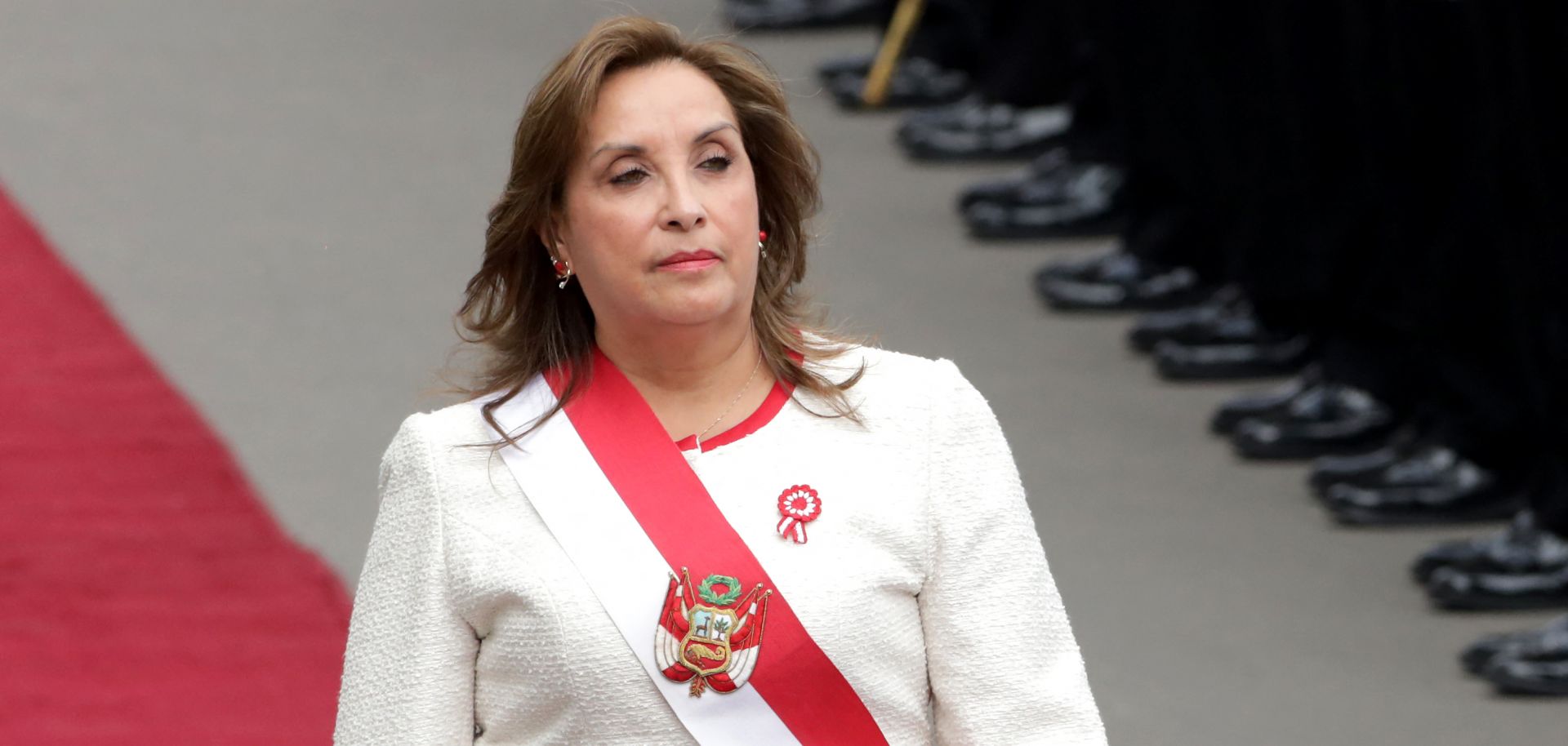
Following President Dina Boluarte's impeachment, Peru's interim government will focus on stricter security policies, though any major reforms will likely be delayed until after a new administration is inaugurated in July. Just after midnight on Oct. 10, Peru's Congress unanimously voted to remove President Dina Boluarte from office on grounds of "permanent moral incapacity" under Article 113 of the country's constitution. The previous day, several blocs in Congress presented motions of impeachment against Boluarte after a shooting at a concert in Lima on Oct. 8 renewed anger over rising crime rates. At least four such impeachment motions were registered, all citing Boluarte's lack of leadership and inability to govern. Following a brief debate during a late-night session on Oct. 9, Congress held votes on the motions. Boluarte did not appear before legislators to defend herself; her lawyers have, in turn, argued the move was unconstitutional and that she was not given enough time to prepare a defense, thus violating her rights. Immediately after removing Boluarte, legislators swore in the president of the Congress, Jose Jeri, as interim president. Jeri, a 38-year-old member of the conservative Somos Peru party, will serve until the end of Boluarte's term in July 2026. He is the seventh president to take office in Peru in six years, highlighting the country's ongoing political instability.
Years of security failures, political unrest and corruption allegations had eroded Boluarte's popularity, ultimately setting the stage for her ousting once Congress could do so without triggering early elections. Boluarte served as vice president under former President Pedro Castillo from July 2021 to December 2022. She became president in December 2022 after Castillo was impeached and arrested for his attempt to illegally dissolve Congress in a failed self-coup. The use of lethal police force against political demonstrators in late 2022 and early 2023 eroded Boluarte's popularity from the start. During her less than three years in office, she also faced multiple corruption scandals and a spiraling security crisis, marked by the proliferation of organized crime and a surge in extortion and targeted killings within Lima's metropolitan area, which her government's repeated states of emergency failed to address. Against this backdrop, Boluarte's approval rating plummeted to the low single digits, despite her government's success in boosting economic growth and controlling inflation. Amid worsening crime levels, Peruvians staged multiple anti-government protests and general strikes over the past year, calling for Boluarte's removal from office. In response to Peruvians' growing discontent, some lawmakers also repeatedly attempted to impeach Boluarte over the years. But these efforts failed due to reluctance in Congress to trigger early elections, which many legislators feared could jeopardize their own positions, given widespread public dissatisfaction with the political establishment. However, in late March, Boluarte called for the next general election to be held on April 12, 2026, which, according to the country's constitution, meant that her removal would no longer trigger an early vote. This change ultimately facilitated her ousting.
- Boluarte's removal adds to the heightened political instability Peru has experienced over the past decade. Since 2016, the country has had seven presidents amid successive corruption scandals and political turmoil. Additionally, six former heads of state who served since 1990 have either been arrested or faced (or are currently facing) trials or for various offenses.
Interim President Jose Jeri will prioritize stricter security policies, but these are unlikely to significantly reduce crime levels in the short term; major structural reforms are also unlikely under Jeri, with Congress focused on upcoming elections. Boluarte was so unpopular and her government was so ineffective that her impeachment is unlikely to trigger any meaningful protests. However, her successor will similarly struggle to address rising crime levels due to limited resources, which will continue to spur sporadic demonstrations in the months ahead. Jeri is expected to implement more stringent security policies in the coming weeks, which will likely involve expanding or intensifying the ongoing states of emergency in Lima and Callao, where extortion is prevalent across various sectors. Stricter rules and military deployments could also be expanded to the rest of the country, as could the adoption of curfews or checkpoints to restrict the movement or lead to the arrests of organized criminal groups and extortionists. Additionally, Jeri will likely rely on the Peruvian military and seek support from the United States to help combat nationwide crime. However, these measures are unlikely to significantly improve Peru's security situation in the short term, leading to continued public dissatisfaction and occasional protests until at least the presidential runoff vote is held on June 7, 2026. Major reforms aimed at addressing Peru's structural challenges — such as skilled labor shortages, inadequate infrastructure and pervasive corruption — are also highly unlikely to be implemented during Jeri's interim presidency. This is because competing political forces in Congress will be focused on gaining power in the April 2026 general election and are thus unlikely to cooperate with the new government, which would risk strengthening Jeri and his conservative Somos Peru party ahead of the ballot. For businesses operating in Peru, the presidential race will likely also exacerbate policy and regulatory uncertainty, as candidates with contrasting platforms are expected to be competitive in the first round.
- In his inauguration speech, just minutes after having been sworn in, Jeri said that criminal gangs are Peru's main enemy and that the country must declare a war on crime.
- An Ipsos poll conducted in September 2025 for the April 2026 presidential election shows Rafael Lopez Aliaga, Lima's right-wing mayor from the conservative Popular Renewal party, as the leading candidate with 10% of projected voter support, followed by Keiko Fujimori of the right-wing populist Popular Force with 8%. Nine other candidates garnered between 2% and 5% of voters' preferences.
