
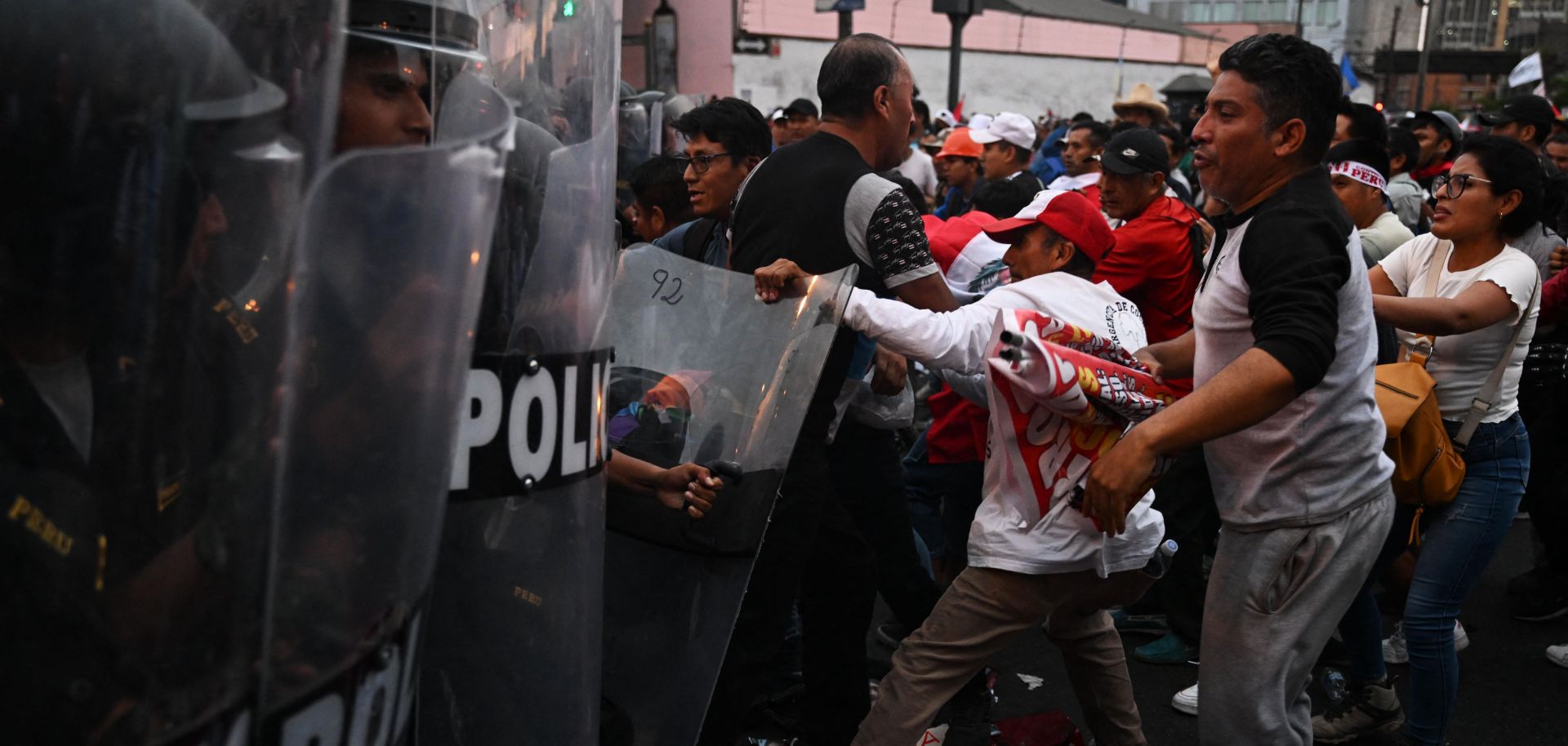
Protestors clash with the police in Lima, Peru, during a demonstration against Peruvian President Dina Boluarte's government on Jan. 4, 2023.
Peru's ongoing political instability will continue to fuel sporadic, economically-disruptive protests by impeding the government's ability to address longer-term issues like food instability and rural poverty. Over the past month and a half, Peruvians have taken to the streets en masse demanding early elections and the release of the country's former leftist president Pedro Castillo, who was impeached and detained on Dec. 7 following an attempted self-coup. Most recently, thousands of Peruvians from the country's southernmost regions demonstrated in the capital city of Lima on Jan. 18 and 19. The ongoing protests in southern Peru have blocked off major roads, causing supply chain disruptions both domestically and for exports transiting through ports or across the Bolivian and Chilean borders. Since assuming the presidency, Castillo's former Vice President Dina Boluarte has struggled to appease protesters and navigate the country's difficult political environment. The new president has been forced to cater to right-wing parties in Congress after losing the support of her former leftist Peru Libre party, which has seen her implement a strong security response to the unrest that has so far resulted in the deaths of over 50 civilians.
- Clashes between protesters and security forces in Peru's southern city of Juliaca on Jan. 9 resulted in the deaths of 18 people, marking the single deadliest day of unrest since the emergence of Peru's latest political crisis. In the wake of the violence, the governors of Peru's southern Apurimac and Puno regions called for Boluarte to resign on Jan. 13. The ongoing violence prompted the Boluarte administration to declare a state of emergency on Jan. 15.
- Less than two years after taking office, Castillo was impeached and detained by authorities last month after he tried to dissolve Congress ahead of a scheduled vote in the legislature to oust him. Castillo pledged to use the legislative hiatus to restructure Peru's judiciary and police institutions. In response, lawmakers in Congress moved up their planned impeachment meeting, where they then swiftly voted to formally remove Castillo from power on the grounds of his ''moral incapacity'' — using a motion that has removed several Peruvian presidents from power in recent decades.
The protests against Castilo's impeachment are also being fueled by Peruvians' frustration with a decade of political turmoil and the country’s urban-rural divide. Over the past five years, Peru has had six presidents (including Boluarte), as well as three Congresses. The South American country's perennial political volatility stems from articles in its constitution that enable the executive and legislative branches to effectively oust each other from office. These measures were originally implemented under the assumption they'd rarely be used, but the opposite has proven to be the case, as evidenced by the constant turnover of leadership in Lima in recent years — with Castillo's ousting being the most recent example. The back-to-back political crises over the past decade have severely weakened Peru's institutions and its government's ability to respond to other emerging crises, which include resurgent COVID-19 outbreaks and food insecurity brought on by ongoing fertilizer shortages and severe droughts. The fallout from the ongoing pandemic and drought have hit Peru's poorer, rural farming regions in the south particularly hard, which Castillo had pledged to address with pro-rural reforms — explaining why southern Peru has seen the most intense and violent demonstrations in the wake of Castillo's ousting.
- Peru's constitution allows Congress to declare the presidency vacant if the current occupant suffers from ''moral incapacity,'' effectively creating the equivalent of a no-confidence vote in parliamentary systems. The legislature used this article to impeach Castillo after his attempted power grab in December 2022, as well as former President Martin Vizcarra in November 2020. Former President Pedro Pablo Kuczynski also resigned in 2018 after Congress threatened to subject him to the same motion.
- Peru's constitution grants presidents the power to dissolve Congress during times of emergency, which former presidents Martin Vizcarra and Alberto Fujimori both did during their terms. Castillo tried to suspend the legislature as well, but his simultaneous attempt to unilaterally overhaul Peru's judicial system (which directly violated Peru's constitution) gave authorities the grounds to arrest him before he could do so.
Peru's political environment will remain tenuous until at least new elections are held in 2024. The controversy surrounding Boluarte's rise to power and her government's heavy-handed crackdown on the subsequent protests will leave the president with few allies in Congress, impeding her administration's ability to pass legislation. Multiple members of Boluate's cabinet have also resigned amid the unrest (including former Prime Minister Pedro Angulo, who quit on Dec. 18 after just one week in office), and more will likely follow suit in the coming months. The continued upheaval both on the streets and within her cabinet, combined with Boluarte's lack of legislative support, will leave her government in a precarious position until early general elections are held in 2024. Boluarte may be forced to resign before then — especially if protests begin to expand to more urban areas and/or significantly more civilians die at the hands of security forces, or if her administration becomes engulfed in a political scandal (over, for example, corruption allegations). If Boluarte is forced out, Congress would take over executive functions until the next ballot, which would likely trigger another public outcry given the legislature's widespread unpopularity (only 10% of Peruvians said they approved of Congress in an IEP poll conducted earlier this month). But as long as it retains support from Peru's armed forces, the Boluarte government is more likely to remain in power. The unrest that has plagued southern Peru over the past month will probably abate as protest fatigue eventually sets in. And while a majority of Peruvians disapprove of Boluarte, only a minority (albeit a vocal one) actually want her to resign. That said, the Boluarte administration will remain fragile and legislatively ineffective. Peru will thus likely see continued political instability until the 2024 election, regardless of whether Boluarte stays at the helm.
This will result in recurrent protests and slowed economic growth over the next two years. Given the country's currently fraught political environment, the greater economic issues facing Peru (such as rising inflation or low crop yields) will likely remain unaddressed until at least the 2024 election. As a result, food insecurity in rural areas and poorer urban areas will increase, which will likely continue to trigger sporadic violent and disruptive demonstrations targeting the country's lucrative extractive industries. Such demonstrations will also discourage tourism and install roadblocks that disrupt the flow of goods throughout the country, further harming domestic consumption and Peru's greater economic outlook.
- Peru's Andean farming communities have faced a severe drought over the past three years due to the ''La Nina'' climate pattern. Amid the lack of rainfall, along with global fertilizer shortages, Peruvian farmers are expected to harvest roughly 20,000 fewer hectares of staple crops (including rice, potatoes and onions) next season.
