
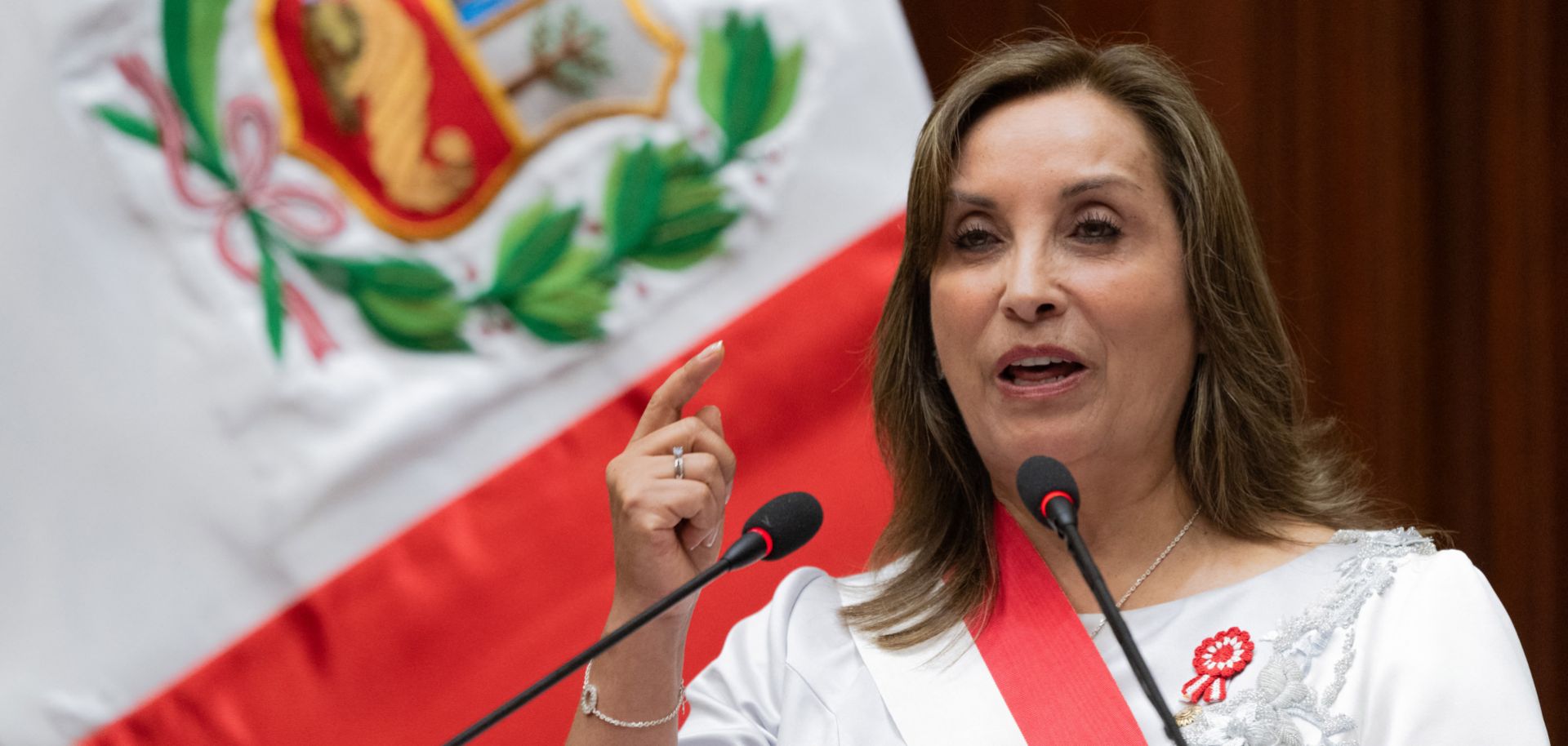
In Peru, heightened political instability has so far not led to economic crises or financial turmoil, but the potential for reduced institutional volatility under a new administration, combined with efforts to reduce bureaucratic red tape, could help the country attract foreign investment and leverage its potential as a key mining and trade hub in the region. On May 5, Peru's opposition in Congress filed an internal investigation request claiming President Dina Boluarte violated the constitution when she allegedly temporarily abandoned her role in June 2023 to undergo plastic surgery in secret — something Boluarte has repeatedly denied. This comes on top of other investigations Boluarte is facing over alleged human rights violations, corruption and embezzlement, along with accusations that her government has failed to curb the growing presence of organized criminal groups in Peru's cities and mining areas. Amid the worsening security crisis, Boluarte's popularity has plummeted, with her approval rating now standing at a mere 2%. But despite her deep unpopularity — and not being affiliated with any political party or having a formal coalition in Congress — she has so far managed to survive multiple opposition efforts to impeach her. In the face of these challenges, Boluarte has pledged to remain in office until the end of her term in July 2026. Adding to the latest bout of political turmoil, Prime Minister Gustavo Adrianzen on May 13 announced his resignation just hours before he was set to face a no-confidence vote in Congress. Earlier the same day, Boluarte also unexpectedly fired Finance Minister Jose Salardi after only four months on the job, and replaced him with Minister of Transport and Communication Raul Perez-Reyes.
- Boluarte served as vice president under former President Pedro Castillo from July 2021 to December 2022. She assumed the presidency after Castillo was impeached for attempting to illegally dissolve Congress in December 2022.
- A spike in organized criminal groups' extortions and targeted killings in recent years has resulted in several strikes and demonstrations against Boluarte's government, which has declared repeated states of emergency in different areas of Peru but has so far failed to improve security conditions.
- Over the past ten years, Peru has had seven heads of state amid successive corruption scandals and heightened political turmoil. Six former heads of state who served since 1990 have also faced (or are still facing) trials or have been arrested for various wrongdoings.
Despite Peru's perennial political volatility, successive governments have remained committed to sound macroeconomic policies, which has enabled the country to maintain financial stability over the past 25 years, despite domestic challenges and various external shocks. From 2002 to 2013, Peru experienced very rapid economic growth in the context of the global, China-induced commodity boom. More recently, the country's economic performance has been middling due to unstable domestic politics (as evidenced by Peru having had six presidents since 2016) and considerable regulatory and bureaucratic obstacles, which have constrained private investment. But even with these unfavorable domestic conditions, successive governments have managed to maintain growth and make substantial progress in terms of economic development and poverty reduction, allowing Peru to become an upper-middle income country comparable to (if slightly poorer than) Brazil, Colombia and Mexico. Despite Peru's low levels of government revenue and high dependence on commodity exports, policymakers' commitment to fiscal discipline — combined with an independent central bank and a sound financial sector — has also enabled the country to weather various global shocks (e.g., COVID-19 and Russia's invasion of Ukraine) without experiencing broader financial instability (e.g., banking sector crises, spikes in inflation, and increased government debt). Indeed, at just over 30% of GDP, government debt is very low, even though half of it is denominated in foreign currency. Additionally, Peru benefits from a solid external financial position, as its foreign-exchange reserves are very large (covering more than 11 months of imports), and its current account is in close balance and fully financed by net foreign direct investment inflows.
- In the ten years leading up to 2013, Peru's annual GDP growth averaged 6.5%. Following the end of the China commodity boom and in the context of increased domestic political instability, real GDP growth has more than halved since then, slowing to 2.5-3.0% today. In recent years, investment as a share of GDP has fallen to below 20%, which is consistent with medium-term economic growth of 2-3%.
- Peru's commodity dependence is high. According to the World Trade Organization, fuel and mining products account for over 50% of the country's total exports, while agricultural products account for an additional 20%. China is Peru's largest export market, followed by the United States.
- Peru's poverty rate has fallen from roughly 60% to 30% over the past 25 years. During the same period, the percentage of the population living in extreme poverty, defined as surviving on less than $2.15 a day, has also declined from 17% to less than 6%.
Political instability is unlikely to significantly ease before a new administration takes office in July 2026, dimming the prospect of major reforms in the near term. Despite her deep unpopularity, Boluarte has managed to remain in power partially because of her ability to appease powerful lobbies in Congress by backing initiatives of interest to various sectors, from private education to transportation. Until March, fears of losing their seats had also discouraged lawmakers from impeaching Boluarte, which would have triggered an early general election at a time when Peruvians have become increasingly frustrated with the political establishment. However, on March 25, Boluarte called for the next general election to be held on April 12, 2026. The winner of the presidential race will take office in July 2026, and Boluarte has indicated she will not run. Should Congress impeach her before then, no early election would be called; instead, the head of the legislature would finish out Boluarte's term before handing over the reins to the new president. The fact that Boluarte's removal would no longer entail a snap ballot raises the likelihood that one of the investigations against her will trigger a successful impeachment proceeding over the next 12 months. Such a scenario is unlikely to fuel more political instability, as an impeachment would only hasten Boluarte's eventual exit, with a new administration still set to take office in July. In the meantime, however, the government — whether headed by Boluarte or, if she is impeached, the president of Congress — will probably only be able to pass minor pro-business legislation aimed at reducing bureaucracy and facilitating trade, aiming to reap the benefits from the Chinese-owned Chancay port and position the country as a regional trading hub. While this deregulatory push may marginally improve the business environment, major reforms aimed at addressing structural challenges — such as skilled labor shortages, inadequate infrastructure and pervasive corruption — are unlikely to materialize before a new president takes office in July. Over the next year, companies in Peru will thus remain exposed to the productivity and competitiveness challenges stemming from these ongoing structural issues.
- On March 31, the Peruvian government announced a package of 402 measures to reduce bureaucracy, increase business efficiency and boost investment, including a $70 billion multi-sector portfolio of public-private partnerships and asset-based projects to be launched in July.
- Chinese and Peruvian authorities participated in the inauguration of the Chancay port in November 2024. The $3.5 billion project is expected to reduce travel time between Peru and China by 10 days, while its capacity to receive large bulk carriers will likely further reduce costs and the need for shippers to consolidate cargo containers at intermediary points. It was built by a Chinese company under Beijing's Belt and Road Initiative.
- Peruvian presidents cannot run for reelection. But since Boluarte was technically elected as vice president (and later assumed the presidency after Castillo was impeached), she could argue a presidential bid in 2026 would not amount to reelection. However, the matter would likely spark judicial controversy, which, combined with her single-digit approval ratings and lack of a political party, makes it highly unlikely that Boluarte will run in the April election.
While corruption will remain a challenge, Peru's political stability should improve in the coming years, barring another major government scandal. Peru has a long history of political corruption. However, the country's largest corruption scandal emerged in the mid-2010s after the Brazilian construction company Odebrecht admitted to paying bribes to Peruvian government officials, including four presidents and the leader of the opposition, to secure public works contracts. The Odebrecht scandal set the stage for the following decade of heightened political instability and successive government changes. Corruption will likely remain an issue in Peru in the coming years, alongside other structural bottlenecks for political stability, such as party fragmentation and growing anti-establishment sentiment among voters. However, unless another major scandal emerges, these underlying issues are unlikely to translate into heightened instability or successive unscheduled government changes as seen over the past decade, since they would represent continuity vis-a-vis the country's history rather than a similarly unprecedented scandal that triggered heightened instability akin to the Odebrecht case. Therefore, although several candidates will be vying for the presidency in 2026 and it is still too early to assess likely frontrunners, there is room for a marginal increase in political stability in Peru in the coming years.
- In March 2018, then-president Pedro Pablo Kuczynski resigned after some key allies were caught on video offering lawmakers a share of public work projects in return for their help in defeating a second impeachment vote against him. Congress then ousted Kuczynski's successor, former President Martin Vizzcarra, also over corruption charges linked to the Odebrecht scandal. Interim President Manuel Merino only lasted five days in power, while his successor, Francisco Sagasti, finished Kuczynski's term in July 2021.
- In the most recent Ipsos poll from April 2025 for the April 2026 presidential election, Keiko Fujimori from the right-wing populist Popular Force is the leading candidate with 11% of projected voter support.
A more stable political environment and more streamlined investment-related policies would enable Peru to capitalize on growing demand for its mineral exports, boosting the country's medium-term economic outlook. Peru's short-term economic growth outlook is fair, but not exceptional, with the International Monetary Fund (IMF) projecting economic growth of 2-3% over the next few years. However, Peru's vast reserves of raw materials critical to the green energy transition structurally position it for accelerated medium-term economic growth, especially as rising geopolitical competition and international economic fragmentation drive more countries to seek access to these strategically important materials. According to the U.S. Geological Survey, Peru has 22% of the world's silver reserves, along with 10% of global copper reserves, 9% of global zinc reserves, 4% of global gold reserves, and 5% of global lead reserves. The projected boom in global demand for such minerals has the potential to unlock greater foreign investment in the country's mining sector (which accounts for 9% of its GDP) and related infrastructure. However, the IMF estimates that $62 billion worth of mining investment projects in Peru have been stalled for several years due to bureaucratic complexity and social conflicts. While Lima's recent deregulation push will help, a more stable political environment will thus be key in ensuring Peru can fully capitalize on this investment potential, as a stronger, business-friendly government would be better able to pass the pro-market reforms needed to improve the country's regulatory environment. Higher investment would boost economic growth and increase government revenues, which would then provide Lima with the fiscal space to pursue growth-enhancing investment policies in the context of macroeconomic discipline, further improving Peru's business environment and economic outlook in the coming years.
- The IMF forecasts that Peru's real GDP will grow by 2.6% this year, in line with the Fund's medium-term projection of 2.3%. Based on Peru's recent historical experience, a combination of increased investment and increased government spending could help lift real GDP growth to 3-4%.
- Copper is the most important export of Peru's mining sector, followed by gold, zinc, iron and lead. Peru is also one of the world's leading producers of silver, tin and mercury.
- According to EY (formerly Ernst & Young), Peru's mineral reserves investment pipeline is worth $55 billion, which is equivalent to 20% of its GDP. According to the Peruvian National Society of Mining, Petroleum and Energy, new mining projects representing an investment commitment of $6.9 billion are also expected to break ground between 2026 and 2028, reinforcing Peru's standing as a key mining hub.
- Global trade tensions remain a risk, as Peru (like many other Latin American economies) is reliant on commodity exports. This makes it vulnerable to a dip in global prices if U.S. tariffs result in a greater-than-expected economic downturn in the United States, and even more so if they result in a broader global economic slowdown.
