
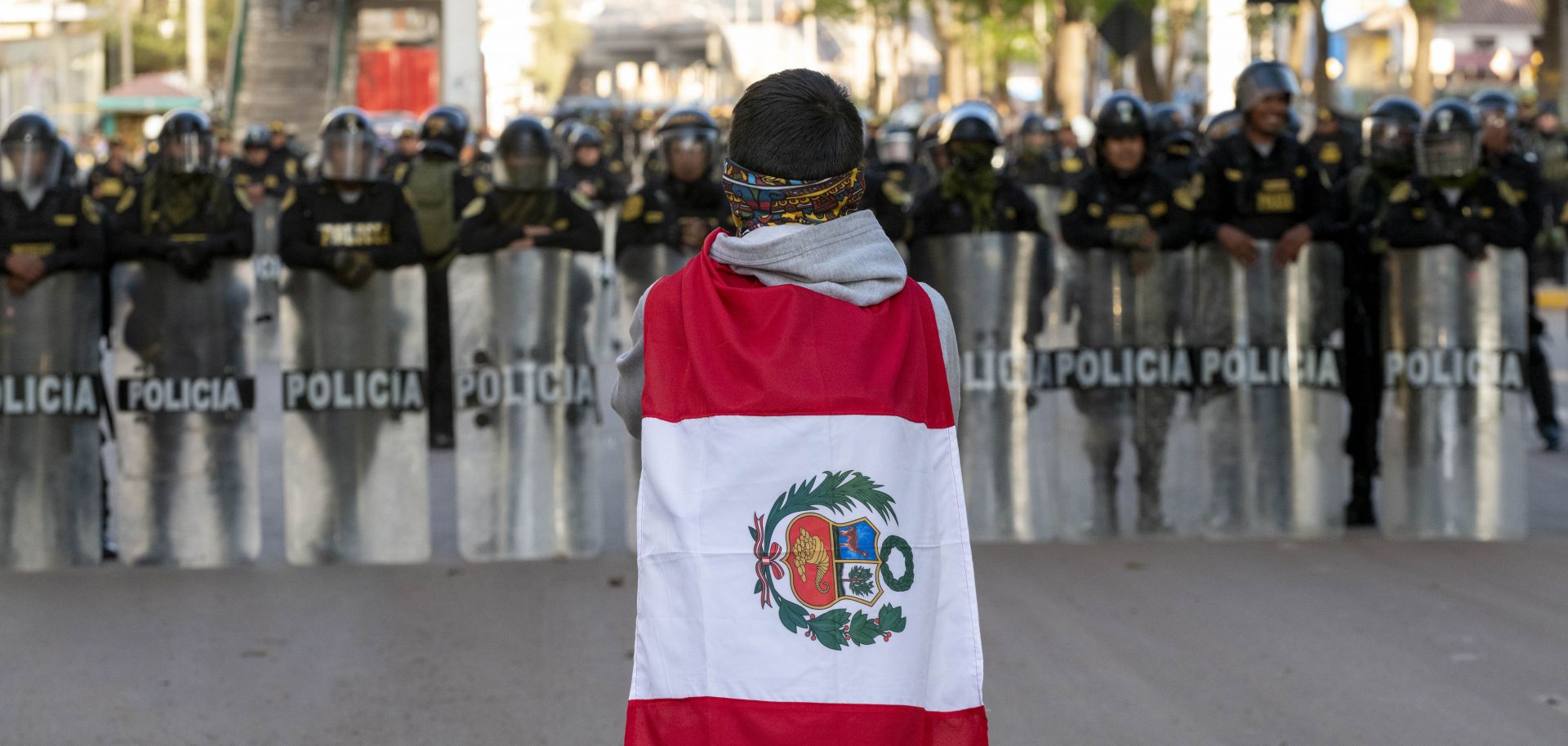
A demonstrator wearing the Peruvian flag stands in front of police officers forming a barrier with their riot shields near the entrance of the airport in Cusco, Peru, on Jan. 19, 2023.
Over the next year and a half, Peru's political climate will remain highly volatile and will likely be dictated by attempts to enact constitutional reforms, campaigning for general elections and civil unrest — leading to economic challenges due to investor concerns and stalled copper production. Protests continue to rage across Peru, two months after the country's former left-wing president Pedro Castillo was impeached and arrested for an attempted self-coup. Since the ex-leader's ousting on Dec. 7, his supporters from rural areas have staged disruptive demonstrations in southern Peru and the capital of Lima, resulting in clashes with police that have so far killed over 50 civilians. Protesters have also targeted transportation nodes including roads, trains and airports, leading to travel and shipping delays. But despite these disruptions, the government has yet to fulfill any of the demonstrators' demands, which include early elections, the dissolution of Congress, Castillo's release and his successor President Dina Boluarte's resignation, measures to improve social services for the country's rural poor, and a new constitutional process. Over the next 18 months, the evolution of Peru's political crisis will largely hinge on Peruvian leaders' response to protesters' calls for constitutional reforms, the outcome of the next general election, and the intensity of the ongoing unrest.
Constitutional Reforms
A full constitutional rewrite that meets all of the protesters' demands remains unlikely. Replacing the country's constitution — which was written by Peru's former right-wing president Keiko Fujimori in 1993 — is at the top of demonstrators' wishlist. Castillo's mostly-Indigenous supporters are hoping to draft a new charter that enshrines a greater social safety net and removes the articles that have fueled the country's perennial political instability in recent years by enabling the executive and legislative branches to effectively oust each other from office. Leftist politicians and protesters have called on Congress to hold a referendum on forming a constitutional convention that would then be tasked with rewriting the document, akin to the recent constitutional reform process in Chile. Conservative parties in Congress, however, would need to approve such a rewrite, which is highly unlikely given that recent polls indicate only a minority of Peruvians support replacing their country's current constitution. But even on the off-chance that Congress does agree to a constitutional rewrite, the process is far from guaranteed to yield a document that includes all the changes protesters want. This is because the country's current political polarization would likely lead to similar divisions within the constitutional assembly — with members elected by Peruvians from the urban areas in and around Lima advocating for slight changes to the country's political and economic systems, with those elected by rural Peruvians pushing for more sweeping structural changes.
- 40% of Peruvians said they supported rewriting their country's constitution in an IEP poll conducted in late January.
- Peru's constitution allows Congress to declare the presidency vacant if the current occupant suffers from ''moral incapacity,'' effectively creating the equivalent of a no-confidence vote in parliamentary systems. The constitution also grants presidents the power to dissolve Congress and call legislative elections during times of emergency. The legislature and executive branches have repeatedly used these articles to remove each other from power since the constitution was ratified in 1993 — resulting in six presidents (including Boluarte) and three Congresses in just the past five years alone.
In an effort to appease protesters, Peru's Congress is more likely to consider minimal constitutional amendments. But even small changes will be difficult to pass due to the country's political fragmentation. The most likely way that the Boluarte government will be able to address protesters' concerns with the country's current constitution is through pursuing amendments. Constitutional amendments require a two-thirds majority in Congress, which will be difficult to achieve due to the legislature's deep fragmentation. But lawmakers may be more willing to consider small changes to the document, especially if it helps ease protesters' calls for a total constitutional rewrite and the ongoing demonstrations. The constitutional amendments proposed by the Boluarte government would almost certainly attempt to decrease political volatility in Peru by removing the two articles that have pitted the country's executive and legislative branches against each other in recent years. But while this would reduce the risk of more revolving-door presidents and legislatures, it's unlikely to address the increasing urban-rural divide underpinning the country's current political crisis and protests — thereby maintaining the potential for future unrest.
- The Boluarte government has also proposed establishing a mechanism that would enable the next Congress to sidestep bureaucratic constraints to more easily make smaller changes to the constitution. But Peru's current legislators will be wary of giving such power to a legislative body with unknown political leanings, and are thus unlikely to approve this mechanism.
General Elections
Peru's next general election will likely yield another fractured Congress, making it difficult for the next president to pass legislation. Though there is still debate over whether it will be held later this year or next year, the general election will see Peruvians elect a new president, as well as all 130 members of the legislature. Peru's party system is highly fragmented, with over 12 parties represented in the National Assembly. This polarization — along with successive political crises in recent years — has severely impeded the government's ability to pass policies and quickly respond to emerging crises, including resurgent COVID-19 outbreaks and severe droughts. As a result, Peruvians have grown increasingly frustrated with their government — and especially Congress, with only 10% saying they approved of the legislature in an IEP poll conducted in February. Within this context, the next ballot will likely produce a National Assembly that's at least as fractured as the current one, as frustration with status-quo politics and the current crisis brought on by Castillo's ousting prompts voters to support more political newcomers and fringe parties. Without a strong and stable coalition in Congress, the country's next president will likely once again struggle to pass and implement policies (including a new fiscal budget), as well as congressional approval to attend high-level events outside the country. The resulting political gridlock would further impede the Peruvian government's ability to respond to current (and future) domestic emergencies and external economic shocks. Investors and markets, meanwhile, will likely view the country's continued weak governance and political instability as a downside risk, potentially delaying new project starts in Peru's mining and oil and gas sectors. Such reduced investment activity would probably prove particularly painful for the country's copper sector (which is already seeing protest-related operation disruptions), as civil unrest resulting from a volatile political climate drives foreign investors and companies to fund copper projects elsewhere.
- Peru is currently scheduled to hold general elections in April 2024. But to appease protesters' calls for early elections, President Boluarte has proposed advancing the election to October 2023. Lawmakers in Congress are currently reconsidering the president's motion to move up the ballot after rejecting her previous attempt late last month.
- The Chinese-owned Las Bambas copper mine in Peru — which supplies 2% of the world's copper — halted production on Feb. 1 as protester-erected barricades have created supply chain disruptions and led to shortages of critical supplies. Peruvian mining association Sociedad Nacional de Mineria y Petroleo y Energia recently said the unrest has left 30% of Peru's copper production at risk.
The unpopularity of Peru's political establishment could see an outsider (and potentially extremist) candidate win the presidency in the next election. In a recent IEP poll, 75% of Peruvians stated they didn't know of anyone who would make a good presidential candidate in the upcoming general election. The lack of viable presidential contenders in Peru among the existing political establishment provides an opening for a potential political outsider candidate to garner significant support ahead of an election. Such an outsider would probably run on an anti-establishment platform that criticizes the existing political elite and past corruption scandals involving government officials — likely with a far-left or far-right slant depending on if they chose to cater to rural Indigenous communities or Lima business elites. This could see the election of an extremist president that seeks to enact sweeping political changes upon taking office, though he or she will almost certainly face challenges passing structural reforms in the likely case of having to deal with another fragmented National Assembly.
Civil Unrest
The nationwide demonstrations (and the subsequent economic disruptions) that have rattled Peru over the past two months will likely abate in intensity and size in the coming months as protest fatigue sets in. As the majority of protesters are lower-class and rural Peruvians, there is a high personal cost to their participation in demonstrations in the form of missed work and the cost of traveling to other locations (namely Lima) to demonstrate. If there are no major developments in the country's political stalemate, turnout at scheduled rallies will gradually wane as people are forced to return to their work due to limited financial means. Such reduced attendance would significantly decrease protesters' ability to maintain roadblocks and cause airport disruptions in southern Peru. A gradual winddown of demonstrations would improve copper supply chains that rely on thoroughfares to bring their goods to the country's ports. It would also likely improve the country's tourism climate, as the protests have disrupted the movement of travelers throughout the country's popular tourist areas (like Machu Picchu). If, on the other hand, Congress fulfills protesters' demands for early elections or a constitutional rewrite (which is unlikely given the National Assembly's current political leanings), the demonstrations could more quickly and drastically dissipate in turnout and intensity. But even then, demonstrators could retake the streets if they disagree with the process leading to constitutional change and/or if fraud allegations emerge during the early general election. This means Peru is poised to see sporadic protests over the next 18 months, regardless of whether there are any breakthroughs in the current political crisis.
Finally, if an impactful political event (such as a corruption scandal) emerges, demonstrations could increase in intensity — raising the risk of greater economic disruptions. An unexpected event that significantly impacts Peru's current political apparatus would almost certainly serve as a trigger for intensified demonstrations. This could include Boluarte dissolving Congress or Congress impeaching Boluarte, and/or the emergence of credible corruption allegations against high-ranking members of the legislature or executive branch. If Boluarte or other leftist politicians find themselves at the center of such an event or scandal, Peruvians from the politically center-right may take to the streets as well, which could lead to intensified protests in the capital of Lima as these right-wing demonstrators try to pressure leftist lawmakers to resign from office. Such protests would likely target highways, airports, government buildings and mining operations as demonstrators voice their discontent with the political event.
