
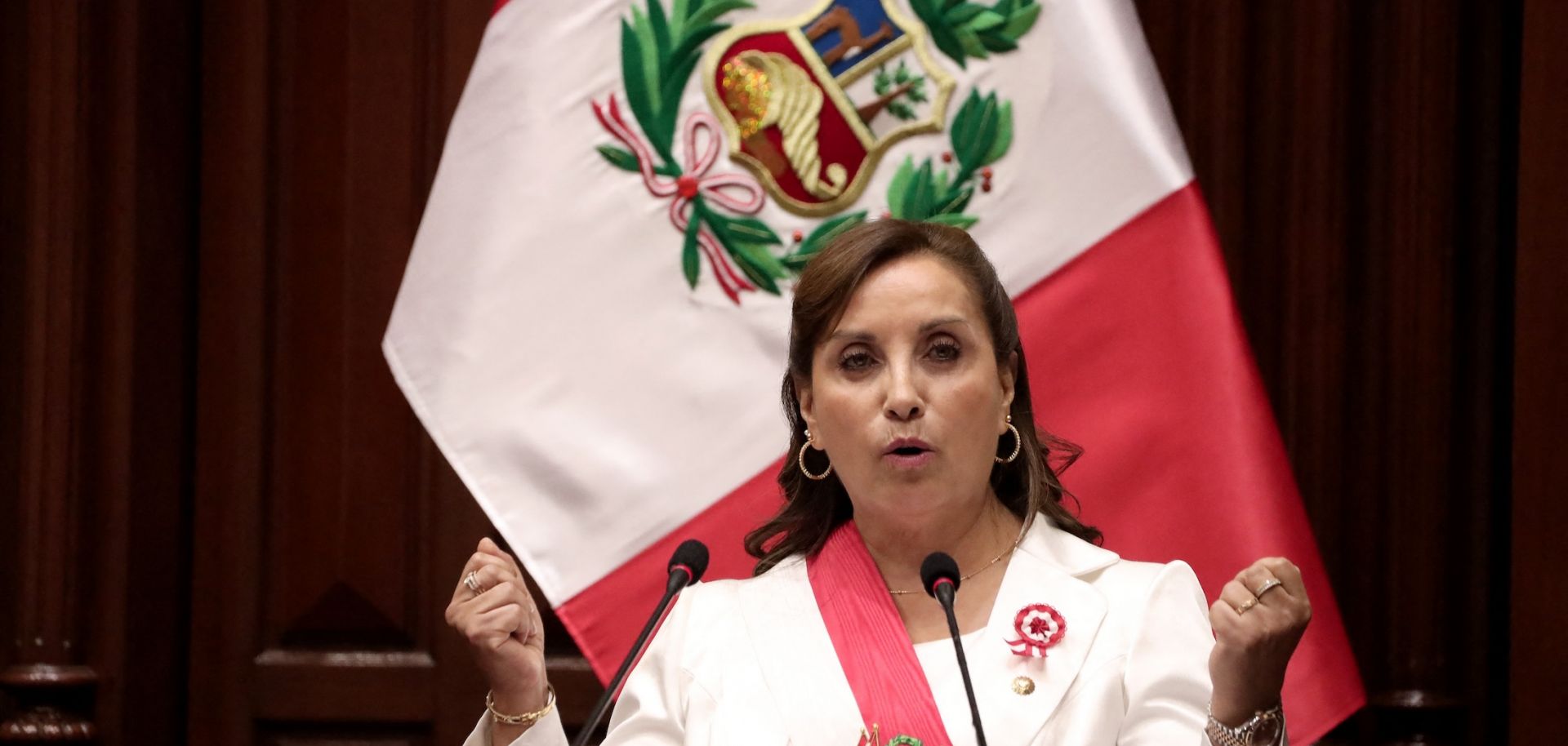
In Peru, repeated impeachment efforts against President Dina Boluarte indicate challenges to policymaking and, to a lesser degree, economic conditions, which will likely persist through 2026, creating logistical headaches and uncertainty for organizations operating in the country. On May 17, Peru's Congress rejected motions aimed at launching an impeachment process against Boluarte, marking the fifth failed impeachment attempt against the president since she assumed office in December 2022 following the ousting of her predecessor. The latest attempt was instigated on the grounds that Boluarte ignored the duties of her office by not informing Congress of a 12-day absence in June 2023, allegedly to undergo cosmetic surgery. The effort, launched by opposition legislators from the left-wing Together for Peru and Free Peru parties, did not reach the required 52 votes to be admitted for debate, after which impeachment requires 87 votes out of the 130 lawmakers in the country's national legislature.
- Boluarte ran as vice president under former President Pedro Castillo in Peru's 2021 general election on the Free Peru platform. However, Free Peru expelled her from the party in January 2022 after she said that she never embraced the party's left-wing ideology. She retained her position as vice president but had few roles in the government until December 2022, when she was sworn in as president after Castillo was impeached for attempting to illegally dissolve Congress. Boluarte supported early elections in the months after taking office, but Congress repeatedly rejected efforts to call elections and she has since stated that she plans to serve as president until her term ends in 2026.
- Boluarte has faced repeated impeachment attempts by Free Peru and other left-wing parties. Previous attempts centered on the so-called ''Rolexgate'' scandal involving Boluarte's wearing of luxury watches, spurring questions as to where she got them or how she afforded them, as well as protester deaths during the government crackdown on anti-government demonstrations in early 2023 over Castillo's impeachment.
The latest impeachment effort follows years of political crisis in Peru, which has challenged policymaking but has only moderately hurt the country's economy thanks to its structural stability. Though opinion polls suggest a majority of Peruvians oppose Boluarte, lawmakers continue to vote against impeachment because doing so would trigger early elections, a process that would put most Congress members' seats at risk given the high disapproval for the legislative branch. The repeated failed impeachment attempts against Boluarte come amid gridlock in Congress, where the anti-Boluarte bloc of parties holds a majority of 74 seats compared with the pro-Boluarte bloc's 56 seats, which has left the body unable to pass major legislation. This impasse and the new failed impeachment attempt are only the latest developments in Peru's years of political instability, as the structure of the executive and legislative branches allows Congress to remove presidents, resulting in Peru seeing seven presidents over the last eight years and with no president serving a full five-year term since former President Ollanta Humala (2011-2016). Though Peru experienced political instability prior to the current crisis, uncertainty over the recent spate of revolving-door presidents and Peru's recovery from the COVID-19 crisis slowed investment flows into the country. Against this backdrop, Peru slipped into a recession in 2023, with the economy shrinking by 0.6% — marking the country's first economic contraction since the 1990s (aside from the COVID-19 pandemic). The Central Reserve Bank of Peru (BCRP) and Fitch Ratings attributed the recession to decreased attractiveness for international businesses and lower confidence among domestic businesses following years of crisis, with disruptions to the tourism and mining sectors from the early 2023 unrest likely also a contributing factor. Meanwhile, Peru's poverty rate rose from 27.5% in 2022 to 29% in 2023, according to BBVA Research. However, the recession appears poised to be short-lived, with Fitch Ratings in April 2024 forecasting 2.6% growth in 2024, maintaining Peru's BBB rating, which denotes good prospects and low default risks. In April, the BCRP also decreased its key interest rate to a 20-month low to further boost growth after year-over-year inflation dropped to the central bank's target range of approximately 3% in the first months of 2024, down from 8.7% in 2023. This rebound and broader macroeconomic stability, despite Peru's extended political crisis, is likely partially the result of the country's sustained efforts to keep government debt low and maintain the structural stability of the independent and well-regarded BCRP, which has enabled the bank to manage macroeconomic policy effectively even across rapid administration changes.
- Boluarte and Peru's Congress have extremely low approval ratings, both of which stood at a mere 9% in March and April.
- Amid the mass anti-government protests that swept across Peru in early 2023, the BCRP issued a report predicting ''zero percent'' growth in the first quarter of 2023, while also noting an expected 16.7% drop in private investment in the mining sector due to the unrest.
- According to the World Bank, Peru's government debt-to-GDP ratio is expected to remain stable at 34% through 2024 and 2025, which is well below the regional average of 51.5% at the end of 2022, according to the Economic Commission for Latin America.
Peru's political paralysis is unlikely to ease before the 2026 election, which means organizations will face continued logistical, financial, compliance and safety challenges, in addition to long-term policy uncertainty. Lawmakers' broad concern that they will lose their seats if an early election is held means Boluarte will likely govern through the end of Castillo's term in 2026. While this will make her Peru's longest-serving president since Humala, it will not translate to increased political stability, as right-wing parties and Boluarte will likely continue to reject anti-establishment parties' legislation, and left-wing parties will likely continue to push for Boluarte's removal. The ongoing political impasse will, in turn, leave the government unable to respond effectively to rising levels of poverty, food insecurity and organized crime. Lack of effective oversight and anti-graft legislation amid worsening corruption levels in recent years could also further increase the prevalence of kickbacks and bribes within Peru's government, contributing to long-standing compliance and financial risks. Though Peru's stable economic institutions will prevent conditions from severely deteriorating, the country's macroeconomic outlook is unlikely to notably improve, and could slightly worsen if there is a significant drop in global prices for Peru's major exports, such as copper, gold and natural gas. Poor investment attractiveness as a result of the ongoing political tumult could eventually see Peru slip back into a recession in the coming years, though this does not appear likely in 2024. The continuation of poor investment conditions also means poverty will likely remain elevated, contributing to already-high anti-government sentiment and raising the risk of additional mass unrest in the next two years; as previous protests have included violence and roadblocks, this would create logistical and safety risks for organizations. Finally, Peruvians' growing frustration with the government could also open the door to a significant anti-establishment swing in the 2026 elections, which would create long-term policy uncertainty for businesses and cast doubt over the state of operating conditions in the country over the next decade.
- In 2020, extractive industries accounted for 12.1% of Peru's total GDP. Peru has 12% of the world's copper reserves. Copper ore and refined copper exports together made up almost 27% of Peru's exports in 2022, according to the Observatory of Economic Complexity.
- Peru appears to have become more corrupt throughout its current political crisis. In Transparency International's 2023 Corruption Perceptions Index (in which lower scores indicate higher perceived levels of government corruption), Peru received a score of 33/100, down from 38/100 in 2020. Meanwhile, the U.S. State Department's 2023 Investment Climate Statements report on Peru highlighted weak anti-corruption policies as a major challenge to business activities in the country.
