
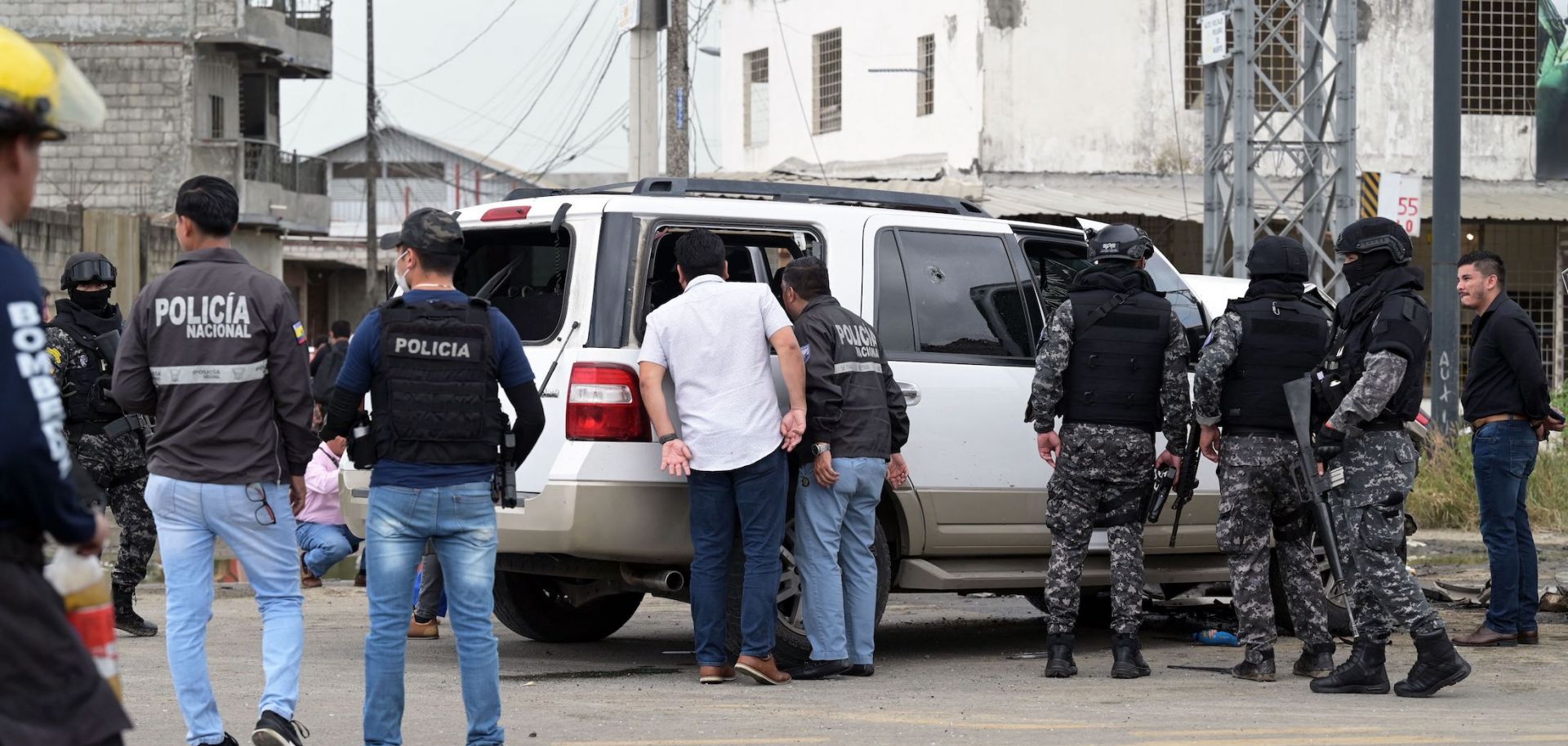
Ecuador has gone from one of the safest countries in Latin America to one of its most dangerous. Since 2021, the South American country has seen a dramatic surge in violent crime. The country's homicide rate increased more than fivefold from 7.7 per 100,000 people in 2020 to an estimated 40 per 100,000 people in 2023, a rise linked to clashes between gangs. In 2023, gunmen assassinated a presidential candidate ahead of the country's general election, and in the first weeks of 2024, President Daniel Noboa declared that crime had escalated to the point of an "internal armed conflict" following multiple high-profile prison escapes and a terrorist attack against a state-owned TV station. Although authorities have consistently increased police and military operations against the gangs over the last three years to bring crime down, no end appears in sight.
Ecuador's challenges highlight questions about broader regional crime. What allows violence to escalate so dramatically in a country — and what countries could be next?
Understanding Crime in Latin America
Violent organized crime is a long-standing concern across Latin America, driven by a range of factors that create an environment attractive to criminal groups and allow them to fester with only limited government pushback. There is significant debate on what exactly fuels violent crime, but three main factors are required for severe gang violence like that seen in Ecuador.
The first, and probably the most fundamental requirement for a country to experience increased violence, is the presence of lucrative opportunities. The range of potential criminal enterprises is vast but, in Latin America, historically has been most focused on drug production and trafficking, as seen in major crime hotspots of Mexico, Colombia, Brazil and now Ecuador, where gangs traffic drugs through the ports of Guayaquil and Esmeraldas. In recent years, criminal groups across Latin America have diversified their activities into areas such as human trafficking, local business extortion, and illicit logging and mining. Such enterprises do not necessarily require violence, but do lay the groundwork for crime to escalate to violence, including as government forces attempt to disrupt their operations.
Once criminal groups want to operate in a given area, poor governance enables them to grow and establish roots, the second factor. Contributing elements include weak security forces unable or unwilling to combat violence, whether due to funding limitations, lack of experience, concern of triggering retaliatory violence or collaboration with organized crime. Low popular confidence in the government creates an additional avenue for criminal groups to entrench themselves in an area, as gangs, cartels and armed groups can provide social services to assist and appeal to disadvantaged communities. Another contributing factor is the presence of multiple, compounding crises — whether political disputes, economic mismanagement, natural disasters — that the government struggles to manage effectively. Overwhelmed by competing challenges, criminal actors face little government pushback until it is too late. Poor border security measures additionally allow criminal groups to obtain military-grade weapons, helping them combat government forces and terrorize locals. In Ecuador, crime rose as political clashes between former President Guillermo Lasso and opposition parties in the National Assembly prevented the passage of security legislation and hindered the government's response to economic challenges that worsened during the COVID-19 pandemic.
And third, to expand into new territory, criminal groups need to recruit enough members to project power, hold resources, and fight the government and/or rival groups. Though gangs recruit from a broad range of demographics, they most often draw from poor men and boys due to their typical disenchantment with the local government and their need for funds to support their families. Should they refuse to join, criminal groups threaten them with physical violence. High levels of poverty in a country or area widen the pool of potential recruits, allowing criminal groups to expand. Demonstrating this, in September 2023, the U.N. special rapporteur on extreme poverty and human rights warned that Ecuador's 10.8% extreme poverty rate was forcing impoverished youths to choose between joining a gang or emigrating to the United States to survive.
While these three characteristics are necessary for a criminal group to build up its presence, they are not alone enough to result in extreme violence. Typically, if a single criminal group is dominant, an area will see only moderate violence from clashes with security forces and attacks on civilians to secure its hold on the community. This has been the case in Mexican states where a single cartel has achieved dominance. For example, Sinaloa state — which the Sinaloa Cartel controls — has a homicide rate well below the nationwide average. In contrast, the worst violence is in places where criminal groups fight each other for supremacy, leading to public clashes that resemble wars, terrorist-style attacks, and high levels of murders and kidnappings. In Ecuador, extreme violence grew as a result of clashes between the country's two dominant prison gangs, Los Choneros and Los Lobos. As groups fear for the security of their revenue streams and their lives, they continuously escalate their tactics, in turn triggering further escalations.
Potential Next Crime Hotspots
These preconditions are present to some degree across Latin America, indicating varying levels of the risk of a surge in severe violent crime similar to that in Ecuador.
Argentina faces long-standing poor economic conditions, popular disillusionment with state institutions and extensive government corruption. Efforts by President Javier Milei to implement drastic spending cuts risk increasing already-high inflation and poverty rates, which could widen the pool of potential recruits into criminal groups. Argentina's geographic position beside drug producers in land-locked Bolivia and Paraguay makes its large ports attractive for drug trafficking, which has long fueled violent crime in its northern border regions. But there is little indication that Argentine criminal enterprises will grow significantly, particularly as the poor economic situation makes it unattractive for migrants and therefore human trafficking activities. This means Argentina faces moderate risks of a severe surge in violence.
Chile has seen citizens' fear of violent crime spike in the last two years, with many blaming President Gabriel Boric for allowing organized crime by the Venezuelan group Tren de Aragua to expand as the group trafficked Venezuelan migrants into the country and expanded into armed robbery and local drug sales. The country reported its highest ever homicide rate in 2022 of 6.7 per 100,000 and crime rose further in 2023, leading 61% of Chileans to fear that the country will experience a crime wave like that in Ecuador, according to a survey published in the newspaper El Mostrador on Jan. 21. But despite this, Chile remains one of the safest countries in the region, with low corruption, generally strong governance (despite elevated anti-government sentiment) and comparatively low poverty rates. Chile's Carabineros federal police force is also well-funded and historically trusted by Chileans, and the government has successfully passed legislation increasing funding and expanding police powers. Therefore, while crime will remain a significant topic of debate in the next two years (particularly ahead of the 2025 general election), Chile will likely see only a minor increase in homicides and organized crime.
Costa Rica is already experiencing a concerning surge in organized crime that could be a prelude to an increase in crime to severe levels. Violence is rising as local gangs involved in drug trafficking compete for territory. This has led the homicide rate to increase from 11 per 100,000 in 2019 to 17.2 per 100,000 in 2023, the most violent year in the country's history. Violence is likely to continue worsening over at least the next year as the government ramps up anti-crime operations, but the country is unlikely to become the region's next crime hotspot. Limiting this risk, the country has among the lowest levels of government corruption in Latin America — though it has worsened slightly in recent years — and a diversified economy that has bolstered it against economic shocks, including the COVID-19 pandemic, limiting the risk of a significant increase in poverty. The government has also managed to overcome tensions between President Rodrigo Chaves Robles and opposition parties to pass legislation expanding resources for the nation's security forces, something Lasso struggled to do before he left office in November 2023. Still, Costa Rica's lack of an army limits the number of available security forces to expand anti-crime operations, which could allow violence to expand.
Guatemala is surrounded by major crime hotspots including Honduras, Mexico and formerly El Salvador. In 2022, the country reported a homicide rate of 17.3 per 100,000 — high but below the countries experiencing truly severe levels of violence — driven by its position on trafficking routes to Mexico and the United States and the extensive presence of Salvadoran and Mexican criminal groups throughout the country. The country will face elevated risks of a severe surge in violence in the coming years amid significant political instability, which will strain President Bernardo Arevalo's ability to respond to violent crime and poor economic conditions. This will give the gangs the space to expand operations and compete with each other for territory and resources. Long-standing extensive government and police corruption will further contribute to this risk.
Panama is a country to watch as human trafficking through its hazardous and undeveloped Darien region more than doubled in recent years. As traffickers increase activities in Panama to expedite smuggling operations, other criminal activities could increase. But Panama does not face significant risks of a surge amid low government challenges and comparatively strong economic conditions. Furthermore, the presence of the strategically important Panama Canal and strong U.S.-Panama ties mean that the United States would likely be inclined to provide significant financial and logistical assistance in combating any significant crime surge.
Peru is one of the Latin American countries most at risk of becoming the next Ecuador. Criminal enterprises have long existed in the country in the form of drug trafficking and production, but in recent years this has expanded into human trafficking and extortion by Venezuelan gang Tren de Aragua, and increased violent robberies against the nation's mining sector. This is in combination with significant political instability, public animosity toward President Dina Boluarte, high corruption, shortcomings in providing basic services and poor economic conditions, as well as an increasingly crowded criminal landscape. Peru's porous border with Ecuador will also create the risk of spillover violence as Ecuadorian authorities crack down on gang activities. With no sign that any of these trends will improve in the near term, Peru is at risk of a surge in severe violence over the coming years.
The Difficult Road Ahead
In Ecuador, as in the next country to see a massive surge in violence, the government will struggle to overcome economic and political crises without first successfully combating violence. The violence in Ecuador, unimaginable only five years ago, has created massive safety risks, emptying the streets of particularly violent areas like Guayaquil and nearby towns as travelers avoid the area and locals remain in their homes. It has also challenged the country's business environment by slowing exports and production due to scrutiny on shipments and the implementation of security checkpoints. It has also challenged the government's ability to attract new investment, adding to long-standing economic challenges, while escalating government corruption and criminality create compliance risks. Meanwhile, emigration from Ecuador has contributed to Latin America's migration crisis, creating transportation challenges from protests by migrants and increased border security measures in Central America and on the U.S.-Mexico border. Latin America's next crime hotspot will see similar safety, logistical and governance challenges for travelers, businesses and humanitarian organizations.
As seen in long-time crime hotspots such as Brazil, Mexico and Colombia, the nature of violence in Latin America is that once criminal groups establish roots, it is nearly impossible to fully remove them. Violence levels may fluctuate, but the risk of a resurgence will always be there, with criminal groups waiting in the wings to push into a gap in government anti-crime or economic capabilities, step into a new criminal enterprise, or seize resources from a rival group. Even El Salvador — which dropped from the position of the most violent country in the Western Hemisphere in 2015 to one of the region's safest as of early 2024 — will face risks of a criminal resurgence in the future as members of the Salvadoran MS-13 and Barrio 18 gangs attempt to return to their home country. Given these significant long-term risks for established crime hotspots, the best path for regional governments is to prevent crime from escalating in the first place. There are things that governments can do to stave off a surge in violence, including decreasing poverty, securing their borders and ports, and stamping out corruption, to name a few. But for many, such measures will be politically and economically out of reach, forcing them onto the difficult path of surging violence, intermittent anti-crime crackdowns and periods of relative calm.
