
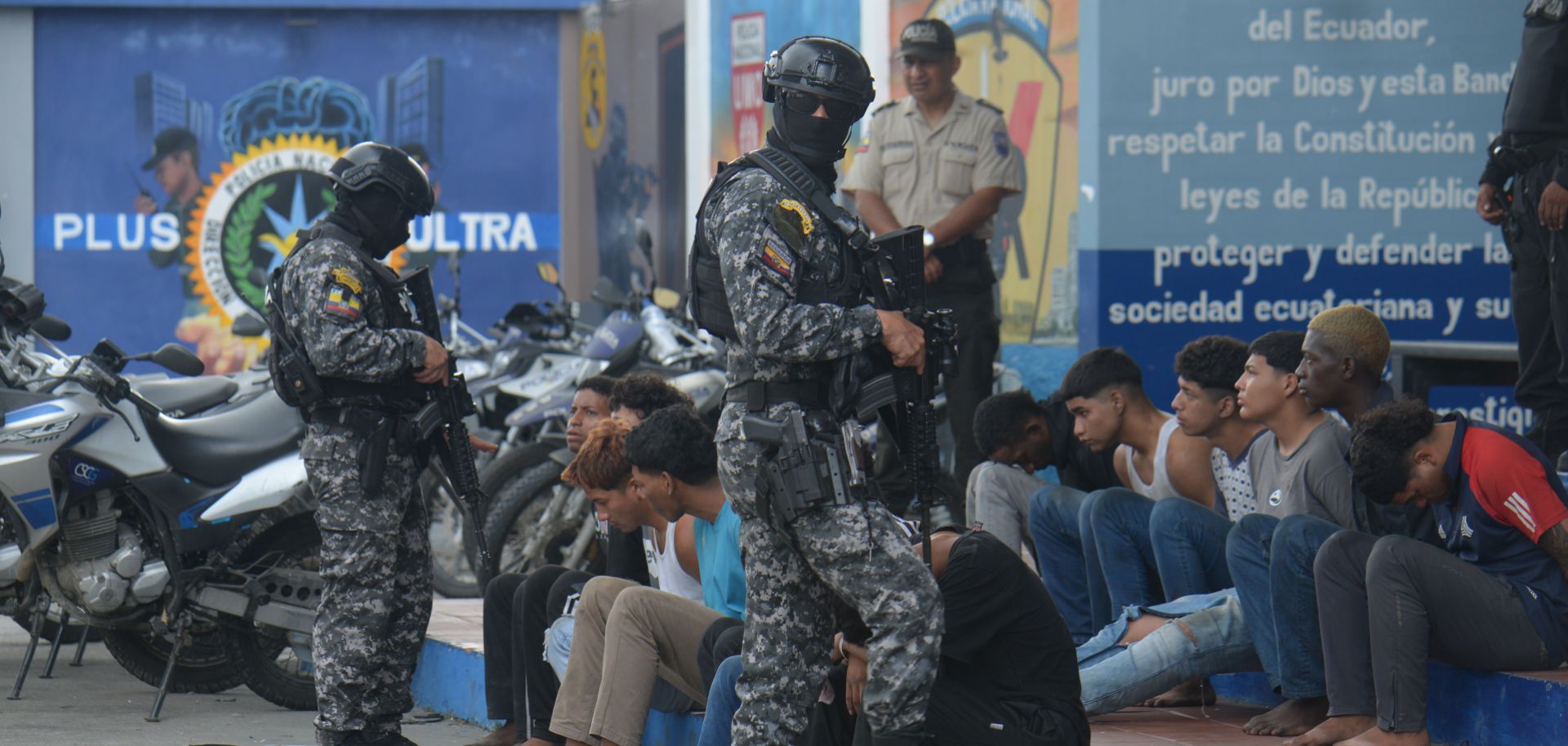
In Ecuador, the declaration of a state of ''internal armed conflict'' will create near-term political unity, which will give the government the tools it needs to secure crime hot spots. But major constraints on curbing rising levels of violent crime will likely lead to a protracted security crisis and, over time, may erode legislative support for Noboa's economic reform agenda. On Jan. 9, Ecuadorian President Daniel Noboa, who only took office in November 2023, issued an executive decree that ''recogniz[ed] the existence of an internal armed conflict'' in Ecuador in response to escalating gang violence across the country. His declaration came after a series of violent incidents earlier in the day, including one in which a dozen gunmen stormed a state-owned TV station during a live broadcast, taking multiple hostages. Gangs also kidnapped multiple police officers and declared ''war'' on the country. The violence left at least 10 Ecuadorians dead. The decree referenced international humanitarian legal norms as a means to use lethal force against the gangs, labeled 22 criminal groups as ''terrorist organizations,'' and provided the Ecuadorian Armed Forces with a mandate to ''neutralize'' them.
- The escalation in violence comes after the leader of the Los Choneros gang, one of the two most powerful in Ecuador, escaped from a jail in Guayaquil on Jan. 7. Responding to the outbreak of at least six prison riots, President Noboa on Jan. 8 issued a 60-day state of emergency, which curtailed freedoms of association and movement, and imposed a nationwide curfew. Gang members referenced the state of emergency as a reason for their declaration of ''war.''
- On Jan. 9, a police officer kidnapped by gang members was forced to read a statement while held at gunpoint that read: ''You declared war, you will get war.''
- Multiple leaders across the region have expressed support for the Ecuadorian government amid the surge of gang violence, including Colombian President Gustavo Petro and Bolivian President Luis Arce. Argentine Security Minister Patricia Bullrich also offered to send security forces to Ecuador to help fight the gangs. Fearing cross-border spillover, Peru declared a national emergency along its northern border with Ecuador and deployed troops to secure the area. Further afield, U.S. Assistant Secretary of State for Western Hemisphere Affairs Brian Nichols wrote that the United States was ''ready to provide assistance to the Ecuadorian government and will remain in close contact with President Noboa'' in a post on X (formerly Twitter).
Geographic proximity to the region's top cocaine producers has made Ecuador a central node in drug trafficking operations, leading Ecuadorian gangs to accumulate power and weapons. Violence in Ecuador has skyrocketed since 2021. Located between Peru and Colombia, Latin America's two largest cocaine producers, the country has become one of the region's key hubs for cocaine trafficking. Criminal groups, such as Los Lobos and Los Choneros, have used Ecuador's main marine ports in Guayaquil and Esmeraldas to ship drugs to Europe, Asia and North America. This expansion of criminal activities has been possible largely due to the Ecuadorian gangs' partnership with Mexican and Colombian criminal enterprises, resulting in an accumulation of both financial resources and powerful weapons. Over the last few years, Ecuadorian groups have grown more violent as they've become further enmeshed in drug-trafficking supply chains, as evidenced by the country's homicide rate jumping from 5.7 murders per 100,000 people in 2018 to over 40 murders per 100,000 people in 2023. Gangs run their operations from prisons across the country, where riots have become increasingly commonplace. In recent months, Ecuadorian gangs have escalated from transporting and trafficking drugs to using terror tactics, such as detonating improvised explosive devices (IEDs), publishing executions of police officers on social media, and conducting high-profile assassinations and kidnappings to provoke widespread fear across society.
- Anti-corruption presidential candidate Fernando Villavicencio was assassinated in Aug. 2023 as he left a campaign rally. His suspected murderers were later killed while detained in a prison in Guayaquil.
Increased security measures may enable the government to reduce violence in current crime hot spots, but will be unable to fully neutralize criminal activity to the extent seen in El Salvador. Noboa's efforts to combat crime — including authorizing the use of lethal force against gangs, the construction of large-scale prisons, and the designation of criminal groups as terrorist organizations — resemble strategies employed by Salvadoran President Nayib Bukele as part of his government's ''war on gangs'' launched in March 2022. As part of this anti-crime campaign, authorities in El Salvador have arrested tens of thousands of people, successfully lowering the country's homicide rate in the process and making it one of the safest countries in the region, despite accusations of major human rights abuses. Ecuador's anti-crime efforts, however, are unlikely to achieve the same results. This is due primarily to the fact that, as of Jan. 9, there were over 20 groups that had been labeled ''terrorist organizations'' in Ecuador; the country's territory is also over 10 times larger than that of El Salvador and is less dense in terms of population. This will create serious logistical challenges for the Ecuadorian security forces in combating criminal activity and give Ecuadorian gang members ample space to evade government forces and regroup. Unlike the two main gangs in El Salvador, Barrio 18 and MS13, most criminal structures in Ecuador are loosely organized and fragmented, which makes them harder to split. Furthermore, the interplay between criminal organizations across Ecuador and violent Mexican and Colombian drug-trafficking cartels, such as Cartel Jalisco Nueva Generacion (CJNG), could lead the transnational criminal groups to support their counterparts in Ecuador against government incursions through the provision of weaponry, or even reinforcements.
- On top of logistical challenges, an investigation in late 2022 found that out of 57 police patrol cars in one of the most violent districts in Guayaquil, only 10 were operational — illustrating the weak capabilities of Ecuadorian law enforcement.
- On Jan. 10, President Noboa estimated that the Ecuadorian gangs total roughly 20,000 members. Meanwhile, Ecuador's military has roughly 40,000 troops and 65,000 police officers, which will now be deployed to fight the gangs.
The constraints to combating violent crime in Ecuador will likely lead to a protracted conflict in the country. While the government may be able to exert operational control over violent cities, such as Guayaquil and Esmeraldas, and reduce cocaine trafficking at the country's main ports, the profit-motivated criminal groups will likely continue to find ways to smuggle drugs and will occasionally target public officials. In the short term, violence between state forces and the gangs will intensify, which will elevate safety risks for Ecuadorians and travelers. The government will likely enhance security measures at ports to reduce the flow of cocaine, which will delay licit cargo shipments. In violent areas, businesses may be targeted and will probably reduce their hours of operation, given the curfew under the state of emergency.
The declaration of ''internal armed conflict'' will promote near-term cooperation between President Noboa and Ecuador's National Assembly, but a failure to severely curb the high-profile violence will open the door to renewed political divisions, which will risk stifling Noboa's economic reforms. Noboa's National Democratic Action party only has 14 of 137 seats in the country's national legislature, necessitating collaboration with opposition parties to pass legislation. Early into his presidency, Noboa formed a loose alliance with former President Rafael Correa's Citizens Revolution Movement, which holds 51 seats, and the Social Christian Party, which has 18 seats, to pass some reforms, like a tax amnesty law earlier this year. In the short term, especially in the context of increased violence, Noboa will likely have an easier time working with the legislative branch to pass a number of anti-crime policies. For example, the president proposed holding a national referendum in March that would re-ask Ecuadorians if they approved of the extradition of criminals (which was formerly rejected via national referendum under the previous president in February 2023). The state of internal war, however, may prevent such a vote from taking place, in which case legislators may decide to approve the measure independently. But while the conflict with gangs may initially solidify President Noboa's coalition, the alliance will grow more fragile over the coming months as individual parties carve out positions and mobilize supporters ahead of elections scheduled for 2025, in which Noboa will likely run. Failure to address the public security crisis before then will likely dim Noboa's re-election prospects and threaten legislative pushback against his contentious economic reform plans, which include reducing government spending and potentially cutting fuel subsidies, to secure funding from international lenders like the International Monetary Fund.
- Former Ecuadorian President Rafael Correa, whose Citizens Revolution Movement holds the most seats in Congress, called for national unity and declared his ''total and unrestricted support'' for President Noboa on Jan. 9.
- Noboa was elected in November 2023 to finish out his predecessor Guillermo Lasso's term, which was cut short after Lasso dissolved the National Assembly in May 2023 and triggered early elections. Noboa's truncated term will only last until late 2025, when he will likely seek re-election.
- Cutting oil and natural gas subsidies would be incredibly unpopular in Ecuador, but such reforms would likely increase the country's probability of securing international loans.
