
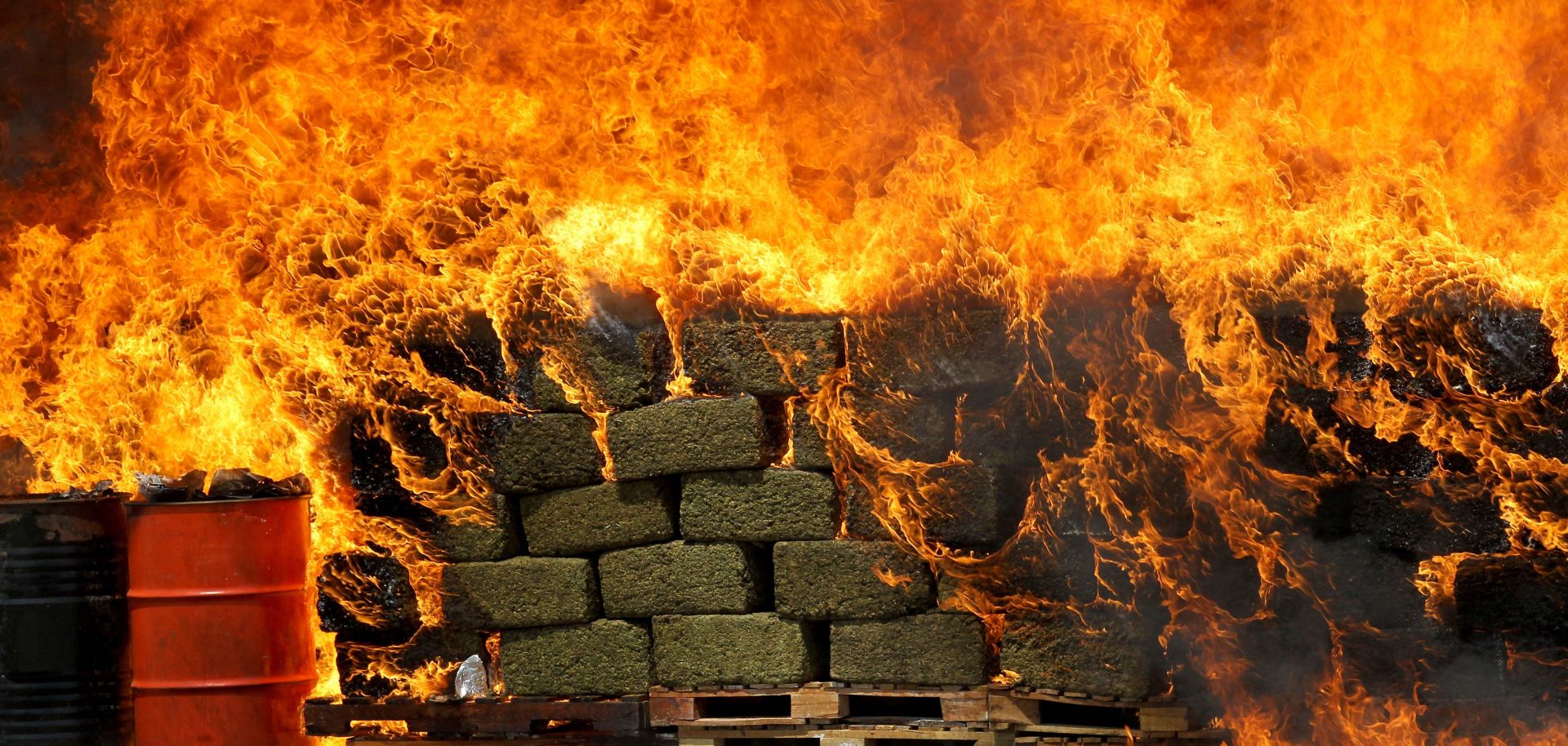
Seized marijuana bricks are incinerated in Guadalajara, Mexico.
The term ''narco-state'' usually brings to mind countries in Latin America where the influence of drug cartels is so vast that they are at least as powerful as the state itself, if not more. In some cases, this is despite the best efforts of a government. But in others, it may be with the direct connivance of top leaders themselves. Prime examples of both phenomena include Panama in 1980s under the dictatorship of Manuel Noriega, Colombia in 1980s and 1990s as cartels violently battled for supremacy, and Mexico in the early 2000s when cartels' influence became so great that the military began a major (and many would say largely failed) crackdown.
In reality, narco-states exist along a spectrum of severity and are far more geographically dispersed. And while each narco-state may look different, all can have major implications — from the strategic level of geopolitics, to the operational one of business activities and to the tactical one of travel security — not only within their borders but often far beyond. With these wide-ranging impacts, it makes sense to review what the ''narco-state'' term means today as the label has become much more fluid and is increasingly featured in media.
A Sliding (Drug) Scale
Definitions of a ''narco-state'' vary. Some focus on the connection between drugs and the economy (i.e. a country where the drug trade makes up a large portion of the economy), others focus on the role of institutions (i.e. complicity in the drug trade by politicians, the judiciary, law enforcement, the military, etc) and still others highlight the level of insecurity (i.e. that the drug trade fuels rampant violence and lawlessness).
To be sure, all three components apply to some of the most notorious examples of narco-states, such as those described above. But surveying the current global security environment reveals a variety of countries that receive the ''narco-state'' label but otherwise have little in common with each other. At one extreme, take North Korea. While most feared for its nuclear weapon and ballistic missile programs (alongside a variety of other criminal activity like cybercrime, money laundering and arms trafficking), Pyongyang also oversees a thriving business in producing and trafficking illicit drugs and knockoffs of legal pharmaceuticals. Trustworthy profit estimates are scant, though numerous defectors have told a similar story of a regime that generates millions of dollars in much-needed hard currency through selling illegal and counterfeit drugs. It is impossible to know exactly how much revenue this drug business generates for the North Korean economy (for context, one well-regarding firm estimates that Pyongyang raked in at least $1.7 billion via cryptocurrency hacking operations in 2022, dwarfing the estimated value of its legal exports by a factor of 10). But no one would accuse the repressive state of having a problem with drug-linked insecurity. By contrast, North Korea's totalitarian regime directly oversees its drug business and does not permit any sort of competition or dissent that could challenge its authority or lead to violence.
On the other extreme, take the Netherlands and Belgium, two liberal democracies that could not be more different than North Korea. They, too, however, have received warnings — initially from government officials and since then reinforced by media coverage — that they are becoming narco-states amid an uptick in violence linked to the drug trade. The reason for the increase is clear: Rotterdam and Antwerp are Europe's two busiest ports and therefore provide crucial conduits for traffickers to move their goods to the continent. For both countries, the recent wave of brazen attacks is certainly out of the ordinary and no doubt raises real security risks. After all, violence has not been confined merely to criminals attacking each other, but has included public attacks that have killed bystanders. Yet despite these realities, it is hard to seriously consider Belgium or the Netherlands as suffering from rampant violent crime, a complete penetration of state institutions by drug gangs or a drug-dependent economy.
And then of course there are a wide variety of countries that fall somewhere in between these extremes. Ecuador, for example, has seen a dramatic surge in drug-related violence over the past three years, along with allegations of corruption and an increasingly prominent drug trade. Ecuador has always been vulnerable to spillover violence due to its geographic proximity to neighboring Colombia and Peru, the world's two largest cocaine producers. But up until recently, the country had never suffered from the sort of repeated bouts of mass violence that have led the government to institute multiple states of emergency. Observers attribute the dramatic escalation in violence and associated rise in corruption to a variety of factors, including the arrival of Mexican drug cartels and changes in trafficking routes that have made Ecuador's Pacific coast much more attractive. But while certainly far more serious than what has been seen in Belgium and the Netherlands, Ecuador still seems far from being a tragic example of criminal state capture, let alone a scenario in which the state itself directs drug production and trafficking operations.
From Narco Presidents to Street Dealers
The range of these examples illustrates that the ''narco-state'' definition is fluid. In particular, the inclusion of countries in Western Europe, even if at the lower end of the risk spectrum, shows that the impacts of the drug trade are not confined to developing countries or remote areas of the world. In fact, the global nature of the drug trade and the vast sums involved (estimates suggest hundreds of billions of dollars per year) means that the activities of narco-states (no matter where they lie on the spectrum) have vast implications at the strategic, operational and tactical levels.
Start at the strategic level of geopolitics and examine Syria. By some measures, Damascus has become the largest drug dealer in the world. Faced with bleak economic prospects after years of civil war and abetted by massive corruption at the highest levels, the regime has turned to producing and trafficking captagon at an industrial scale. Captagon is a synthetically produced amphetamine stimulant used in everything from boosting the energy of fighters before battle to providing a party high at nightclubs. The drug is commonly found across the Middle East and increasingly beyond. According to a widely cited estimate, $5.7 billion in Syrian captagon was seized in 2021, but the regime likely raked in multiple times that amount since it is safe to assume that, as with all illegal drugs, only a fraction of the captagon was interdicted. For context, Syria's estimated legal exports that year were approximately $900 million, meaning the amount earned from the captagon trade is by far the regime's most valuable export and source of hard currency.
Unsurprisingly, Damascus puts the profits to use to fund its domestic repression and ongoing military campaign to reclaim territory. But the Syrian regime isn't the only one in on the action; a variety of militia forces and rebel groups also make money from the captagon trade. This ensures that there is plenty of cash to fuel the ongoing civil war that continues to be a flashpoint for regional instability amid Russian, Turkish, U.S. and other countries' military involvement. And if that is not concerning enough, even terrorist groups like Islamic State have allegedly used sales of captagon and other drugs to fund their operations.
The captagon trade also shows how the Syrian narco-state has clear regional — and increasingly global — impacts. There is hardly a nearby country that does not seem to be struggling to combat the drug's proliferation, ranging from next door Lebanon (where profits help fund Hezbollah and its Iranian backers) to Saudi Arabia (where experts have accused Syria of using the drug as a crude form of coercion: either give us financial support or we will continue to flood the Saudi market with pills). Illustrating Riyadh's concern over the drug's impact at home, it temporarily banned fruit and vegetable imports from Lebanon in 2021 after finding 5.3 million pills hidden in a shipment of pomegranates. The Syrian narco-state is also beginning to attract greater concern beyond the region as seizures of captagon increasingly occur across the world. Illustrating this, the 2023 U.S. National Defense Authorization Act included the Countering Assad's Proliferation, Trafficking and Garnering of Narcotics (CAPTAGON) Act, which requires U.S. authorities to develop an interagency strategy to combat narcotics networks linked to the Assad regime.
Similar narratives can be found across the globe. In Latin America, Venezuela's state-sponsored involvement in the drug trade (both via the direct involvement by top leaders and by providing safe haven to myriad criminal groups) funds its own repression at home and violence elsewhere in the region, most immediately across the border in Colombia. Similarly, in Southeast Asia, recent estimates show a sharp uptick in drug production throughout Myanmar since its coup two years ago; profits are not only helping to finance the junta, rebel forces and ethnic militias, but are also crowding out legitimate commerce as a way for farmers to simply make ends meet. Unsurprisingly, this dynamic is fueling growing concern in neighboring countries like Thailand about the likely spillover impacts.
The pernicious impacts of narco-states also extend down to the operational level of business activities. Aside from bringing violent risks (more on that below), the drug trade creates clear complications for companies operating in or near narco-states. The most obvious is corruption, which accompanies drugs wherever they go. For the drug trade to become influential, let alone institutionalized, there needs to be complicity from people whose jobs are supposed to be doing the opposite. Driven by a mixture of greed and fear, everyone from judges and tax collectors to police officers and customs inspectors (and at times national leaders and industry titans) can be found on the take.
For businesses, the perniciousness of corruption has clear and deleterious impacts. Most obviously, when officials start accepting drug-linked bribes, they also often start making demands of legitimate businesses as a culture of graft takes root. This manifests as everything from demanding small payments to secure local permits to massive fraud involved in awarding government contracts. In some places, this is merely seen as the proverbial cost of doing business, but it nonetheless drains corporate budgets and brings compliance and legal risks. There can also be major reputational considerations, if at all seen to be connected to illicit schemes or helping to prop up corrupt governments — even if only tangentially. Things are even more complicated when foreign companies work through local third parties (which is a common practice, especially when moving into a new market), making proper due diligence all the more difficult. And since other crimes (like human trafficking and money laundering) typically accompany the drug trade, evaluating supply chain risks becomes a lot harder as well.
The drug trade also causes a wide variety of secondary corporate harm that, over time, can have far worse consequences than the immediate complication of confronting corruption. After all, the drug trade can crowd out space for legitimate business activities, redirect potential talent, lower human capital, and reduce productivity — all of which harm a country's attractiveness for investment. Moreover, governments fighting the drug trade have to redirect a lot of resources (not least their attention, but also a lot of money and personnel), which could otherwise go to improving infrastructure, education or other business-friendly pursuits. And for those governments that are in cahoots with criminals, policymaking generally becomes much more opaque and the rule of law erodes, with clear negative consequences for companies. In addition, when the drug trade becomes deeply institutionalized, popular grievances rise and good (or, in some places, any) governance falls — a poor combination for either economic development or political stability. Finally, the drug trade undermines (and sometimes even silences) free and independent media through violent intimidation, making it all that much harder for businesses to understand what is truly happening on the ground.
The third and final way to consider the dangerous impacts of narco-states comes at the tactical level: namely, the drug trade's impact on travelers. It goes without saying that the illegal drug business is a violent one and, even when criminals seek to contain their rivalries and not attract undue attention, the realities of fierce competition mean that bystanders can suffer physical harm or other disruptions to their daily lives.
Take Mexico as an example. While cartels usually try to avoid harming foreigners in their brazen violence, a series of attacks in late 2021 and early 2022 along the Riviera Maya, one of the most important tourist spots in Mexico, illustrated how no location can truly be safe. Among other incidents in this timeframe, two foreign tourists were killed in Tulum in October 2021 during a shootout between rival gang members at a restaurant just off the city's main street. The following month, a dozen gunmen stormed a beach outside a luxury hotel in Cancun, killing two rival gang members and sending foreign tourists scrambling for cover. And in January 2022, a hitman broke into a luxury hotel in Playa del Carmen, where he killed two foreigners and injured a third (though the victims appear to have been involved in drug trade rather than innocent bystanders). 2022 also saw cartels essentially shut down major border cities like Tijuana and Mexicali for multiple days — trapping foreigners and locals alike — as a show of force against the government.
Of course, such violence is not unique to Mexico but tragically haunts many other countries that have received the ''narco-state'' label — raising real safety risks for not only foreign travelers, but the locals who almost always suffer the most. Local residents are usually aware of what areas to avoid, certainly more than tourists. But narco-states are so dangerous precisely because the drug trade cannot simply be separated from mainstream society; it infects everything.
'Just Say No'
Drug liberalization and the rise of synthetics are the two key (and somewhat opposing) global developments that will greatly affect the way these dynamics develop in the future. In recent years, there has been a growing global push to loosen rules around cannabis, and some governments are even making noises about doing the same for hard drugs like cocaine and heroin. More broadly, there is widespread recognition that the ''war on drugs'' will never be won and some sort of a policy rethink is required. Thus, on one hand, there is a force at least somewhat seeking to break criminals' hold over the drug trade by bringing at least a portion of it into the legal or at least gray market.
But on the other hand, there is the rising global popularity of synthetic drugs. Unlike many drugs that are created from otherwise natural substances that can only be grown in certain areas, synthetics are chemical compounds that can be produced in a lab anywhere on the planet. This gives synthetic drugs a number of advantages, including generally being cheaper to produce, easier to hide and capable of having their formulas constantly adjusted to ensure the right potency and skirt regulations — all of which make them much more profitable, but also much more harmful. Look no further than the deadly toll fentanyl and other synthetic opioids — whose precursor chemicals are shipped from China to Mexico before being transported across the border — has taken on the U.S. populace in the past few years.
When evaluating these two forces, the second appears to be much more powerful than the first, indicating that the ''narco-state'' label will likely grow to encompass only more countries in the future. This, of course, bodes ill for geopolitical, operational and security risks — and suggests that the list of future narco-states may very well look different from those today.
