
View of a cannabis plant planted by the Mexican Cannabis Movement on March 10, 2021, in front of the Mexican Senate in Mexico City.
Editor's Note: This security-focused assessment is a part of one of many such analyses found at Stratfor Threat Lens, a unique protective intelligence product designed with corporate security leaders in mind. Threat Lens enables industry professionals and organizations to anticipate, identify, measure and mitigate emerging threats to people, assets and intellectual property the world over. Threat Lens is the only unified solution that analyzes and forecasts security risk from a holistic perspective, bringing all the most relevant global insights into a single, interactive threat dashboard.
Mexico is on the cusp of legalizing cannabis amid a shifting economic relationship with the United States and lingering internal security concerns. A proposed law making its way from the House to the Senate that would legalize marijuana stands to soon make Mexico only the third country in the world to permit all aspects of cannabis production and distribution. The measure represents a sweeping change to governmental policy on cannabis, and may pressure U.S. officials to open a legal avenue to the U.S. market. With a population of approximately 125 million, Mexico will become the world's largest fully legal marijuana market, followed by Canada and Uruguay; the medical use of the drug is legal in dozens more countries. The bill, which Mexican President Andres Manuel Lopez Obrador has indicated he will sign into law, had been expected to be approved during an April 2021 legislative vote, although recent senatorial maneuvering most likely will delay the vote until the September 2021 session.
- The Mexican Supreme Court issued two rulings in late 2018 that, along with three previous rulings dating back to 2015, effectively declared the country's ban on recreational use of marijuana unconstitutional.
- The country’s current General Health Law allows a person to legally possess 5 grams of marijuana; the new law will officially legalize recreational use and allow adults 18 years and older to possess up to 28 grams and to grow as many as eight plants for personal use.
- Commercial production will also become legal with governmental regulatory approval to issue licenses to cultivate, research and export cannabis.
Current U.S. Status of Cannabis
With 16 states and the District of Columbia allowing recreational use of marijuana and 36 states allowing some form of medical use, an expanding U.S. market may provide Mexico with a large and rich nearby customer. The United States could become Mexico's largest consumer of cannabis if it moves toward cannabis legalization, or even decriminalization, and Mexican growers are allowed to export across the border. Soon to be sandwiched on both the northern and southern borders between two of the three legal marijuana markets in the world, the United States will experience significant pressure to move to some form of legalization.
Three out of four U.S. states that border Mexico have approved, or will approve, recreational marijuana use, pressuring neighboring states and opening convenient lanes of trade despite the current U.S. federal ban.
- California has been at the forefront of U.S. cannabis legalization efforts by passing the Compassionate Use Act in 1996 to authorize medical use and the Adult Use of Marijuana Act in 2016 to legalize recreational use. California also hosts a thriving state-regulated cultivation and production industry.
- Arizona permanently legalized medical marijuana in 2010, with recreational use following in 2020.
- New Mexico approved medical use in 2019. On April 12, Gov. Michelle Lujan Grisham signed a law to fully legalize, regulate and tax cannabis for adults 21 and older, making New Mexico the newest state to do so.
- Texas is an outlier compared to most other border states in its outlook toward cannabis legalization; little indicates this will change soon. While medical use is technically legal, the current restrictions on what conditions qualify for a cannabis prescription severely limit medical approval. Texas legislators have over 40 cannabis-related bills in the current congressional session, which range from proposals for decriminalization to medical use, but none that has a chance of significantly expanding legal cannabis use is likely to pass.
- Nearby states with more permissive positions on cannabis, which eventually could result in a changed Texas policy on legalization through constituency pressure and/or after evaluating the potential tax revenue. Colorado was one of the first states, along with Washington, to fully legalize cannabis and has maintained a sustained commercial market. New Mexico is on the cusp of recreational and commercial legalization. Oklahoma approved medical use in 2018 and, although a prescription currently requires state residency, a proposed bill would make it legal to prescribe to out-of-state customers. If it passes, the Oklahoma medical marijuana market would suddenly be within easy driving distance to politically connected cities like Dallas/Fort Worth, Austin, San Antonio and Houston.
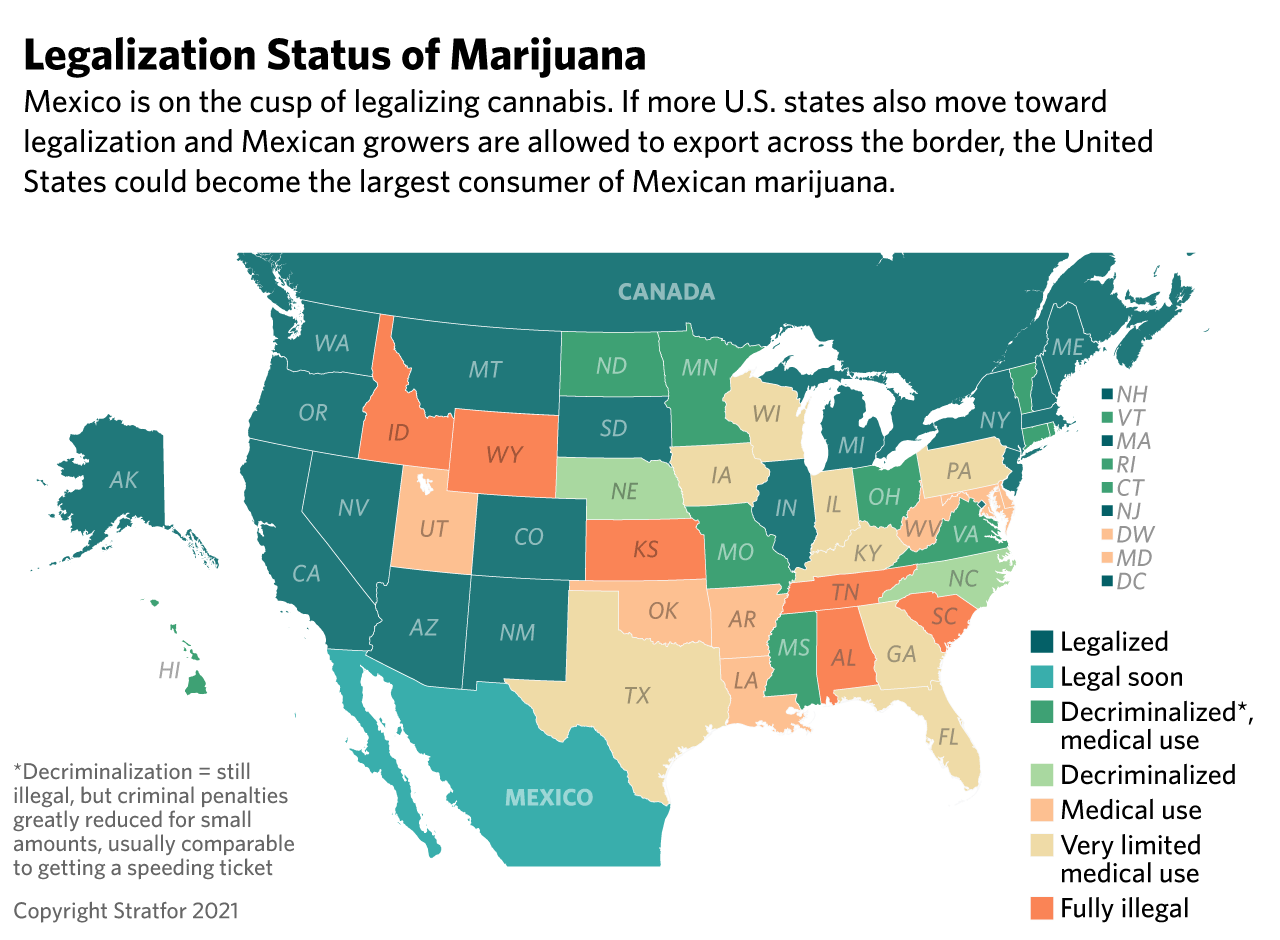
Over 40% of Americans currently live in states with full legalization, and a Gallup poll in November of 2020 showed that over 68% of the country supports national legalization, an all-time high. While cannabis is still prohibited at the U.S. federal level, national legalization, or at least decriminalization, is a realistic possibility with Democratic control of both Congress and the White House.
- Senate Majority Leader Charles Schumer signaled in an interview with Politico on April 3 that he is ready to bring national marijuana reform legislation to a vote and is currently crafting a bill with Democratic senators Cory Booker and Ron Wyden.
- Schumer appears confident that U.S. President Joe Biden will be open to discussion of the matter. Although Biden has not indicated whether he will sign off on national legalization, he said during his campaign that he was willing to hear experts weigh in on rescheduling cannabis.
- With Democratic control to bring bills to the floor and marked national popularity for legalization, repealing cannabis prohibition may be an issue with at least partial bipartisan support.
Mexican National Security Issues and Cartel Response to Legalization
Mexican marijuana legalization will not lessen crime, rampant corruption and cartel violence, disappointing advocates who hoped legalization would be a significant step toward decreasing the cartels' grip on the country. Cartels have taken steps to diversify from drug trafficking and are otherwise poised to exploit potential opportunities. As these entrenched criminal organizations take advantage of a burgeoning new market, they could contribute to a risk of increased crime and violence. Mexico would have to impose broad governmental reforms to combat corruption before a decrease in overall cartel control would diminish in the country. Large cartels are prepared for marijuana legalization through other illegal income streams, and in some cases are well prepared to take advantage of new opportunities legal cannabis will provide. As small to midsize cartels shift strategies to fill gaps left by larger organizations or compete for a share of a diminished illicit marijuana market in the wake of federal cannabis legalization, related criminal activities are likely to increase.
- Cartels have significant resources dedicated to the production and trafficking of synthetic drugs. They have also diversified their income streams into other activities such as fuel theft, cargo theft, heroin production and cocaine trafficking.
- Even though cannabis smuggling was once a significant source of cartel income, marijuana trafficking offenses in the United States have nonetheless steadily decreased by over 50% from 2015-2019 as cartels diversified to other avenues of criminality and the United States refocused law enforcement resources to combat cocaine, heroin and synthetic drug smuggling and human trafficking.
- An uptick in cartel-related crime will likely have the most noticeable human toll at border areas with the United States, possibly affecting diplomatic decisions between the Biden and Obrador administrations. Asylum seekers and migrants held up in border areas would face increased risks of spillover violence and exploitation as human smuggling and extortion expand as criminal organizations ramp up such operations.
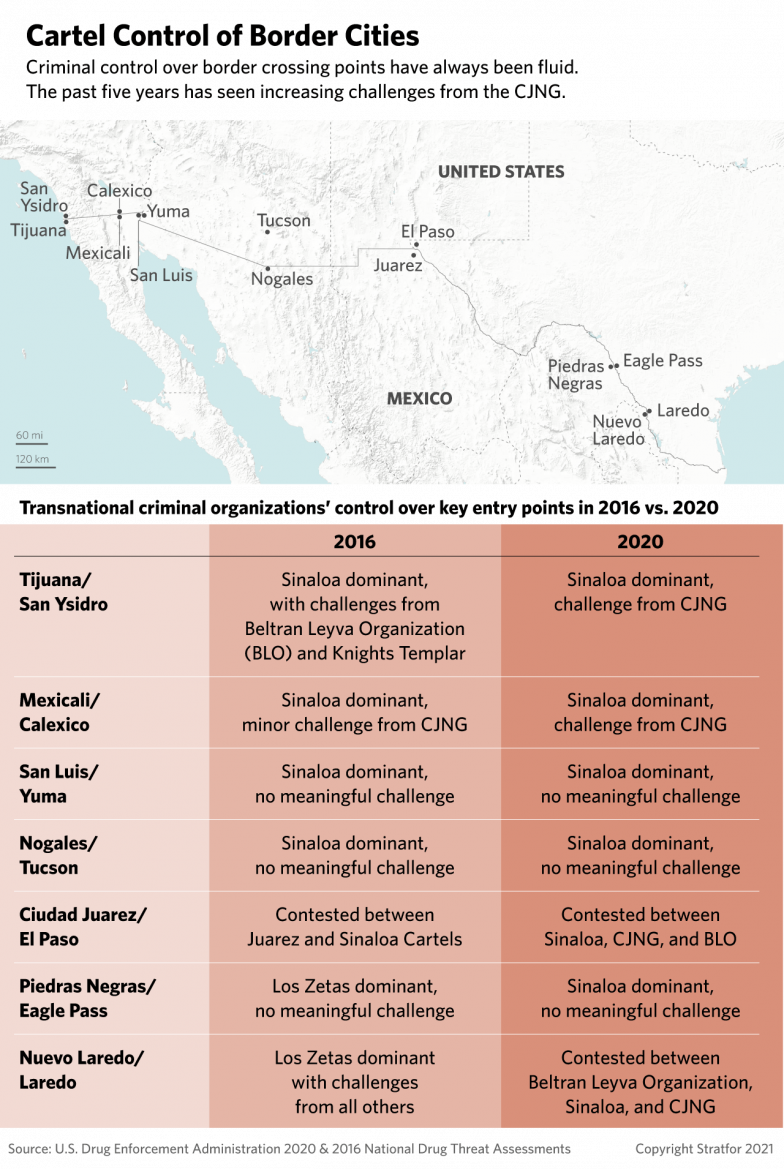
The two largest cartels, the Cartel de Jalisco Nueva Generacion (CJNG) and Sinaloa, have well-diversified narcotic revenue streams that will reduce the impact of cannabis legalization and have steadily decreased their reliance on cross-border marijuana smuggling for income. Even though the Sinaloa Cartel has traditionally been more dependent on cannabis smuggling for revenue than the CJNG, both cartels have many other avenues of illicit income from drug smuggling. Cartels continue to produce and traffic large quantities of other narcotics besides cannabis, including South American cocaine and Mexican heroin, with large portions of drug smuggling profits coming from synthetic drugs such as methamphetamine and fentanyl. The CJNG is particularly insulated from any significant revenue dip that legalization would potentially cause, as the cartel's dependence on illicit marijuana for income has been relatively minor compared to that of the Sinaloa.
