
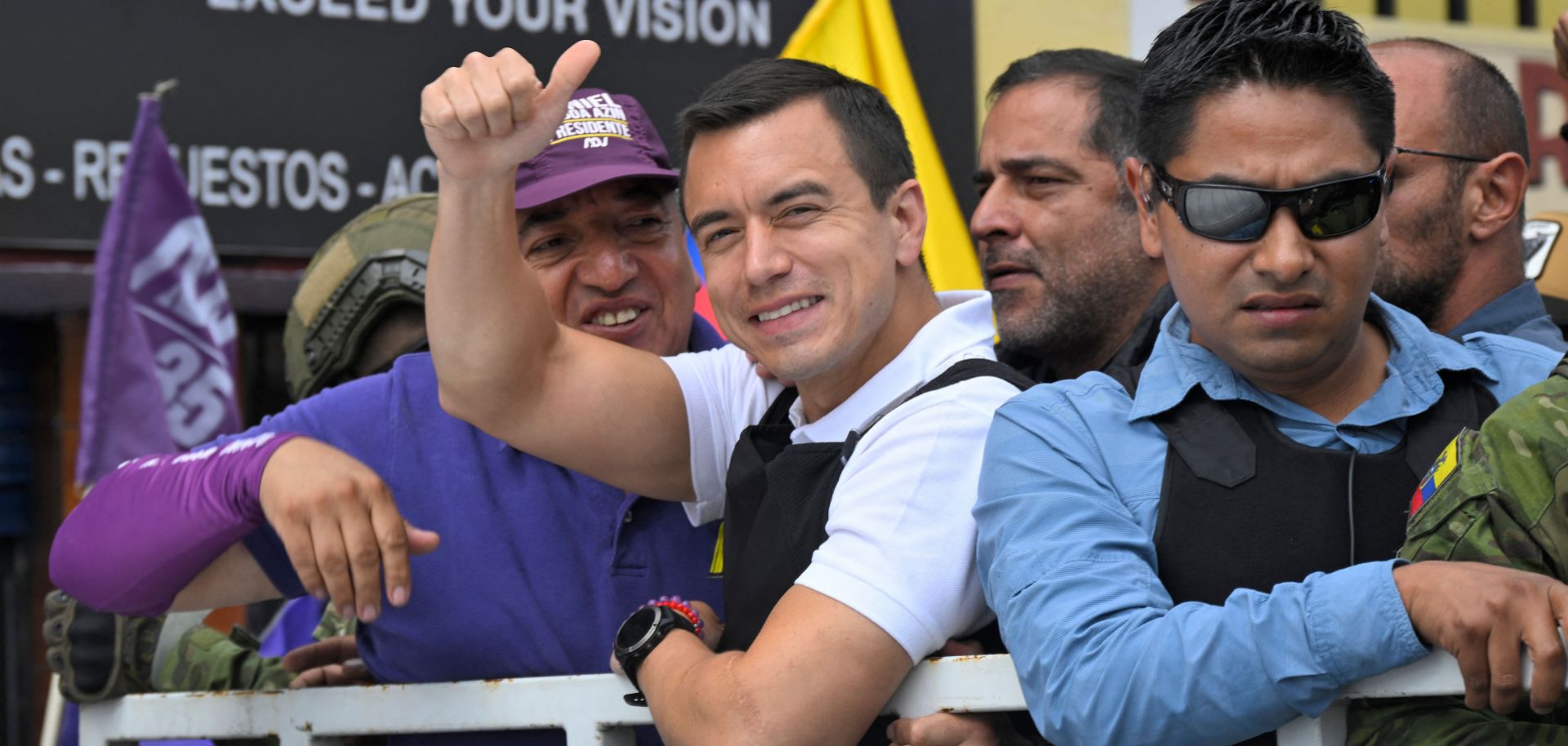
Ecuador's run-off presidential election could end years of political deadlock, but the country's instability, along with its security and economic challenges, will almost certainly persist regardless of the outcome. On Oct. 15, Ecuadorians will choose between two presidential candidates in the final round of the country's early elections, called after President Guillermo Lasso invoked a constitutional mechanism to dissolve the National Assembly in May over an impending vote to impeach him. Left-wing Citizen Revolution Movement candidate Luisa Gonzalez, a protege of former President Rafael Correa, came in first place in the first round of the election held on Aug. 20, with 33.6% of the vote. Gonzalez will compete with center-right National Democratic Action candidate Daniel Noboa, who unexpectedly came in second place in August after securing 23.4% of the vote. The winner of the Oct. 15 election will take office on Nov. 30 and serve for less than two years until the end of Lasso's term in May 2025, after which the country will return to its regular election schedule.
- Election polling released Oct. 4-5 indicates a close race between Gonzalez and Noboa. Surveys by pollsters Omar Maluk and NEO Consulta showed Gonzalez winning with 51.1% of the vote, while a poll conducted by Negocios & Estratgias had Noboa winning with 44%, with 7% undecided.
The election comes amid years of political gridlock and a surge in gang violence in Ecuador that has targeted political figures and government officials. Since taking office in May 2021, President Lasso has been embroiled in near-constant political gridlock with opposition parties in the National Assembly. This prevented him from passing business-friendly economic reforms promised during his campaign, and hindered the government's response to poor economic conditions. Lasso has also struggled to combat extreme gang violence, which has surged since 2021. During the current election period, this violence has included attacks against political figures and members of the country's legal system, as well as car bombings in the capital Quito and other major cities. Most significantly, on Aug. 9, days before the first round of the election, gunmen killed presidential candidate Fernando Villavicencio following a campaign rally in Quito. The assassination led Lasso to declare a continuing state of emergency, which has included counter-crime operations (sometimes disrupting transportation and business activities in entire neighborhoods) and security checkpoints. The operations have spurred retaliatory attacks by gang members in some parts of the country.
- Amid political challenges, Lasso's approval rating fell from 71% at the start of his presidency in 2021 to 14% in 2023.
- Ecuador's economy is projected to grow by 1.5% in 2023 before slowing to 0.8% in 2024, down from 2.4% in 2022. The country's poor economic conditions are the result of its slow recovery from the COVID-19 pandemic, which the Lasso administration has largely failed to combat.
- Homicides in Ecuador rose 82% in 2022, with over 4,600 violent deaths reported that year in a country with less than 18 million people. Violence has continued to escalate in 2023, with 3,568 murders reported in the first six months of this year. The uptick in homicides is the result of transnational crime groups, such as the Jalisco New Generation Cartel, expanding drug trafficking operations in the country, arming local gangs and leading to a significant increase in violence.
If Gonzalez is elected president, her left-wing government would likely be more stable, though it may also enact expansionary economic policies that increase Ecuador's risk of a sovereign debt default. After working as a public servant under the Correa government, Gonzalez was elected to the National Assembly in 2021 as a representative for Manabi Province. Given the close race, Gonzalez's close association with former President Correa (who served from 2007 to 2017) may hurt her chances of winning by making her unpalatable to moderate voters; this is because Correa remains a controversial figure in Ecuador and has been convicted for corruption (though he has denied wrongdoing and is currently living in exile in Belgium, and would be arrested if he returns to Ecuador). However, her left-wing populist stances may make her popular among those who want a break from the deeply unpopular, center-right Lasso. If Gonzalez wins, she would benefit from her Citizen Revolution Movement party holding the largest number of seats in the National Assembly. While the party only controls 48 of the 137 seats in the legislative body, it will be better situated to form alliances with other parties to achieve a majority and pass major legislation. Gonzalez has pledged to increase oil production and promised to use $2.5 billion from Ecuador's $6.96 billion in international reserves to boost the economy — namely, by increasing funding for the country's security forces, health programs and education, as well as increasing small business loans to create new jobs and combat youth unemployment. But while such spending would be popular in the short term, it could contribute to long-term risks of Ecuador defaulting on its debt if the country's fiscal deficit widens.
- If Gonzalez is elected president, her administration may try to pardon Correa, which would be popular among her supporters but would likely spur protests among the opposition.
- In August, global rating agency Fitch downgraded Ecuador's long-term foreign currency issuer default rating from B- to CCC+ — putting the country further below investment-grade status, on par with junk bonds. In its report, Fitch noted that it does not anticipate significant economic reforms in the near term amid political uncertainty.
Conversely, if center-right candidate Noboa wins the election, his pro-business policy agenda would likely face significant pushback in the National Assembly, prolonging Ecuador's political gridlock. Noboa will attract voters who are opposed to Gonzalez (and former President Correa) and fear that a left-wing president could further hurt Ecuador's economy. However, he has significantly less government experience than Gonzalez, which could hurt his appeal. Some voters may also negatively associate him with his father Alvaro Noboa, a businessman involved in Ecuador's banana industry who unsuccessfully ran for president five times from 1998 to 2013, and has faced multiple controversies for his opposition to workers' rights and investigations into the use of child labor by his company. On the campaign trail, Noboa has proposed offering benefits for companies that hire young people in order to combat Ecuador's high youth unemployment. He also announced an $830 million plan to improve security at borders, in ports, and on highways. But if Noboa wins, he could find himself at odds with the National Assembly, similar to Lasso's strained relations with the body prior to its dissolution in May. Noboa's National Democratic Action coalition has only 13 seats in the National Assembly, meaning he'd need to secure support from multiple other parties to pass any piece of legislation. If he's able to pass legislation as president, Noboa has said he would focus on job creation and promote public investment in the technology, tourism and agriculture sectors. But if Noboa fails to make sufficient alliances as president, Ecuador may remain in political gridlock until 2025.
- The National Democratic Action coalition was founded in May to support Noboa's candidacy. Given the coalition's newness, it may take time to form alliances, though there are parties with which the coalition will likely be able to find common ground, including the second largest party in the National Assembly, the center-right Movimiento Construye (Villavicencio's party prior to his assassination).
Regardless of who wins, Ecuador's next leader will face significant challenges, ranging from a short presidential term, high crime and poor economic conditions. Given that their term will only last through May 2025, the country's next president will almost certainly struggle to implement structural reforms in the less than two years they're in office. This challenge may prove particularly daunting for Noboa due to his insufficient support in the National Assembly, though Gonzalez's party would also need time to build consensus in the legislative body in order to pass major legislation. However, the most significant challenge Ecuador's next president will face is severe crime. During a debate on Oct. 1, both Noboa and Gonzalez promised to strengthen security forces and seek international assistance to crack down on crime. While an increase in funding and security presence will undoubtedly help the security situation, the impact of such measures would be constrained by the fact that Ecuador's main gangs, Los Lobos and Los Choneros, are receiving funds, equipment and logistical assistance from transnational drug cartels in Mexico and Colombia, bolstering their capabilities beyond those of a domestic gang. This indicates that Ecuador's fight against organized crime will be protracted and inconsistent regardless of who wins the presidential run-off, with violent crime likely to fluctuate and shift geographically in the coming years in response to government counter-crime efforts. Safety risks from organized crime have the secondary effect of hindering Ecuador's economic recovery. The use of ports for drug trafficking threatens supply chains in the country, while significant safety risks for foreign tourists and businesspeople have also made Ecuador increasingly unattractive for investment. In addition, persistent crime will likely discourage foreign direct investment and keep domestic consumption below its potential, negatively impacting economic growth.
- Insufficient economic growth could fuel anti-government sentiment, potentially spurring unrest. Indigenous activists, students and labor unions staged mass anti-government protests across Ecuador in June 2022 in opposition to Lasso's economic policies and elevated fuel and food prices. Five people were killed and hundreds more were injured in the unrest.
