
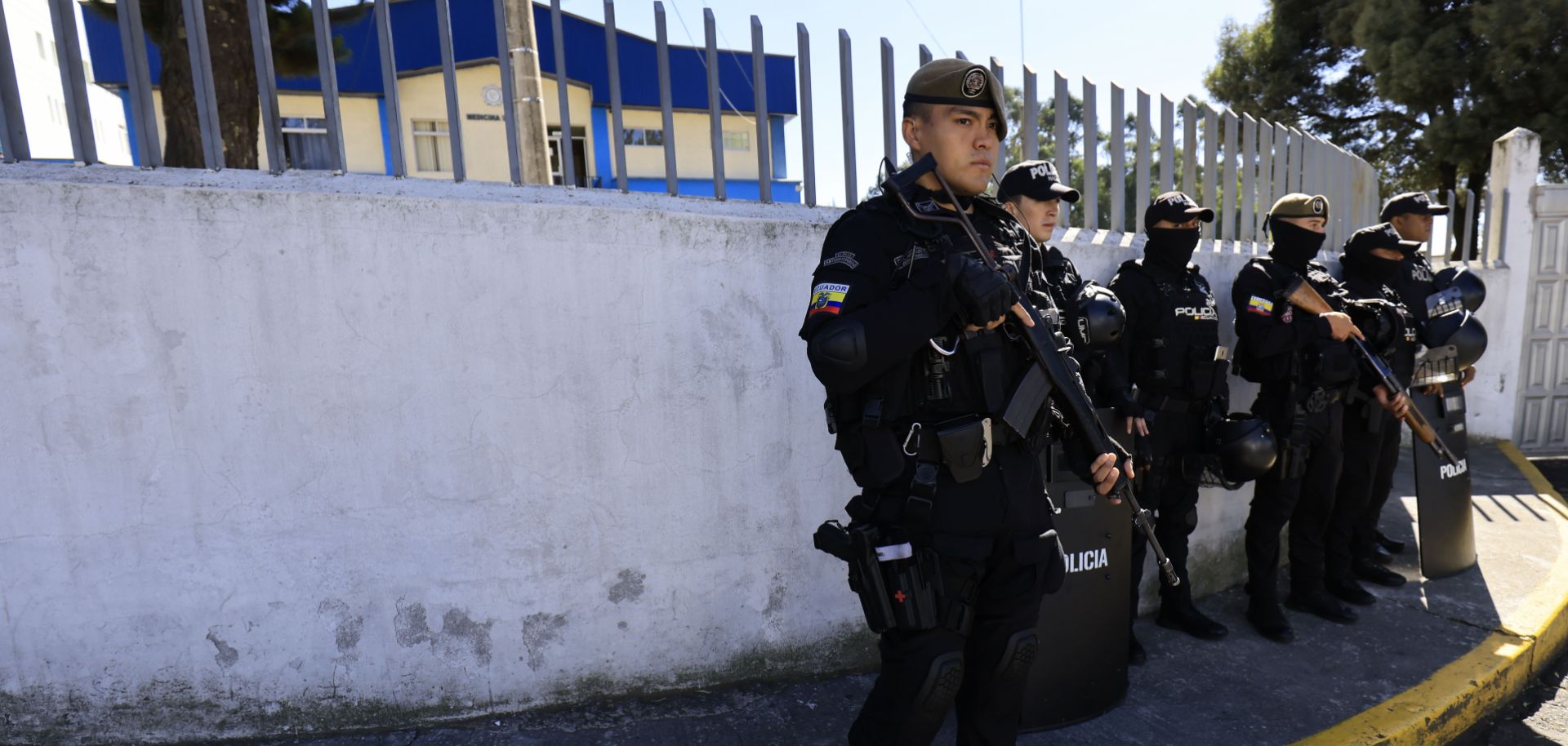
In Ecuador, the assassination of a presidential candidate signals increasingly brazen political violence that could see more voters support tough-on-crime politicians in the Aug. 20 election. On Aug. 9, unknown assailants shot and killed centrist presidential candidate Fernando Villavicencio in the capital of Quito during a campaign event, less than two weeks before Ecuador is set to hold general elections. In response, Ecuadorian President Guillermo Lasso declared a 60-day nationwide state of emergency. He also said the military would be mobilized to guarantee security during the upcoming election, but that the vote would still proceed as planned. The government has yet to identify the perpetrators, but Villavicencio's campaign was heavily focused on rooting out corruption and the influence of criminal organizations in the Ecuadorian government. A day before his assassination, Villavicencio had reportedly received threats from the Los Choneros cartel, one of Ecuador's largest criminal organizations.
- Before entering politics, Villavicencio was a journalist who covered government corruption and was most well-known for revealing evidence leading to charges against former socialist President Rafael Correa. On the campaign trail, he asserted that elected officials' close ties with drug cartel leaders had effectively turned Ecuador into a ''narco-state.''
- On Aug. 8, Villavicencio stated that ''the leader of the Los Choneros cartel threatened to break me,'' insinuating he had received threats on his life.
- Shortly after the government confirmed Villavicencio's murder, presidential candidates Yaku Perez and Jan Topic temporarily suspended their campaigns.
- The Aug. 20 general election is a snap election after Lasso invoked a constitutional mechanism to dissolve the National Assembly, where he faced a looming impeachment vote.
The assassination comes amid a surge in violence related to transnational drug trafficking in Ecuador, including politically motivated killings. Violence in Ecuador has been on the rise since domestic gangs began receiving increased support from international drug cartels in Colombia and Mexico in 2020. Over the past three years, local criminal gangs — including Los Choneros (whose leader allegedly threatened Villavicencio) and Los Lobos, Ecuador's two largest criminal organizations — have conducted regular attacks throughout the country, including shootings, bombings and arson attacks. Violent attacks against political figures like Villavicencio, as well as attacks against officials in Ecuador's justice system (including judges, prosecutors and police officers) have also become increasingly commonplace. Just last month, for example, two assailants shot and killed the mayor of Manta, the country's third-largest port city. In May, gunmen also attempted to kill the mayor of the town of Duran (which is located near the port city of Guayaquil). The coming days could see more attacks on politicians and other government officials, as well as their associates and family members, as criminal organizations seek to influence the Aug. 20 election.
- Between 2020 and 2022, Ecuador's official homicide rate increased from 7.7 per 100,000 people to 25.9 per 100,000 people.
- Prior to local elections in January 2023, Ecuador's government accused 28 candidates from across the country of having possible ties to drug trafficking and illegal mining, demonstrating the risk of criminal involvement in Ecuador's elections.
The assassination will likely disrupt voting patterns and provide a boost to presidential and legislative candidates with a hard-line stance on security. Villavicencio's death will only heighten voters' safety concerns around the Aug. 20 ballot, which could further decrease turnout in an election that had already seen a high degree of voter apathy. And in the wake of the high-profile security incident, those who do brave the polls will likely also be more apt to cast votes for candidates viewed as being tough on crime. This could bode well for presidential candidate Jan Topic, a businessman and former sniper of the Foreign Legion of the French Army who, if elected, has pledged to enact a sweeping crackdown on criminal activity akin to that imposed by El Salvador's strongman president Nayib Bukele. Before Villavicencio's assassination, opinion polls had left-wing candidate Luisa Gonzalez in the lead with around 29% of popular support, followed by several other candidates (including Villavicencio and Topic) polling between 5-15%. Such a fragmented political environment means that an increase in support for Topic could see him qualify for the runoff vote, on Oct. 15. The high-profile security incident will probably also see voters favor legislative candidates that promote a more hawkish approach to crime, which could result in a National Assembly that allocates more funds toward security measures and is more willing to deploy the military in response to domestic security concerns. Should the election yield an executive and legislative branch that both favor a tough-on-crime approach, the government could extend the nationwide state of emergency, unlock more funding to construct new prisons, and invoke special powers to conduct mass arrests (at the risk of triggering human rights violations).
- According to Ecuador's electoral rules, if no presidential candidate obtains at least 50% of the vote in the Aug. 20 election (or 40% of the vote with a 10-point lead over the next candidate), the presidential race will advance to a run-off between the top two candidates on Oct. 14. Polling indicates that as many as 50% of voters have still not decided who they will vote for, which could produce unexpected results.
