
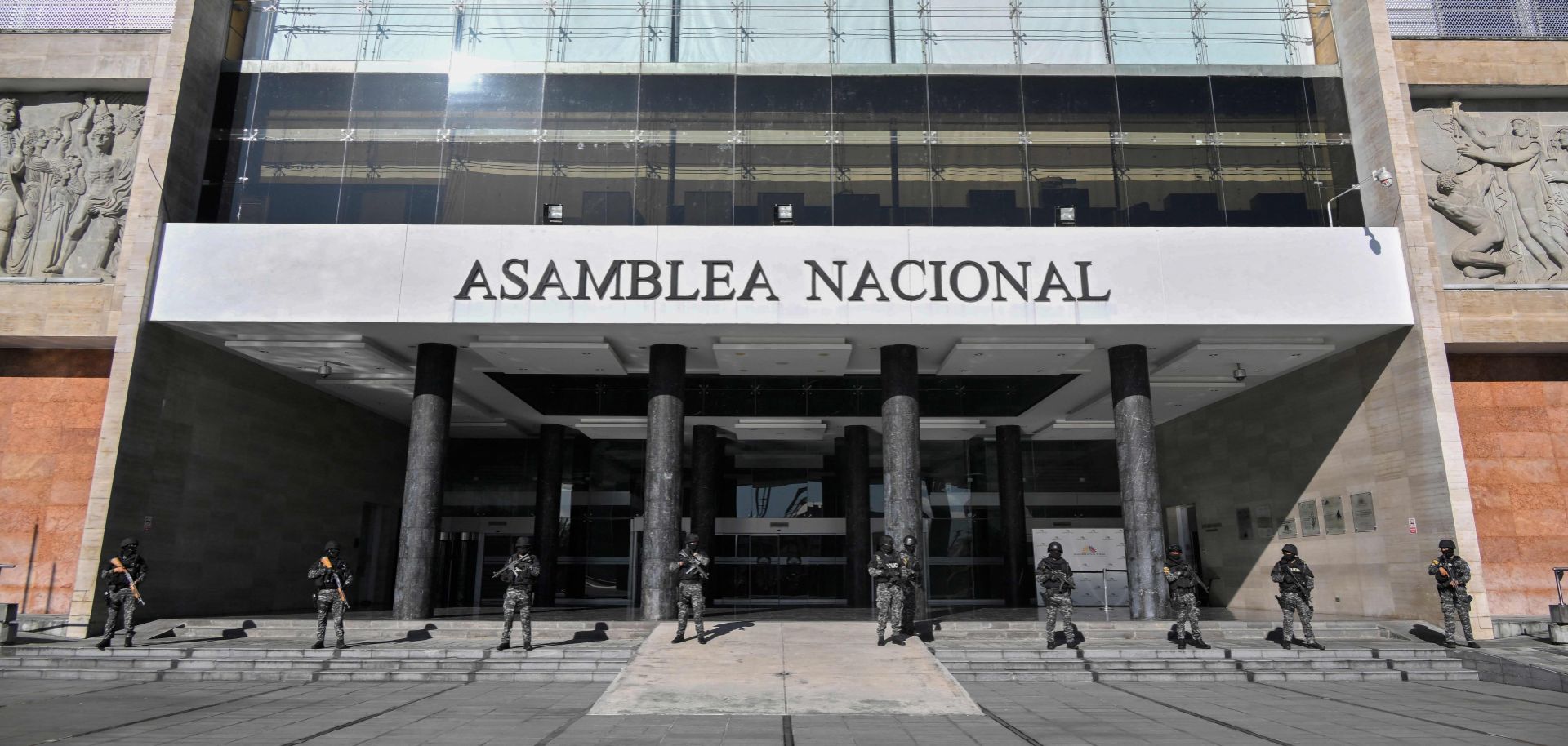
Police forces stand guard outside Ecuador's National Assembly in Quito after the country's president issued a decree dissolving the legislature on May 17, 2023.
In Ecuador, the president's decision to dissolve congress and rule by decree for up to six months before early general elections will face institutional opposition and likely lead to disruptive (even if short-lived) protests. On May 17, Ecuadorian President Guillermo Lasso dissolved the opposition-led National Assembly, where he faced a looming impeachment vote, and announced he will rule by decree for the next six months until new elections were held. In doing so, Lasso invoked Article 148 in Ecuador's constitution, which allows the president to disband the legislature, call snap elections and assume executive authority in the interim. Lasso justified his decision by claiming the National Assembly's ongoing effort to impeach him had caused ''a serious political crisis and internal commotion.'' The decree went into effect immediately, though several legislators filed petitions with the Constitutional Court calling the use of Article 148 as unconstitutional, which select members of the court will affirm in the coming days. If the court decides that Lasso's move was unconstitutional, the National Assembly will resume normal operations and Lasso will remain president. Conversely, if the move is ruled constitutional, Lasso will rule by decree and Ecuador's Electoral Commission will announce a date for the next presidential and legislative election in the coming days. The early ballot has been tentatively scheduled for Aug. 20, 2023.
- Ecuador's National Assembly approved an impeachment trial against Lasso on May 9. 88 of the 116 present legislators voted in favor, just four votes shy of the two-thirds majority needed to successfully impeach Lasso. A legislative commission previously recommended Lasso's impeachment due to his alleged involvement in a scheme to embezzle public companies. Lasso's brother-in-law reportedly was the main culprit in the embezzlement scandal, known locally as the ''Encuentro'' case.
- Throughout his presidency, Lasso had failed to implement his pro-business platform due to opposition in congress, which is dominated by the leftist populist Union For Hope coalition and the Indigenous Pachakutik Party.
- Article 148 in Ecuador's constitution is commonly known as the ''cross-death'' mechanism because it both dissolves the legislature and calls for an early presidential election. Prior to invoking the article, Lasso's term would have ended in 2025.
- Shortly after dissolving the National Assembly, Lasso announced the first decree is the passage of the tax reform he had proposed days prior, which seeks to reduce taxes on low- and middle-income earners. The Constitutional Court has since affirmed it will review the decree.
While Lasso will try to pass policy via decree, he will face pushback from the Constitutional Court and local officials. While controversial, Lasso's decision is constitutional, which means that his political rivals will have no legal means to oust him before the early presidential election. Lasso's decision to push through his proposed tax reform by decree signals that he may use the same mechanism to push through other elements of his policy platform, which includes increased security spending and tax incentives for businesses investing in natural resource extraction in Ecuador. However, this strategy faces two constraints. For one, the Constitutional Court will still need to ratify all of Lasso's decrees, which means that some of his proposals may be blocked. Secondly, Lasso's executive decrees could face resistance to implementation as most key local officials belong to the leftist Union For Hope coalition and may disagree with Lasso's policies, specifically on security measures carried out on the local level. If local officials refuse to cooperate with Lasso's executive decrees, it could lead to a crisis of power between local and federal levels that may result in the military enforcing Lasso's security policies.
- Ecuador's influential former president Rafael Correa called Lasso's move ''illegal,'' but subsequently lauded the upcoming elections as a ''great opportunity to send Lasso home.'' This indicates that while opposition figures may disagree about the use of the ''cross-death'' mechanism, they will still try to take advantage of the early ballot and the uproar over Lasso's apparent power grab to win the presidency.
- Ecuador's security climate has rapidly deteriorated over the past year. The country of 17.5 million people reported 4,603 homicides in 2022, marking an 82% increase from 2021. In response to the uptick in violence, Lasso fielded several security proposals that were rejected in a Feb. 7 public referendum, which included boosting national security by allowing greater collaboration between the armed forces and police, among other measures. In addition to the tax reform, Lasso may also seek to push through some of his rejected security reforms over the next six months.
Protests can be expected in the coming days, as Indigenous groups and other sectors of Ecuador's society are likely to disapprove of Lasso's ability to rule by decree. The country's largest Indigenous activist group, the Confederation of Indigenous Nationalities of Ecuador (CONAIE), will almost certainly announce demonstrations in the immediate aftermath of Lasso's announcement to send a message that he should not seek to implement decrees that would increase natural resource extraction on their ancestral lands. But other politically active sectors of society, such as students and unions, may also take to the streets to voice their anger over their president's move to dissolve the National Assembly and rule by decree. Indigenous demonstrations, in particular, will likely target key highways in Ecuador, which could cause supply chain delays and transportation disruptions throughout the country. Protesters could seek to occupy roads and facilities crucial to the oil and gas industry as well, potentially disrupting Ecuador's natural resource extraction sector's ability to continue operations. The unrest, however, may be short-lived as Ecuador will now enter into a period of intense political campaigning ahead of the early general election, which could potentially dull protest efforts over the course of the six months as many view a new government and legislature as an opportunity for change.
- In response to Lasso's May 17 announcement, CONAIE leader Leonidas Iza said the president had ''launched a cowardly self-coup'' and that his organization viewed Lasso's government as having ''become a dictatorship.''
- For two weeks in June 2022, CONAIE protesters blocked key roads to Ecuador's oil and gas fields, causing widespread disruptions that forced the government to declare a force majeure on exports of the country's Oriente crude oil for several days until the Lasso government agreed to hold negotiations with protesters.
