
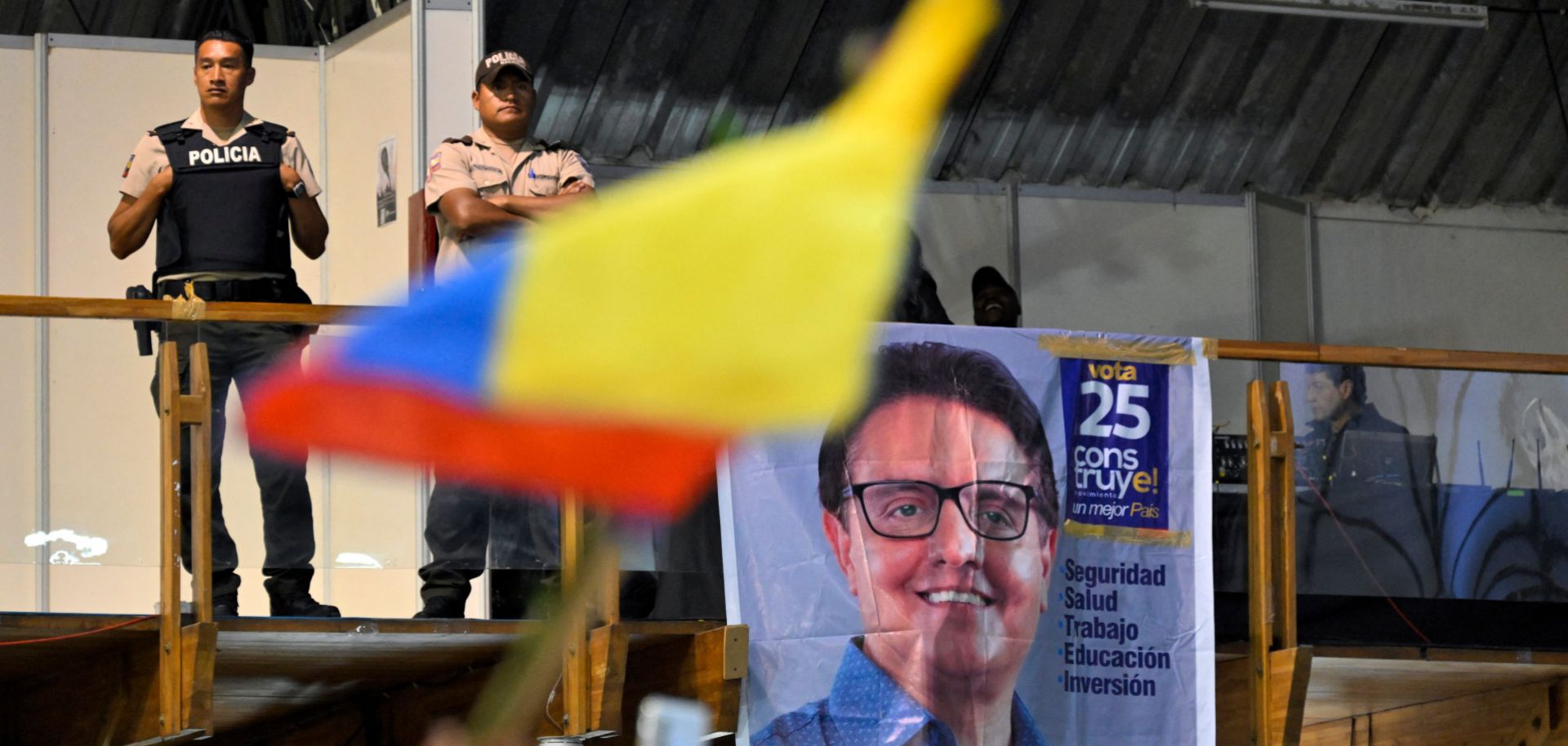
General elections in Ecuador may lead to the emergence of an anti-establishment or extremist presidential candidate, while a simultaneous referendum threatens the country's oil output. On Aug. 20, Ecuadorians will elect their next president and all 137 members of the county's unicameral Congress, as well as vote in a concurrent national referendum on whether the country should continue drilling for oil in an ecologically important section of the Amazon jungle. In a separate referendum in Quito, voters in the capital city will also decide whether to halt mining in the Choco Andino Biosphere Reserve, which is home to the endangered Andean Spectacled Bear. The main candidates running in the presidential election include populist Luisa Gonzalez, right-wing businessman Jan Topic, Indigenous leader Yaku Perez, center-right former Vice President Otto Sonnenholzner and center-left Christian Zurita (who replaced assassinated candidate Fernando Villavicencio). According to Ecuador's electoral rules, if no presidential candidate obtains at least 50% of the vote in this weekend's ballot (or 40% of the vote with a 10-point lead over the next candidate), the presidential race will advance to a run-off between the top two candidates on Oct. 14.
Ecuador's snap election comes amid rising insecurity and political strife. Over the past three years, Ecuadorian criminal groups have received increased support from international drug cartels in Colombia and Mexico. As a result, the country has seen rising insecurity and regular episodes of violence, including shootings, bombings and arson attacks. Violent attacks against political figures have also become more common, as acutely evidenced by presidential candidate Villavicencio's recent assassination. Ecuador's growing security crisis has, in turn, led to public discontentment and concerns over personal safety. Aside from these security concerns, Ecuadorians are also facing a time of political strife. The Aug. 20 general elections will take place two years earlier than expected after current President Guillermo Lasso invoked a constitutional mechanism on May 17 to dissolve Congress, where he faced a looming impeachment vote. The high degree of political polarization in Ecuador has led the country's fragmented former National Assembly to block nearly all of Lasso's policy proposals, a risk that could continue should the Aug. 20 vote produce a similarly fragmented National Assembly. Finally, Ecuador's economy is slowing down, with the International Monetary Fund now expecting the country's GDP to expand by only 2.8% in 2023 after growing by 4.2% in 2021 and by 3% in 2022.
- Between 2020 and 2022, Ecuador's official homicide rate increased from 7.7 per 100,000 people to 25.9 per 100,000 people.
- On Aug. 9, unknown assailants shot and killed centrist presidential candidate Fernando Villavicencio in the capital of Quito during a campaign event after receiving threats from the Los Choneros cartel, one of Ecuador's largest criminal organizations.
- Attacks against officials in Ecuador's justice system (including judges, prosecutors and police officers) have also become increasingly commonplace, as exemplified by the July assassination of the mayor of Manta, the country's third-largest port city. In May, gunmen also attempted to kill the mayor of the town of Duran (which is located near the port city of Guayaquil).
- Ecuador periodically experiences violent prison riots that demonstrate the brutality of the country's organized criminal groups, with the recent riot on July 21 killing 31 people — several of whom were beheaded.
If left-wing frontrunner Luisa Gonzalez wins the presidential election, her proposals to expand social welfare programs and security spending could jeopardize Ecuador's foreign currency reserves. Preceding her 2021 election to the National Assembly, Gonzalez's extensive background involved advisory roles for former president Rafael Correa, including ministerial positions and General Secretary of the President's Office and various ministerial positions. If elected president, Gonzalez has promised to utilize around $2.5 billion from Ecuador's $6.9 billion foreign currency reserves to enhance youth employment, bolster national security, and fund significant infrastructure projects. However, such allocation bears the risk of diminishing reserves, potentially hampering the country's ability to meet its foreign-currency-denominated debt commitments. Moreover, Ecuador's foreign currency reserves are the backbone of the country's financial system and its economy's dollarization (Ecuador formally adopted the U.S. dollar as its currency in 2020). Insufficient reserves could worsen a financial crisis if the Ecuadorian state and banks don't have access to enough dollars. Spending the country's foreign currency reserves may also weaken the central bank's ability to serve as a lender of last resort, which is already constrained by the country's dollarized status.
- On Aug. 9, the last day for opinion polling for the Aug. 20 election, polls had Gonzalez in the lead with around 29% of popular support, followed by several other candidates polling between 5-15%.
The fragmented political arena means that a number of candidates have the potential to make it to the runoff vote, creating an opportunity for an anti-establishment candidate to become president. As of Aug. 9, local polling had indicated that as many as 50% of voters had not decided which presidential candidate they were voting for, which could produce unexpected results. Consequently, various contenders could advance to the likely runoff presidential election.
- Jan Topic, a businessperson and a former sniper in the French Foreign Legion, is running on a promise to launch a sweeping crackdown on crime akin to that imposed by El Salvador's assertive leader, President Nayib Bukele. Topic is pro-business and has suggested that he would seek to promote trade and tourism while also offering incentives for foreign investment.
- Indigenous leader Yaku Perez is staunchly pro-environment and has suggested halting all new oil and gas exploration contracts. Perez has also emphasized the necessity of establishing a commission, supported by both the United Nations and the Organization of American States, to conduct an investigation into corruption in Ecuador.
- Former Vice President Otto Sonnenholzner's security strategy encompasses investing in greater control over prisons (alluding to the country's prison riots) and furnishing law enforcement agencies with advanced resources, supported by an initial $300 million investment in security and border control. His economic proposals include maintaining dollarization and revitalizing public investment to foster economic growth.
- Former journalist Christian Zurita replaced centrist presidential candidate Fernando Villavicencio after his Aug. 9 assassination, and will likely continue his predecessor's anti-corruption and -gang push. While little is known about Zurita's economic stances, Villavicencio was staunchly pro-union and sought to moderately increase social welfare spending. Villavicencio's recent murder could result in higher support for Zurita if voters find his law and order rhetoric more appealing amid rising crime in Ecuador.
The approval of the referendum on oil extraction would trigger a substantial decrease in Ecuador's projected oil output, affecting both fiscal revenues and net exports. One of the Aug. 20 referendums will ask voters whether the country should allow companies to continue extracting oil in the ITT block (Ishpingo, Tiputini and Tambococha), which is located in the Amazon region of Yasuni. Should people vote ''no,'' the consequent loss of production in the ITT block would cut Ecuador's total projected oil output by 12 %, leading to a decrease of $600 million in fiscal revenues, as well as a drop in the country's net exports. On June 20, Ecuador's energy minister said the country would risk losing $1.2 billion in oil income per year should voters decide to ban production at one of the country's most successful blocks. This referendum, which adds to the parallel referendum in Quito on mining in the Choco Andino areas, indicates that the country may see an emergence of environmental nationalism that could further hinder Ecuador's ability to expand its natural resource extraction.
- State-owned energy company Petroecuador began production at the ITT block in 2015 and currently pumps 55,000 million barrels of oil from the region.
