
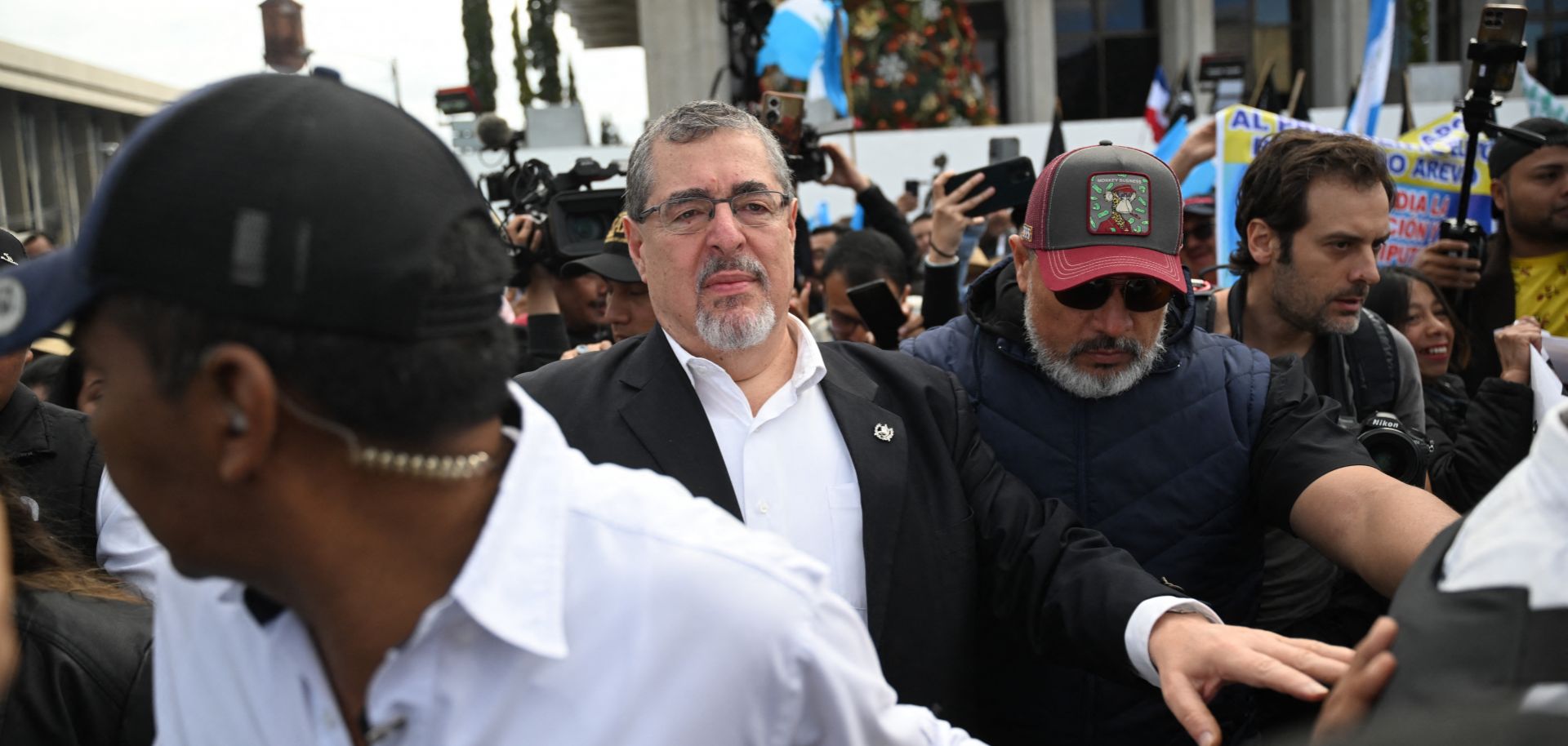
Guatemala's political crisis will likely continue regardless of whether authorities prevent President-elect Bernardo Arevalo from taking office, creating long-term domestic challenges for organizations while threatening U.S.-Guatemala relations. On Dec. 8, the Attorney General's office called for the results of Guatemala's Aug. 20 general elections to be annulled, claiming ''serious irregularities'' in the vote tally. The action followed months of repeated raids against Guatemala's Supreme Electoral Tribunal (TSE), the court that regulates elections in the country, and Arevalo's Seed Movement Party. The call to annul the vote also marked the most explicit effort by the office so far to prevent Arevalo from assuming the presidency on Jan. 14, 2024. The office called for Congress to remove Arevalo's immunity as well, which would open the door to formal charges against him and his possible arrest. On Dec. 14, however, Arevalo secured a rare win when the Constitutional Court issued an order commanding Congress to guarantee the inauguration of all officials elected in the 2023 vote. However, an adversarial attorney general, weakened TSE and combative Congress may still complicate Arevalo's ascension to the presidency. Thus, despite substantial mobilizations from Guatemalan civil society, the recent Constitutional Court order and condemnations from abroad, Guatemala's political crisis risks deepening.
- Left-wing, anti-corruption candidate Bernardo Arevalo won Guatemala's Aug. 20 Presidential run-off elections with 58% of the vote. But since his victory, political elites in Guatemala have taken a series of steps to challenge the transfer of power. In September, authorities raided the TSE, which then suspended Arevalo's Seed Movement party in November at the request of the Attorney General's office.
- The U.S. government sanctioned Attorney General Maria Consuelo Porras in May 2022 for ''repeatedly obstruct[ing] and undermin[ing] anti-corruption investigations in Guatemala to protect her political allies and gain undue political favor.''
The actions of the Attorney General's office are most likely an attempt by Guatemala's political elite to prevent the next government from taking over and launching a corruption crackdown. Guatemala has long faced severe corruption challenges. The 2015 La Linea case exposed officials and politicians' involvement in a customs corruption ring, ultimately leading to then-President Otto Perez Molina's resignation and later imprisonment on corruption charges. Though the case led to greater efforts to crack down on government graft immediately following the revelations, corruption has only worsened since 2015, with the government also targeting judges and journalists involved in anti-corruption investigations. Arevalo's supporters within Guatemala and international monitors from the Organization of American States (OAS) have alleged that the political elite is threatened by his anti-corruption platform, leading to ongoing efforts to prevent him from taking office.
- Guatemala's political elite spans the political spectrum and includes the center-right Vamos party of current President Alejandro Giammattei and the center-left National Unity of Hope (UNE) party of Sandra Torres, who lost to Arevalo in the second round of the August presidential election.
- Transparency International's 2022 Corruption Perceptions Index gave Guatemala a score of 24 out of 100, making it the fifth most corrupt country in Latin America, behind Honduras (23), Nicaragua (19), Haiti (17) and Venezuela (14). In their scale, 0 represents ''highly corrupt'' and 100 represents ''very clean.'' Guatemala's score dropped from 28 out of 100 in 2015.
- Previously, the International Commission Against Impunity in Guatemala — formed as part of an agreement with the United Nations in 2006 — investigated and prosecuted corruption-related crimes. The U.N.-backed commission, known by its Spanish acronym CICIG, was instrumental in exposing the La Linea scandal. However, in 2019, then-President Jimmy Morales terminated the agreement and alleged that CICIG participated in illegal acts, kicking the body out of the country. Prosecutors and judges who cooperated with CICIG have since fled the country in fear of political prosecution, with anti-corruption lawyer Flor de Maria Galvez Alvarez leaving Guatemala in March 2022.
How the Crisis Could Unfold
Scenario #1: Arevalo is stripped of immunity and arrested.
Removing Arevalo's immunity and arresting and charging him with money laundering (of which the office has already accused him) is likely the easiest method through which the attorney general could prevent Arevalo from taking office. While the TSE has defended Arevalo's immunity twice already, the institution was hobbled on Dec. 1 after prosecutors stripped four magistrates of their immunity. A lawmaker of the center-left Will, Opportunity, and Solidarity Party speculated that removing judges' immunity was a deliberate act to pack the court with anti-Arevalo judges, increasing the chance that the court would vote to remove Arevalo's immunity. If the new magistrates vote to remove Arevalo's immunity, it could open the president-elect to criminal charges — including those related to allegations of money laundering for not detailing the origin of funds used to pay an administrative fine to the TSE in 2022 — and possible arrest, preventing him from taking office. It is unclear exactly how Congress or the Attorney General's office could proceed with these efforts, and with only a few weeks until the inauguration, there may not be enough time for the Attorney General's office to circumvent existing political protections for Arevalo, limiting the risk of Arevalo's arrest before he takes office. Given that this development would be unprecedented, authorities could declare a ''State of Prevention,'' which wouldn't directly prevent Arevalo's inauguration but may give government forces the leeway to suspend legal requirements and take faster action against him. There is also the potential that Arevalo could face threats to his physical safety, demonstrated by an August statement by the Inter-American Commission on Human Rights (an arm of the OAS) that Arevalo's right to life, personal integrity and health are at risk. Arevalo could flee Guatemala in response to any threats of arrest or against his life. In this scenario, Arevalo's Vice President-elect Karin Herrera Aguilar would likely take office, though given that she has faced similar targeting by the Attorney General's office, she may not remain in office for long.
Scenario #2: The election results are annulled.
Since July, the Attorney General's office has taken several actions that appear aimed at invalidating the results of the general election, and will likely continue such efforts over the next two weeks to try to keep Arevalo from taking power. This includes the office's allegations of irregularities and fraud during the election and its recommendations that the results be declared ''null and void.'' The TSE is the only judicial organ with the power to certify or nullify election results and the president of the court, Blanca Alfaro, quickly responded that the results of the election were ''official'' and ''unalterable.'' Furthermore, the TSE has ended sessions and entered winter recess from Dec. 15 to Jan. 3, closing the window of opportunity that prosecutors have to issue new complaints against Arevalo before he is sworn in. Still, the Attorney General's office could attempt to use an alternative means to overturn the results, such as through a congressional vote or via a Supreme Court or Constitutional Court ruling, but there may not be enough time to do so before Arevalo's Jan. 14 inauguration. In this scenario, new elections would be likely, though the timeline for how quickly such elections would occur is unclear. President Giammattei may remain in office until new elections are called (though he has said he will leave office as scheduled in January) or Congress could appoint an interim president.
Scenario #3: Arevalo takes office, but has a challenging presidency.
In a baseline scenario in which the Attorney General's office and other government bodies take no further actions to specifically target Arevalo or invalidate the election results, Arevalo will still struggle to govern effectively. Congress remains dominated by the Vamos and UNE parties of the country's political elite, members of which have already shown their intent to oppose Arevalo when they declared members of his Seed Movement party ''independent'' in November, meaning party members elected to Congress cannot chair committees or hold leadership positions. If Arevalo takes office in January, this adversarial stance will almost certainly carry through into his presidency. Congress would very likely impede major policies promised in Arevalo's campaign platforms, most likely including counter-corruption efforts, but also potentially extending to improvements to healthcare and education. These deep political divisions may go so far as to prevent Arevalo from passing a budget and from confirming individuals to even minor appointments. While Arevalo may complete his entire four-year term as president, under these conditions, his administration would face near-constant governance challenges.
Scenario #4: Authorities try to oust Arevalo after he takes office.
In this scenario, the Attorney General's office would continue its case against Arevalo after he's sworn in as president, with the ultimate goal of removing him from office. Guatemala does not have an impeachment mechanism; the closest equivalent is the removal of a president's immunity to allow them to be arrested and, in turn, removed from office. To kick off this process, which was previously used against former President Otto Perez Molina in 2015, the attorney general would have to first submit a request to remove Arevelo's immunity to Guatemala's Supreme Court, after which Congress must also approve the request. This request may face challenges in the Supreme Court. But given that some court members are themselves subject to suspicion for alleged involvement in corruption and that the top court rejected a motion by Arevalo in November to halt legal moves against him, there's also a chance the Supreme Court would approve the request. In Congress, there would similarly be a significant risk that this request would reach the two-thirds majority required to pass, as a previous congressional vote to remove immunity from members of the TSE achieved 108 of 160 votes, surpassing the two-thirds majority. This scenario is particularly likely due to limits on Arevalo's ability as president to remove Attorney General Consuelo Porras from office before the end of her four-year term in 2026. The president can only remove the attorney general ''for a justifiably established cause'' — specifically, being convicted of committing a crime during the exercise of their functions. This would be extremely challenging for Arevalo's government to achieve, particularly due to the lack of independence within Guatemala's judicial system. As Arevalo will likely remain at odds with Guatemala's political elite for the entirety of his presidency, there will be the constant threat that efforts to remove him from office will resume, even if they decline in the months after he takes office. If Arevalo is removed from office, his vice president, Karin Herrera, would become president (as occurred following Molina's 2015 removal), but she has already faced similar calls for her immunity to be stripped and would thus face similar risks as Arevalo.
Domestic and International Implications
Regardless of how the current political crisis unfolds, Guatemala is set to face significant domestic challenges over the coming years, creating logistical, safety, compliance and reputational risks for organizations. In the near term, further efforts to keep Arevalo from taking office will almost certainly result in pro-Arevalo protests in Guatemala City and throughout the country, which could escalate to violence. Widespread protests would create substantial disruptions to business operations as protesters have previously blocked major highways, disrupting supply chain shipments within Guatemala and to neighboring countries. Even if additional explicit actions targeting Arevalo are not taken, such protests could occur in response to political challenges to Arevalo's government from opposition parties. The political crisis will also limit government bandwidth for combating other challenges. For example, Guatemala is facing food security challenges and a high poverty rate. As the government struggles to combat these issues, poverty may worsen in the coming years. Guatemala also has poorly maintained infrastructure and a severely under-resourced education system, and insufficient efforts to address these issues will risk limiting investment over the long term, exacerbating operational difficulties for organizations already present in the country. If authorities do not effectively implement a counter-crime strategy, violent crime in the country could further increase as well. Challenges and legal targeting of anti-graft efforts by both Arevalo himself, as well as anti-corruption prosecutors and judges, will also limit long-term efforts to combat corruption in the country. As various Guatemalan governments take different stances against it over the coming years, organizations operating in the country will face compliance risks. Finally, if challenges to Arevalo continue or escalate, businesses will face elevated reputational risks doing business in the country if activist groups criticize companies for ''supporting'' an increasingly authoritarian government. This risk would be particularly pronounced if protests by Guatemalan activists in the United States or other Western countries over the political crisis increase attention on the situation in Guatemala.
- Guatemala's poverty rate is among the highest in Latin America and the Caribbean, at 55.2% of the population in 2023, according to the World Bank.
- Guatemalan government crime statistics indicate the country had a homicide rate of 17.3 per 100,000 people in 2022, an increase from 16.6 per 100,000 in 2021, due to increased activities by the Salvadoran gangs MS-13 and Barrio 18.
If Arevalo is prevented from taking office, it will worsen Guatemala's relations with the United States, increasing the risk of further sanctions while also fueling regional migration, creating broader safety and logistical risks. If actions against Arevalo continue and especially if he is kept from assuming or later removed from the presidency, Guatemala's subsequent government would face significant criticism from the international community, particularly the Organization of American States, the United States and the European Union. Additional U.S. sanctions would be almost certain, though the United States would be hesitant to use sector-based sanctions as the largest drivers of economic activity in Guatemala are manufacturing and agriculture, and sanctions targeting these domains would cause significant economic harm to poor Guatemalans without meaningfully affecting those in power. Still, such sanctions will become more likely the longer Guatemala's democratic backsliding continues. Worsening relations with the United States could have the secondary effect of pushing Guatemala to seek alternative partnerships with other global partners, like China. This is important as Guatemala is one of the remaining 13 countries in the world that recognize Taipei over Beijing, giving Taiwan legitimacy on the world stage. While both current President Giammattei and Arevalo have committed to maintaining Guatemala's relationship with Taiwan, a diplomatic break with Washington could threaten this dynamic. Finally, the political crisis will likely continue to drive Guatemalans to emigrate due to the lack of economic opportunities and fear of repression. If migration from the country increases substantially, it would contribute to already record-high regional migration. Increased migration is already straining Mexican and U.S. government resources, disrupting supply chains at Mexico's borders with both the United States and Guatemala due to protests, increased inspections, and worker shortages as border personnel are diverted to migrant processing. The current uptick in migration is also providing funds to transnational criminal groups engaged in migrant trafficking, so a further increase in migration could additionally contribute to safety risks from violent crime in Mexico.
- U.S. Customs and Border Protection reported encounters with 34,537 Guatemalan migrants in September 2023, 12.8% of the total 269,735 migrant encounters.
- President-elect Arevalo has indicated he intends to maintain Guatemala's relationship with Taiwan, while also improving relations and increasing trade with China.
