
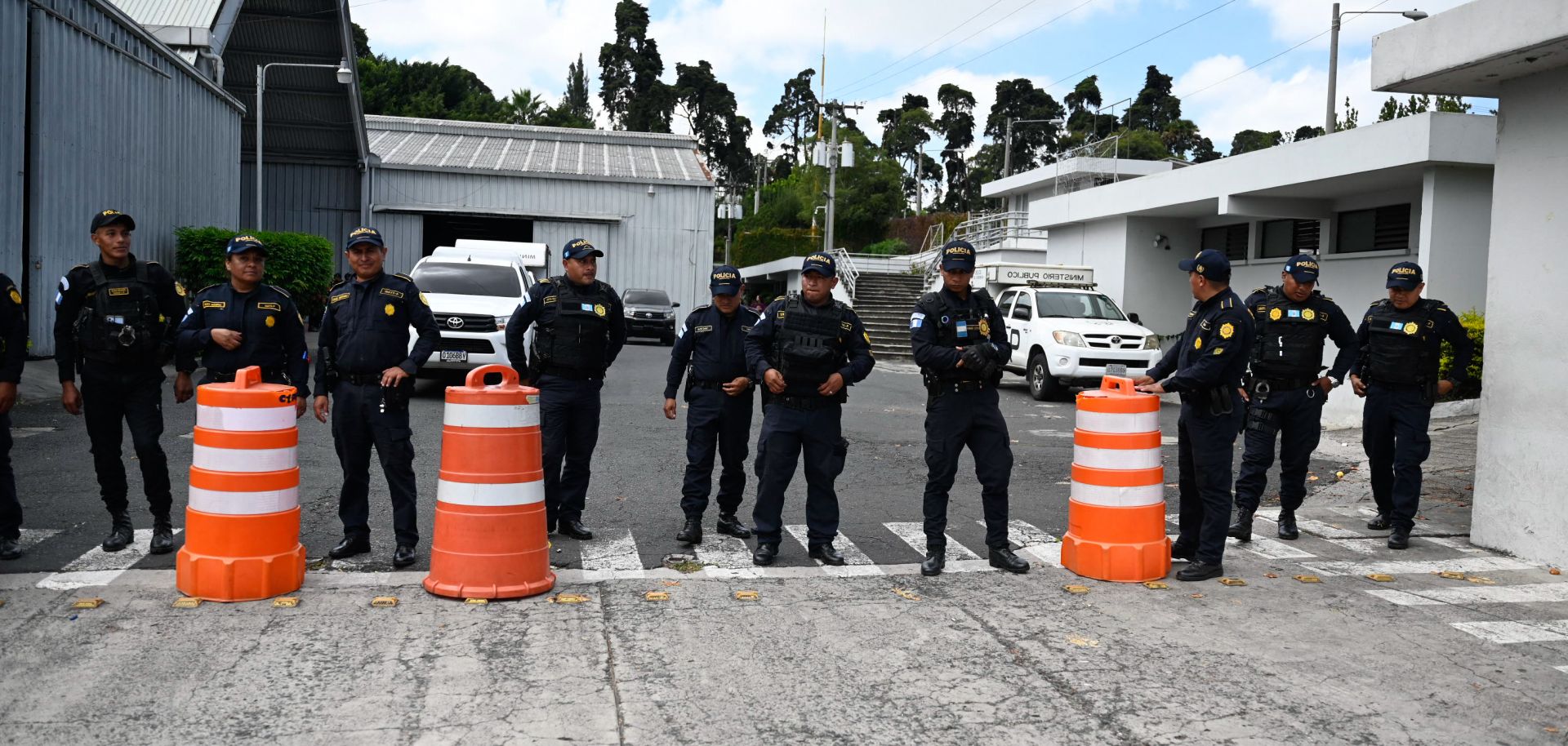
Police officers remain at the entrance of the Electoral Process Operations Center during government raids in Guatemala City on Sept. 12, 2023.
Government raids are increasing concern that officials will attempt to prevent President-elect Bernardo Arevalo from taking office, which would increase unrest and worsen relations between Guatemala and its allies. On Sept. 12, officials from Guatemala's Attorney General's office launched new raids against the offices of the country's Supreme Electoral Tribunal (TSE). The TSE alleged that during the raid, officials opened ballot boxes and photographed their contents, which a TSE spokesperson called illegal and unprecedented. At the news, Arevalo suspended his presidential transition process and called for Attorney General Consuelo Porras' resignation. The raid followed a series of similar government actions against the TSE, including multiple previous raids against TSE facilities and investigations into electoral judges and volunteer poll workers. The Attorney General's office has also ordered suspensions of Arevalo's Seed Movement party multiple times, all of which the TSE blocked from taking effect until the end of the electoral period on Oct. 31.
- Arevalo achieved a surprise second-place victory in the first round of the country's presidential election on June 25 with 11.8% of the vote after polling at around 3% ahead of the election. He campaigned on a promise to launch a crackdown on government corruption, a major concern among the Guatemalan population. Arevalo won the Aug. 20 runoff election with approximately 60% of the vote, defeating National Unity of Hope (UNE) party candidate and former first lady Sandra Torres.
- Torres, a member of Guatemala's political elite and a close ally of current President Alejandro Giammattei, has yet to publicly accept her election loss almost a full month after the vote. Her UNE party filed a complaint on Aug. 25 alleging voter fraud over the way votes were counted.
Judicial actions against Arevalo and the TSE demonstrate a rising risk that Guatemala's political elite, long accused of institutional corruption, will attempt to prevent him from taking office. Continuing actions by the Attorney General's office against the TSE suggest that Guatemalan officials may be planning to formally dispute the results of the Aug. 20 election and prevent Arevalo from taking office on Jan. 14, 2024. Such actions would most likely be driven by concern among Guatemala's entrenched political elite that corruption investigations under Arevalo's administration will target them. Political elites' sway over state institutions could enable them to successfully overturn the election results. However, significant international attention on the election and warnings from the United States, the European Union and the Organization of American States — as well as weekly peaceful pro-Arevalo demonstrations — may constrain such efforts.
- President Giammattei, Attorney General Porras and a range of other Guatemalan officials, businesspeople and political figures have repeatedly been accused of corruption and undermining anti-corruption investigations.
- Judge Erika Aifan, a well-known anti-corruption judge, left Guatemala in March 2022 and alleged being legally persecuted while investigating President Giammattei's 2019 presidential campaign.
- In June, a Guatemalan court sentenced Jose Ruben Zamora, an anti-corruption journalist and founder of the country's El Periodico newspaper, to six years in prison for money laundering. Zamora's conviction sparked condemnation by international press freedom and human rights advocates.
- Prior to the election, the Guatemalan government suspended multiple major presidential candidates, with critics alleging the suspensions constituted election interference in an effort to keep the country's political elites in power.
If Guatemala's political elites do overturn the election results, it would likely increase unrest and worsen the country's relations with foreign partners. Overturned election results would almost certainly result in a surge of anti-government unrest. The largest, most disruptive protests would likely occur in Guatemala City, where Arevalo has the largest base of support, and may spur clashes with security forces and attacks on government buildings. Additionally, Guatemala's relations with foreign partners, particularly the United States, would grow strained. In the short term, the U.S. response could include a further expansion of sanctions against Guatemalan officials. If democratic backsliding escalates, the United States could sanction specific sectors of Guatemala's economy, as previously seen in Nicaragua. Such measures could target agricultural products such as Guatemalan coffee or bananas, which make up only a small portion of U.S. imports of the products but a large portion of Guatemalan exports. However, the United States is likely to be wary of implementing measures that significantly hinder partnerships on other issues or hurt poor Guatemalans, making such measures a last resort. Additionally, Washington would likely hesitate to entirely abandon relations with the Guatemalan government, as Guatemala is an important partner on migration and regional crime, and is among the Central American countries that have expressed continuing support for Taiwan.
- Protests in Guatemala City have grown in size in recent weeks to the low thousands, with protesters alleging that officials are attempting to launch a "coup d'etat" against Arevalo.
- The United States imposed sanctions on Attorney General Porras in 2021. In July, Washington imposed sanctions on prosecutor Rafael Curruchiche, who has overseen recent raids against the TSE. More than 30 other Guatemalan political figures and businessmen were also sanctioned.
- In response to authoritarian and repressive policies by the government of Nicaragua's President Daniel Ortega over the last two years, the U.S. Biden administration cut Nicaragua's sugar export quota and issued an executive order allowing sanctions against Nicaragua's gold and mining industries.
