
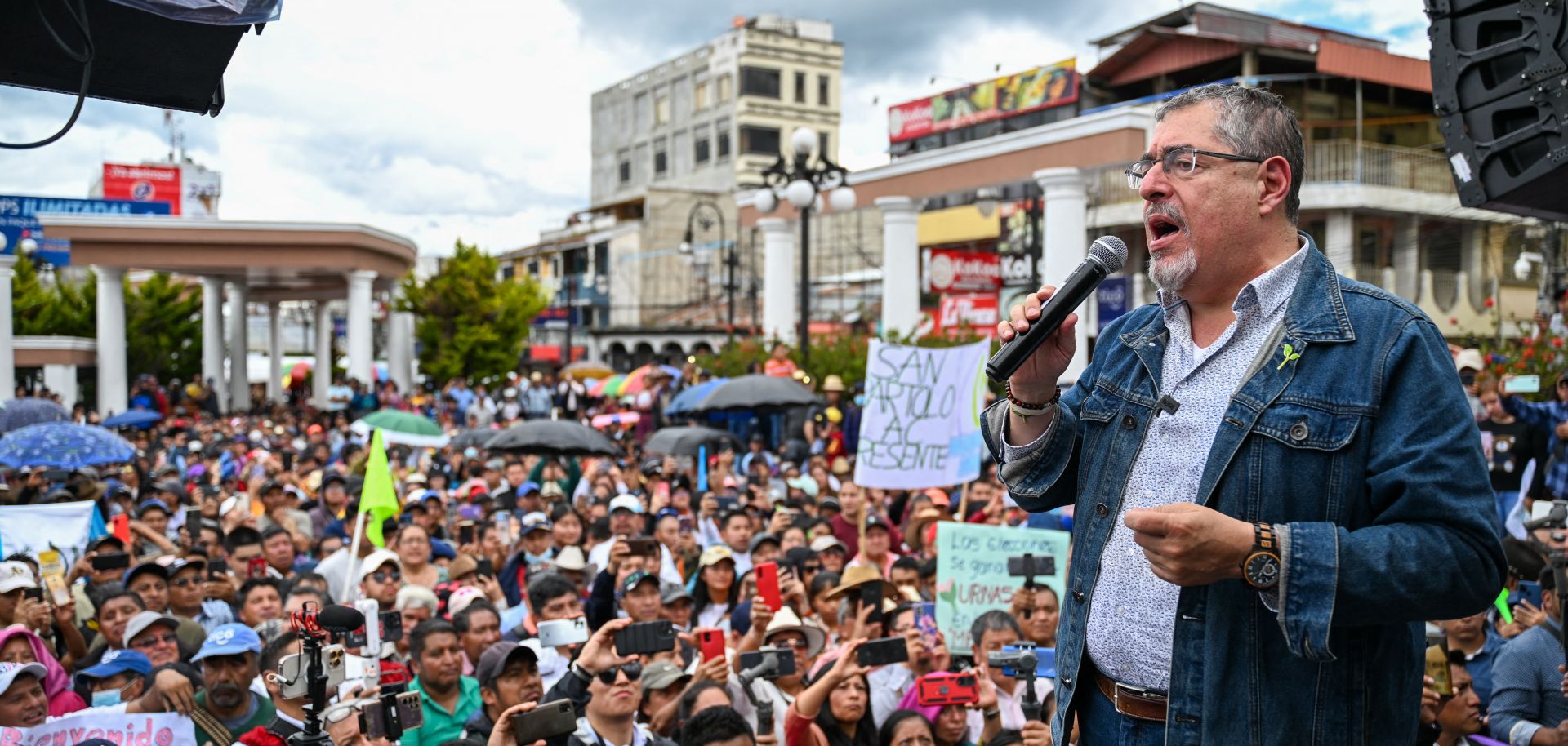
If the anti-corruption candidate wins Guatemala's presidential runoff, attempts by the country's political and economic elites to keep him from entering office could lead to social unrest and U.S. sanctions. After unexpectedly coming in second in the first round of the country's presidential election in June, leftist lawmaker Bernardo Arevalo from the progressive Seed Movement party will compete against former first lady Sandra Torres from the conservative National Unity of Hope Party (known by its Spanish acronym UNE) in a runoff race scheduled for Aug. 20. A relative political newcomer, Arevalo has campaigned heavily on rooting out corruption in Guatemala and has also promised to bring back the reformist judges, prosecutors, and journalists who have fled the country in recent years for fear of political persecution under outgoing President Alejandro Giammattei. Torres, by contrast, is a career politician who has pledged to maintain many of outgoing Giammattei's pro-business policies, as well as the strict anti-abortion law that the country's conservative Congress passed in March 2022.
- Torres and Arevalo came in first and second place, respectively, in the June 25 election, with the former securing 15.8% of the vote and the latter securing 11.8% (followed by various other presidential hopefuls who each secured 6-8% of the vote). Because neither of the top two victors received over 50% of the vote, they will compete in Sunday's runoff vote. Arevalo's victory in June surprised the country because his Seed Movement party had previously been polling at around 3%.
- Arevalo has served as a deputy in Guatemala's Congress since 2020. He is the son of the country's former leftist president Juan Jose Arevalo, who governed from 1945 to 1951 and is widely credited with laying the foundation of the country's democracy.
- Torres has run for president on four separate occasions and played an active role as first lady when her husband, former President Alvaro Colom, was in office from 2008 to 2012. Her UNE party has historically supported populist policies and campaigned on significant social welfare programs in the 2010s. But over the past decade, both Torres and her party have shifted toward the right on social issues like abortion.
- Local polling in Guatemala is often unreliable. But a study presented by the Liberty and Development Foundation, which surveyed 1,242 adults face-to-face between July 18 and 27, predicted that Arevalo would win 63% of the vote in the Aug. 20 runoff election.
- In Guatemala, presidents are elected every four years to serve a single term. The country's past three presidents have all been right-leaning, including current President Giammattei.
Guatemala's 2023 electoral cycle has been marred with allegations of interference against the country's courts and policing forces, while prominent candidates have been disqualified or intimidated. Guatemala's Administrative Litigation Court and the Supreme Electoral Tribunal suspended a number of promising presidential candidates ahead of the June 25 ballot, including Thelma Cabrera of the left-wing Movement for the Liberation of Peoples and Roberto Arzu of the conservative Podemos party. Shortly after his shock win in the first round, Arevalo also faced the threat of being disqualified, with the government prosecutor ordering on July 12 to suspend and investigate his Movimento Semilla party for allegedly falsifying signatures. But the country's Constitutional Court temporarily blocked the order the next day following a flood of criticism from Guatemalan activists and international observers, who expressed concern that banning Arevalo and/or his party posed a major threat to Guatemala's democratic process. Against this backdrop, the administration of U.S. President Joe Biden — which has focused on combating corruption in the so-called Northern Triangle countries of El Salvador, Guatemala and Honduras — has put out several statements condemning the candidate suspensions in Guatemala.
- Guatemala has traditionally struggled with corruption, as the country's political and economic elites have long had influence over the judiciary, the military and the state institutions. In 2022, Transparency International ranked Guatemala 150 out of 180 countries in its Corruption Perceptions Index.
- In a statement released on July 2, the U.S. State Department expressed that it was highly concerned by ''efforts to interfere with the June 25 election results.''
Should Torres win the election, she would likely govern with the support of the political elite and fail to introduce significant reforms to reduce corruption and improve institutional transparency. Torres' UNE party has strong support in rural areas, as well as from the ruling political elite. If she wins the Aug. 20 runoff, her administration would thus likely be able to pass policy with relative ease so long as she does not attempt to stage a significant anti-corruption push. A Torres victory would portend an orderly transition of power because the political establishment would unlikely try to interfere with the election results. A Torres victory would be the least politically disruptive outcome of the upcoming ballot, as Guatemala's ruling elite would unlikely try to interfere with the election results. It would also be the least economically disruptive scenario, as Torres has pledged to maintain the current administration's pro-business policies as well. If elected, Torres would likely seek to implement a higher degree of public spending to bolster farmers and the poor in line with her party's socialist roots, which could lead to a larger debt-to-GDP ratio. But overall, her tenure as president would not bring about significant change for Guatemala and the country would continue to see a high degree of corruption spanning the highest levels of government, the judicial system and the business sector.
If Arevalo wins, the ruling elite may seek to disqualify his victory in an effort to retain political control of the country, potentially leading the United States to levy narrow sanctions or challenge Guatemala's involvement in the Central America–Dominican Republic Free Trade Agreement (CAFTA-DR). The ruling elite may seek to prevent Arevalo from taking office if he wins the Aug. 20 runoff vote, either by claiming election fraud or by persecuting Arevalo on corruption charges. Should this occur, Guatemalans would likely take to the streets to protest the government interference, with demonstrators potentially shutting down major highways and city thoroughfares. International powers such as the United States would also likely take action against the political elite, most immediately by levying sanctions on high-level political officials that could hinder their access to offshore assets. In addition, the Biden administration would likely threaten, and potentially enact, limited economic sanctions against certain sectors of Guatemala's economy similar to its actions in neighboring Nicaragua. Should Arevalo's victory be disqualified, the White House may hint at suspending Guatemala's involvement in the 2004 CAFTA-DR as well, citing the country's failure to comply with the trade agreement's democratic stipulations. But the Biden administration would be highly unlikely to follow through on suspending Guatemala from the pact due to the risk of economic blowback and business disruptions.
- Nicaraguan President Daniel Ortega secured a controversial fourth term in the country's November 2021 election, which was widely regarded as a farce. On the day of his inauguration in January 2022, the U.S. Treasury Department and the European Union both placed sanctions on Ortega's associates. In April 2022, the Biden administration significantly cut Nicaragua's sugar export quota to the United States in response to the mass imprisonment of Ortega's public critics. This past October, the White House also issued sanctions against Nicaragua's gold and mining industries in order to further increase pressure on President Ortega over his authoritarian actions.
Should Arevalo win the runoff election and be allowed to enter into office, he would likely attempt to enact his reform agenda but ultimately be unsuccessful due to institutional blocks. The ruling elite may strategize that the best course of action in the event that Arevalo wins the Aug. 20 ballot is to allow him to enter into office in an effort to avoid the negative repercussions of interfering with the election results. Even so, Arevalo would likely face institutional challenges from the elite who control much of the country's courts system, military and Congress. In the concurrent legislative election held on June 24, Arevalo's Seed Movement party only secured 23 seats of Guatemala's 160-seat parliament. Without a majority in Congress, Arevalo would likely struggle to pass even basic policy as establishment political parties are highly likely to block his reform agenda. Arevalo would likely be able to make some headway on his anti-corruption charge, potentially by working with the United States to impose high-level sanctions on members of Guatamala's current political elite. He could also try to combat corruption by reinstating the U.N. anti-graft commission in the country that the Guatemalan government shut down in 2019. However, it remains unlikely that Arevalo would be able to complete his campaign promise to allow persecuted anti-corruption prosecutors, activists, judges and journalists to return to the country as the court system would still be able to arrest them. As such, Arevalo would probably serve as a lame-duck president and would likely be under constant threat of impeachment due to his lack of political capital.
