
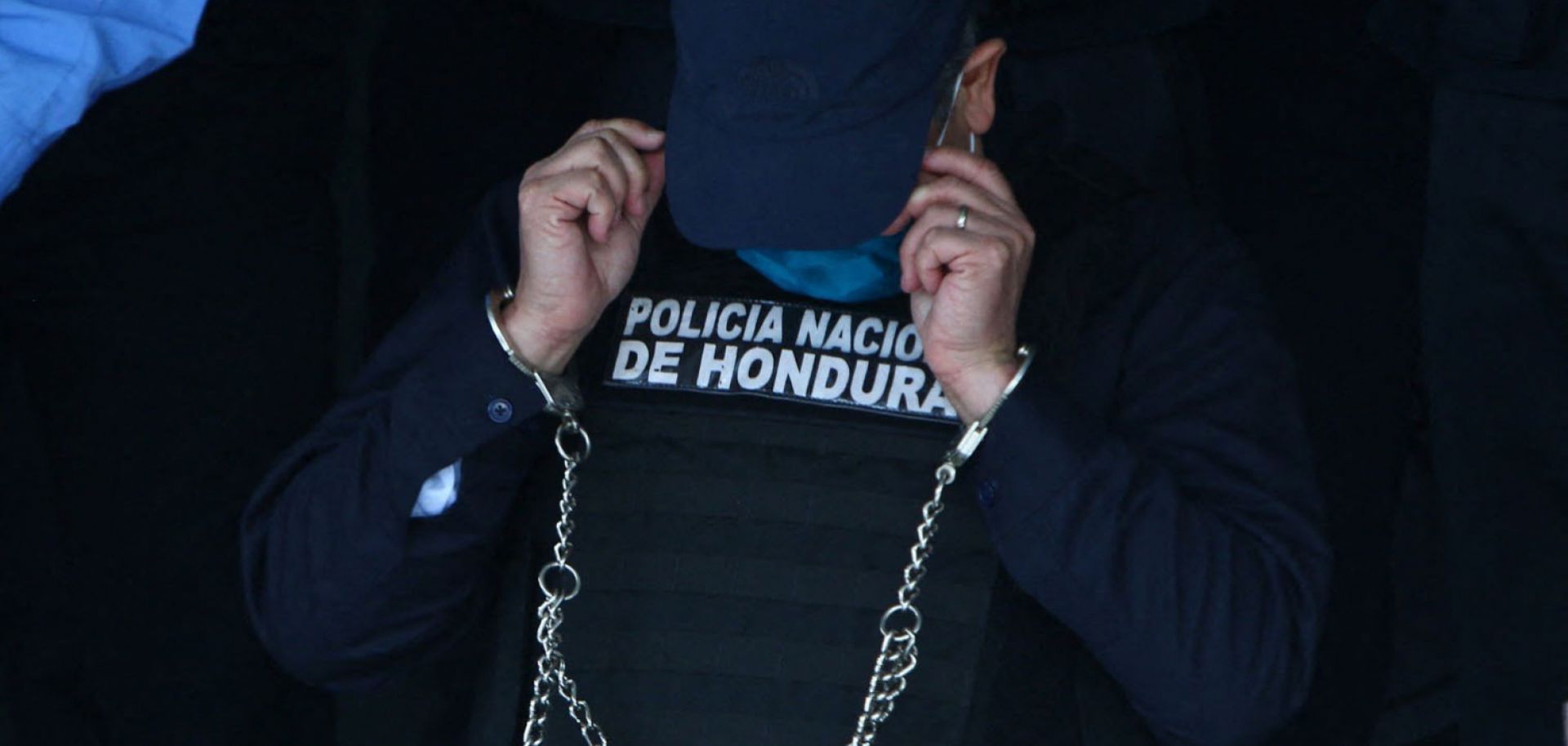
Juan Orlando Hernandez, the former president of Honduras, is seen handcuffed at the headquarters of the country’s police force in Tegucigalpa on Feb. 15, 2022. He was arrested after receiving an extradition order from the United States.
The U.S. anti-corruption push in Honduras may attract more business to the Central American country, but it’s unlikely to achieve the White House’s primary goal of curbing migration flows to the United States. Police arrested former Honduran President Juan Orlando Hernandez on Feb. 15, a day after the United States issued a request for Hernandez’s extradition over gunrunning and drug trafficking charges. Honduras’ Supreme Court is expected to rule on whether to grant the extradition request. But the legal battle over Hernandez’s extradition to the United States could span months due to the former president’s position in the Central American country’s parliament (where he’s a congressman), which offers some legal protections.
- Between 2005 and 2017, Hernandez allegedly received millions of dollars of bribes from both Central American and Mexican drug cartels and is wanted to stand trial in New York City courts.
Hernandez’s arrest and potential extradition mark a significant step in a broader U.S. push to strengthen democracy in Central America and, in turn, reduce migration flows from the region by barring corrupt individuals from political engagement. The administration of U.S. President Joe Biden has declared that corruption threatens U.S. national security, economic equity, global anti-poverty and development efforts, and democracy itself. Central America has been a key focus of this anti-graft push, with the goal of curbing the unprecedented number of migrants who have tried to cross the U.S. southern border in recent years. The White House sees corruption in Central America as one of the primary drivers of the poor quality of life that encourages people to migrate to the United States, as lackluster economic growth and widespread cartel influence are often a result of high levels of graft and political dealings with drug traffickers. In March, Vice President Kamala Harris formed a task force to lead these efforts focused on tackling the root causes of migration in Honduras, El Salvador and Guatemala.
- In June, the White House released a policy paper outlining its anti-corruption strategy, which includes curbing illicit financing, holding corrupt actors accountable, strengthening multilateral anti-corruption architecture and improving diplomatic engagement.
- U.S. immigration authorities encountered roughly 700,000 people from El Salvador, Guatemala and Honduras at the Mexico border in 2021 — up from the 400,000 such encounters reported in 2020 and the 623,000 reported prior to the COVID-19 pandemic in 2019.
- In recent years, large groups (or caravans) of migrants have periodically rushed crossing points along the U.S.-Mexico border — leading to temporary shutdowns that, in some cases, have significantly disrupted the flow of crucial goods from Mexico. In September, for example, a flood of Haitian migrants forced authorities in Del Rio, Texas, to close the border crossing there for a week.
A new like-minded government in Honduras has given the Biden administration a key ally in its regional anti-corruption push, which has so far struggled to gain traction. Over the past year, the Biden administration’s U.S. anti-corruption efforts have been met with significant pushback from the governments in Guatemala, El Salvador and (up until recently) Honduras. In response to this resistance, the White House has sanctioned high-level officials, but has been hesitant to increase pressure by imposing economic sanctions for fear of only exacerbating the financial factors driving Central Americans to migrate north. However, recently-elected Honduran President Xiomara Castro has pledged to crack down on corruption in the country. And her government, which took office in late January, has also signaled a willingness to cooperate with international anti-graft audits. This change in leadership will enable the White House to fully deploy its carrot and stick approach to rooting out graft in Honduras, which will likely include sanctioning and arresting corrupt politicians and businessmen, while simultaneously giving substantial amounts of aid and resources to the government and civil society organizations for economic development projects.
- In El Salvador, Salvadoran President Nayib Bukele has openly criticized Biden’s push to strengthen democracy in Central America. Despite initially feigned interest in the hopes of gaining more U.S. aid, Guatemalan President Alejandro Giammattei has consistently undermined the White House’s initiative over the past year by firing key anti-corruption officials, including the prosecutor who oversaw the unit tasked with fighting graft in Guatemala.
- In early July, the U.S. State Department published a list of more than 50 officials suspected of corruption or undermining democracy in El Salvador, Honduras and Guatemala. The list included high-level politicians and current cabinet members from all three Central American governments.
- Castro’s legislative coalition holds a slim simple majority, which theoretically enables her to unilaterally pass legislation but not constitutional amendments. However, a recent rupture in her own Libre Party will likely limit her government’s ability to pass legislation as factional leaders attempt to assert power — potentially affecting the government's ability to pass anti-corruption legislation. But even if the Castro administration is able to pass anti-graft measures, implementing them will likely also prove difficult amid resistance from politicians and criminal groups seeking to maintain their influence.
Ramped-up anti-corruption efforts in Honduras will create both risks and opportunities for companies operating in the region. In the short term, firms in Honduras will likely see an increased regulatory burden and frequent audits as part of anti-corruption investigations. But Central American countries are still likely to see an influx of foreign investment as part of the White House’s strategy in the region includes offering perks to companies that move their supply chains closer to the United States in an effort to avoid higher freight costs and supply chain disruptions. In the long term, this shift toward “near-shoring” — combined with more efficient anti-corruption practices and U.S. economic aid — could help industrialize Central American economies, which are currently heavily reliant on exports of raw materials.
- 71% of the chief procurement officers at clothing companies surveyed in a recent McKinsey & Co. poll said they plan to increase “near-shoring.” Eight out of the 10 respondents from North American apparel companies surveyed in the poll also said they plan to increase their company’s sourcing value share in Central America.
- Spurred by the White House’s efforts to lower migration in the region, U.S. yarn spinning company Parkdale Mills in December announced plans to build a new spinning facility and invest $150 million in Honduras. The company ultimately plans to shift roughly 1 million pounds of yarn per week away from supply chains in Asia to Central America.
The increased anti-corruption push in Honduras could inspire Guatemala to follow suit while deepening anti-democratic tendencies in El Salvador and Nicaragua. Other Central American governments will see the former Honduran president’s recent arrest and potential extradition as a sign that the United States is likely to ramp up its anti-corruption efforts elsewhere in the region. In Guatemala, growing domestic calls to address the pervasive corruption plaguing the country’s institutions has the potential to yield a new government more in line with the White House’s anti-graft efforts in next year’s general election. Conversely, U.S.-led anti-graft efforts will likely push the governments of El Salvador and Nicaragua — both of which have faced corruption allegations — to continue breaking democratic norms in an effort to thwart U.S. influence that could threaten their places in power. El Salvador and Nicaragua could also pursue greater trade and diplomatic ties to China, which is less likely to pressure governments on their corruption efforts compared with the United States.
- In late July, tens of thousands of Guatemalans took to the streets to demand the country’s president and attorney general both step down following the expulsion of the internationally renowned anti-corruption prosecutor, Juan Francisco Sandoval.
- On Feb. 14, a local investigative news outlet in Guatemala reported that President Giammattei received bribes from construction companies that helped fund his 2019 presidential campaign, citing an anonymous witness’s testimony. Since then, two assistant lawyers serving on the special prosecutor’s anti-corruption task force (which Sandoval formerly headed) have been arrested and another five have quit.
Anti-corruption efforts alone are unlikely to curb high migration flows to the United States, though they may become more effective in tandem with increased economic opportunity and security measures. Corruption is only one of the factors pushing Central Americans to flee their home countries; others include a lack of job opportunities, poor security conditions and high rates of gang activity. While the U.S. anti-corruption efforts may curb graft and strain ties between governments and criminal groups, they will only be effective if they’re implemented in tandem with measures that also address these other factors. Significantly decreasing rates of violent crime and boosting economic opportunities, however, would likely require decades of effort and significant cooperation from Central American governments — some of which have already indicated they are unwilling to cooperate with the United States. Moreover, future U.S. governments may be less inclined to focus on the region, potentially enabling Central American governments to backtrack on progress made.
