
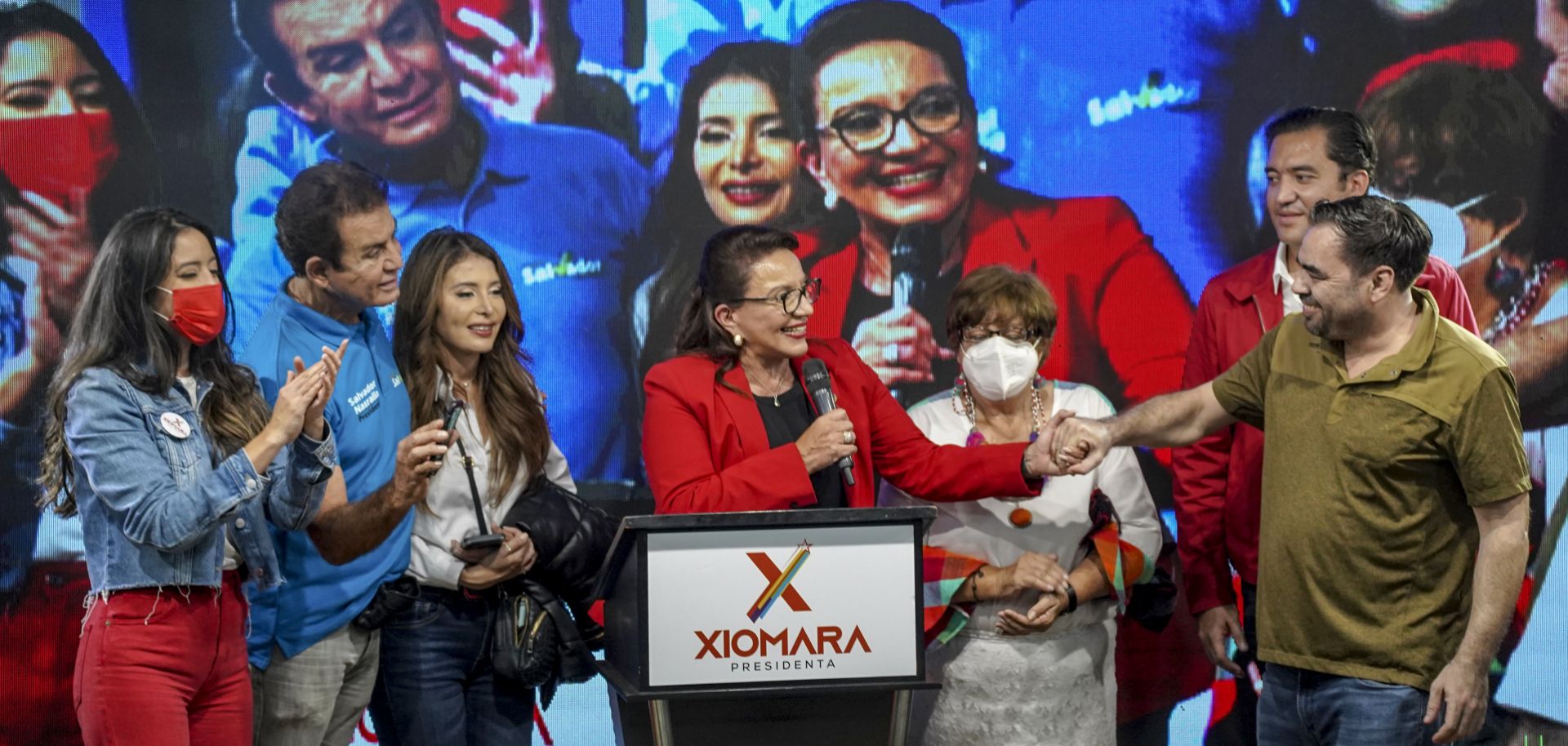
Honduran presidential candidate Xiomara Castro (third from right) speaks at a press conference on Nov. 28, 2021, in Tegucigalpa, Honduras.
While she’ll likely struggle to pass domestic reforms, Honduras’ new president could significantly alter the country’s international policy, potentially switching diplomatic relations from Taiwan to China. Former first lady Xiomara Castro from the leftist Freedom and Refoundation Party (Libre) is set to become Honduras’ next president after opposition candidate Nasry Asfura from the right-wing National Party conceded defeat in the country’s recent presidential election. Castro will take office on Jan. 27, assuming Honduras' electoral authority officially declares her president, which is highly expected.
- In mid-October, Honduras’ two strongest-polling political parties — the Liberty and Refoundation Party and the Savior Party of Honduras — announced an alliance to support Castro’s presidential bid in the country’s Nov. 28 election.
- The election marks the end of 12 consecutive years of National Party leadership in Honduras, returning to a leftist presidency for the first time since Castro’s husband Manuel Zelaya was ousted in a 2009 coup.
Legislative opposition will likely impede Castro’s ability to implement her expansive platform of domestic reforms. Current President Juan Orlando Hernandez will likely push through political appointments (including, potentially, a new central bank chief) and legislative action in an effort to maintain political influence after he leaves office in January. While the votes are also still being counted from the concurrent Nov. 28 legislative election, the economically conservative National Party and the like-minded Savior Party of Honduras both appear set to win a significant amount of seats. This could further complicate Castro’s ambitious policy agenda, which emphasizes anti-corruption, transparency and security reforms.
- Castro, a self-described democratic socialist, has berated the militarization of the country’s police and heavy-handed law enforcement tactics, suggesting that law enforcement activity involving civilians should be separate from militarized anti-gang efforts.
- The legislative election, the results of which have not yet been called, could return many of the National Party’s 61 legislators to Congress.
Castro will be better able to change international relationships if desired, including possibly switching diplomatic alliances from Taiwan to China, which may influence other regional countries to follow suit. On the campaign trail, Castro’s Libre party announced that she would seek to establish formal diplomatic relations with Beijing as president. But neither Castro nor her party has committed to a stance on China since winning the election. In an effort to win over Honduras, China will likely send representatives to discuss potential investment deals, loan opportunities or infrastructure development. However, the United States is also likely to court Castro with proposals for cooperation in exchange for retaining relations with Taipei. Should Honduras switch diplomatic alliances, it may prompt other regional countries to consider doing the same in an effort to boost domestic economic development. This may particularly affect Guatemala and Paraguay, which have both recently signaled their discontent with Taiwanese allegiance after China championed vaccine diplomacy in the region.
- The Taiwanese government congratulated Castro on Nov. 30, stating that Taiwan would attempt to work with the administration to “deepen relations on the basis of their long-standing friendship with the country.”
- A switch in diplomatic relations was initially part of Libre’s campaign platform, but the party has avoided defining that position since aligning with the pro-Taipei Savior Party of Honduras.
- The Caribbean and Latin America are home to 9 of the 15 countries that retain formal diplomatic relations with Taiwan. In addition to Honduras, Belize, Guatemala, Haiti, Nicaragua, Paraguay, Saint Kitts and Nevis, Saint Lucia, and Saint Vincent and the Grenadines have yet to switch diplomatic alliances. In light of the Honduran election results, Belize affirmed its “steadfast” support for Taiwan while other regional governments did not issue statements on the matter.’
