
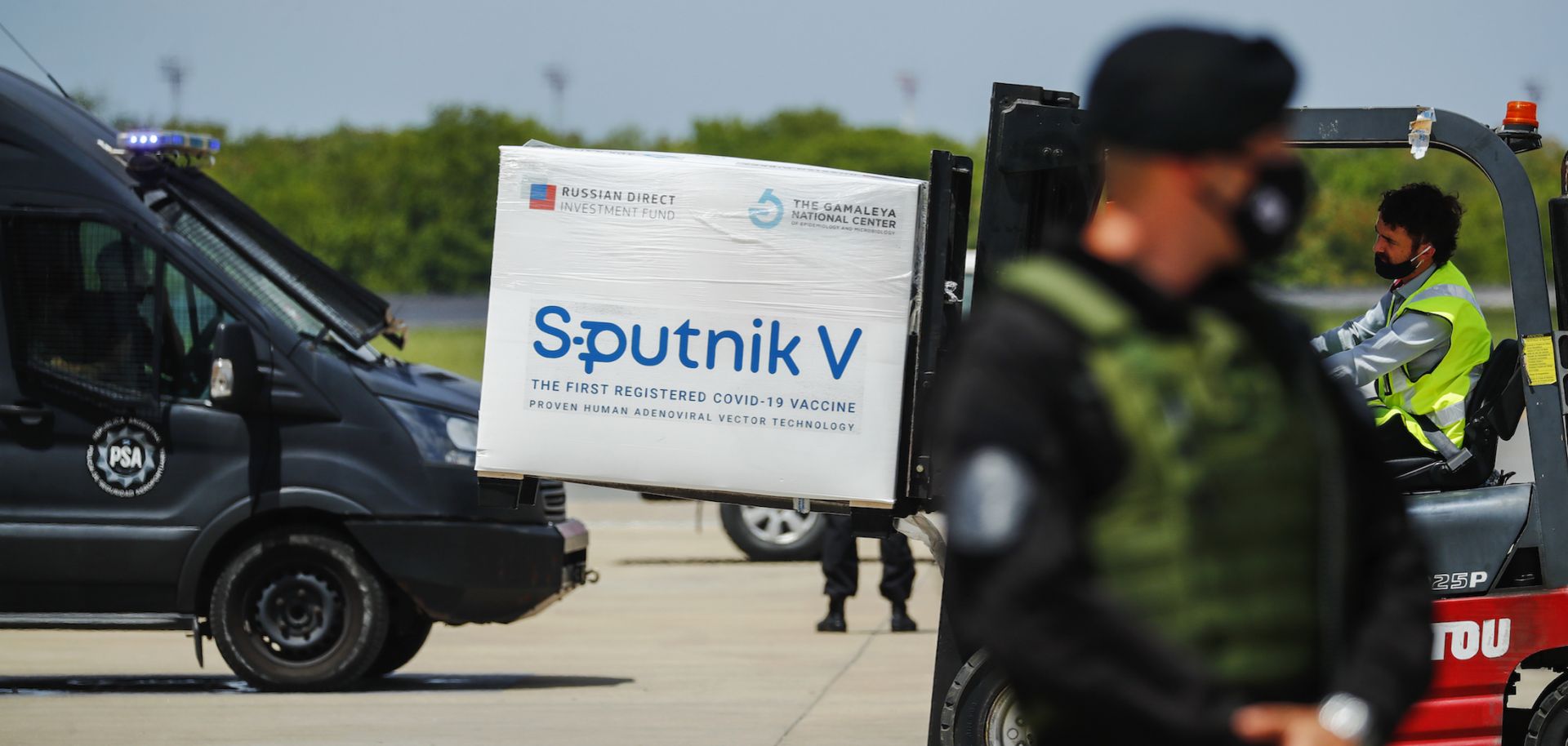
A member of the airport police stands guard as a forklift unloads a container full of Russia’s Sputnik V COVID-19 vaccine from a plane in Ezeiza, Argentina, on Jan. 16, 2021.
A delay in shipments of Russia’s COVID-19 vaccine will likely push back inoculation timelines in Latin America, testing the future electability of politicians who were hoping to quickly roll out the vaccine. On Jan. 27, Russia announced that shipments of its Sputnik V vaccine to a number of countries will be delayed by two to three weeks. Argentina, Bolivia, Venezuela, Mexico and Paraguay will all be impacted, having already purchased significant quantities of the vaccine. Argentina, meanwhile, will receive shipments on an altered schedule. The delay is due to the facilities in Moscow expanding their production capacity in the hopes to meet growing global demand. Argentina was the first country to buy a significant amount of doses of Russia’s Sputnik V, but the vaccine’s popularity in the region spread due to its affordability and availability.
- The promised fast availability that Sputnik V offers is far more appealing than that of its competitors, even with the recent delays. With the exception of Mexico’s shipments, the majority of Sputnik V shipments were supposed to arrive in the first quarter of 2021. The main alternative in the region, AstraZeneca, will not release doses to most countries until midway through the year as it fills early purchase contracts from other countries first.
- According to the Russian Direct Investment Fund, the price per dose of the Sputnik V vaccine, which will be paid by governments, is $10, making it more affordable for Latin American economies currently in recessions. The price is significantly lower than China’s Sinovac vaccine ($30 per dose) and Pfizer’s vaccine ($20 per dose). AstraZeneca’s vaccine, however, remains the most economical option at just $4 per dose.
- On Feb. 2, The Lancet published trial results showing Russia's Sputnik V vaccine provided around 92% protection against COVID-19. Previously, there was controversy surrounding the vaccine’s safety and efficacy, given the little data Russia had released from clinical trials. Despite these concerns, however, many governments were nonetheless inclined to purchase Sputnik V doses in an effort to begin the vaccination process.
Five Latin American countries purchased large quantities of the vaccine and four are heavily reliant on shipments of Sputnik V in the first quarter of 2021 to jumpstart their inoculation campaigns. The weeks-long delay will make it more difficult to keep up with ambitious vaccination schedules. Argentina, Bolivia, Mexico, Venezuela, and Paraguay have bought significant amounts of the vaccine to support inoculation efforts. Mexico has purchased large amounts of other vaccines, lessening its dependence on Sputnik V. Conversely, Russia’s Sputnik V makes up at least 50% of doses ordered for the other four countries.
- Argentina purchased 24.3 million doses of Sputnik V, making up a little under half of the country’s total vaccine purchases. Russia’s vaccine is currently the only one in circulation in Argentina, with more than 375,000 already vaccinated and a shipment of 220,000 doses entering the country on Jan. 29 (though this is down from the originally scheduled 600,000 doses).
- Bolivia purchased 5.2 million doses of the vaccine, making up over half of the country’s total vaccine purchases. Similar to Argentina, the vaccine will be the first one in circulation in Bolivia, with a shipment of 20,000 doses landing in the country on Jan. 29. The first parts of AstraZeneca’s shipments are also due to arrive in April.
- Venezuela purchased 11 million doses of the vaccine, though none have been delivered. This might eventually be enough to make a dent in inoculating the country’s 28.5 million people. But Venezuela is being asked to pay for the almost 2 million doses being offered by the traditionally donation-based COVAX program backed by the World Health Organization (WHO), as well as China’s apparent reluctance to provide vaccines to Caracas, mean that the autocratic administration of Venezuelan President Nicolas Maduro will be reliant on Russia to provide the vaccine necessary to quell potential fodder for the opposition.
- Paraguay purchased 3 million doses of Sputnik V vaccine, a significant amount in vaccinating the country’s 7 million people. The first doses, which originally were supposed to hit the country in February, will now be distributed in March.
Delays in vaccine shipments will likely lead to further social unrest, anti-incumbent sentiment and extended economic recessions in countries where leaders have promised quick vaccination campaigns. Across Latin America, populations are growing tired of on-and-off lockdowns, financial strain and failing healthcare systems. Social unrest is growing, with activists in various countries demanding that politicians pursue aggressive vaccination campaigns. Additionally, economies will likely experience prolonged pain due to extended social distancing measures. For many leaders, the ability to say that inoculation has started is crucial in claiming success in their fight against the pandemic — especially for Argentina and Mexico, which are both holding important legislative elections later this year. The delay in shipments of the Sputnik V vaccine will only fuel anti-government sentiment in countries like Venezuela, Mexico and Brazil, where many hospitals have already reached or are nearing capacity. Vaccine campaigns are almost always plagued with delays at the beginning and take time to hit their stride. However, given the rising pressure and the potential for vaccine nationalism to increase in the near term, Latin American leaders will see rising internal pressure to buy large quantities of vaccines and pursue aggressive vaccination campaigns. With vaccine manufacturers operating at capacity to fill the orders of other countries, leaders will likely be forced to further rely on Russia’s Sputnik V vaccine.
