
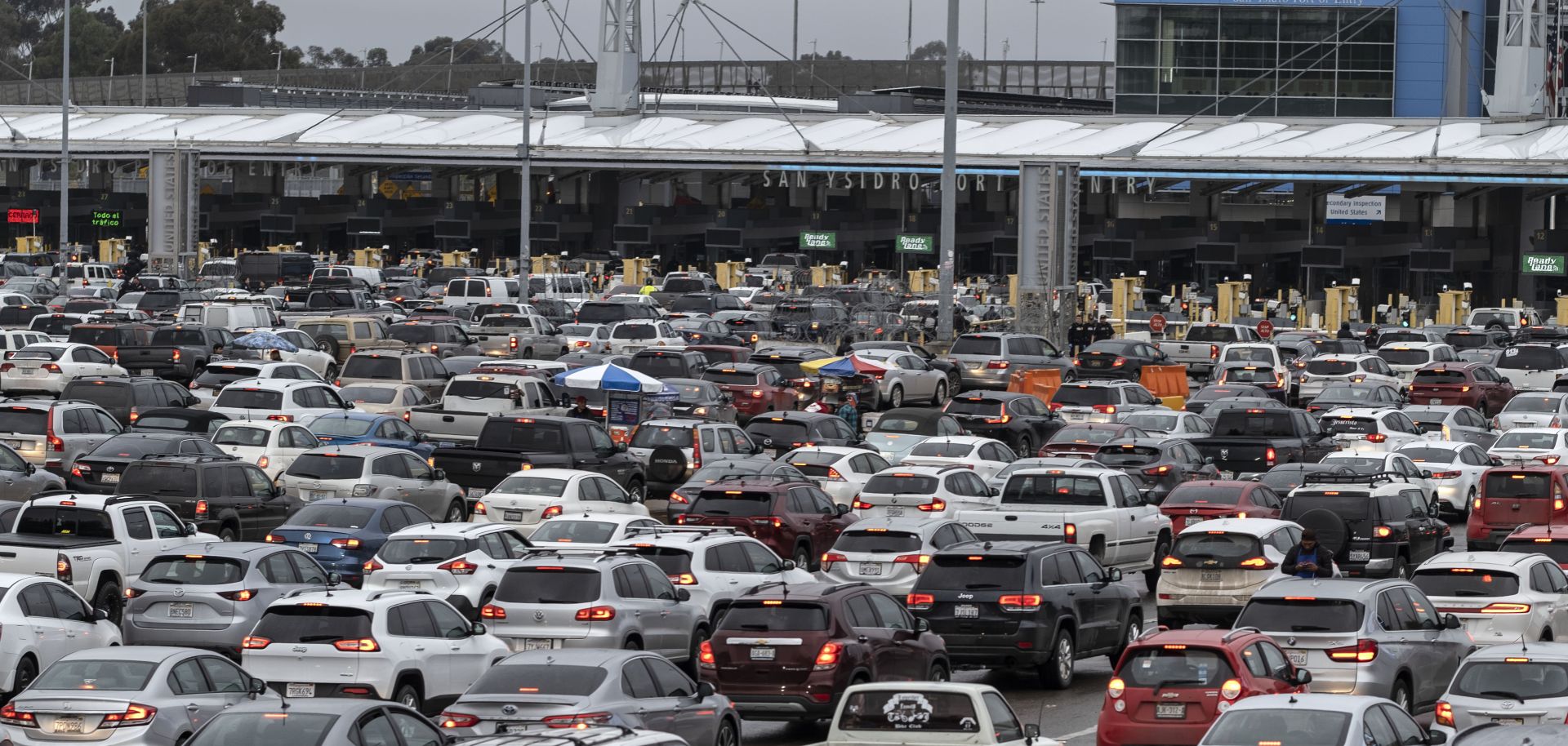
Cars line up on the Mexican side of the San Ysidro crossing port at the U.S.-Mexico border in Tijuana, Mexico, on March 12, 2020.
The compounding crises of 2020 will likely contribute to a new wave of immigrants from hard-hit Central American countries. While previous surges of migrants in 2018 and 2019 contributed to significant disruptions along the U.S.-Mexico border, a repeat of those episodes in 2021 is unlikely. But addressing the many security challenges that still plague the United States’ southern border will require working more deeply with Mexico on a long-term solution.
Immigration and the status of the U.S.-Mexico border will be among the policies to see the most dramatic shifts in approach once U.S. President-elect Joe Biden takes office in January 2021. The distinction between Biden and outgoing U.S. President Donald Trump’s rhetoric on immigration is as stark as it is relevant, with the latter campaigning on his signature border wall and using a flurry of executive orders to block, slow down and deter immigration. Biden, by contrast, has promised to defund the ongoing construction of the border wall, as well as reform the U.S. immigration system to make it more efficient and create pathways to citizenship for millions of undocumented immigrants currently in the United States. But as immigration constraints related to both the COVID-19 pandemic and Trump’s aggressive policies weaken, Biden could soon find himself facing another surge of Central American migrants at his country’s southern border.
Changes to Immigration Patterns
The U.S.-Mexico border is one of the longest and busiest in the world. In 2018, 500,000 people and $1.7 billion worth of goods crossed the nearly 2,000-mile border every day, according to the U.S. Bureau of Transportation Statistics. Mexico is the United States’ third-biggest trading partner behind Canada and China; U.S. consumers and manufacturers are also heavily reliant upon the dozens of road and rail networks that connect the two countries along the border. Consumers and manufacturers were thus concerned when surges of migrants from Central America caused disruptions to the movement of people and goods across the U.S.-Mexico border in 2018 and 2019. Trump also threatened to place tariffs on Mexican goods if migrant flows through Mexico didn’t decline.
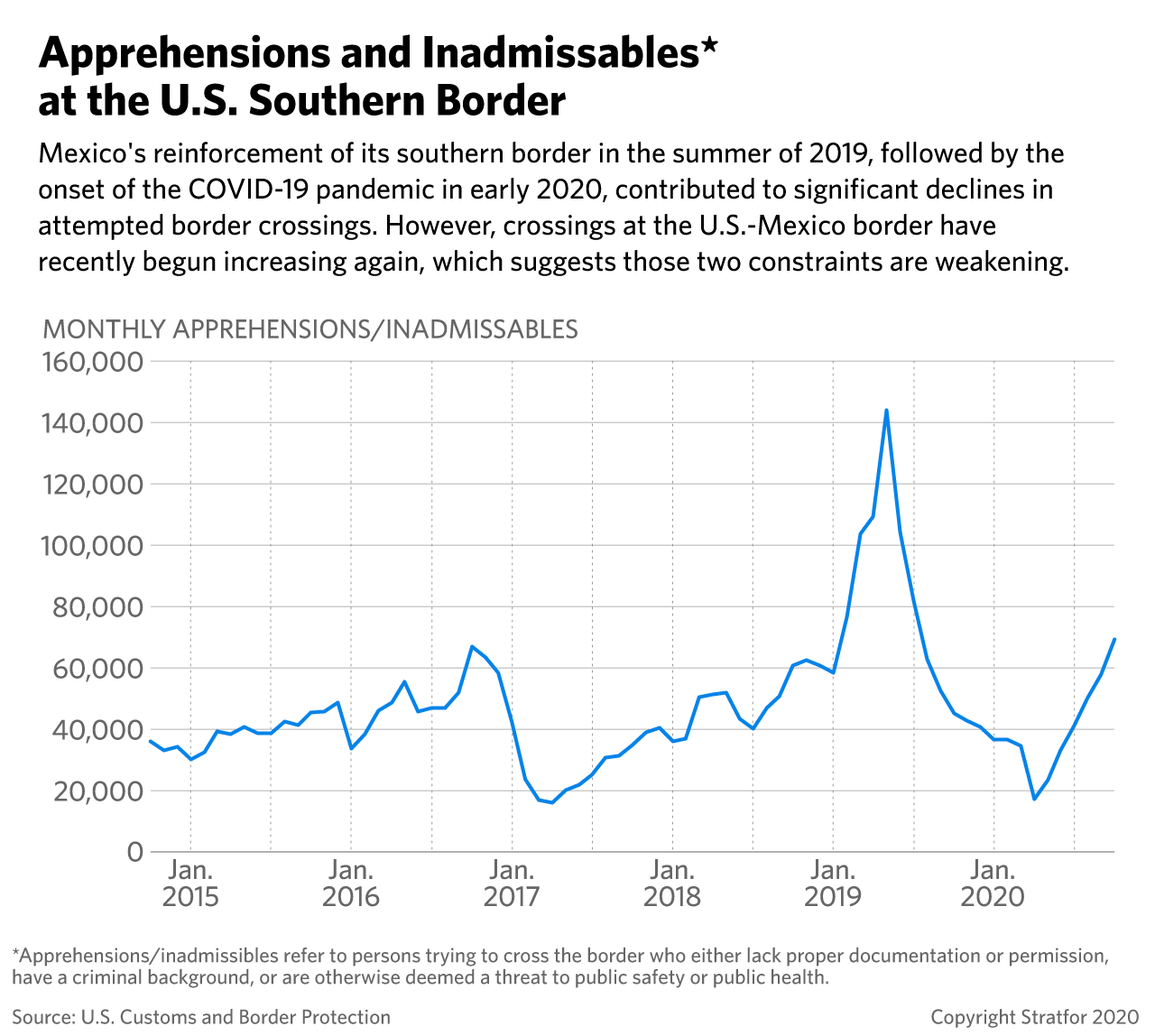
Immigration along the southern U.S. border has changed dramatically over the course of the 21st century. In 2000, Mexican nationals accounted for 98% of U.S. Customs and Border Protection (CBP) apprehensions along the U.S.-Mexico border (while imperfect, apprehensions are an approximate indicator of how many people are attempting to cross the border illegally). Since 2000, CBP apprehensions of Mexican nationals have been declining, while apprehensions of nationals from Guatemala, Honduras and El Salvador (the three Central American countries that make up what’s known as the Northern Triangle) have been increasing. Now, Guatemalans and Hondurans both outnumber Mexicans in apprehensions at the border, with El Salvadorans in fourth place.
The Push and Pull
These changes have made Central America much more relevant to future waves of migration. Poverty, crime and corruption already provided Guatemalans, Hondurans and Salvadorans plenty of incentives to emigrate before 2020, as evidenced by the years-long upward trend in apprehensions of Northern Triangle nationals along the U.S.-Mexico border. But the economic fallout from the ongoing COVID-19 pandemic, combined with back-to-back major hurricanes in November, has further worsened living conditions in the Northern Triangle, especially for the poorer, marginalized segments of society that were already more likely to attempt the arduous journey north to the United States. The World Bank is projecting negative GDP growth of 8.7%, 7.1% and 3% for El Salvador, Honduras and Guatemala, respectively, for 2020.
The factors pulling migrants to the United States are also set to strengthen in 2021. First and foremost, those considering immigrating to the United States will feel they have a better chance of entering and staying in the country once Biden takes office compared with the past four years under Trump. Second, the U.S. economy has always been a strong pull for migrants from all over the world. But the expected fast timeline for the U.S. economic recovery in 2021 will make the United States that much more appealing to those seeking work. Part of that economic success is also based on the anticipation of widespread access to COVID-19 vaccines by the second half of 2021. Marginalized, impoverished populations in Central America may assess that their chances of receiving a COVID-19 vaccine are higher in the United States than in their own hometown — an incentive that could convince them to overcome fears of exposure to the virus during the risky journey north.
Constraints on Migration
Trump’s campaign pledge to build a wall between the United States and Mexico was his highest-profile policy aimed at addressing unauthorized immigration. But his deal with Mexican President Andres Manuel Lopez Obrador in 2019 to reinforce Mexico’s southern border, along with the unexpected COVID-19 pandemic, have so far had a much more dramatic impact on reducing illegal immigration. Between May and October 2019, the Mexican government deployed thousands of newly minted National Guard forces to its southern and northern borders to reinforce existing military efforts aimed after Trump threatened to impose tariffs on Mexican exports to the United States. Over that same time period, CBP apprehensions at the US.-Mexico border declined by two-thirds, suggesting that attempted unauthorized border crossings returned to more normal levels. The onset of the COVID-19 pandemic in early 2020 has since further reduced border apprehensions to record lows. A combination of public concern, stay-at-home orders and a freeze on nonessential personal border crossings similarly impacted authorized travel, with border crossings plummeting from 24 million in December 2019 to just under 8 million in April 2020.
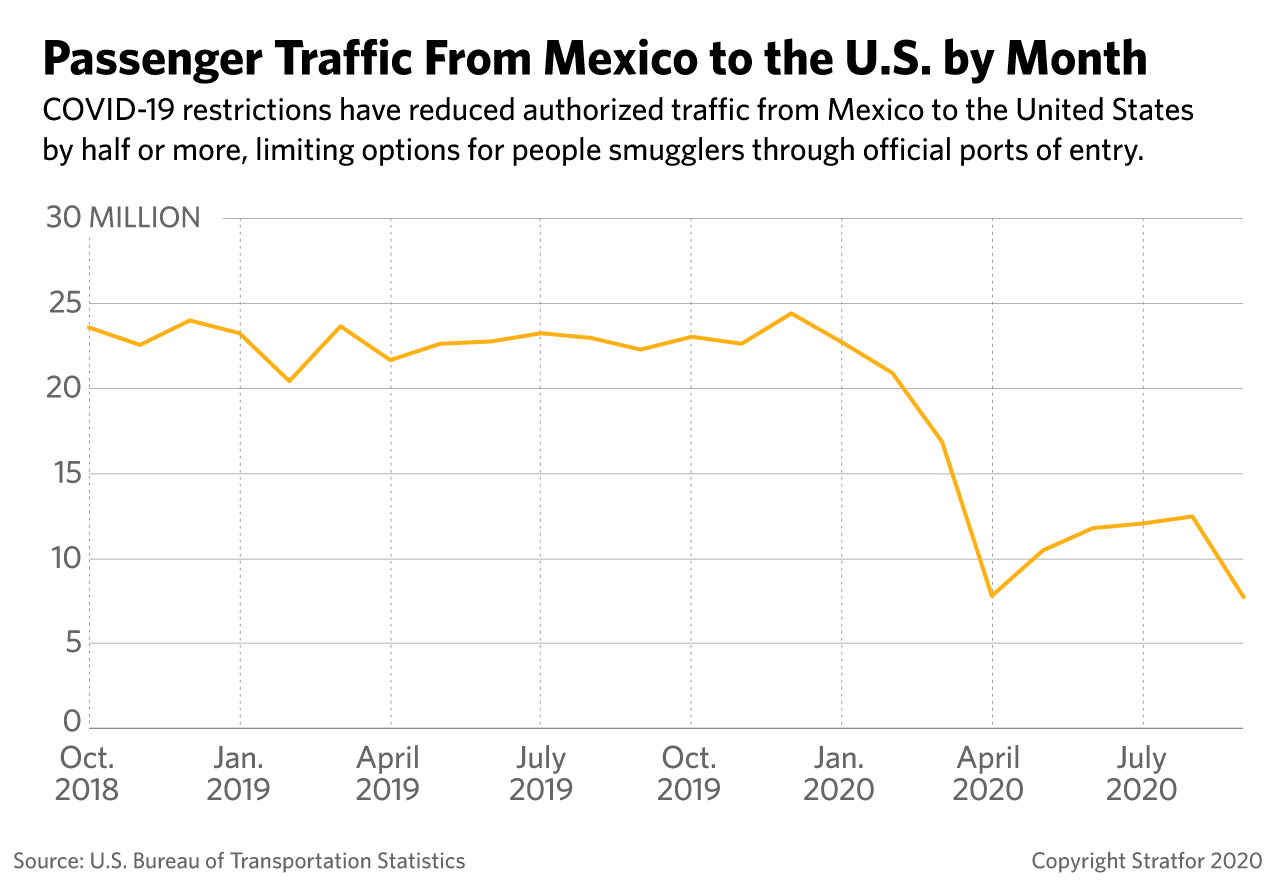
But these forces that contributed to an overall decline in border activity are not permanent. First, Biden will likely upend Trump’s efforts to shift the migration burden onto Mexico via threats and personalized deals. And second, COVID-19 vaccines are likely to be widely available by the second half of 2021 in the United States and other developed nations. As greater immunity alleviates fears of infection and death, local officials will lift restrictions on the movement of people, prompting the United States, Canada and Mexico to eventually reopen their borders. The subsidence of concerns over contracting the virus and return to normal levels of traffic will create more opportunities for smugglers and human traffickers to bring unauthorized individuals into the United States.
Mexico’s Role
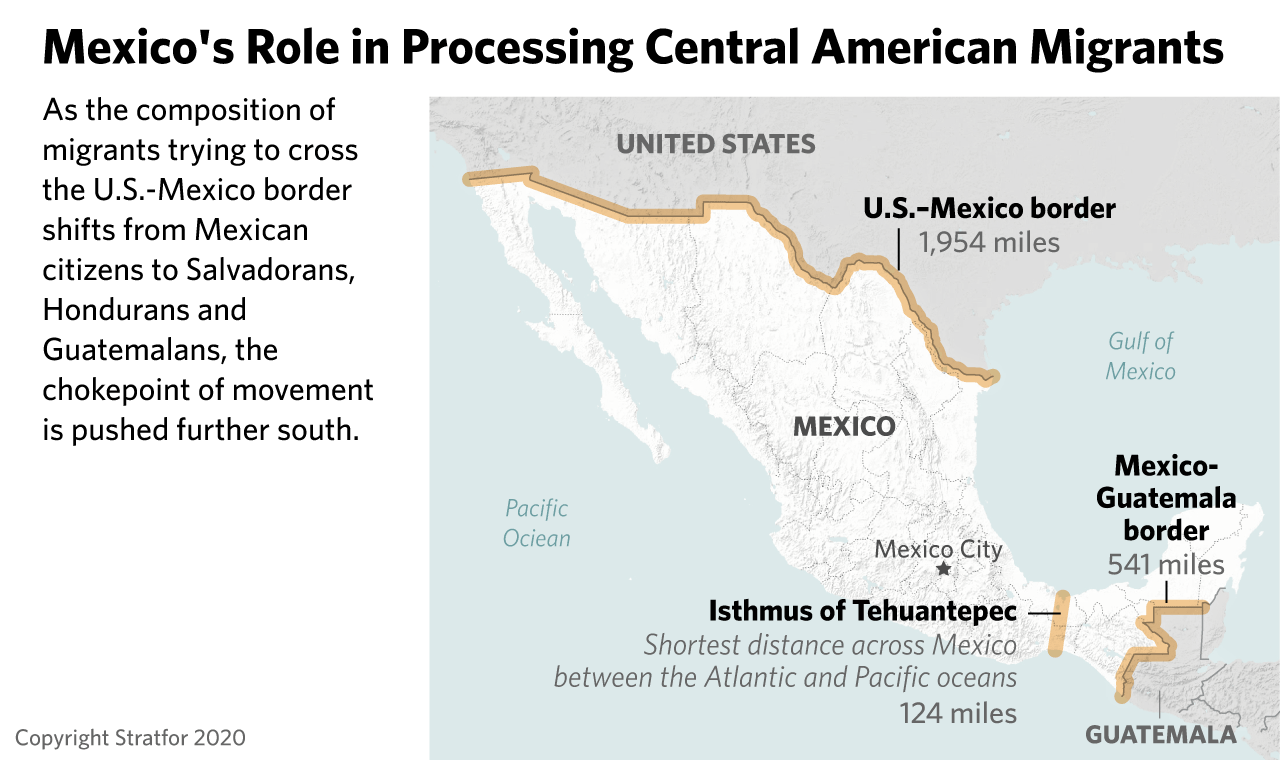
As the constraints to immigration along the U.S.-Mexico border weaken, 2021 could see a repeat of the border disruptions seen between 2018 and 2019, depending on how heavily Mexico and the United States respond to the expected surge in migrants from Northern Triangle countries. Once the primary source of migrants at the U.S. southern border, Mexico is now largely a transit country for Central Americans seeking entry to the United States. Between 2016 and 2019, Northern Triangle nationals outnumbered Mexican nationals in apprehensions. Mexico also fell from first to third (behind Guatemala and Honduras) as a source of nationals attempting to immigrate illegally. This has, in turn, made Mexico’s southern border with Belize and, more importantly, Guatemala, a focal point when it comes to U.S. immigration from Mexico.
The 124-mile wide Isthmus of Tehuantepec, which spans the Mexican states of Oaxaca and Veracruz, is a far more strategic chokepoint for stopping migrants from the Northern Triangle than the borders Mexico shares with both the United States and Guatemala. Since 2014, Mexico has deployed military units and established thousands of checkpoints between Guatemala and the Isthmus of Tehuantepec in an effort to apprehend and deport migrants from Northern Triangle countries. This effort will continue regardless of who is in the White House, meaning there will be basic infrastructure in place to limit migration from Guatemala, Honduras and El Salvador — especially as the COVID-19 pandemic remains a top priority for the Mexican government.
But without U.S. threats or incentives to stem a flow of migrants moving through Mexico to the United States, Mexico cannot be guaranteed to defend its southern border in 2021 and beyond with the same vigor that contributed to the rapid decline in attempted migrations in 2019. The incoming Biden administration will likely remove some of its predecessor’s executive orders that slowed down the asylum application process and enhanced border security efforts. This will prompt more Central Americans to migrate to the United States, increasing pressure on Mexican security forces trying to stop them from moving north.
The Mexican government, meanwhile, will have less incentive to block these Northern Triangle migrants from reaching the United States as Biden’s more lenient policies reduce the threat of U.S. retaliation, while the distribution of vaccines reduce the threat of migrants spreading COVID-19 in Mexico. Mexico also has plenty of other security threats requiring its finite federal security resources, including a record-high murder rate, rampant fuel theft from its national energy company, and powerful criminal organizations competing with the state over territorial control.
A New Approach Under Biden
But even if renewed migration incentives spark another surge of unauthorized crossings along the U.S.-Mexico border, the widespread disruptions to border activity seen in 2018 and 2019 are unlikely under the Biden administration. While Trump administration policies appear to have deterred immigration, they also contributed to increased tensions. In November 2018, for example, thousands of Central American nationals seeking asylum in the United States protested along the California border in the Mexican city of Tijuana, resulting in U.S. border security forces firing tear gas in an attempt to disperse the crowds. U.S. Customs and Border Protection (CBP) closed the nearby San Ysidro port of entry (one of the busiest along the border) to enhance security measures and prevent protesters from rushing the border. As apprehensions of unauthorized immigrants along the U.S.-Mexico border climbed dramatically, Trump then threatened to close the entire border in 2019. While that threat never materialized, CBP did deploy agents away from border checkpoints to border patrols, slowing down commercial and passenger traffic and causing days-long delays that threatened those strategic supply chains.
The 2019 threats to shut down the border and delays at border crossings were the product of the Trump administration’s efforts to force Congress to approve funding for his border wall project. But President-elect Biden has criticized these more aggressive tactics and has promised to reverse Trump’s executive actions on asylum. Compared with Trump, Biden is also more likely to seek a comprehensive strategic deal that addresses the underlying issues compelling people to flee the Northern Triangle countries, rather than rely on threats to motivate Mexico’s actions along its own southern border. An agreement between the United States, Mexico and Central American countries on humanitarian aid, technical assistance and infrastructure development in the Northern Triangle that incorporates Mexico’s proximity to the region would be a more sustainable solution to addressing migration issues. Such an agreement is unlikely to come quickly, but if there are early signs of progress and prioritization of such a deal during the initial months of the Biden administration, it would likely sustain Mexico’s efforts to stem migration along the southern border, thus alleviating pressure on the U.S.-Mexico border.
But the strategic significance and political contentiousness of the U.S.-Mexico border means that other types of crises are still possible. Unmitigated surges in migrants could overwhelm an already understaffed U.S. Border Patrol, potentially disrupting personal and commercial traffic at certain ports of entry. Conservative opposition in the United States could thwart the Biden administration’s ability to either pass comprehensive immigration reform or pursue a more holistic strategy that addresses the source of migration flows from Central America. While Biden is expected to bring a different policy approach and style of governance to the U.S.-Mexico border, the historical and compounding challenges introduced in 2020 make a comprehensive solution very unlikely in 2021.
