
Editor's Note: For geopolitically significant elections, RANE publishes detailed scenario analyses that outline potential outcomes of the vote and their various domestic and international implications. Our previous scenario analyses have covered elections in Germany, Canada, Australia, Poland, South Korea, Japan, Guyana, Norway, Moldova, the Netherlands, Chile and Bangladesh.
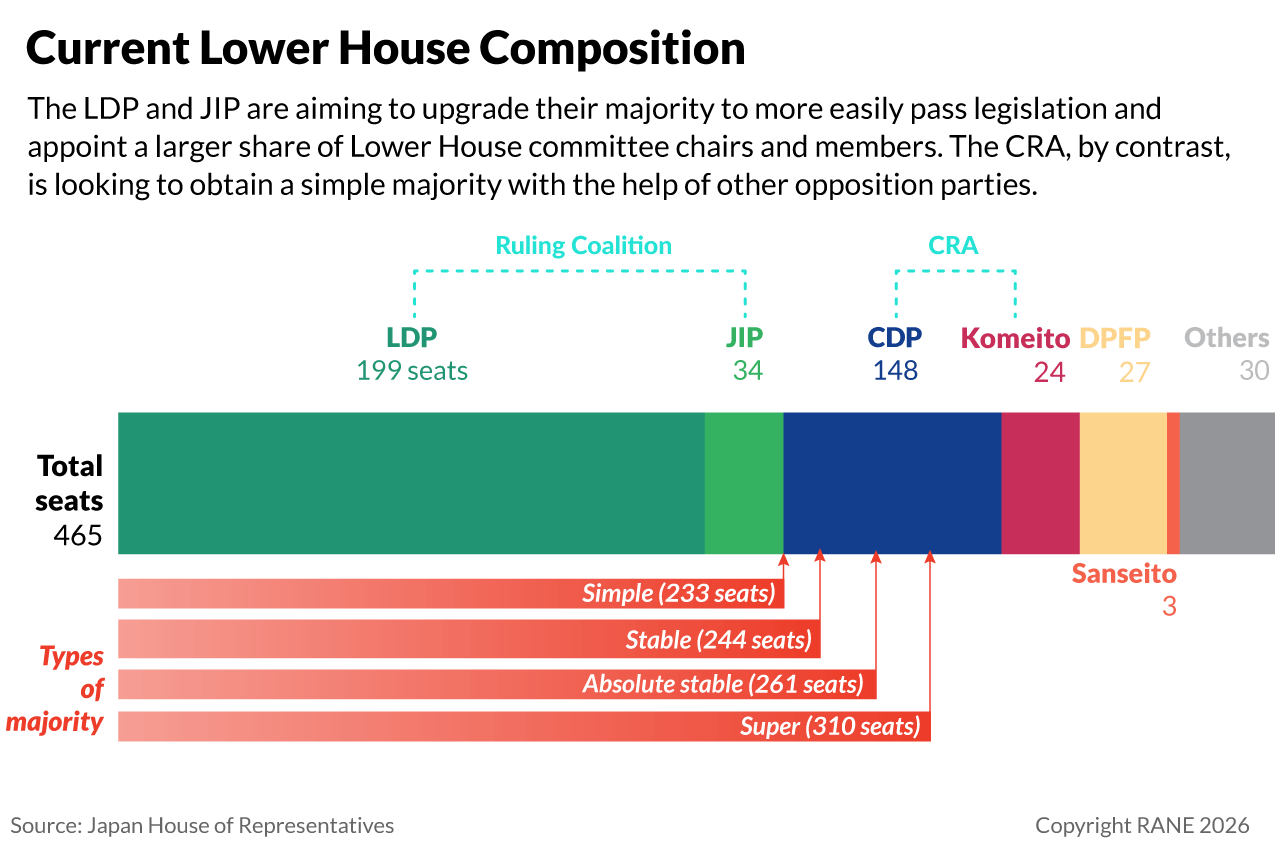
Following Japanese Prime Minister Sanae Takaichi's Jan. 23 dissolution of the more powerful lower house of Japan's Diet, Japanese voters will go to the polls on Feb. 8 after a record-short 16-day campaign period. Takaichi came into office in the October 2025 leadership election of her ruling conservative Liberal Democratic Party (LDP) by tapping into surging popular support for conservative populism. However, in the process, she lost the LDP's 26-year coalition partner, the center-left Komeito, and gained a new, untested partner in the Kansai-based conservative Japan Innovation Party (JIP). After political horse-trading, she was able to piece together the smallest possible majority in the lower house (233 seats) with the JIP, but opposition parties still chair eight out of 17 powerful lower house standing committees, including the crucial Budget Committee. Riding a honeymoon period of public support following her October election, pledges to cut taxes and a rally-around-the-flag effect from growing tensions with China, Takaichi decided to call snap elections. The election will select all 465 seats, comprising 289 seats in single-candidate constituencies selected via first-past-the-post voting as well as 176 seats for multi-member constituencies decided by a party vote with proportional representation. The Cabinet must call a special session of the Diet within 30 days after the Feb. 8 election — although local news sources suggest it could come as early as Feb. 18 — to vote on Japan's next prime minister, with the ruling and opposition parties both attempting during this period to put together a coalition for the strongest majority. The Feb. 8 snap election scenarios can be divided into an enlarged conservative coalition majority, a weakened and potentially expanded conservative coalition and a centrist opposition government.
An empowered conservative coalition scenario would see the combined seat count of the LDP and JIP grow. Takaichi would remain as prime minister and be better able to pursue policies like tax breaks that ease cost-of-living concerns and expand fiscal spending. On national security policy, Takaichi would expand defense spending and remove limitations on Japan's ability to project military power, sell arms and carry out counterintelligence work, all of which would bolster ties with the United States and strain them with China and potentially South Korea. Even if the LDP alone regains a simple majority, it would likely maintain its coalition with the JIP. Either way, Takaichi may still try to expand the coalition to include the Democratic Party for the People (DPFP), or less likely, the nativist Sanseito, to give the government control of the upper house too. With a strong mandate, Takaichi would be more likely to serve her entire term and reduce the risk of Japan returning to a trend of revolving-door prime ministers.
A weakened conservative coalition scenario would involve a combined loss of seats by the LDP and JIP, possibly a minority government, and would likely see Takaichi and both heads of JIP resign. After a volatile period of horse-trading, a new LDP premier would likely replace Takaichi, while the new ruling coalition would attempt to add another conservative party, likely the center-right DPFP, to regain a majority. The most likely replacement for Takaichi would be a coalition builder like Defense Minister Shinjiro Koizumi, who has both strong ties to LDP reformers and a prominent place in the conservative Takaichi government. Due to a weaker coalition, Koizumi or a similarly minded premier would likely limit the expansion of fiscal spending to only those items necessary to satisfy coalition partners, including tax breaks. He would push through Takaichi's national defense priorities, if at a slower pace, while toning down Takaichi's hawkish rhetoric, ending Japan's current diplomatic spat with China but perpetuating a steady erosion of ties. U.S. relations would generally remain strong, but Koizumi's more measured pace of defense modernization would at times spur U.S. censure, trade restrictions and other threats. A minority LDP government or an expanded coalition with a slim majority would likely be unstable. Coalition partners would demand more of the weakened LDP. The prime minister would struggle to balance ties with LDP conservatives, likely leading to slow and inconsistent policymaking, as well as the risk of another LDP premier's early resignation.
In a centrist opposition government scenario, the newly formed Centrist Reform Alliance (CRA) — composed of lawmakers formerly from the Constitutional Democratic Party (CDP) and Komeito — would gain enough seats to form a government, though it would likely rule as a minority government or obtain a slim majority with the help of one or more center-leaning opposition parties, like the center-right DPFP. In this scenario, CRA co-leader and former head of the center-left CDP Yoshihiko Noda would most likely be prime minister. A CRA coalition would expand social welfare but cut back on defense spending and attempt to rein in Takaichi's fiscal expansion. This shift would improve Japan's relations with China and keep ties with South Korea strong but would significantly strain ties with Washington, risking new U.S. tariffs and other forms of coercion. As with the only two other periods with the LDP out of government in Japan's postwar history, a CRA-led government would likely be fractious and slow to make policy, a problem exacerbated by the lack of a majority in the upper house for the new government. It would also likely see Noda's early resignation as the policy expectations of disparate opposition parties clash. Fellow CRA co-leader Tetsuo Saito could succeed Noda as a stopgap premier, but the LDP would likely regain its ruling party status within two to three years of the February 2026 election.
Enlarged Conservative Coalition Majority
An empowered conservative coalition would involve the LDP and JIP gaining seats, with their ability to quickly pass policy improved incrementally if they are able to surpass the 244-seat stable majority threshold, the 261-seat absolute stable majority or the two-thirds (310-seat) supermajority. Takaichi will remain as prime minister and be better able to pursue social spending policies meant to ease cost-of-living concerns, like tax breaks, and to expand fiscal spending at large, though both would raise pressure on Japan's debt servicing and likely accelerate inflation, driving the central bank to raise rates. The ruling coalition would also be able to more rapidly expand defense spending due to renewed control over key lower house committees like the Budget Committee and seek to remove limitations on Japan's arms sales, overseas projection of military power and ability to conduct counterintelligence work. These developments would bolster ties with the United States while straining near-term ties with China and long-term ties with South Korea. An election victory would make Takaichi much more likely to serve her entire three-year term as prime minister and reduce the risk of Japan experiencing rapid-fire elections and changes of leadership, making for stabler policymaking.
Implications
- Takaichi's focus on expansionary fiscal activity, including tax cuts, will spur consumption in the next year but also push up inflation and worsen the phenomenon of lagging real wages in the next few years, eventually exacerbating household cost-of-living concerns and requiring either additional social spending (and therefore more inflation) to defray political pressure or renewed and politically unpopular fiscal austerity.
- Takaichi's spending would exacerbate Japan's already high government debt, but the large share of this debt that is domestically owned would help prevent this from becoming a financial crisis, even if debt servicing costs grow and weigh on future budgets due to elevated spending.
- The government's tightened restrictions on immigration would shrink the labor pool for low-skill, blue-collar work, raising prices and creating service gaps, but the population of high-skilled workers would continue to expand as Tokyo grants them exemptions to immigration rules.
- Takaichi's relatively pro-business stance and comparative laxity on labor protections (for example, on laws restricting overtime) would lower business costs and raise Japan's attractiveness for foreign investment in fields like automobile manufacturing and advanced technologies like AI.
- A Takaichi government would expand industrial policy relative to her predecessors, including via tax breaks and subsidies, for advanced technologies like artificial intelligence, increasing Japan's competitiveness versus China and U.S. firms.
- After coming to power on a nationalist support base and already engaging in a spat with Beijing over Japan's support for Taiwan, Takaichi would steadily worsen relations with China, portending Chinese trade restrictions and military brinkmanship around disputed territories.
- As the honeymoon periods of Takaichi and South Korean President Lee Jae Myung wane, the likelihood will grow of a steady erosion of ties as both lean on historical grievances against the other to mobilize domestic support, risking a backtracking of their military cooperation that emboldens Chinese maritime adventurism near disputed island features.
- Takaichi's higher defense spending and expansion of military capabilities in non-self-defense scenarios will improve U.S. relations as Washington seeks greater support from regional defense partners, facilitating better coordination to track Chinese drills and deter Chinese aggression against Taiwan.
- Expanded counterintelligence laws and related new agencies risk straining Japan's ties with China, North Korea and to a lesser extent, Russia.
- Takaichi is likely to demand heavy concessions from North Korea in return for any promise of economic relief or diplomatic engagement, including pushing for a resolution to the abductees issue and for North Korean denuclearization. However, this would impede U.S. and South Korean efforts to rekindle diplomatic talks with Pyongyang using economic incentives, moderately increasing the risks of military clashes on the Korean Peninsula.
- The conservative coalition would seek to expand restarts and permitting of new nuclear power plants, relatively reducing Japan's reliance on winter liquefied natural gas (LNG) imports and related power shortages, while also curbing already slow solar and wind expansion.
- The Feb. 8 snap election will likely not leave enough time for the Diet to pass a budget for March 31, holding up spending during April and perhaps May, but the LDP's stronger majority will allow it to push through a budget fast enough to avoid a major hit to the new government's honeymoon period, for example due to a delayed consumption tax cut.
- Emboldened by a conservative win, the LDP would likely seek to abandon or stall most efforts at political finance reform, maintaining avenues for business and civil society lobbying as well as related corruption, which occasionally lead to the early resignation of prime ministers, especially those from the LDP. But even so, this would preserve the LDP's strong funding sources and its electability, supporting long-term political stability.
- A stronger LDP victory will allow the conservatives to select the chairs of most or all lower house standing committees, including the powerful Budget Committee, facilitating more rapid policymaking and reducing the risk of a funding gap that would impede implementation of Takaichi's social and defense spending pledges.
- Though the LDP is most likely to select the center-right DPFP as a new coalition partner, if it expands the coalition at all, in a less-likely scenario, the LDP could add the nativist Sanseito as a coalition partner, exacerbating anti-immigrant policies and accelerating national defense expansion. This would worsen Japan's labor shortages, further degrade relations with China and threaten tenuous relations with South Korea.
- A stronger conservative government would focus Japan's economic engagement with Africa, Central Asia and Southeast Asia on critical minerals and supply chain security efforts, with a focus on reducing Japan's economic exposure to China, helping Japan diversify its industrial supply chains but also limiting the scale and scope of Japan's financial assistance to regional developing countries.
- In the event the LDP-JIP coalition wins a supermajority in the lower house, the government will be able to propose and pass legislation, including social and defense spending policies, much more rapidly by overriding any upper house vetoes.
- If the LDP cannot expand its coalition, upper house opposition to its policies could still slow down policymaking, as Takaichi would be forced to engage in case-by-case coordination with various conservative opposition parties in the upper house.
Weakened and Potentially Expanded Conservative Coalition
A weakened conservative coalition would see the LDP and JIP combined lose seats but stay in power, likely under a new LDP premier. The new conservative coalition would likely seek to add a third party to regain its governing majority, with the center-right populist DPFP the most likely candidate. Takaichi's most likely replacement would be a coalition builder like Defense Minister Shinjiro Koizumi, whose strong ties to LDP reformers and incumbency in the Takaichi government would allow him to unite the disgruntled LDP elite. Though the new premier would seek to limit Takaichi's expansionist fiscal policy, a new partnership with the DPFP would test that fiscal conservatism and likely result in short-term social spending injections to keep the fragile coalition afloat. Likewise, the new leader would maintain Takaichi's national defense priorities, but would only be able to implement them at a slower pace due to the LDP's legislative weakness, straining defense ties with the United States and risking U.S. tariffs and other coercive measures. This new leader would likely avoid Takaichi's hawkish rhetoric on historical issues, ending Japan's current diplomatic spat with China but still perpetuating a long-term erosion of ties. A weakened and potentially enlarged coalition would be unstable and subject to high demands from vying intra-LDP ideological camps and new coalition partners, making it likely that the new premier would be blamed for the government's dysfunction and forced to resign prior to the end of their three-year term, reigniting the volatile election cycle in Japan.
Implications
- The weakened conservative coalition would still seek to expand restarts and permitting of new nuclear power plants, but center-left election victories would likely yield greater local obstructionism to plant operations, deepening Japan's relative reliance on winter LNG imports and raising the risk, relative to the previous scenario, of related power shortages.
- A weakened LDP would be more reliant on the DPFP to keep its majority, making the government more likely to focus on short-term, populist spending measures and weakening the prime minister's ability to focus on foreign policy, including defense and trade.
- To keep its coalition together, a weakened LDP would be more likely to fulfill campaign promises to the JIP, including cutting Diet seats by 10% and establishing Osaka as a secondary political capital, increasing the electability of the conservative JIP and raising Kansai's profile as a foreign investment hub and focus of business lobbying.
- The Feb. 8 snap election will likely not leave enough time for the Diet to pass a budget for March 31, holding up spending during April, May and potentially even June, delaying or entirely suspending LDP campaign promises, like a consumption tax cut, that could dent the new government's already weak support.
- Chastened by a conservative loss, the LDP would likely pursue moderate political finance reforms, reducing avenues for civil society lobbying and related corruption, thus reducing the related risk of corruption causing early resignation of prime ministers, but maintaining avenues for business lobbying and related policy feedback loops.
- A more reformist LDP would seek to moderate antagonistic rhetoric toward China but still expand the defense budget and expand the capabilities and role of Japan's military, making it more likely that China reverses its current economic restrictions on Japan (including bans on seafood imports and defense-related rare earth exports). However, under the LDP, Japan-China ties would remain tense, posing the possibility of revived Chinese trade restrictions and other coercive measures.
- The LDP would likely slow the pace of defense reforms as voters focus on kitchen-table issues and an ascendant center-left in the Diet uses its hold on certain committees to block the funding or passage of defense policies.
- Slower defense reforms under a weakened LDP would raise the risk of U.S. trade restrictions, including tariffs, on Japan, while greater public support for center-left parties would yield heavier local opposition to U.S. defense deployments, impeding U.S. efforts to reposition assets toward Japan's southwest to deter a Chinese invasion of Taiwan.
- Another poor electoral showing for the LDP would accelerate criticism of the ruling party from within its ranks and from conservative opposition parties, making it moderately likely that the prime minister (most likely Shinjiro Koizumi) resigns early or calls another round of snap elections in a risky attempt to try to avoid being forced to resign, prolonging political and policy uncertainty in Japan.
- Following another LDP loss, the conservatives could again have to share the allocation of the chairs of lower house standing committees, including the Budget Committee, with center-left parties, prolonging the risk that opposition parties impede the LDP's expansion of social and defense spending.
- A weakened LDP would moderate its nationalist rhetoric, facilitating Tokyo's efforts to deepen defense and economic ties with South Korea as a hedge against China.
- The LDP would seek to balance security and development interests in its engagement with Africa, Central Asia and Southeast Asia, including cooperation on critical minerals, supply chain security and development aid. However, greater budgetary uncertainty about funding flows would impede implementation.
- A weakened LDP would seek to loosen regulatory restrictions on advanced industries, like AI, but be impeded by slow policymaking and the government's lack of full control over the budget, eroding Japan's competitiveness relative to industry leaders in the United States, China and Europe.
- The LDP under a reformer would seek to use economic incentives and pragmatic diplomatic engagement with North Korea to resolve the decades-old issues of abducted Japanese citizens and North Korea's nuclear weapons expansion, facilitating U.S. and South Korean efforts to re-establish talks with Pyongyang and reducing the likelihood of a clash on the Korean Peninsula.
- A weakened LDP under a more moderate premier would be more likely to eventually revive its long-term partnership with the center-left Komeito. In the short term, this would support the LDP's electability by allowing it to again take advantage of Komeito's voter mobilization network, fading in strength as it is. But it would also prolong the LDP's long-term electability issues by keeping the normally conservative umbrella party tied to the left-wing Komeito, which is unpopular among Japanese conservatives.
- If the DPFP does not want to link itself to a seemingly failing party, the LDP's ability to pass policy would be constrained in the lower and upper houses, slowing all policymaking as the premier would be forced to negotiate each policy on a case-by-case basis.
Centrist Opposition Government
A centrist opposition government led by the Centrist Reform Alliance (CRA) — which involves former lawmakers from the Constitutional Democratic Party and Komeito — would likely have to form a coalition with one more centrist-left or center-right opposition party or face rule as a minority government. CRA co-leader Yoshihiko Noda would likely be the prime minister, but the new government's ability to pass policies would be heavily dependent on coalition partner personalities, like populist DPFP leader Yuichiro Tamaki, driving social spending beyond even the CRA's pro-labor and pro-welfare stances, impeding the CRA's efforts to return to fiscal responsibility. In addition to expanded social spending, the opposition coalition would stall or reduce defense spending, invoking U.S. ire and potentially tariffs or even a temporary shift of frontline defense assets to nearby partners like the Philippines. It would also improve Japan's relations with China and prevent a reversal of the recent Japan-South Korea rapprochement. A CRA-led government would be highly fractious and slow on policymaking, partly due to conservative opposition in the upper house, impeding broad-scoped government plans, for example, to systemically raise wages above inflation or diversify economic growth out of Tokyo. The opposition premier would likely resign early due to these internal pressures, giving way to either another opposition prime minister or a fragile LDP government. Either way, this scenario would perpetuate political uncertainty in Japan for years to come.
Implications
- The new centrist coalition would seek restarts of nuclear power plants but oppose new plant permits and favor expanding renewables. In the next few years, this would increase Japan's reliance on LNG and heighten the risks of winter power shortages.
- The CRA would slow the expansion of Japan's military budget and halt the LDP's efforts to expand the role of the military, with the CRA eschewing arms exports and a role for the military beyond homeland defense.
- The CRA would seek pragmatic, productive relations with China and avoid discussion of sensitive historical and geopolitical subjects like Taiwan. It would instead seek deeper trade and investment opportunities, reducing the risk of Chinese export curbs and other trade restrictions on Japan.
- The CRA's efforts to scale back Japan's defense role would worsen relations with the United States, which views Japan as the cornerstone of its Indo-Pacific defense ally network. This would raise the risk of U.S. retaliatory tariffs on Japan, a move of certain offensive weapons from Japan to the Philippines, Guam or South Korea or other forms of U.S. coercion.
- The CRA would avoid committing to a clear stance on the defense of Taiwan, instead emphasizing Japan's self-defense focus. In doing so, Tokyo would reduce the risk of at-sea and mid-air clashes with Chinese military assets and more broadly lower tensions with Beijing. However, this weakened deterrence would also help make a Chinese blockade or invasion of Taiwan more likely over time.
- The CRA's domestic economic policies would be heavily pro-labor and pro-household, portending greater tax breaks and wage hikes but also higher costs for businesses, impairing Japan's attractiveness for foreign business in labor-intensive industries.
- The CRA would reverse the conservative government's anti-immigrant policies, instead easing immigration processes and seeking better benefits for migrant workers, reducing the risk of labor and service shortages in industries like manufacturing, transportation, medical and elderly care, retail services and construction.
- The CRA-led coalition would be fractious and subject to policy delays, partly due to the majority of conservative lawmakers in the upper house. This would impede the CRA's ability to fulfill coalition promises and likely lead to the early resignation of the most likely CRA prime minister, Yoshihiko Noda.
- A CRA victory would allow the center-left to reconfigure the chairs and members of lower house standing committees, including the powerful Budget Committee, but the likely necessity of a CRA coalition with the populist DPFP would impede the CRA's efforts to return to fiscal conservatism and portend greater social spending.
- The CRA would pursue political finance reform, including restrictions or outright bans on corporate, religious and civil society fundraising for political parties. This would permanently hurt the LDP's political fundraising, making it harder for the party to return to and stay in power in future elections, thereby adding to long-term political volatility by undermining Japan's natural party of government.
- A CRA victory would reduce the likelihood that the center-left Komeito returns to its former partnership with the LDP, making the LDP more reliant on other conservative coalitions in the future, hurting the LDP's electability and increasing long-term political instability in Japan.
- A center-left government would focus less on economic security engagement with Africa, Central Asia and Southeast Asia and more on traditional development aid. Its control over the Budget Committee would facilitate regional aid, but a reduced supply chain security effort would elevate Japan's vulnerability to future Chinese export restrictions.
- The CRA would focus more than the LDP on labor and data protections in advanced industries like AI, increasing regulatory burdens. Its budget would focus more on social and household issues and less on industrial policy, further reducing Japan's global competitiveness in advanced industries compared to China, the United States and Europe.
- The CRA would focus on humanitarian aid and economic incentives for North Korea while deemphasizing military threats and historical issues like the abductees issue, supporting U.S. and South Korean efforts to re-establish diplomatic talks with North Korea and reducing the risk of military clashes on the Korean Peninsula.
- A loss by the pro-business JIP would curb its political influence in Kansai and halt its plan to make Osaka a secondary political capital and attract greater funding from Tokyo. These combined developments would reduce Kansai's political influence and its attractiveness to domestic and foreign investors as an alternative growth hub to Tokyo.
