
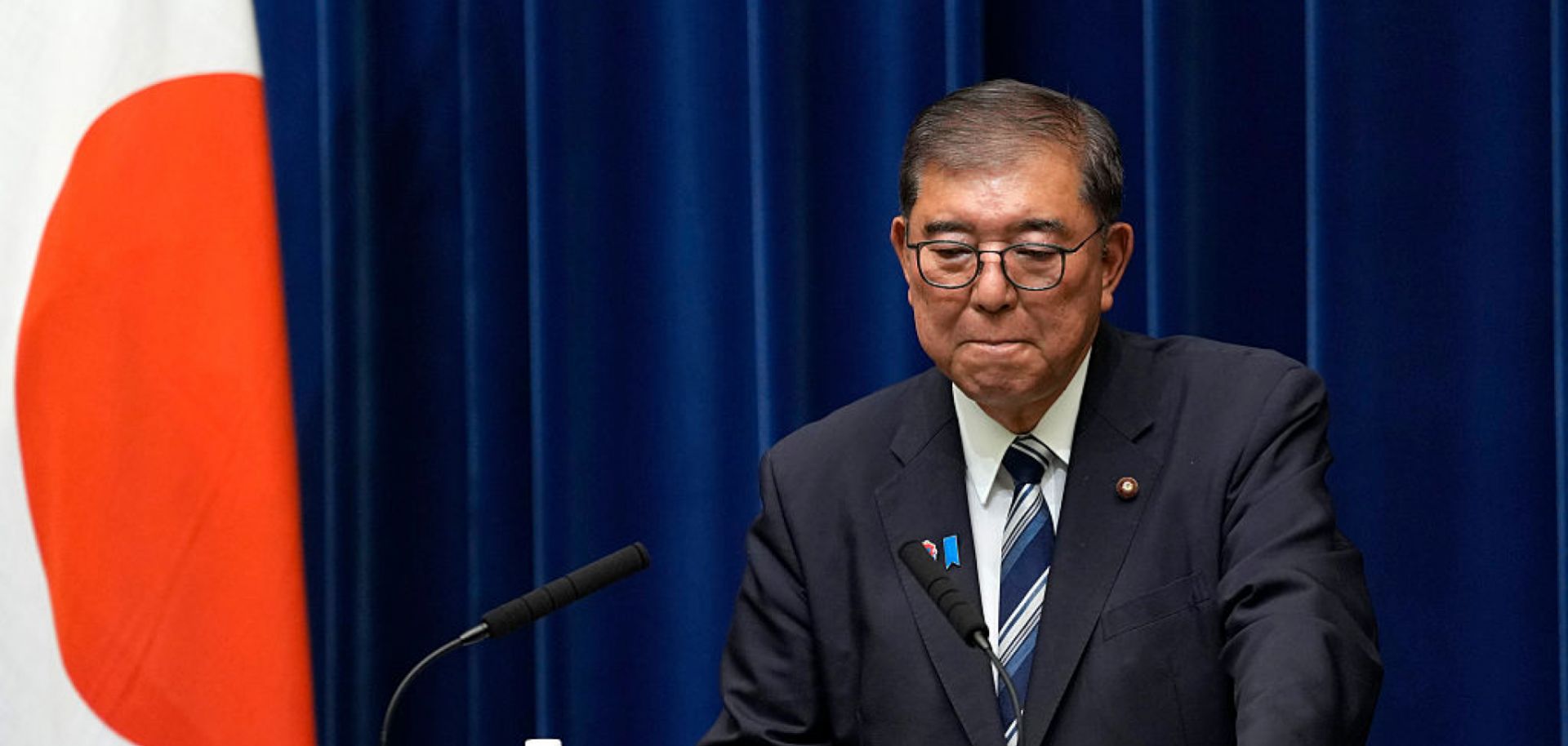
In Japan, Prime Minister Shigeru Ishiba's resignation sets up a volatile party leadership contest between conservative and reformer candidates, with the former risking controversial anti-foreigner stances and strained China-South Korea ties, and the latter likely prioritizing domestic economic issues at the expense of foreign policy commitments. On Sept. 7, Ishiba announced at a press conference that he planned to resign from his position as soon as his ruling Liberal Democratic Party, or LDP, picked a replacement for him as party president. Ishiba cited his recent completion of negotiations on a U.S.-Japan trade deal as a reason for the timing of his decision, as he had stated on July 20 that he would not resign while trade talks remained unfinished. In addition, his announcement was likely intended to preempt the LDP's upcoming vote on whether to hold an early party presidential election, which was forecast to pass. This comes after Ishiba, who became party president in September 2024, led the LDP through three major electoral losses in less than a year and failed to restore public confidence in the party following a slush fund scandal. The LDP's vote on whether to hold an early party presidential election, originally scheduled for Sept. 8, is no longer necessary, as the election will now certainly take place due to Ishiba's departure. The date and process of this upcoming election have yet to be set, but Reuters sources on Sept. 8 claimed the government was looking at an Oct. 4 date. LDP leadership has suggested that the vote will poll Diet lawmakers and rank-and-file LDP members, which would disadvantage the conservatives who seek to replace Ishiba, as rank-and-file LDP members largely supported Ishiba's administration and opposed the conservatives' campaign to oust him.
- Ishiba's Agriculture Minister Shinjiro Koizumi, along with former prime minister and party elder Yoshihide Suga, met with Ishiba on the night of Sept. 6 and pressured Ishiba to resign, according to sources from Japanese news outlet Jiji Press. Koizumi specifically urged him to do so prior to the Sept. 8 vote to avoid a split in the party and not to call a snap election.
- LDP Secretary General Hiroshi Moriyama said on Sept. 7 that it was important to "have as many party members directly participate [in the election] as possible," suggesting the vote will poll the Diet and the rank-and-file LDP members, as opposed to the Diet and the LDP prefectural federations.
- In the October 2024 lower house elections, the LDP lost its majority largely due to its failure to address an ongoing scandal stemming from a November 2023 revelation that lawmakers from numerous LDP factions misused the proceeds of their factional fundraising. Then, in June 2025, the LDP also lost the mayoral seat for Tokyo, Japan's capital and largest city. The next month, the LDP lost its majority in the upper house elections. Ishiba's enemies pointed to these "three losses" to justify calls for his ouster.
The potential candidates to replace Ishiba fall into two camps: conservatives led by former Economic Security Minister Sanae Takaichi and reformers led by Agriculture Minister Shinjiro Koizumi. The last time the LDP chose a party president, the selection process involved nine candidates and a two-stage election. As an LDP factional outsider, Ishiba was not a strong contender at the outset, but he emerged victorious after outgoing Prime Minister Fumio Kishida threw the support of his faction behind Ishiba in the second-stage runoff vote. The other two finalists in that three-person runoff were the staunch conservative Takaichi, who would have been Japan's first female prime minister, and the young (aged 44) reformer Koizumi, son of former Prime Minister Junichiro Koizumi. Ishiba has rejected the prospect of running, but Takaichi and Koizumi are again frontrunners in this upcoming leadership election, and there is no shortage of potential competitors. The LDP's conservatives support a return to the high spending and low interest rates championed by late Prime Minister Shinzo Abe, are less apologetic about Japan's World War II history and are more assertive about Japan's right to hold its own standing army (in contrast to Japan's pacifist constitution). The reformers see many of the conservatives' positions as outdated and conservative officials as electorally moribund as Japan's population becomes more urban and young voters abandon the LDP. They also seek to clean out corruption from within the LDP — driven by conservatives — that contributed to recent election losses, and they hold a more equity-minded view of economic policy, supporting workers' rights. However, reformers also support fiscal responsibility to defuse the debt risks long exacerbated by the "Abenomics" policies championed by conservatives. Both camps support a strong U.S. military alliance.
- Rival conservatives to Takaichi include the young and sociable Takayuki Kobayashi, the politically well-connected but publicly ill-received Katsunobu Kato, and the master administrator Toshimitsu Motegi, whose personality clashes with fellow party leaders.
- Potential competitors to Koizumi for the mantle of party moderate and reformer include Chief Cabinet Secretary Yoshimasa Hayashi and, potentially, Kishida, although he has denied this prospect.
Ishiba's resignation improves LDP reformers' electoral chances and could lead to another conservative loss, which would open the door to a party split. Ishiba's decision to resign — instead of allowing conservatives to wield their influence in the Diet to secure a victory in the Sept. 8 vote — bolsters the chance of fellow reformers like Koizumi to win the upcoming party leadership election, particularly as the public opposed the conservatives' campaign to oust Ishiba. If they win, reformers will have to coordinate with an opposition party to confirm the new LDP party president as Japan's prime minister, given that the LDP has a minority government in the lower house of the Diet. The reformers' most likely partner would be the Japan Innovation Party, whose policies — fiscal responsibility, regional revitalization (growth beyond Tokyo), and military strengthening — align closely with those of the reformers. However, a win for the reformers would set back LDP conservatives twice in a row, which could push them to split off to form a new party and retake what they see as the lost mantle of LDP conservatism. This would raise the chance of a snap lower house election, as a split LDP would exacerbate Diet gridlock. A snap election could lead to a loose ruling coalition of ideologically diverse opposition parties that run a dysfunctional government less capable of addressing economic livelihood issues and foreign policy challenges. Alternatively, a win by the conservatives in the LDP leadership election would see them seek to partner with at least one larger opposition party to confirm their premier. The right-wing nativist party Sanseito would be the most likely candidate for a partnership, although the party's anti-foreign posture could hurt business sentiment and tourism in Japan.
- Conservatives under former Prime Minister Taro Aso failed to bring Takaichi to the premiership in 2024 following Kishida's resignation. The failure followed Kishida's dismantling of the LDP's Aso-aligned Abe faction as part of his attempts to address the slush fund scandal.
Turnover in Japan's highest office may undermine Ishiba's recent conclusion of a trade deal with the United States, though military cooperation will likely remain strong, regardless of who becomes Japan's next prime minister. Ishiba's departure poses a moderate chance of impeding the implementation of the U.S.-Japan trade deal, as the White House's latest executive order defining the terms of the deal leaves some aspects, including the terms of Japan's $500 billion investment pledge, up for debate. Though Ishiba's replacement is unlikely to seek a full renegotiation, the new prime minister may have their own interpretation of the deal's terms. Additionally, Japan's new prime minister will likely appoint a new trade envoy, given that current envoy Ryosei Akazawa was a close political ally of Ishiba's, slowing the pace of dispute resolution talks and raising the chance of new U.S. tariffs. However, both LDP camps will continue to support a strong U.S.-Japan military alliance, so military cooperation will remain steady, regardless of the LDP leadership election outcome. If a conservative prime minister comes to power, the faction would likely seek to expand defense spending and the mission set of the military more quickly than the reformers, in line with U.S. goals.
A conservative prime minister would risk deepening tensions with China and scuttling military cooperation with South Korea, while a reformer would focus on addressing economic livelihood issues, risking neglect for foreign programs like Ishiba's recently announced development financing program for Africa. A conservative prime minister would revive revisionist, unapologetic narratives about Japan's imperialist predations and war crimes in World War II, which would risk a diplomatic rift with South Korea and likely prompt Seoul to suspend or scrap its trilateral security cooperation with Japan and the United States on tracking North Korean missile threats. A conservative prime minister would also risk fraying ties with China, with which Tokyo is attempting to preserve workable economic relations despite maritime security tensions driven by disputed island territories in the East China Sea, China-Russia joint bomber drills in the Sea of Japan, and China's threatening military activities around Taiwan and the South China Sea. Meanwhile, a reformer prime minister could shift away from Ishiba's focus on foreign policy to prioritize domestic economic issues in response to households' concerns about food affordability and wages in the October 2024 and July 2025 elections. This could jeopardize Japanese development spending abroad, like the over $7 billion in infrastructure and sustainable development financing for East Africa that Ishiba pledged at the ninth Tokyo International Conference on African Development in August. This was a somewhat controversial pledge, coming alongside Tokyo's "African Hometown" initiative (also launched at the conference) of cultural exchanges with African cities. This initiative directly contradicted the "Japan First" platforms of some rising opposition parties, like Sanseito, which claimed the plan would facilitate mass immigration.
