
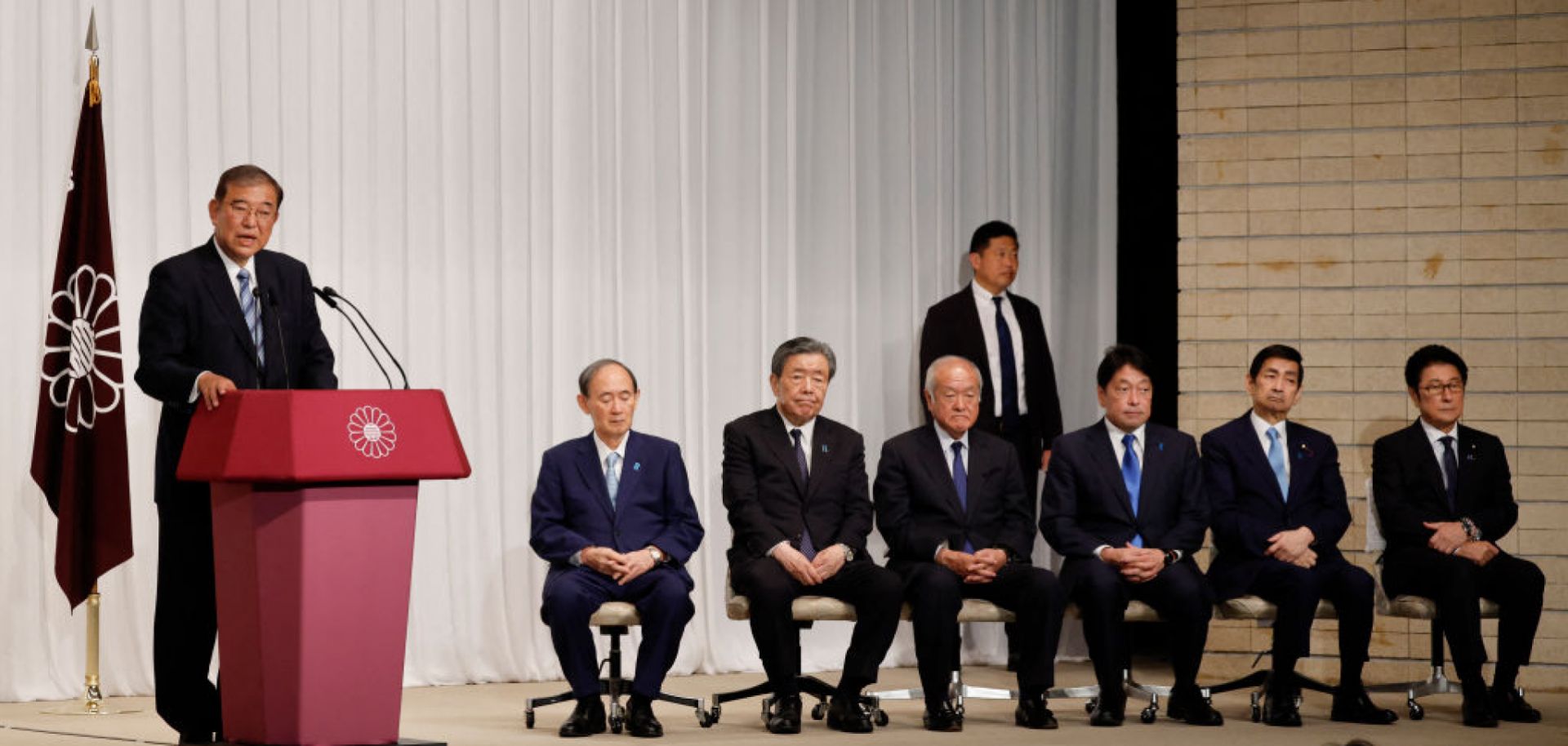
Japan's latest elections highlighted structural issues for the dominant Liberal Democratic Party (LDP), which could in the coming months drive it to expand its coalition or incorporate its rivals' policies to address the public's economic concerns; otherwise, Japan may turn inward for years, and though the LDP will emerge still atop the country's political system, it will do so as first among equals rather than as its undisputed leader. The LDP's losses in the July 20 upper house elections spurred heated debates about the fate of LDP President and Japanese Prime Minister Shigeru Ishiba in both Nagatacho — the seat of government in Tokyo — and in Japanese society at large. While the LDP itself is divided about Ishiba's fate, one thing its members and the general public agree on is that the party is experiencing a systemic electoral crisis that will not be solved by either preserving or ousting Ishiba. This is raising bigger questions about the stability of Japan's government, as the LDP has been in power almost uninterruptedly for seven decades. In fact, since 1955, when the LDP was founded, Japan has only experienced two periods of opposition government — from 1993-1994 and from 2009-2012, both characterized by frequent leadership changes and sclerotic policymaking by disunited opposition parties. The LDP has run Japan for the rest of that time, with coalition partner Komeito by its side since 1999.
- Immediately following the July election, a wide range of LDP officials called for Ishiba to resign, including senior party elder Taro Aso, at least eight prefectural federations of the LDP, and the director of the LDP's Youth Division, Yasutaka Nakasone. Others, however, gave statements of support for Ishiba, including LDP General Secretary Hiroshi Moriyama and Defense Minister Gen Nakatani, while more liberal leaning party elders Fumio Kishida and Yoshihide Suga obliquely rejected calls for a change of leadership.
- In the July 20 upper house elections, the combined seat count of the LDP and minor coalition partner Komeito dropped from 146 to 122, below the 125-seat threshold for a majority. In the party representation vote, specifically, the LDP's vote count sank from 18.3 million in 2022 upper house elections to 12.8 million in 2025, the lowest party vote count in an upper house election since July 1995. In that time, Komeito also lost support, dropping from 6.2 million to 5.2 million votes. In this election, the LDP's support was still five million votes higher than the best-performing opposition party.
- In the October 2024 lower house elections, the LDP-Komeito coalition's combined seat count dropped from 291 to 215, well below the 233-seat majority threshold. The LDP's party vote support dropped from 19.9 million in October 2021 to 14.4 million in 2024, the lowest support in any lower house election since the party was founded in 1955. Komeito's party support, too, sank from 7.1 million to 6.0 million votes. The LDP's performance was still four million votes higher than the top opposition party.
- On July 28, the Japanese newspaper Asahi Shimbun posted the results of a nationwide survey taken on July 26-27. In it, 81% of respondents said the LDP's poor electoral showing was due to ''problems with the entire LDP,'' while only 10% cited ''problems with Ishiba himself.'' The same share (81%) of LDP supporters also cited problems with the party itself.
The LDP's declining popularity stems from a combination of long-term structural challenges and recent leadership and corruption scandals that have eroded its rural base, exposed internal divisions and undermined public trust. First, the LDP's traditional voter block is in rural areas, which have seen a steady economic and demographic decline amid Japan's ongoing urbanization, as their predominantly elderly residents die off and younger generations move to cities. Moreover, the LDP has experienced a crisis of leadership since its charismatic head and prime minister Shinzo Abe (2012-2020) stepped down in 2020 and was assassinated in 2022. Since then, no other LDP leader has been able to corral the party's feuding factions as successfully as Abe. In recent years, Japan has also experienced rare inflation that has consistently surpassed wage growth, raising cost-of-living concerns among Japanese households. The LDP, however, has been hesitant to address these concerns (e.g., with reduced taxes or more subsidies) for fear of undermining its efforts at long-term fiscal responsibility. This has caused the public to characterize the LDP as a ''do nothing'' party, in contrast to various populist parties proposing new public spending or tax cuts. On a tactical level, the LDP has failed to properly address recent corruption scandals, most prominently the controversy surrounding the Abe faction's failure to fully report party faction revenues, commonly known as the slush fund scandal. Notably, the slush fund scandal was only revealed to the public in November 2023, after Abe died. This presented then-Prime Minister Fumio Kishida with the tall order of properly dealing with the implicated lawmakers to appease public outrage, without also dismantling the political infrastructure Abe had built within the LDP. But Kishida's half-measures — implementing only light political finance reforms, pursuing no legal actions against lawmakers but instead against their subordinates, and dissolving party factions — ultimately failed to sate public ire and only deepened factional rifts within the LDP.
- Kishida tried to purge the LDP of slush fund-implicated lawmakers prior to his resignation in August 2024. He expelled a number of Abe faction lawmakers from key government and party roles, pursued party discipline against implicated lawmakers — with most of those punished being loyal to the Abe faction — and dissolved his own party faction (which was only lightly implicated) to pressure other implicated factions, including the more powerful Abe faction, to also dissolve, which they later did. After his resignation and as a new party elder, Kishida lent his support in the eleventh hour of the September 2024 LDP leadership election to centrist and long-time factional outsider Shigeru Ishiba, exacerbating his feud with the LDP's right-wing, who strongly opposed Ishiba for his past support for the resignations of Abe and former Prime Minister Taro Aso, the current leader of this right wing faction.
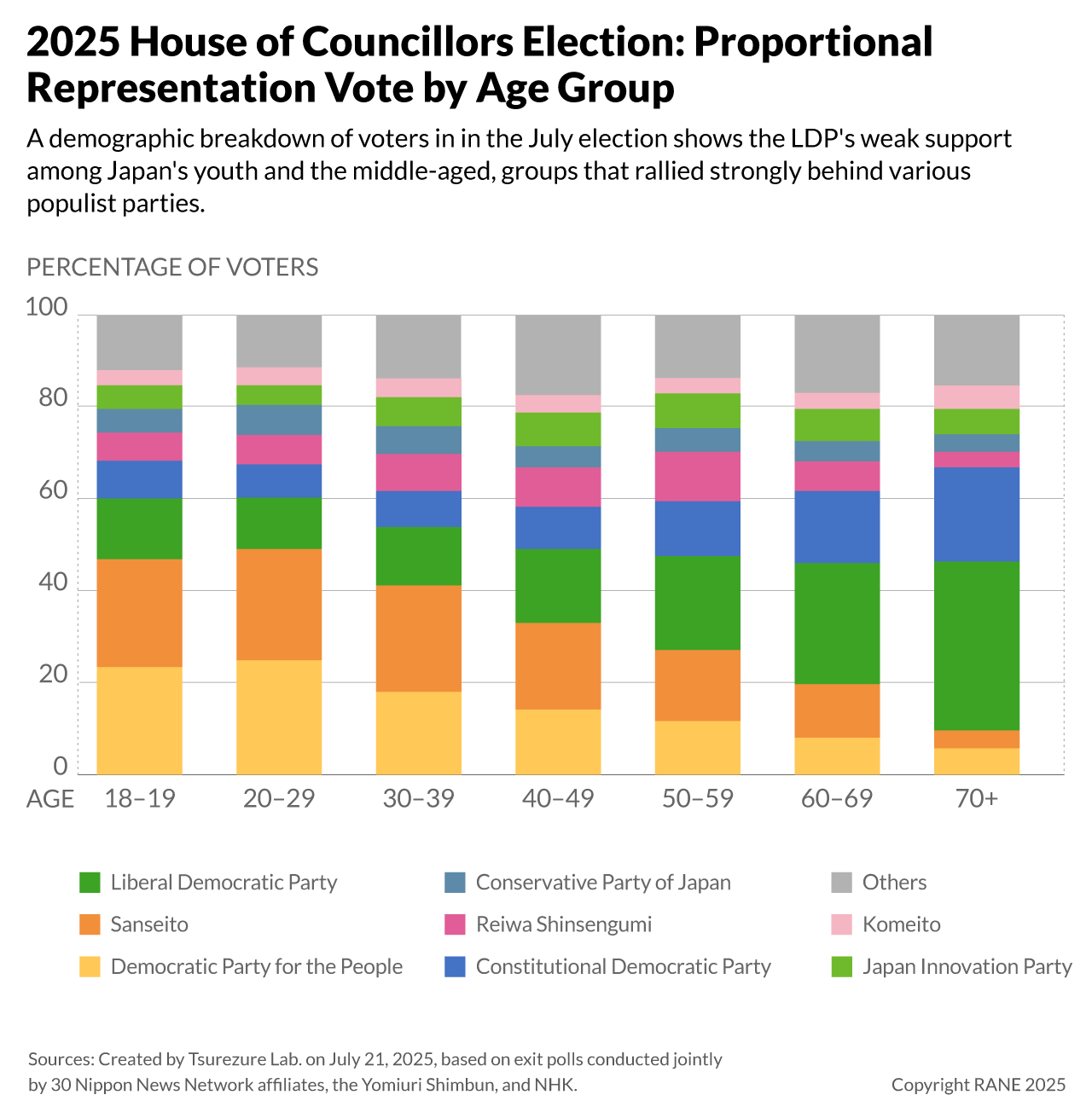
Compounding the LDP's problems, its coalition partner Komeito is also experiencing an electoral decline, as the party's aging support base and odd partnership with the LDP take their toll. Komeito is the political wing of Soka Gakkai, which in Japan is alternatively called either a lay Buddhist organization or a religious cult. Thus, the party has long been a strange coalition partner for the secular conservative umbrella LDP. But one thing Komeito has always brought to the relationship is its ability to mobilize votes. By mixing political activism and religious duty, Komeito (via Soka Gakkai) has helped its politicians and those of the LDP — through strategic candidate coordination — to win many elections. But the price for this minority party to sit atop the Japanese political system for decades alongside the LDP has been steep. Komeito has had to abandon Soka Gakkai's ideological commitments to expanding social welfare and supporting pacifism as well as its opposition to nuclear weapons and nuclear energy — all positions that run contrary to the LDP's policy agenda. Now, a growing share of Japanese youth — including young adherents of Soka Gakkai — are turning toward populist parties that are adept at using social media to stoke economic grievances and anti-establishment sentiment. Thus, the cognitive dissonance required for young acolytes of Soka Gakkai to listen to their elders and support the long-standing LDP government is growing less manageable, and this dissonance is manifesting in low youth support at the ballot box for Komeito and the LDP.
- In the July 2025 upper house elections, 57-61% of Japanese voters between the ages of 18 and 39 supported various populist parties like the left-wing Reiwa Shinsengumi, the center-right Democratic Party for the People (DPFP), the Conservative Party of Japan and the nativist Sanseito party, while less than 4% of these younger voters supported Komeito. In comparison, Komeito secured 5.5% support in the 50-59 age group, 7.8% in the 60-69 age group, and 8.7% of the 70 years and older age group. Likewise, support for the establishment conservative LDP in younger age brackets was just 11-13%, while its support in more senior age brackets ranged from 21-37%.
An expanded LDP coalition remains unlikely for now, but this could change if Ishiba successfully cooperates with the opposition on policy post-election or if he is replaced by a premier from the LDP's right wing. The LDP's seemingly chronic condition of worsening electoral prospects has driven it to debate internally (and sometimes publicly) the merits of broadening its coalition, both for the stability of the party's current minority government and for the LDP's long-term prospects as an umbrella group for a wide range of conservative ideologies. However, the main candidates for such an expanded coalition — DPFP, Nippon Ishin, and Sanseito — have signaled since July that they are not interested in joining an LDP coalition, at least not one led by Ishiba. Still, these initial rejections may be partly intended to help these populist opposition parties avoid accusations of hypocrisy, as giving the LDP a lifeline would contradict the anti-establishment platforms they campaigned on ahead of the July upper-house elections. If Ishiba remains in office and is able to lead the Diet through multiple rounds of successful policy coordination with opposition parties, as he did from October to June, some of these parties may yet warm to the idea of joining the LDP under Ishiba — particularly Nippon Ishin, a party whose public support (like the LDP's) has weakened in the two last elections. This would, in turn, give Ishiba a chance to get his government back in the majority and remove the latent threat of a no-confidence vote against him. Likewise, if the centrist Ishiba is replaced by a prime minister from the LDP's right wing, that leader will have even more ideological overlap with the ascendant conservative opposition parties (and more discord with stagnating left-leaning opposition parties) to justify a coalition. This would enable those conservative opposition parties to justify joining the LDP by pointing to Ishiba's ouster as proof that the parties have sufficiently admonished the establishment.
- On July 22, the leader of the rising nativist opposition party Sanseito, Sohei Kamiya, said he had no interest in joining a coalition with establishment parties like Ishiba's LDP. On July 31, the then-leader of the nationalist conservative party Nippon Ishin, Seiji Maehara, announced there was currently no opposition within the party to forming a coalition with the LDP, but added, ''we are not considering forming a coalition with the Ishiba Cabinet.'' Though Seiji has since stepped down, he assumedly also spoke for his then co-leader of the party, Hirofumi Yoshimura, who was also at that meeting. The leader of the center-right DPFP, Tamaki Yuichiro, has not definitely stated his position on a coalition since the July 20 upper house elections, but he has repeatedly called for Ishiba's ouster. Ishiba's conservative enemies within the LDP have considered expanding the coalition government to include the DPFP, if they are able to first oust Ishiba.
However, a coalition expansion would have its costs, including changes to the LDP's economic goals and reduced policy flexibility. Accepting new members in the government coalition would force the LDP to adopt some of the new members' policy priorities. A DPFP courtship could take Japan in a more fiscally expansive direction, particularly regarding social spending, threatening the LDP's efforts since 2021 to turn away from ultra-loose monetary policy and toward steadily deflating long-term debt risks. This partnership would likely be well received by Komeito's voter base, which also supports social spending and aligns with the DPFP's avowed pacifism. A partnership with Nippon Ishin, by contrast, would introduce a new focus on downsizing the government as a whole, and the party would be an ardent supporter of revising Japan's constitution to expand the role of the military — something the LDP would support, but the disillusioned voter base of Komeito might balk at. A union with the nativist Sanseito party would follow a similar trajectory on military matters. However, the party's anti-foreigner policies could also alienate centrist and liberal-leaning LDP supporters and be at odds with some of the LDP's pro-business, pro-immigration policies. Moreover, given the short shelf-life of many opposition parties in Japan, the LDP would want to choose its new coalition partner wisely, as wedding itself to another moribund party would reduce policy flexibility and risk relegating the LDP to another minority government in the near future.
In the likely event that Ishiba stays in office, the LDP will be inclined to adopt some of its rivals' populist views, but this would mean abandoning fiscal restraint. In keeping with its long-term status as an umbrella group for a wide range of conservative ideas, the LDP could avoid a coalition expansion and instead try to neutralize some of its opponents by adopting their viewpoints that proved the most popular with voters in the October 2024 and July 2025 elections. This scenario is more likely if Ishiba stays in office, which seems probable given the disunity of his enemies inside and outside of the LDP. Since its founding, the LDP has only expanded its coalition twice — once from 1994-1996 in a marriage of convenience with its rival the Japan Socialist Party, and once in 1999 with Komeito, a coalition that stands to this day. The drawbacks of another coalition expansion are thus likely not lost on the party's leadership. If, given those costs, the LDP instead opts to remain in the minority, it could seek to adopt some of its rivals' populist and anti-foreigner sentiments, as well as limited fiscal expansion (e.g. tax cuts), to both ensure the continued functioning of the Diet and undermine the raison d'etre for its opposition, though cuts to government revenue would increase the national debt. This tactic, too, may risk some disunity within the LDP, as it requires ideological flexibility. It may also require many small policy compromises with various parties at different times, which would force the LDP to maintain at least amicable relations with many opposition parties and reduce its room to pursue polarizing policies that are more in line with the LDP's financial responsibility goals, like raising taxes or cutting spending to reduce debt. However, this tactic would still be less disruptive policy-wise than permanently adopting a new coalition member, as the LDP could temporarily shift its views for just long enough to pass individual policies to appease public concerns.
- There are signs that the LDP is already seeking to address some of the concerns about foreigners expressed by its rivals. Following demands from ruling and opposition lawmakers in June for a review of lax requirements for various entry visas, Japan's Immigration Service Agency announced on Aug. 4 that it would raise the required capital for a business manager visa from 5 million (just under $34,000) to 30 million yen ($203,000) and require the holder to employ at least one full-time employee, previously not required if the capital threshold was met. The number of visa holders in this category surged from 18,100 in 2015 to 41,600 in 2024. About half of these visa-holders are Chinese nationals, which is notable given Japan's historically tense relationship with China, stemming from the two countries' rivalry during and before World War II.
The LDP's near-term policy choices will influence Japan's foreign relations, with a turn toward nativism likely improving ties with the United States under Donald Trump, while a partnership with the DPFP would impede the expansion of the U.S.-Japan military alliance. If the LDP adopts the views of or forms a coalition with either the nationalist conservative party Nippon Ishin or the nativist Sanseito party, Japan's relations with the United States would likely improve, as there would be high overlap with the policy priorities of U.S. President Donald Trump, namely his home-nation-first, anti-immigration stances. However, such populist and anti-foreigner views would fray Japan's relations with neighboring South Korea and China, which tend to condition improved economic and security cooperation on the Japanese government maintaining its official, quasi-apologetic stance about World War II. If, on the other hand, the LDP joins forces with the center-right DPFP, Tokyo's ties with both Washington and Beijing will likely suffer. The DPFP maintains some of the anti-foreigner and pro-sovereignty attitudes of Sanseito, which could still strain Japan's ties with China (e.g., by exacerbating territorial disputes in the East China Sea). But the DPFP also avows an ''exclusively defensive'' Japanese military, which would impede the United States' efforts to position Japan at the forefront of the U.S. regional security network aimed at deterring a Chinese invasion of Taiwan.
- New South Korean President Lee Jae-myung (inaugurated in June) campaigned on a more anti-Japan and pro-China platform than his predecessor, Yoon Suk Yeol. During Yoon's term (2022-2025), South Korea-Japan relations improved, including through trilateral security cooperation to track North Korean missile threats. This was driven partly by Yoon's effort to avoid publicly discussing Japan's World War II atrocities against South Koreans, but also by the efforts by Japanese prime ministers post-Abe to avoid visiting the controversial Yasukuni war shrine and releasing new official statements about the war.
However, it is equally likely that the LDP will fail to manage either a coalition expansion or a strategic adoption of its rival's policies; in that event, Tokyo would likely turn inward for the next few years, inhibited from pursuing long-term policies like military strengthening and fiscal consolidation. Public discontent about the LDP's political corruption and failure to address cost-of-living concerns has steadily increased since 2021, while the party's factions have increasingly feuded among themselves. Against this backdrop, there is as good a chance as not that the party's efforts to expand its coalition or adopt opposition viewpoints will be insufficient to shake its image as a ''do nothing'' party. If the LDP bungles this near-term challenge, there is a low likelihood that an opposition government comes to power or, more likely, that the LDP remains in a minority government but is internally disunited and consumed by parochial policy disputes, unable to plan foreign and economic policy beyond a six-month time horizon. This would threaten to slow down Japan's military expansion goals and its ability to deter and respond quickly to provocations, like Chinese challenges to Japan's sovereignty over the Senkaku Islands or even threats to Taiwan. It would also delay long-term questions about economic reforms — including those aimed at making Japan's pension system more streamlined for an aging population and moving away from ultra-loose monetary policy to increase Tokyo's responsiveness in times of economic crisis — as populist parties take advantage of the LDP's power vacuum to advocate for more social spending.
Despite this short-term volatility, the LDP is poised to remain the central force in Japanese politics for the foreseeable future, even if it must adjust its core policy agenda. Past periods of opposition government have shown the LDP quite capable of the kind of rapid reform and policy flexibility necessary to regain its majority government position. Meanwhile, the LDP's decline in the polls, while steady, has also been slow relative to even the most popular opposition parties. Together, these factors suggest that even if Japan does have a multi-year period of internal focus, the LDP will emerge from this inward-looking period as still the main force in Japanese politics. Nonetheless, periods where the LDP has a weak minority government or is in the political opposition will become incrementally more frequent as its voter base ages. These successive periods will push the LDP to gradually redefine its conservative core — the lowest common denominator of views that holds together an incredibly diverse political party — to align more with the changing views of Japanese society. This will entail greater social spending, measures to cut costs of food and housing and shift tax burdens from households, and other policies aimed at addressing households' growing concerns about economic inequity and the high expense of raising a family. The LDP will likely also dial back its more socially conservative views, as public sentiment slowly skews progressive on issues like same-sex marriage, labor rights and gender equality at home and in the workplace. On national security issues, however, Japanese voters' growing concern about threats from China will permit the LDP to more rapidly pursue its military modernization goals, including expanding arms exports, engaging more in exercises and contingency planning beyond Japan's waters, and (eventually) amending the constitution to weaken the pacifist terms that limit Japan's ability to wage war and hold a standing army. These shifts will increasingly strain Japan's ties with China and South Korea, inhibiting bilateral efforts to reduce trade restrictions. Thus, in the crowded field of Japanese political parties, though the LDP will increasingly serve as the first among equals, it will evolve to ensure it stays relevant on key policy issues and resists dissolution, the fate of dozens of Japanese opposition parties formed since World War II. The LDP's continued prominence will maintain Japan's place as the United States' top defense ally in the Indo-Pacific and keep Japan on the path to reviving nuclear power, slowly waning the country's historical reliance on energy imports.
- During the first post-war period in which the LDP was ousted from government (1993-1994), the party quickly moved to join a coalition with its chief rival, the Japan Socialist Party (JSP), and a recent splinter party from the LDP, putting into place an LDP-backed prime minister from the JSP, Tomiichi Murayama, from 1994-1996. In the 1996 lower house elections, the JSP then suffered seismic losses while the LDP made modest gains. This prompted the LDP to ditch its new coalition partner and rule alone until 1999, when it formed a new coalition with Komeito.
- During Japan's second post-war period of opposition rule (2009-2012), the Fukushima nuclear disaster in 2011 and unpopular tax hikes were large contributors to the downfall of multiple, short-lived opposition prime ministers. But the return of the LDP to power in 2012 was also partly due to its adoption of policies focused on monetary easing and fiscal spending under Shinzo Abe, known as ''Abe-nomics,'' which ran counter to the LDP's post-1990s penchant for fiscal discipline and were more in line with the opposition's typical focus on greater public spending. This led to the longest period of LDP rule under a single leader, Abe, since 1955.
