
Editor's Note: For geopolitically significant elections, RANE publishes detailed scenario analyses that outline potential outcomes of the vote and their various domestic and international implications. Our previous scenario analyses have covered elections in Germany, Canada, Australia, Poland, South Korea, Japan, Guyana, Norway, Moldova, the Netherlands and Chile.
Bangladesh's Feb. 12 general elections are likely to result in a government led by the conservative Bangladesh Nationalist Party (BNP), either alone or in a coalition with allies. A BNP-led government would focus on economic stabilization, diversification beyond ready-made garments into information and communication technology, logistics, renewable energy and agriculture, while maintaining International Monetary Fund (IMF) engagement and implementing targeted welfare programs such as the Family Card initiative. The government would likely pass institutional reforms, including those limiting executive power, strengthening judicial independence and enforcing anti-corruption measures, though legal and bureaucratic hurdles would probably slow implementation. Politically, the BNP would likely pursue legal action against members of the former governing Awami League party, heightening the risk of further polarization and public protests. Foreign policy would likely adopt what the BNP describes as a "Bangladesh First" approach, seeking balanced ties with India, Pakistan and China while restoring trade channels with India that were disrupted by the interim government's restrictions on imports and land ports
In a less likely outcome, a coalition led by the Islamist Jamaat-e-Islami party, likely including the student-led National Citizen Party (NCP) and the conservative Liberal Democratic Party, would likely emphasize cautious economic reform, anti-corruption efforts and Islamic-influenced social policies, maintaining IMF engagement while softening austerity through targeted subsidies and welfare programs. Implementation of institutional reforms would likely be selective due to the coalition's ideological diversity, and social initiatives would probably blend Islamic welfare concepts with support for women and youth. Foreign policy would likely focus on pragmatic, balanced engagement with India, cautious normalization with Pakistan and transactional cooperation with China, though without deep strategic alignment.
In a third scenario, if no bloc secures a majority, the BNP and its allies, along with a Jamaat-led alliance, could attempt to form a coalition government. Disagreements among partners over the choice of prime minister and the allocation of key ministerial portfolios could complicate coalition formation talks. Even if these positions are agreed upon and the coalition is established, there would still be a risk of legislative gridlock, slow decision-making and heightened political uncertainty. Governance under this scenario would be incremental and constrained, increasing the risk of protests, social tension and public frustration over stalled reforms. Economic policy would likely focus on short-term stabilization, with stalled diversification and delayed fiscal reforms due to disputes over welfare, subsidies and austerity. Social programs would likely be uneven, combining BNP-targeted welfare with Jamaat-influenced religious initiatives. Anti-corruption efforts and judicial reforms would probably proceed only partially, with selective enforcement exacerbating political polarization. Foreign policy would likely remain cautious and pragmatic, maintaining functional engagement with India and Pakistan.
The BNP Leads the Government, Either Alone or in a Coalition
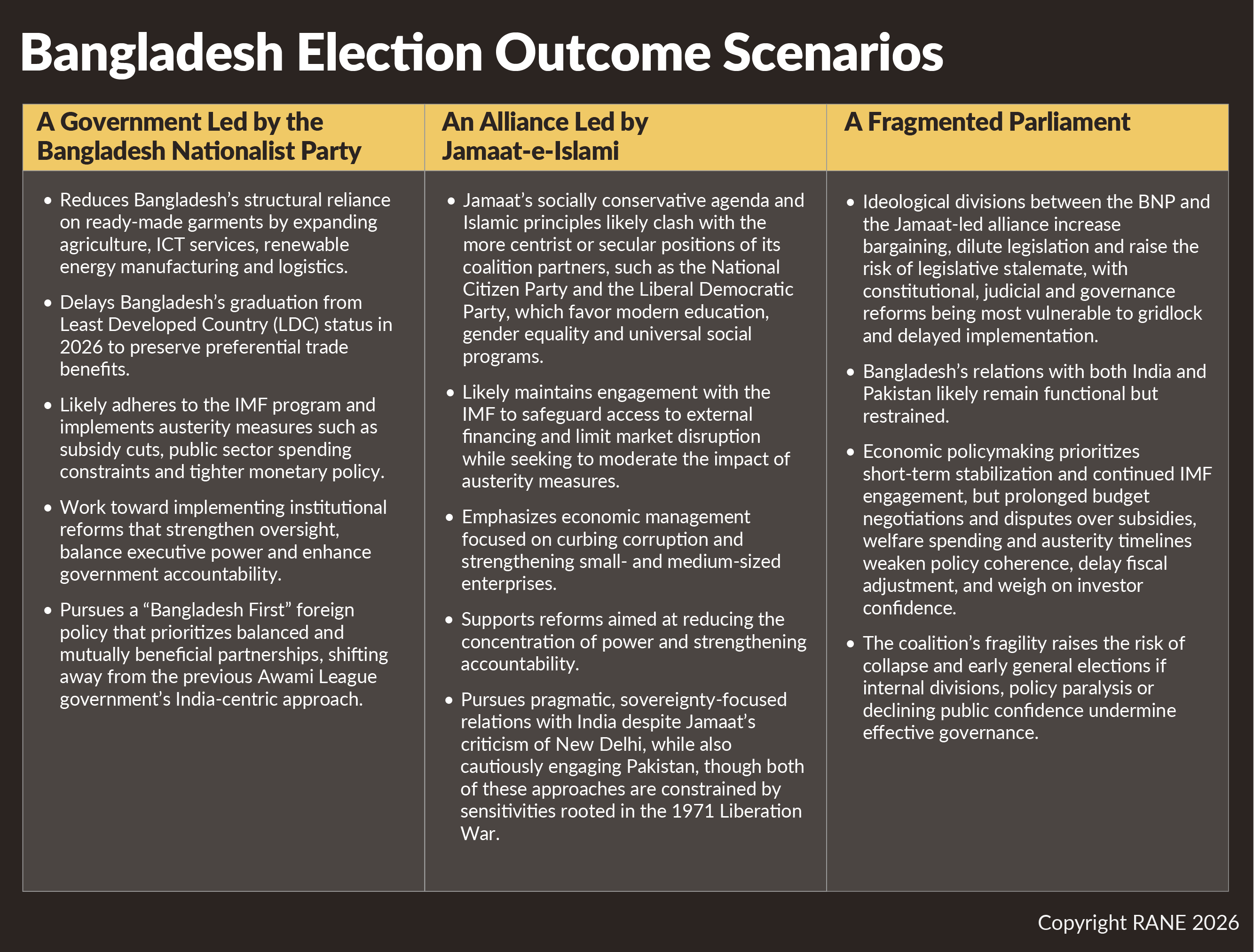
In this scenario, the conservative Bangladesh National Party (BNP) forms a government either independently or through a coalition with allies including the Jatiya Party, National People's Party and Nagorik Oikya, prioritizing economic stabilization, diversification and institutional reform while seeking to reset domestic and foreign policy after years of political turmoil. A BNP-led government would aim to reduce Bangladesh's structural reliance on ready-made garments by expanding agriculture, information and communication technology (ICT) services and renewable energy manufacturing. In the near term, this would include boosting agricultural productivity, growing the ICT sector and improving domestic logistics, while also strengthening competitiveness in the ready-made garment sector through better law and order, reliable energy, improved labor conditions and compliance with global standards. A BNP-led government would also pursue more ambitious, long-term initiatives, such as scaling renewable energy manufacturing and transforming ICT and agriculture into major export-driven sectors capable of rivaling the ready-made garment industry in economic contribution. In this scenario, Bangladesh would likely adhere to the IMF program and implement austerity measures to manage inflation, debt and fiscal deficits, despite heightened risks of protests and public dissatisfaction. Socially, the government would expand targeted welfare initiatives such as the Family Card program, invest in job creation for women and young people through vocational training and support for small and medium-sized businesses, though revenue constraints would hinder implementation. Institutionally, the BNP has endorsed the July Charter, established by the interim government, which outlines broad institutional and governance reforms, including those to limit prime ministerial power, establish a bicameral parliament, strengthen judicial independence and enhance anti-corruption frameworks; however, legal hurdles, institutional inertia and opposition pressure may slow implementation, raising the risk of public backlash if reforms stall. Politically, the government would likely pursue legal action against senior members of former Prime Minister Sheikh Hasina's Awami League party, satisfying popular demands for accountability but increasing polarization and the risk of unrest. The BNP would adopt a "Bangladesh First" approach to foreign policy, seeking more balanced external partnerships while repairing strained ties with India by restoring trade and connectivity mechanisms (such as the suspended transshipment facility), maintaining pragmatic economic engagement with China and cautiously improving relations with Pakistan amid domestic sensitivities linked to the 1971 war.
Implications
- The BNP-led government seeks to reduce Bangladesh's structural reliance on ready-made garments by expanding agriculture, ICT services, renewable energy manufacturing and logistics. In the near term, this includes boosting agricultural productivity, growing the ICT sector and improving domestic logistics, while also strengthening competitiveness in the ready-made garment sector through better law and order, reliable energy, improved labor conditions and compliance with global standards. However, while incremental diversification away from ready-made garments is achievable, the government struggles to position Bangladesh as a global supplier across agriculture, ICT services and renewable energy manufacturing due to fiscal and infrastructure constraints.
- For Bangladesh's ready-made garments sector, the government likely focuses on boosting competitiveness by stabilizing law and order, resolving energy and infrastructure bottlenecks, improving labor conditions and ensuring compliance with evolving global standards — factors that are critical for attracting and retaining buyers.
- The BNP likely seeks to delay Bangladesh's graduation from the United Nations' Least Developed Country (LDC) status in 2026, viewing it as necessary to preserve preferential trade benefits, concessional financing and policy flexibility that support industrial growth and social welfare programs. The government can do so by formally requesting an extended transition through the U.N. process, citing persistent structural vulnerabilities, export concentration in ready-made garments and ongoing external economic pressures. Delaying the LDC graduation would ensure that Bangladesh retains access to duty-free exports, favorable loans and technical assistance as its economy continues to strengthen and diversify. However, if the government is unable to secure a deferment, it could result in reduced trade preferences, higher borrowing costs and tighter fiscal constraints, heightening the risk of slower economic growth, job losses and increased vulnerability in key sectors such as ready-made garments and agriculture.
- The BNP works to implement a "Family Card" program designed to provide targeted social security support, including direct financial assistance, women's empowerment initiatives and a phased rollout to rural and low-income populations. This initiative could help reduce poverty, improve household resilience and expand access to essential services for vulnerable communities. However, constraints such as limited fiscal resources, administrative capacity and potential delays in distribution could slow implementation and reduce the program's short-term impact.
- With a fiscal deficit of around 5% of GDP, inflation near 10%, economic growth slowing to 3.8% and public debt at roughly 38.5% of GDP, Bangladesh's macroeconomic environment remains strained, limiting fiscal and policy space. This likely compels the BNP to adhere to the IMF program and implement austerity measures, such as subsidy cuts, public sector spending constraints and tighter monetary policy. The austerity measures heighten the risk of protests and public dissatisfaction, particularly among low-income and vulnerable populations, though the government likely maintains its course to preserve macroeconomic stability and investor confidence.
- The government works to boost employment, particularly for women and youth, by expanding vocational training programs, offering targeted incentives for businesses to hire underrepresented groups, promoting entrepreneurship initiatives and providing each district with financial support for small and medium-sized enterprises, along with foreign language training and specialized skill development programs aimed at generating 2 million jobs overseas each year. However, the impact of these initiatives are limited by funding constraints, uneven access to quality training facilities and mismatches between workforce skills and labor market demand.
- The BNP likely pursues a broad agricultural agenda, including improvements to irrigation and waterways, price stabilization for key crops, expanded access to inputs and credit and investments in cold storage and supply chains. The party also plans to promote renewable energy for farms and waste management and deliver modern agricultural technologies to farmers. These measures aim to boost food security, productivity and rural livelihoods, though implementation may be limited by fiscal constraints, administrative capacity and difficulties reaching remote communities.
- The BNP is one of the signatories of the July Charter, which notably proposes creating a bicameral parliament, among other key reforms. The BNP supports this reform, which will help strengthen legislative oversight, balance executive power, and enhance the accountability and transparency of government institutions, potentially reducing the concentration of authority in the prime minister's office and fostering more inclusive decision-making. Since the charter requires constitutional amendments and other legal changes, a two-thirds majority would be needed to advance the ambitious reform package through parliament and formally ratify it. The government is likely to meet that threshold, since other parties have already indicated their support for the July Charter. If, however, the government fails to fully implement the charter, it would likely spark public frustration, trigger protests from civil society and draw criticism from opposition groups who view the reforms as incomplete or selectively enforced.
- Other measures under the July Charter include limiting the prime minister's powers, reforming institutions to strengthen democracy and accountability, enhancing judicial independence and implementing robust anti-corruption measures. While the BNP likely supports these reforms in principle, it may face constraints even with a parliamentary majority, including bureaucratic resistance, procedural and legal hurdles, limited fiscal resources and opposition pressure outside parliament. Failure to fully implement these measures could trigger political backlash and public unrest, undermine government legitimacy, slow broader reform efforts and heighten social and political tensions.
- The BNP likely pursues legal action against senior Awami League leaders, including investigations, arrests and trials related to alleged corruption, mismanagement or abuse of power during previous administrations. While these actions may satisfy supporters seeking accountability, they also risk exacerbating political polarization, provoking retaliatory measures from the opposition and generating domestic and international criticism over perceptions of selective justice or politically motivated prosecutions. This could heighten tensions and unrest, particularly in urban centers and Awami League strongholds, Dhaka, Chattogram, and Khulna, where political competition and protests have historically been most intense.
- The BNP pursues a "Bangladesh First" foreign policy, prioritizing balanced and mutually beneficial partnerships, shifting away from the previous Awami League government's India-centric approach. The government seeks to improve relations with India, including reinstating the transshipment facility for Bangladeshi exports that was suspended in 2025 and disrupted trade flows. Restoring this and other cooperative mechanisms could ease tensions, promote economic collaboration and stabilize bilateral relations in support of Bangladesh's development objectives. But improvements are incremental due to ongoing political sensitivities between the two countries, such as India's continued hosting of former Bangladeshi Prime Minister Sheikh Hasina.
- The BNP likely balances relations with Pakistan by modestly enhancing defense and economic ties. However, any effort to deepen military cooperation could face domestic resistance due to the historical legacy of the 1971 war and the continuing political and societal sensitivities surrounding it.
- The BNP likely pursues pragmatic engagement with China, focused on economic and infrastructure cooperation, including investment in energy, transport and technology sectors. But the government maintains a cautious stance on strategic and security matters with Beijing, in order to avoid antagonizing regional partners.
- The BNP uses its dominant political influence to keep sidelining the Awami League and its supporters. In response, Awami League supporters periodically protest, and Awami League members increasingly consider forming a new party or defecting to another one.
- If the BNP leads a coalition government rather than holding a clear majority, it may face challenges in pushing through its legislative agenda, risking slowed or compromised policy implementation. Coalition dynamics could require concessions to smaller parties with differing priorities, increasing the potential for internal disagreements, legislative gridlock and delays in institutional reforms and economic initiatives. This, in turn, could heighten political uncertainty, reduce investor confidence and exacerbate tensions with opposition groups and civil society.
Jamaat-e-Islami Forms a Governing Coalition With Smaller Parties
A coalition led by the Islamist Jamaat-e-Islami (Jamaat) party would likely include the student-led National Citizen Party (NCP) and the Liberal Democratic Party (LDP), along with smaller partners. Such a diverse coalition government would likely blend anti-corruption measures and cautious economic reform while managing internal ideological differences. Economically, the government would likely continue engaging with the IMF to secure financing and market stability, while softening austerity through targeted subsidies and selective welfare programs. Social policies could combine Islamic welfare principles, such as zakat-inspired support for the poor and interest-free loans for small businesses, with modern programs like cash transfers, public healthcare and education for women and youth. However, fiscal limits and coalition compromises may slow the rollout of these measures. Institutionally, the alliance would likely implement provisions included in the July Charter, supporting reforms that limit executive authority, enhance accountability and strengthen judicial independence, particularly when framed as addressing past Awami League mismanagement. However, internal disagreements and bureaucratic hurdles could limit full execution and foster perceptions of politically motivated enforcement. The government may incorporate Islamic principles in family law, inheritance and finance, though sweeping constitutional Islamization is unlikely due to coalition dynamics and public sensitivities. Politically, the NCP's participation in a coalition with the socially conservative Jamaat-e-Islami may weaken the NCP's reformist and youth-driven image, leading to reduced support for the party among young people and low-level protests. In terms of foreign policy, while Jamaat has expressed support for constructive relations with India, it has emphasized that ties must respect Bangladesh's sovereignty and avoid interference in domestic politics. A government led by Jamaat would thus be unlikely to seek deep strategic alignment with New Delhi. India would likely approach engagement with such a government cautiously, given Jamaat's historical opposition to Bangladesh's independence and collaboration with Pakistani forces in 1971. At the same time, Jamaat's ideological affinity and historical ties with Pakistan suggest it would seek stable engagement with Islamabad, while carefully navigating domestic sensitivities related to the Liberation War. Relations with China and other partners would likely focus on pragmatic economic cooperation, including infrastructure, energy and investment projects.
Implications
- Policy implementation is shaped by the need to balance ideological priorities between Jamaat, the NCP, the LDP and smaller partners. Jamaat's socially conservative agenda, emphasizing Islamic principles in education, welfare and moral policies, likely clashes with the more centrist or secular positions of NCP and LDP, which favor modern education, gender equality and universal social programs. These differences could slow reforms, require compromises on socially conservative measures and temper Jamaat's potentially hard-line policies.
- Joining a coalition with Jamaat increases the NCP's influence in parliament, though at the cost of eroding its reformist and youth-oriented image from the July 2024 uprising. The party's alignment with Jamaat could alienate young supporters, dampen grassroots engagement and make it harder for the NCP to maintain an independent political identity over time.
- The Jamaat-led alliance likely emphasizes economic management focused on curbing corruption and strengthening small and medium-sized enterprises. Efforts to reduce dependence on ready-made garments may include expanding agriculture, halal food and agro-processing, and information and communications technology services. However, limited fiscal space, bureaucratic capacity constraints and the need to balance coalition interests likely slow implementation and narrow the scale of these initiatives.
- The alliance likely maintains engagement with the IMF to safeguard access to external financing and limit market disruption while seeking to moderate the impact of austerity through expanded welfare programs, targeted subsidies and potentially the use of Islamic social finance mechanisms, such as zakat-based assistance.
- The government likely focuses on preserving access to global markets for the ready-made garments sector by maintaining compliance with international standards, while seeking efficiency gains through targeted infrastructure investments.
- Social initiatives likely blend Islamic welfare concepts with contemporary support mechanisms, including microfinance, skills training and targeted assistance for women and young people. However, implementation is potentially uneven, constrained by limited funding and the need to accommodate differing priorities within the coalition.
- Agricultural policy likely emphasizes better irrigation, support for small farmers, expansion of halal-compliant production and improved access to technology and inputs.
- The alliance likely prioritizes anti-corruption measures, potentially taking a firmer approach against Awami League figures accused of mismanagement.
- While the coalition government supports constructive relations with India, it also emphasizes that ties must respect Bangladesh's sovereignty and avoid interference in domestic politics, making deep strategic alignment unlikely. India likely engages cautiously, given Jamaat's historical opposition to Bangladesh's independence and collaboration with Pakistani forces in 1971, though practical cooperation in trade, connectivity and border management remains possible.
- Jamaat's ideological affinity and historical ties with Pakistan suggest the coalition could seek stable engagement with Islamabad. However, the alliance would likely proceed carefully, framing any economic or diplomatic improvements as part of broader normalization rather than strategic realignment, in order to navigate domestic sensitivities tied to the Liberation War.
- The government likely pursues pragmatic economic cooperation with China, including on infrastructure, energy and investment projects, while avoiding deep strategic alignment. This approach supports development objectives and helps prevent Bangladesh from tilting too heavily toward any single external partner.
- Regarding the July Charter, the alliance may endorse certain governance and accountability measures in principle, but its ideological diversity makes full support uncertain. The alliance will likely support reforms aimed at reducing the concentration of power and strengthening accountability, particularly if they are framed as addressing the actions of the Awami League or previous administrations. The alliance will likely also support formal judicial reforms in principle, but practical steps, such as ensuring that appointments and enforcement are depoliticized, could be limited, reflecting both coalition compromises and ideological preferences for moral/religious frameworks of justice. Failure to fully execute the July Charter's measures could exacerbate political polarization, provoke civil society protests and undermine the alliance's credibility as a government capable of genuine institutional reform. Selective enforcement may also reinforce perceptions that reforms are politically motivated, particularly if they are used to target opposition figures.
- The government may pass laws that reference Islamic ethics in areas like family law, inheritance, charitable giving and banking regulation, but sweeping constitutional changes toward an "Islamic state" remain unlikely due to coalition compromises and public sensitivity.
- India likely remains mistrustful and cautious in its relations with a Jamaat-led government due to Jamaat's historical Islamism and only recent adoption of an ostensibly wider policy platform. Beyond likely limiting how close Bangladesh and India become, this also threatens more frequent outbursts of anti-Bangladesh unrest and intercommunal violence in India, as greater scrutiny of the Bangladeshi government could lead to more frequent accusations that its authorities are anti-Hindu or anti-India.
- Political parties, civil society groups and individuals that prioritize secular governance likely coordinate opposition to Jamaat and any of its policies seen as religiously motivated, threatening spontaneous and possibly violent demonstrations surrounding such controversies.
- The absence of the BNP and the Awami League in the ruling coalition fuels grievances among many Bangladeshis, given these parties' historically sizable influence and support. This, combined with the BNP and Awami League's developed mobilization networks, risks fueling regular, large-scale anti-government protests in Bangladesh.
- Jamaat's electoral success potentially galvanizes hard-line Islamists in Bangladesh, given the party's long-standing Islamist orientation and alleged extremist links. This may increase popular and/or political pressure to adopt more religious governance and/or hard-line policies. In a more escalatory scenario, it may even encourage violent extremists to conduct attacks to force authorities toward hard-line religious rule.
A Fragmented Parliament Yields a Fragile BNP-Jamaat Coalition
A fragmented parliament in which neither the Bangladesh National Party (BNP) nor the Jamaat-e-Islami-led alliance secures a majority would likely result in a fragile power-sharing arrangement marked by policy compromise, slowed decision-making and heightened political uncertainty. Economically, the government would likely converge on a cautious agenda focused on macroeconomic stability, continued engagement with the IMF and preserving market access for the ready-made garments sector, as both blocs prioritize avoiding financial disruption. However, differences over austerity, welfare expansion and the role of Islamic social finance would complicate budget negotiations, delaying reforms and discouraging large-scale investment. Social polarization could intensify as secular and Islamist constituencies contest the direction of reforms, increasing the risk of protests from students, labor groups and civil society actors frustrated by stalled change. Politically and institutionally, governance would be hampered by legislative gridlock. While both sides have expressed conditional support for elements of the July Charter, disagreements over the pace, scope and intent of reforms — particularly those affecting executive power, judicial independence and accountability mechanisms — would likely delay constitutional amendments and weaken enforcement. Anti-corruption drives and legal action against Awami League figures would raise concerns about selective justice and further polarize the political environment. Foreign policy would likely default to the lowest common denominator, emphasizing balance and risk avoidance. This would see the government maintain pragmatic engagement with India on trade and border management, cautious ties with Pakistan shaped by historical sensitivities, and continued economic cooperation with China without deeper strategic commitments.
Implications
- Deep ideological differences between the BNP and the Jamaat-led alliance significantly constrain policy implementation, producing frequent bargaining, diluted legislation and a high risk of legislative stalemate. Major reforms likely advance only through narrow, transactional compromises rather than a coherent strategy.
- Parliamentary gridlock is most pronounced on constitutional, judicial and governance reforms, where Jamaat's religious framing and the BNP's institutional reform agenda diverge. This raises the risk of prolonged delays to the July Charter's implementation or partial, symbolic adoption rather than full execution.
- Economic policymaking emphasizes short-term stabilization over deeper structural reform, as both sides seek to limit market volatility amid political uncertainty. Prolonged budget negotiations likely delay fiscal adjustments, resulting in weaker revenue mobilization, heightened debt levels and lower investor confidence.
- The government likely continues to engage with the IMF, seeing it as a shared necessity to preserve external financing and investor confidence. But disagreements over subsidy cuts, welfare spending and austerity timelines potentially weaken policy consistency and complicate program implementation.
- Efforts to diversify the economy beyond ready-made garments are potentially hindered by a fragmented strategy. The government likely focuses on export services, logistics and ICT, while Jamaat-aligned partners likely favor agriculture, small-scale enterprise and halal-compliant value chains, hindering a unified and effective approach.
- The ready-made garments sector remains a rare area of consensus, with the government prioritizing export market access, compliance with international standards and basic law-and-order stability. However, political deadlock potentially delays deeper reforms that address infrastructure bottlenecks, energy reliability and labor relations.
- The government likely adopts a patchwork approach to social policies, combining BNP-backed targeted welfare programs with Jamaat-influenced religious or community-based assistance. This could result in uneven coverage, inconsistent eligibility criteria and administrative inefficiencies across regions.
- Agricultural policy may advance incrementally due to cross-party backing for rural stability, including irrigation improvements, input access and price support, though funding constraints will remain a challenge.
- The government selectively pursues anti-corruption efforts — particularly against Awami League figures, an area where the BNP and Jamaat align. While this may satisfy public demands for accountability, selective enforcement risks reinforcing perceptions of politicized justice.
- Judicial and institutional reforms outlined in the July Charter likely face repeated delays, as constitutional amendments require consensus that is difficult to sustain in a fragmented parliament. Partial reforms may proceed, but enforcement and independence could remain weak.Failure to deliver visible institutional reform could intensify public cynicism toward the political class, weaken trust in democratic processes and increase pressure from civil society, professional groups and student networks.
- Social tensions potentially rise as debates over the role of Islamic principles in governance re-emerge. While sweeping Islamization is unlikely, incremental changes in areas such as family law, finance or education could provoke resistance from secular groups and urban constituencies. Given that the BNP has previously incorporated Islamic references in governance — such as emphasizing Islamic values in state rhetoric, expanding support for madrasa education and accommodating Islamic banking and finance — it could support limited, incremental changes.
- Relations with India likely remain functional but restrained, focused on trade, border management and security coordination, as Bangladesh avoids politically sensitive initiatives that could expose coalition fractures.
- Bangladesh may modestly increase economic and diplomatic engagement with Pakistan, though any visible expansion of defense cooperation is unlikely due to BNP sensitivities and public Bangladeshi opinion shaped by the 1971 war.
- Ties with China likely remain pragmatic and transactional, centered on infrastructure financing and investment projects, though political instability and policy uncertainty could slow project approvals and disbursements on Bangladesh's end.
- The government's disunity and perceived dysfunction exacerbate public grievances, likely leading to more frequent and severe protests, especially if economic challenges and daily hardships worsen. Intense political division also drives more frequent street clashes between rival parties. The combination of governmental challenges and frequent disruptions from protests diminishes Bangladesh's business appeal, hindering reform and disrupting local business operations. This environment also increases the chance of a significant anti-government movement and subsequent pressure for a new election.
- The fragility of a BNP-Jamaat-led coalition heightens the risk of collapse and early general elections if internal divisions, policy paralysis or declining public confidence undermine its ability to govern effectively. An early vote would deepen political uncertainty, increase the risk of unrest, delay economic reforms and weaken investor confidence. It could also intensify disputes over electoral credibility and further polarize the political landscape, particularly if underlying governance and institutional challenges remain unresolved.
