
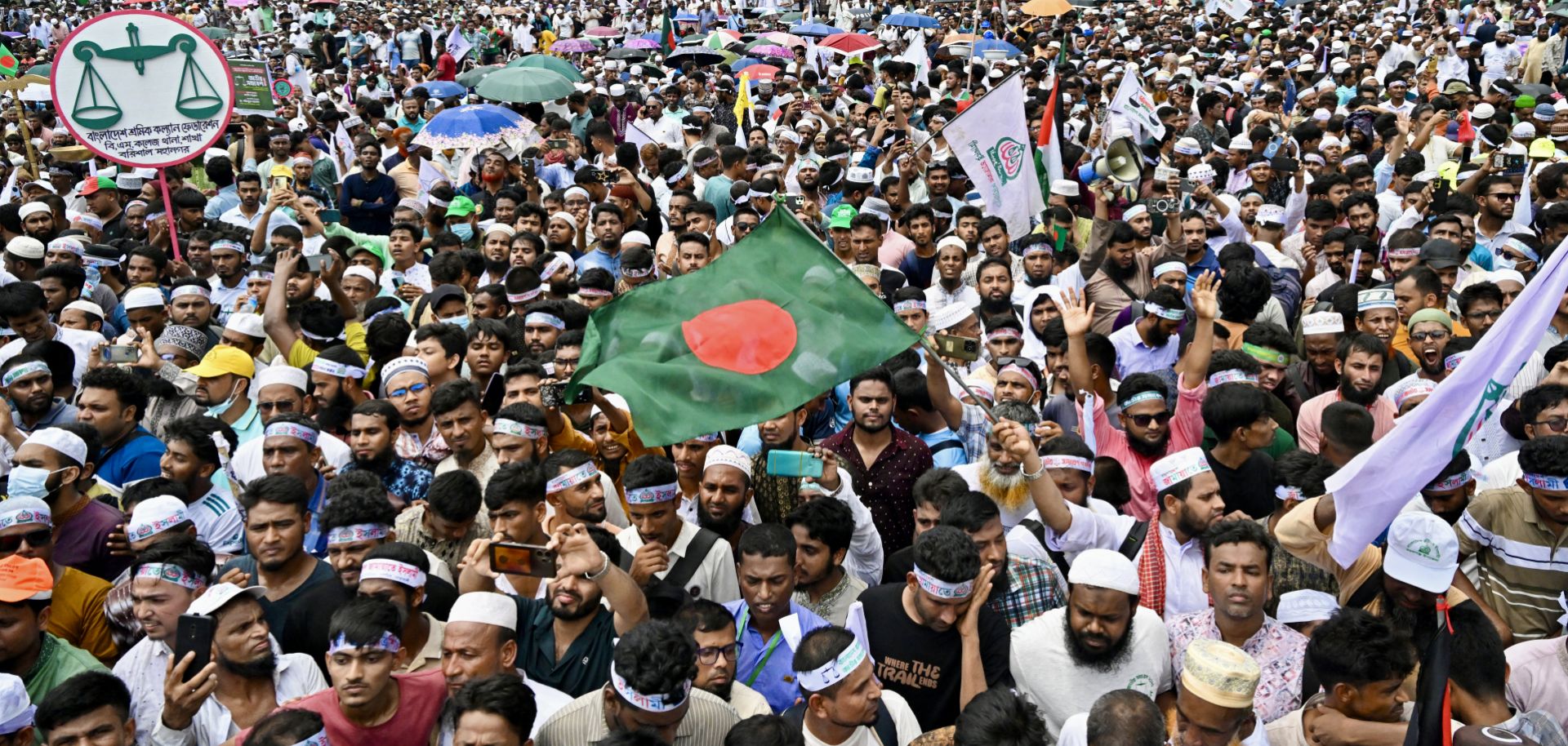
While delays remain possible, political pressure will likely compel Bangladesh's interim government to stick to its pledge to hold elections in February 2026, paving the way for a functioning parliament, greater political stability and the implementation of key reforms. On Aug. 5, Bangladesh's interim leader, Muhammad Yunus, announced that he would formally ask the Election Commission to schedule national polls for February 2026. On Aug. 18, Election Commission Senior Secretary Akhtar Ahmed then said a draft roadmap outlining preparations for the ballot had been completed and would soon be submitted for final approval. These developments come a year after mass protests toppled the government of former Prime Minister Sheikh Hasina, paving the way for the interim administration, which has pledged to root out corruption, prevent a return to Hasina's concentration of power, and work to restore democracy, strengthen institutions and implement governance reforms.
Yunus appears to be yielding to mounting pressure for a clear election timeline, despite slow progress on the reforms he had previously insisted were prerequisites for scheduling elections. The announcement of the February elections comes amid growing frustration over the interim government's slow progress on promised reforms that activists hoped would usher in a more democratic political system less prone to authoritarianism. The government has fulfilled some of its pledges, like removing loyalists of former Prime Minister Hasina's Awami League party from senior posts. It has also advanced judicial and police reforms, such as the introduction of body cameras and transparent interrogation rooms, stricter arrest procedures, and the establishment of reform commissions for anti-corruption agencies and the judiciary. However, the current administration has struggled to implement more ambitious constitutional changes — such as curbing executive power, shortening parliamentary terms and creating a bicameral legislature — due to its limited mandate as an unelected body and the need for broad political consensus. Instead, the interim government has been working with major political parties (excluding the Awami League) to build agreement on these proposals, under the expectation that an elected government will carry them forward. But the timing of this political transition had been uncertain due to Yunus's insistence on needing more time to implement his political and economic reforms before holding new elections. In June, under pressure from several parties and a growing number of activists, Yunus eventually floated April 2026 as a possible election date. However, this failed to satisfy critics, who argued the interim government's sweeping reform agenda was being used as an excuse to delay Bangladesh's transition back to democracy.
- Yunus has repeatedly emphasized that electoral reforms are a minimum prerequisite for holding elections. These reforms include appointing new Election Commission members and implementing measures to enhance the commission's independence and authority, such as improving voter registration and strengthening safeguards against fraud. The interim government has so far appointed a new Election Commission, established reform bodies and drafted a reform charter. However, deeper changes, such as bolstering the commission's independence, improving voter registration and adding fraud safeguards, remain pending.
- Bangladesh has a history of contested elections, with both Hasina's Awami League and the Bangladesh Nationalist Party accused of manipulating the process, suppressing rivals and exploiting state institutions to secure political advantage. Allegations of voter intimidation and influence over the Election Commission have repeatedly undermined confidence in the electoral system.
- Critics attribute the government's slow progress on reforms to disorganized decision-making, with overlapping commissions, frequent leadership changes and poor coordination. Uncertainty over an election date had further heightened public concerns about Bangladesh's future.
While Bangladesh will remain vulnerable to electoral delays due to ongoing reforms and logistical challenges, Yunus will likely follow through on his pledge to hold elections in February to avoid heightened political tensions, which will ease opposition pressure and, in turn, pave the way for a functioning parliament and greater political certainty. Yunus's announcement of a February election will likely appease many of the interim government's most vocal critics, as evidenced by representatives of the Bangladesh Nationalist Party, Jamaat-e-Islami and the National Citizen Party joining him on stage to announce the election date. While this may reduce the risk of anti-government unrest in the short term, significant challenges remain. The Election Commission's roadmap, which must cover voter registration updates, constituency delimitations, ballot printing, polling staff deployment and security arrangements, will require careful coordination to finalize. Yunus's ongoing reform agenda adds further complexity, heightening the risk of delays if consensus or preparations are not completed on time. However, since any delay will likely heighten political tensions, fuel public frustration, trigger protests or unrest and undermine confidence in the electoral process, the interim government is likely to stick to its pledge, despite the challenges. This commitment is reinforced by the Election Commission's active preparations and the European Union's 4 million euro support package, which will assist in capacity-building, expert advice, effective planning and strengthening dispute resolution mechanisms. Holding elections in Bangladesh would mark a key step toward ending the current period of political instability and restoring a functioning democratic system. It would allow for a fully operational parliament to debate and pass laws, oversee the executive and implement reforms. While divisions among political parties may persist, credible elections would provide an opportunity to legitimize governance, build consensus on key reforms and give the next government a clear mandate to govern effectively.
- On May 10, the interim government imposed a nationwide ban on the Awami League and all affiliated organizations under the Anti-Terrorism Act, with the restrictions set to remain in place until the completion of the International Crimes Tribunal (ICT) trials involving the party and its leaders. The ban will prevent the Awami League from returning to power and meets a key demand of the general population for accountability. However, supporters of the Awami League could still stage protests or otherwise express dissent, which may create localized disruptions during the electoral process.
