
Bangladesh's interim government will likely schedule a general election between December 2025 and June 2026, but if it does not due to the lack of progress on electoral reforms, it will heighten the risk of instability, economic difficulties and public discontent, potentially leading to military intervention. On March 25, Bangladeshi Chief Adviser Muhammad Yunus reaffirmed that an election will be held between December 2025 and June 2026. The interim government argues that this timeline allows for essential electoral, judicial and police reforms to ensure a free, fair and credible vote, especially given allegations of widespread rigging in previous elections under the ousted Awami League party. The interim government has promised to eradicate corruption and prevent the consolidation of power under former Prime Minister Sheikh Hasina, pledging to restore democracy, strengthen institutions and implement governance reforms. Critics argue that the reforms proposed by the interim government are overly extensive and risk delaying the democratic process.
- Yunus has led Bangladesh's unelected interim government since August, following deadly student-led protests that forced Hasina to flee to New Delhi.
Amid mounting pressure from political parties to hold an election by December, the interim government will likely focus on implementing reforms to facilitate the election process. On March 6, Nahid Islam, a former student leader in the interim government and head of the newly launched National Citizens' Party, said struggles to ensure public safety have made it difficult to hold a general election this year, but parties like the Bangladesh Nationalist Party have repeatedly called for elections. On March 30, the BNP warned of growing instability and "strong resentment within the people" if a vote does not occur by December. The government's struggle to progress significantly on its reform pledges has also upset its critics. This slowdown is largely due to disorganized decision-making, marked by overlapping reform commissions, frequent leadership changes and poor coordination. The lack of an election date has intensified public concerns about Bangladesh's future. While there is no significant desire for Hasina's return, public patience will diminish if tangible improvements, particularly economic ones, fail to materialize.
- The NCP was officially founded Feb. 28 by students who had led the uprising against Hasina. The NCP is independent of the interim government, though its leader, Nahid Islam, previously served as a government adviser before resigning to establish the party, which is widely seen as aligned with the current administration. He has made one the first public acknowledgments by a former government official indicating that the government is struggling to meet its core responsibilities, specifically, ensuring public safety — a prerequisite for holding credible elections.
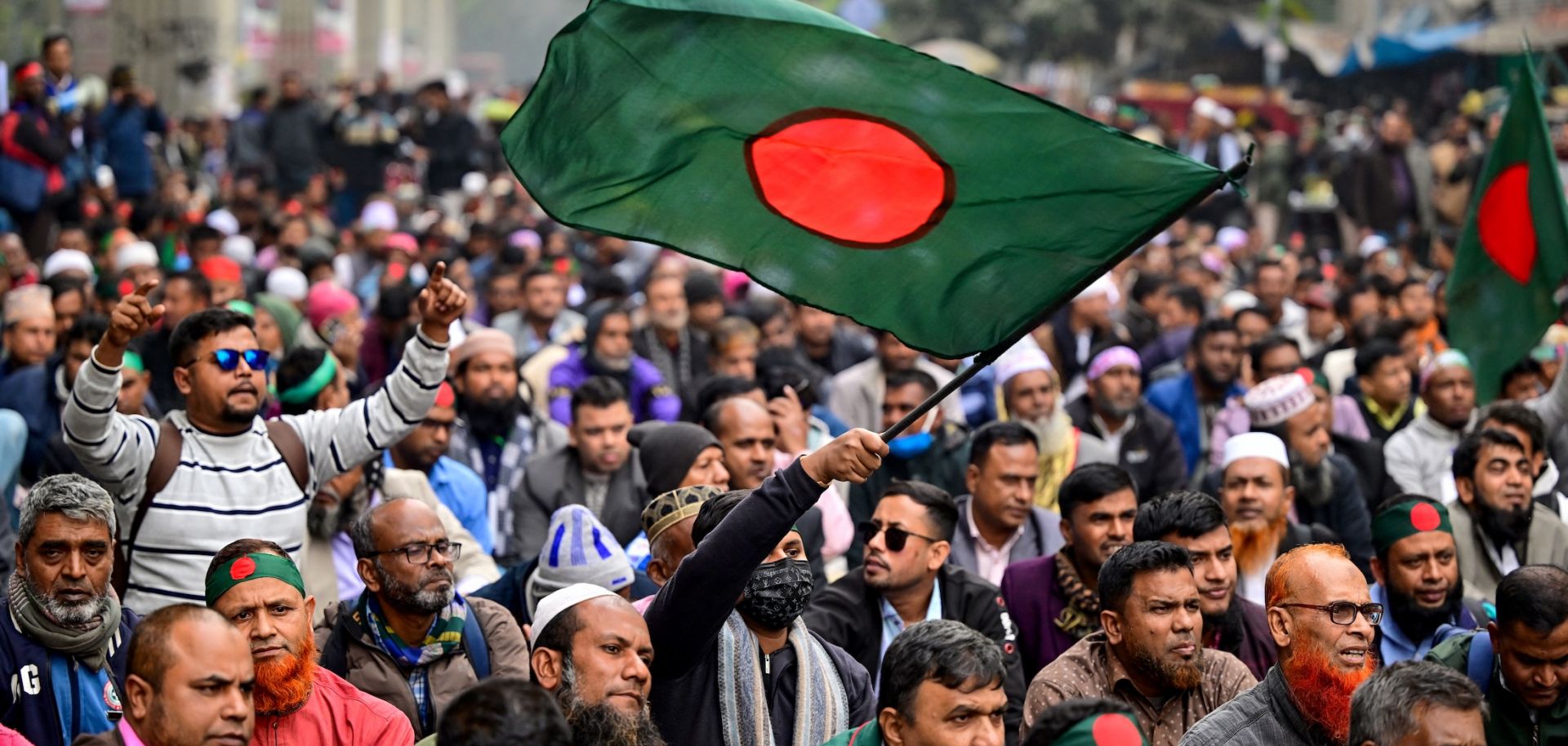
- While public safety has improved, and revenge attacks against Hasina supporters have declined compared to the immediate aftermath of her ouster, challenges remain. Many police officers continue to refuse to report for duty, and activists, energized by last year's movement, frequently take to the streets for various causes. About three months after the interim government took power, tens of thousands of BNP activists rallied in November 2024, demanding swift reforms and elections. In February 2025, thousands of protesters demonstrated against Hasina by destroying the home where her father, the first postindependence leader of Bangladesh, was slain. The attack was triggered by a speech Hasina was set to give to her supporters from exile in India.
- Bangladesh faces mounting economic challenges, with inflation expected to rise from 9.7% in 2024 to 10.7% in 2025, according to IMF projections. At the same time, GDP growth is anticipated to slow from 5.4% to 4.5%. The country also has a balance of payments deficit, dwindling foreign exchange reserves and a banking sector weakened by rising loan defaults. These challenges have been exacerbated by President Donald Trump's announcement on April 2 of a series of reciprocal tariffs, including a 37% tariff on Bangladesh, something likely to significantly impact the country's textile industry, a major exporter of apparel to the United States.
The Awami League will likely face significant limitations on its ability to compete in the upcoming election, while the NCP, benefiting from ties to the interim government, is poised to emerge as the primary competition for the BNP; were the election delayed, the NCP would likely gain strength. While the interim government has not explicitly said it will ban the Awami League, the party will likely face restrictions in contesting elections, such as the arrest and prosecution of former members. In any case, with Hasina and senior leaders either in exile or on the run, the Awami League has lost influence as a political force. Meanwhile, the main competition for the BNP will likely come from the NCP, a party perceived as benefiting from the interim government's favor. Perceptions the interim government favors the NCP stem from the fact that student leaders, who played a key role in the uprising, have ties to the interim government. A delayed election could strengthen the NCP, which, despite some association with the interim government, remains organizationally separate. The extra time would allow the party to solidify its identity, try to win support from voters tired of the country's main parties (the BNP and the Awami League), and mobilize support. It could expand its influence by building grassroots networks, recruiting youth activists, and promoting its reform agenda more widely.
- The BNP and NCP differ significantly in both ideology and their vision for constitutional reform. The BNP favors preserving the existing constitutional framework. It supports the current five-year term for parliament and opposes reform proposals that would separate the roles of party leader and parliamentary leader. By contrast, the NCP sees the current structure as fundamentally flawed and advocates for sweeping constitutional changes under a proposed "Second Republic." It supports shortening parliamentary terms to four years, in line with recommendations from a reform commission, and endorses separating party leadership from parliamentary leadership to prevent power concentration. While the BNP seeks to restore and improve democratic norms through moderate institutional reform, the NCP wants a more radical restructuring of the political order.
- The coming months will be a critical test for the NCP, as its support from left to right and everything in between raises the risk of internal tensions that could hinder its ability to present a cohesive political alternative.
- In November, the interim government revoked the press credentials of more than 50 journalists, a move critics condemned as censorship, particularly since it primarily targeted Awami League supporters. On Oct. 23, 2024, the interim government officially banned the Bangladesh Chhatra League, the student wing of the Awami League, accusing it of involvement in violent unrest during the protests that led to Hasina's resignation.
While the government will likely hold an election between December 2025 and June 2026, delays are possible due to slow progress in constitutional reform talks among parties and ongoing political tensions, leading to increased political instability, economic challenges and social unrest. The interim government will likely hold an election between the promised December 2025 and June 2026 dates, amid growing pressure from political parties, the business community and the military for a timely vote. The interim government will likely prioritize electoral reforms ahead of the election given growing domestic and international scrutiny, and with fears that further delays could trigger broader unrest. While the interim government has not revealed what reforms it plans to prioritize, they will likely include the establishment of a permanent national constitutional council to appoint Election Commission members, as well as enhancing the commission's autonomy and transparency. Political parties will also face stricter regulations, such as requirements that they publish member lists, conduct committee elections through secret ballots and prohibit foreign branches. The interim government will pursue constitutional reforms, including limiting executive power, shortening parliamentary terms and transitioning to a bicameral parliament. But these reforms are unlikely to be enacted during its tenure due to the need for broad political consensus and the administration's limited authority as an unelected body. Instead, it is collaborating with major political parties, excluding the Awami League, to build consensus on proposed changes and increase the likelihood that the next elected government will implement them. Political parties are open to working with the interim government on these reforms. But if the government misses the promised election deadline, their patience will wear thin, and frustration over the delays will likely escalate and prevent reform implementation. Reforms will likely include establishing a bicameral parliamentary system with a four-year tenure, reinstating the caretaker system — which until the Awami League abolished it in 2011 sought to ensure free and fair elections — introducing a referendum process for constitutional amendments, and imposing a two-term limit for both the president and prime minister.
- Significant differences over the proposed constitutional reforms have emerged between BNP and NCP. NCP leaders have warned that BNP objections could stall the reform process, preventing meaningful changes and rendering the student protests ineffective. Still, the NCP prefers dialogue over confrontation, and plans to engage with the BNP in the coming weeks.
A delay in elections risks deepening political instability, increasing the likelihood of military intervention; prolonging the political crisis; and worsening economic challenges, particularly in the ready-made garment industry. Delays in the consultation process for constitutional reforms are likely given the deep-seated disagreements between major political parties. While the interim government does not intend to implement these reforms itself, it is seeking to build consensus so that the next elected government can take them forward. If this consensus proves difficult to build and political deadlock ensues, elections could be delayed. This would deepen political uncertainty and undermine the interim government's legitimacy, particularly if it is widely perceived as overstaying its mandate. This environment could heighten the risk of military intervention, especially if public unrest intensifies and political institutions appear incapable of resolving the crisis. The military has intervened under similar conditions during Bangladesh's postindependence history, most notably during extended caretaker governments. Any intervention could involve direct military rule or less overt control over the interim administration. While military intervention would likely be framed as a move to restore stability, it could indefinitely delay the return to electoral democracy and trigger international backlash, including diplomatic pressure or sanctions. Political instability will likely erode investor confidence and delay foreign aid or IMF disbursements. Key sectors like the ready-made garment (industry will likely face further disruptions as foreign companies, already beginning to scale back, may accelerate their exit in favor of more stable production bases such as India.
