
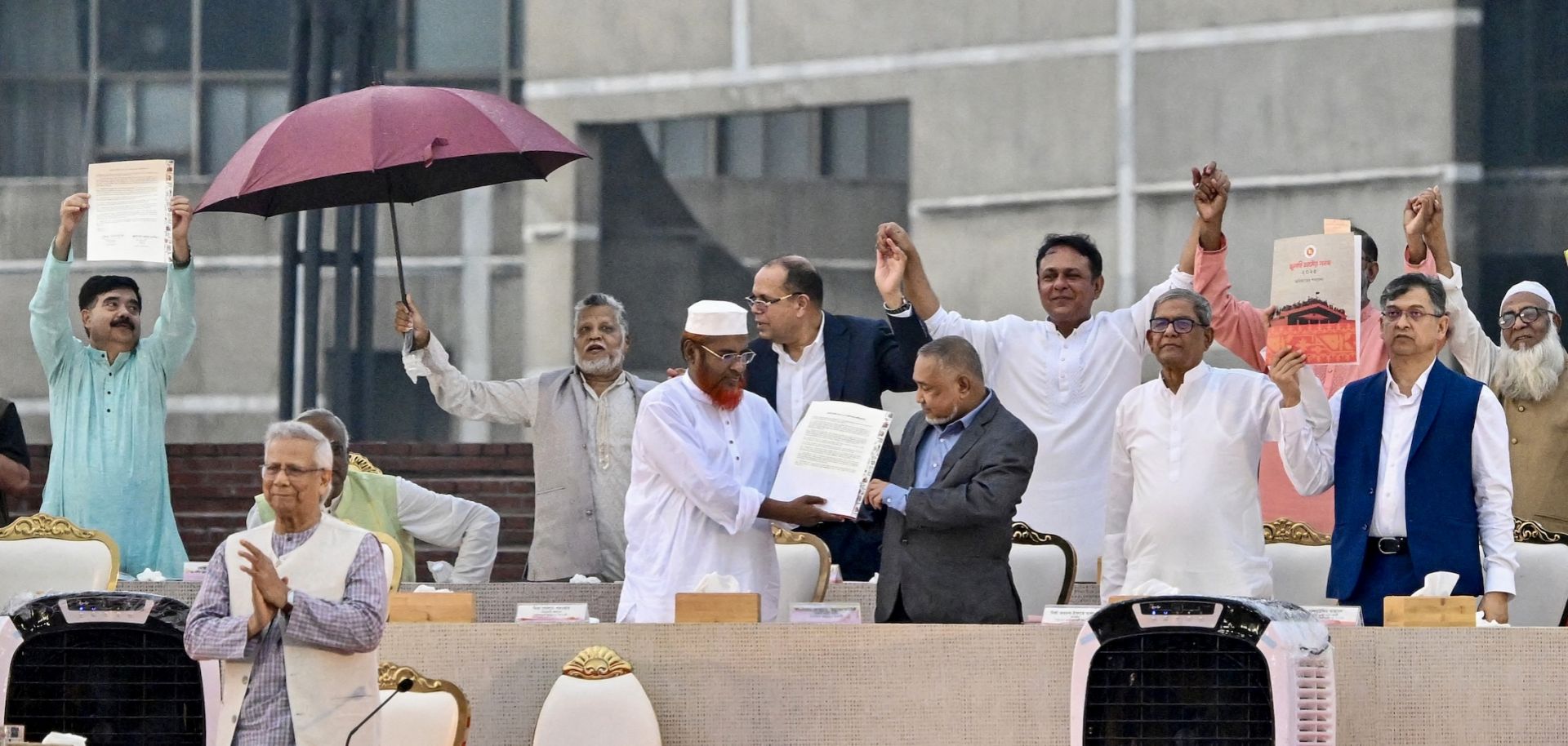
Bangladesh's political charter, a roadmap for constitutional reforms aimed at strengthening governance and limiting executive power, incorporates demands from protesters in the 2024 uprisings that ousted former Prime Minister Sheikh Hasina and has broad party backing, but its non-binding nature and uncertainty over which party will win the February elections leave a risk of renewed unrest if the next government fails to implement the reforms. On Oct. 20, a 13-member delegation of ''July fighters'' — people who took part in the July 2024 uprisings that led to the fall of former Prime Minister Sheikh Hasina's government and were injured or lost family members in the violence — met with the National Consensus Commission, calling for legal protection and the issuance of official identification cards recognizing them as ''July injured heroes.'' Their demands followed protests on Oct. 17 where demonstrators, mostly from the July Fighters group, clashed with police outside Parliament while urging the government to grant formal recognition and social security guarantees. That same day, representatives from 25 political parties and alliances, including major groups such as the Bangladesh Nationalist Party (BNP) and Bangladesh Jamaat-e-Islami, signed the July National Charter 2025, a reform roadmap spearheaded by the interim government after the uprisings.
- In response to the protests, the government later amended the charter to incorporate these demands, ensuring recognition, support and legal protections for those affected.
The proposed reforms underscore efforts by some of Bangladesh's main political forces to curb the concentration of power, strengthen democratic institutions and ensure greater accountability and transparency in governance ahead of the February general election. The July National Charter was developed through the National Consensus Commission, which was formed in mid-February. It brings together proposals from six reform bodies covering the constitution, judiciary, electoral system, anti-corruption commission and public administration. The charter aims to strengthen accountability, transparency and democratic governance and to prevent a return to the kind of concentration of power seen under Hasina. Notably, the charter calls for the establishment of a bicameral legislature to replace the current unicameral system and sets a 10-year limit on how long any individual can serve as prime minister — both of which require constitutional reforms. In addition, it proposes creating an independent body to oversee the selection of judges, a measure intended to strengthen the judiciary's independence and reduce political influence. The signing of the charter comes as Bangladesh prepares for its first general elections since the ouster of Hasina, scheduled for February 2026. The charter is also a part of a broader effort to address widespread public frustration and rebuild trust in major political parties, which have faced mounting discontent since the 2024 uprising.
While the charter lays the groundwork for post-election reforms, its non-binding nature and lingering public skepticism create a heightened risk of renewed protests and political instability if the next government fails to follow through. The signing of the charter marks the fulfillment of a key objective for the interim government, which sought to secure party endorsements for the policies in the charter ahead of the February elections. The aim was to ensure that the next administration would carry forward its reform agenda, particularly measures requiring constitutional amendments. The interim government chose not to advance these amendments itself because there is currently no functioning parliament and none will be in place until after the elections. By securing commitments from political parties now, it hoped to lay the groundwork for these reforms to be enacted once a new parliament is formed. However, not all parties signed the document. The student-led National Citizen Party, for example, rejected it on the grounds that it was not legally binding and therefore offered no guarantee that future governments would adhere to its provisions. This lack of legal enforcement underscores the charter's largely symbolic nature, despite its being hailed as a landmark political agreement. Early protests over the charter's failure to recognize the July Fighters group have already emerged, signaling a sustained risk of unrest linked to the charter. Most parties will potentially adhere to the charter's provisions due to the broad political consensus built during consultations and the risk of political backlash if they don't. However, it remains uncertain how genuine this commitment is. Some parties may be signaling support ahead of the elections while preparing to later argue that the roadmap cannot be enforced or that other national priorities take precedence, making it difficult to predict whether the reforms will be wholly implemented. The incoming government failing to follow through with constitutional amendments and incorporate the proposed reforms, or being slow to implement changes, could trigger renewed demonstrations and heighten political instability. Some of the proposed reforms are broad and principle-driven, lacking detailed implementation guidelines or timelines, creating the risk that they could be interpreted differently by different parties, a risk further compounded by the fact that the charter is not legally enforceable.
- The signing of the charter was particularly significant because securing broad party support was not easy during the consultation phase. Major groups such as the BNP initially raised strong objections to several provisions and signaled they would only sign if their concerns were addressed. This early resistance, combined with expectations that some parties would opt out entirely, made the eventual endorsement a notable political achievement for the interim government.
- While Hasina's Awami League has rejected the charter and remnants of its vast organizational network and loyal voter base could still protest, its formal ban from elections and leadership vacuum have sharply curtailed its ability to mobilize politically, making it unlikely that the party will be able to mount a significant challenge to the charter's implementation.
