
Editor's Note: For significant elections, RANE publishes a series of scenario analyses focused on different outcomes of major elections, describing how an election outcome might unfold with implications for each potential outcome. In 2025 so far, we have profiled Germany, Canada, Australia, Poland, South Korea, Japan, Guyana, Norway, Moldova and the Netherlands.
Chile will hold general elections on Nov. 16 to elect a president, the entire Chamber of Deputies and half the Senate. A runoff will follow on Dec. 14 if no presidential candidate secures over 50% of the vote. President Gabriel Boric cannot seek re-election, and his coalition backs Communist Party candidate Jeannette Jara. Her main rivals include far-right candidate Jose Antonio Kast, center-right candidate Evelyn Matthei and ultra-right candidate Johannes Kaiser. Campaigns have centered on crime, migration and slow economic growth, amid Chileans' frustration over failed constitutional reforms since the 2019-2020 protests.
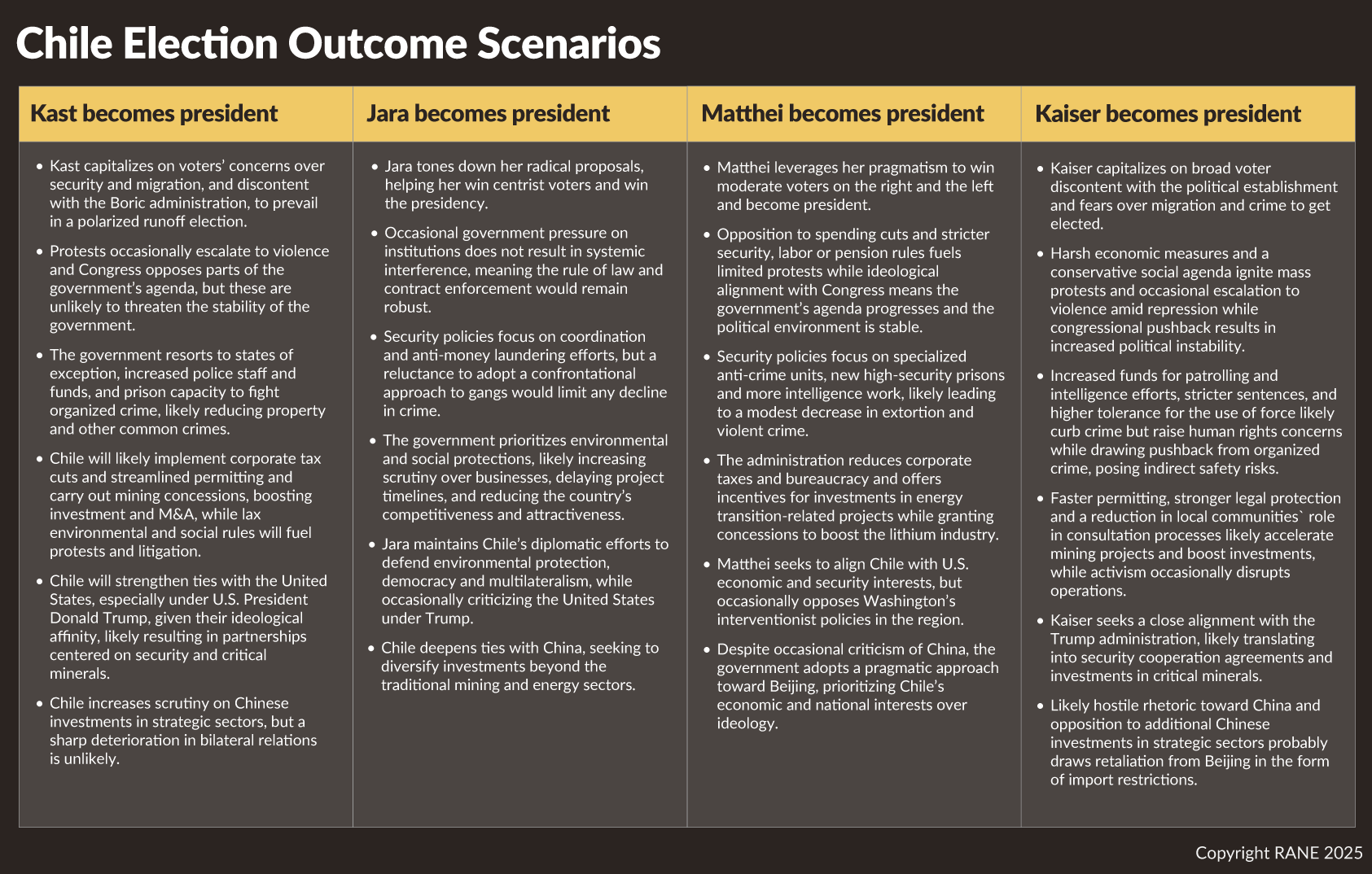
In the most likely scenario, Jose Antonio Kast of the Republican Party wins in a polarized runoff, likely against Jara, capitalizing on public insecurity and fatigue with Boric. Kast's government would emphasize tougher security and migration measures, fiscal conservatism and pro-business policies, spurring protests but improving Chile's fiscal metrics. Mining firms would benefit from tax relief and faster permitting. Relations with the United States would strengthen, while scrutiny of Chinese investment would rise, but not harm trade.
In a less likely scenario, Jara narrowly wins the presidency, maintaining policy continuity with Boric. Regulatory risks would remain low, but labor and compliance costs would increase under policies that favor higher wages and stricter environmental standards. Chile would deepen ties with China and occasionally clash with a Donald Trump-led United States.
In an unlikely scenario, Evelyn Matthei wins and pursues market-friendly reforms, fiscal discipline and migration control, limiting unrest risks and improving investor sentiment. Cuts to social spending would fund corporate incentives, benefiting mining and energy sectors. Matthei's government would align more closely with the United States, while keeping pragmatic relations with China.
Finally, in a very low likelihood but high impact scenario, Johannes Kaiser wins by capitalizing on anti-establishment backlash. As president, he implements broad austerity, deregulation and privatization measures, sparking violent protests under harsh policing. Kaiser's administration strongly aligns with the United States, straining relations with China.
Far-Right Candidate Jose Antonio Kast Wins the Presidency
Kast's pursuit of fiscally conservative, pro-investment policies, combined with his significantly tougher approach to security and migration, would increase the risk of institutional instability and social unrest. The administration's emphasis on fighting crime through expanded intelligence capabilities, tougher penalties and higher investments in public security would likely reduce property and violent crime and result in an overall safer operating environment for companies. His economic agenda would prioritize fiscal consolidation and a strongly pro-investor agenda (including tax relief and streamlined permits), further improving Chile's business climate and helping attract investments, especially to copper, lithium and infrastructure. However, Kast's tougher security policies (including a crackdown on criminal groups and undocumented migrants and opposition to violent Indigenous attacks in the south of the country), along with his conservative social and cultural agenda and attempts to undermine the country's democratic and oversight institutions, would trigger frequent demonstrations. The largest protests would occur in Santiago and occasionally escalate to violence, sustaining operational and indirect safety risks for firms throughout his term. Moreover, Kast's disregard for institutional checks and balances and social minorities would become reputational risks for the private sector, especially those partnering with the federal government. Although Chile's mostly center-right Congress would support most of Kast's pro-business proposals, more radical or controversial proposals, such as expanding presidential powers under states of emergency or restricting women's or LGBTQ rights, would be diluted as legislators operate as an effective check on the president's powers.
Implications
- Despite facing repeated (sometimes violent) protests and a large center-right bloc in Congress actively serving as a check on his administration, President Kast's hold on power likely remains secure, as he will most likely moderate extreme proposals and secure a blocking minority legislative coalition. Therefore, while Chile may face some political and policy volatility, it is unlikely to escalate into a serious challenge, such as impeachment.
- Kast likely occasionally resorts to states of exception to fight organized crime, seeking to at least partially restrict freedoms of movement and assembly in some parts of the country. Despite legislative and judiciary decisions against his decrees, Kast's administration gradually normalizes controversial discretionary actions in the name of maintaining public order. His presidential appointments further politicize Chile's judiciary and weaken oversight and regulatory bodies, which fuels legal unpredictability and undermines Chile's historically business-friendly environment by impairing the effectiveness of the country's dispute resolution system, especially in cases involving concessions, permits and other government-related disputes.
- Kast likely balances significant spending cuts, including to social programs, with corporate tax reductions and targeted subsidies to boost critical sectors, such as mining, renewable energy and infrastructure. This helps reduce operational costs and attract investments, while also improving Chile's fiscal landscape. The country's sovereign rating outlook likely improves as well, reducing the cost of credit and strengthening the Chilean peso, thereby making imported inputs more affordable. Congressional opposition likely limits Kast's ability to defund social programs or forces him to scale back proposed tax cuts. The initial sharp and fast reduction in Chile's public service apparatus also creates bureaucratic hurdles and disrupts business operations during the first months of his administration.
- In the mining sector, Kast likely implements streamlined permitting and carries out concessions to private lithium projects, while seeking to expand investments in the extraction and processing of rare earth minerals. This likely incentivizes greenfield and brownfield projects and increases merger and acquisition opportunities. However, his disregard for environmental and Indigenous protections increases risks of disputes with local communities, potentially fueling protests and litigation, and increasing risks of operational disruption and reputational damage stemming from protests.
- To curb the presence of organized criminal groups in Chile, Kast's government seeks to expand intelligence gathering, police staffing and funding, and prison capacity. These policies likely reduce levels of property and common crime, especially in large urban centers and logistics areas, improving the operational environment for the private sector. However, potential police abuses and weak accountability mechanisms occasionally result in high-profile scandals, likely undermining the long-term sustainability of such measures.
- Kast adopts very strong rhetoric around securing Chile's borders, though resource shortages and other operational hurdles likely force him to scale back his border security efforts. While he will likely send the military to critical crossing points, a large-scale construction of walls and ditches alongside the northern border will not materialize and smugglers will continue to find new routes alongside the country's lengthy territory.
- Despite Kast's strong rhetoric on securing Chile's borders, operational and resource constraints likely limit the scope of his efforts. While Kast's government likely deploys the military to key crossing points, his promises of building large-scale walls and ditches along the northern border likely prove infeasible, enabling smugglers to continue finding new routes across Chile's extensive territory. The tighter controls also become obstacles to legal cross-border movements, creating logistical and supply chain disruptions, while increasing shipping costs, particularly in the northern regions.
- Kast's government implements strict measures to control illegal migration, including tightening entry rules for foreigners, establishing detention facilities for undocumented migrants, and prioritizing expulsions. As a result, large numbers of migrants leave Chile, which reduces labor supply in agriculture, construction, hospitality and low-skilled services — increasing pressure on wages and resulting in increased costs and potential staff shortages in these sectors.
- Kast likely resorts to extended states of exception to tackle violence perpetrated by the Mapuche and other Indigenous groups, especially in the Araucania and Biobio regions, prioritizing the protection of private property and infrastructure assets. This temporarily reduces the frequency of arson and sabotage attacks on companies operating in Araucania and Biobio, especially those in the forestry, energy and logistics sectors. However, firms with activities in Concepcion and Temuco, the main cities in these regions, face greater indirect security risks stemming from higher anti-government protest activity, as the government's increased policing and likely arrests of some of these Indigenous groups' members also deepen long-held Indigenous grievances with the Chilean state.
- Kast's spending cuts and conservative social and cultural agenda trigger frequent protests by unions, students and left-wing groups. Escalation to violence is likely due to the government's concurrent efforts to suppress dissent via enhanced surveillance, stricter regulations on protest activity, and stronger legal protections for police. Combined popular anger over Kast's policies and perceived police brutality will likely increase risks that demonstrators directly target private sector assets near protest hotspots through vandalism or arson attacks, posing higher safety risks while also increasing operational costs and insurance premiums.
- U.S.-Chile relations strengthen due to Kast's ideological alignment with Trump, boosting bilateral cooperation on security and critical minerals. This likely manifests as joint efforts to combat organized crime and transnational drug trafficking, as well as increased U.S. foreign direct investment into Chile (both in the form of greenfield projects and M&A transactions), which boosts the Chilean economy and facilitates greater long-term exploration and processing of the country's rare earths. However, should a Democrat retake the White House after 2028, U.S.-Chile ties could become strained, though the impact on businesses would likely be limited.
- Kast's government likely increases scrutiny over Chinese investments, especially in strategic sectors like mining, energy, infrastructure, logistics and telecommunications, aiming to reduce Chile's dependence on Beijing. This creates higher political and regulatory risks for existing Chinese companies and investors in Chile, stemming mostly from investigations, audits or delayed government authorizations. That, in turn, likely new deals involving Chinese players, while creating opportunities for competition from companies and investors from the U.S., Europe and the Middle East. Still, Kast will seek to avoid a rupture or sharp deterioration in bilateral relations with China, which remains Chile's top export destination.
Communist Party Candidate Jeannette Jara Wins the Presidency
Like the Boric government, a Jara administration would not clash with the country's democratic institutions nor overly interfere with market dynamics, even though Jara would advocate for a more prominent role of the state in the economy while pushing for a stronger social agenda that includes higher minimum wages and pensions, and tighter social, environmental and labor rules. That said, Chile's mostly center-to-right-wing Congress would likely prevent the approval of significant expenditure increases or regulatory measures it perceives as overly detrimental to businesses, limiting risks of significant interventionist policies. Despite recurring deficits, the country's debt trajectory would remain manageable as Jara resorts to ad hoc tax hikes on businesses to offset growing social expenditure. Increased regulatory requirements would be burdensome for companies operating in Chile, especially those in the extractive and labor-intensive sectors (such as mining, forestry, agrifood, manufacturing and construction), and would also delay projects by slowing permitting timelines.
Implications
- Political instability risks remain low, as Jara appoints centrist allies to key ministries, negotiates reforms with legislators, and avoids resorting to coercion to repress dissent and protests. A mostly center-right Congress dilutes or blocks several government economic and social proposals, eventually resulting in legislative gridlock, while an active and pro-government civil society demands expanded rights or benefits in a mostly peaceful manner.
- While Jara's government may pressure Congress, the judiciary and/or oversight bodies in matters sensitive to its agenda, this does not translate into a systemic capture of the public sector so as to challenge Chile's well-established institutional checks, judicial independence and independent media. The country's rule of law thus remains robust, with companies operating amid clear contract enforcement, even as Jara seeks to expand the role of the state in the economy and increase regulation on social, labor and environmental issues.
- The government seeks to expand Chile's welfare framework, including by raising the minimum wage above the rate of inflation and avoiding significant cuts to pensions. These measures are likely funded by targeted tax increases on high-performing sectors, such as mining and technology. Wider deficits do not immediately cause a severe fiscal crisis due to the current low debt-to-GDP levels, but they potentially lead to negative credit rating outlooks or, in a more extreme scenario, even a downgrade. Such a downgrade could increase the cost of credit, while the higher wages would put pressure on corporate profit margins.
- Businesses face greater government scrutiny on the environmental and social impact of their operations in Chile, likely facing additional costs to comply with stricter rules or risk fines. The government's prioritization of local communities in consultation processes also likely delays project timelines and reduces Chile's attractiveness for greenfield investments, especially in extractive sectors and in environmental or socially sensitive areas. But the Jara administration likely offers incentives for small and medium-scale mining to stimulate local economies, and resorts to public-private partnerships to explore lithium and manufacture value-added goods like batteries.
- The government seeks to strengthen the coordination of public security forces, tighten financial oversight of organized criminal groups, expand firearms seizures and deport foreign felons convicted of drug trafficking. Financial institutions and large corporations are likely required to expand anti-money laundering reporting, increasing compliance costs. But the Jara administration avoids adopting a more confrontational approach to tackling gangs, which limits its impact on reducing crime levels, thereby leaving businesses exposed to theft, robberies, extortions and indirect safety risks stemming from targeted killings or shootouts between rival gangs.
- Jara's government likely adopts measures to fight human smuggling and curb organized criminal groups' operations across Chile's borders, including additional bureaucratic requirements for foreigners to enter the country, and increased patrolling and drone surveillance, though the use of force is limited. For businesses, better control of contraband supports local commerce, especially in northern Chile, but more complex border procedures and checks increase costs and create logistical challenges for regional trade routes.
- Instead of relying on widespread mass deportations, Jara seeks to register undocumented migrants. This strategy aims to formalize a segment of the labor force, while also signaling that Chile will not accept unlimited migration flows across its borders. Businesses in labor-intensive sectors like agriculture, construction and hospitality likely also face stricter enforcement of labor standards and higher penalties for employing workers without proper documentation.
- Jara seeks to de-escalate rhetoric around the Indigenous Mapuche people, avoiding referring to them as terrorists while emphasizing dialogue, social development and targeted security actions as solutions. This leaves businesses involved in the timber, energy and logistics industries in southern Chile exposed to occasional acts of sabotage or arson attacks, though government efforts for a negotiated solution potentially result in fragile truce agreements that temporarily reduce violence.
- President Jara, due to her Communist Party's strong ties with unions and social movements, is more likely to engage in negotiations than to repress protests. This significantly lowers the risk of large-scale demonstrations, as well as the risk of unrest escalating to widespread violence. However, localized strikes and mobilizations centered on issues like wages, pensions or sectoral reforms may still occasionally disrupt business operations near protest hotspots in Santiago and other major cities.
- Jara broadly maintains Chile's current diplomatic priorities, including cooperation on climate change, defense of democratic values and multilateral institutions, and a rules-based international order that facilitates trade. She likely criticizes President Trump's interference in South American affairs, creating occasional diplomatic friction that potentially results in U.S. visa or financial sanctions being placed on Chilean officials. In an extreme scenario, Washington could impose new tariffs on some Chilean exports, though the likely exemption of minerals would limit the overall impact on bilateral trade. While Jara would avoid interfering with U.S. investors' interests in Chile, an escalation of political tensions with the United States could lead her administration to seek alternative partners for certain defense and vital infrastructure initiatives.
- Due to her party's ideological affinity with the Chinese Communist Party, Jara likely seeks to strengthen Chile's "strategic partnership" with Beijing, including by expanding Chinese investment beyond the traditional mining and energy industries into areas like technology, innovation and value-added mineral production. Consequently, Chinese state-owned and private enterprises find increased opportunities in lithium, renewable energy and infrastructure, intensifying competition for foreign investors from other countries. This pro-China bias likely triggers pushback from the White House, further raising the risk of U.S. tariffs or other retaliatory measures.
Center-Right Candidate Evelyn Matthei Wins the Presidency
As president, Matthei would pursue a limited fiscal consolidation that combines spending cuts with the preservation of some social programs, creating fiscal room for reducing corporate taxes and providing investment incentives, such as subsidies. Her pro-mining and energy-transition agenda would translate into faster permits and concessions, including for lithium extraction, helping boost greenfield investments. On the security front, Matthei would invest in personnel and equipment to fight organized crime and tighten rules on border and migration controls to appease voters. Companies and investors would benefit from an overall stable macroeconomic environment, regulatory predictability and a more business-friendly environment than under the Boric administration. While some anti-government protests would occur, they would largely remain small in scale and non-violent, while the lack of harsh police repression would prevent an escalation to widespread unrest.
Implications
- Matthei's presidency is marked by a broadly stable political environment, facilitating medium- to long-term investment planning for businesses in Chile. This stability stems from her ability to pass a pro-business policy agenda through Congress, thanks to her political alignment with most legislators.
- Representing Chile's traditional center-right, Mattei likely works within the country's established democratic system, prioritizing the approval of reforms and major legislation through Congress over frequent use of decrees. This limits the risk of institutional erosion and maintains a robust rule of law, characterized by independent courts and regulators. For companies, operational conditions thus largely remain the same.
- Matthei likely adopts a balanced fiscal policy, aiming to reduce spending while also preserving some essential social programs for very low-income Chileans. A gradual fiscal consolidation underpins Chile's strong sovereign ratings, limiting financial volatility while marginally reducing long-term financing costs.
- Matthei's government also reduces corporate taxes, streamlines permits, provides incentives for investments in energy transition-related projects and grants concessions to boost lithium production and processing. Her moderate and pragmatic approach to policymaking likely improves Chile's mining competitiveness and attractiveness, bringing in more copper and lithium investments via greenfield opportunities or M&As. Matthei also calls for environmentally and socially responsible exploration, but not at the expense of project timelines, with her government likely backing businesses over local communities or environmentalists when issuing permits or influencing dispute resolutions.
- Matthei's security platform prioritizes increasing the number of police officers and specialized anti-crime units, building high-security prisons, and strengthening intelligence work to fight organized criminal groups, extortion and violent crime. Increased government investments in investigations and enforcement likely leads to a slight decrease in crime rates, marginally reducing security risks and financial losses for companies operating in Chile.
- Matthei's deployment of soldiers to Chile's northern border marginally improves security, resulting in a slight decrease in crime and smuggling. But active organized criminal groups continue to pose safety risks through common, property and violent crime.
- On immigration, the Matthei administration enforces stricter penalties for illegal entry, reduces most social benefits for undocumented migrants, and increases deportations, though softer rhetoric might limit voluntary departures. To counter labor shortages, Matthei likely resorts to sector-specific temporary visas, promoting formal, sponsored migration. Labor-intensive sectors like agriculture, construction and hospitality face more bureaucracy and higher costs but benefit from reduced reputational risk, fewer staff shortages and less wage pressure.
- Matthei likely labels violent Mapuche groups as terrorists, deploying the military to Araucania and Biobio. This hard-line stance probably provokes retaliation — mostly attacks on security forces, with occasional targeting of forestry, energy and transportation assets — leading to higher insurance premiums in the medium term.
- Matthei's cuts to public spending and harsh anti-crime policies likely trigger occasional protests from students, unions and left-wing groups. Her administration seeks to contain these demonstrations without resorting to severe repression, limiting the risk that they escalate into wide-scale unrest. This also reduces the risk of direct violence against private assets, though businesses operating near protest activities could face indirect safety risks during rare clashes.
- Matthei would seek to align Chile with U.S. economic and security interests in the region, facilitating trade, cooperating on the fight against drugs and cartels, even though she would avoid supporting the violation of South American countries' sovereignty or other U.S. policies perceived as authoritarian or interventionist among Chileans. The pragmatic relationship would likely result in increased cooperation on law enforcement, border security and mining investments amid a regulatory environment with strong legal protections for U.S. firms.
- Matthei pursues a pragmatic relationship with the United States, prioritizing alignment with U.S. economic and security interests through facilitating trade and cooperating on the fight against drug trafficking groups in the region. But she remains careful to avoid supporting U.S. policies that Chileans might perceive as authoritarian or interventionist, such as violations of South American countries' sovereignty. This cooperation with Washington strengthens Chilean law enforcement, improves border security and encourages mining investments, particularly in a regulatory environment with strong legal protections for U.S. firms.
- Despite labeling China a dictatorship, Matthei also adopts a pragmatic approach toward Beijing. She prioritizes Chilean economic and national interests over ideology, which makes a major rupture or diplomatic crisis with China during her term unlikely. Trade and investment ties, especially in copper, lithium, renewables and infrastructure, largely continue, though concerns around intellectual property protection and espionage potentially deter Chinese investments in strategic sectors, such as logistics, telecommunications and ports.
Ultra-Right Candidate Johannes Kaiser Wins the Presidency
In the least likely scenario, Kaiser would use the presidency in a highly disruptive manner, pushing for a libertarian program that consists of deep spending cuts, aggressive privatizations, rapid deregulation and a sharp reversal of climate and ESG commitments. He would also resort to heavy-handed security policies to fight crime, curb illegal migration and crack down on anti-government protesters. Kaiser would resort to presidential decrees to circumvent legislative opposition and leverage legal inconsistencies to push his agenda. Such a strategy would fuel legal uncertainty and political instability, as Congress would occasionally act to block his agenda by overturning presidential vetoes with a qualified majority. Amid a polarized social and political environment, mass protests would become frequent over time, and retaliatory attacks by the Mapuche Indigenous people would increase in frequency, intensity and geographic scale. International human rights and climate watchdogs would be highly likely to denounce his administration's abuses, fueling reputational risks to companies in Chile in the long term.
Implications
- Kaiser's sympathy for Chile's dictatorial period, hostility to "globalist" and "woke" agendas, and disregard for institutional norms will likely result in the repression of the leftist political opposition, civil society organizations and unions. Mass protests by unionists, students and left-wing groups will become frequent, while far-right pro-government demonstrations will take place occasionally. General strikes will likely disrupt operations across the country, and states of emergency could represent additional challenges to logistics.
- Kaiser's recurring attempts to bypass Congress and legislators' efforts to block his agenda will result in repeated institutional crashes that increase political instability and test Chile's institutional framework. These attempts will also create reputational risks for companies in the country, especially those doing business with or promoted by the Kaiser administration, such as concession or public-private partnerships.
- Kaiser will seek to drastically shrink the size of the state via deep spending cuts to social programs, privatizations, agency closures and mass firings of public servants. Meanwhile, he will not cut corporate taxes or subsidize investments, given his stance that the state should not interfere with the economy. These actions will reduce Chileans' available income and hurt consumer-oriented sectors, especially in more remote parts of the country where public servants account for a larger portion of the labor force. However, they will also significantly improve Chile's fiscal position and support Chile's credit ratings over time, likely resulting in upgrades. Additionally, a large privatization pipeline will attract investor interest, especially in the energy, infrastructure, utilities and mining sectors, although risks that future leftist governments could reverse these policies may compound reputational concerns and deter private capital inflows.
- The government will prioritize rapid permitting and stronger legal protection for approved licenses while curbing local communities' role in consultation processes. These changes will likely accelerate the approval and expansion of copper and lithium projects, boosting investments. However, local communities and NGOs will target mining concessions or projects that are clearly connected to the Kaiser administration, and protests will disrupt operations. In addition, ESG-related disputes and litigation will fuel uncertainty and pose heightened reputational risks. Kaiser will also seek to privatize Chile's state-owned copper company Codelco, but strong popular and political opposition will likely significantly delay or block such efforts.
- The government will increase funding for security and intelligence institutions and will tolerate a greater use of force by the authorities. As a result, companies in security, tech and defense-related supply chains contracting with the government will face elevated reputational risk around potential human rights violations. In Congress, the Kaiser administration will push for stricter sentences, including the death penalty, for crimes such as targeted killings, kidnappings and rape. This harsh crackdown on crime will likely lead to a sharp decline in offenses in the short to medium term, improving operating conditions. However, it will also likely lead to pushback from criminal gangs in the form of occasional prison riots or attacks on government buildings or police forces, posing indirect safety risks to companies nationwide.
- The government will likely militarize Chile's northern border and resort to frequent security operations to crack down on illegal crossings from Bolivia and Peru. While this may reduce smuggling and irregular migrant flows, militarizing the border will risk creating friction with neighboring countries and disrupting logistics. Export-oriented companies relying on Andean routes will likely face delays, tighter compliance costs and potentially retaliatory violence from criminal groups in the form of violent cargo theft or occasional explosive/arson attacks to pressure the government to back down from its heavy-handed grip on security.
- Widespread deportation campaigns will likely be strictly enforced to prevent undocumented migrants from working or receiving social benefits. Additionally, Kaisar will resort to his large online following to expose companies relying on non-Chilean workers, even if legally. These campaigns will likely pose significant operational challenges to labor-intensive sectors by causing staff shortages, necessitating higher wages and creating reputational risks.
- Kaiser will likely resort to states of emergency and other exceptional mechanisms to deploy the military and use force to crack down on Mapuche activism. The government will oppose negotiations around land restitution to Indigenous people and label most violent incidents as terrorism, leading local groups to engage in sporadic sabotage, roadblocks and, in rare instances, direct confrontation with the military. These conflicts will likely expose private sector assets in the Araucania and Biobio regions to indirect safety risks and more frequent operational disruptions stemming from blocked roads or railways or damage to their transportation assets.
- Kaiser's aggressive liberalization, sharp reduction in the size of the state and confrontational culture war rhetoric will likely revive large-scale urban protests, potentially matching or exceeding the magnitude of those recorded in 2019. The government's low inclination to compromise will raise the likelihood of violent clashes amid severe police repression. Companies across Chile's main cities will face high risks of vandalism and increased financial costs stemming from required repairs, mitigatory measures or higher insurance premiums. Should police repression result in the deaths of protesters, reputational risks to companies directly engaging with the Kaiser administration would further increase.
- Kaiser will seek to closely align Chile's foreign and domestic policy with that of the U.S. Trump administration, including by cracking down on drug trafficking, spreading anti-left rhetoric, opposing the "woke agenda" and supporting Israel. The impacts on the business environment will stem mostly from security improvements amid stronger bilateral cooperation and ad hoc investments in lithium and rare earths extraction and processing. While a future Democratic White House would criticize the Kaiser government's human rights record and climate policy, that criticism would not interfere with private sector investments in the country.
- Chile will adopt hostile rhetoric toward China, criticizing the country's authoritarianism and expanding presence in Latin America. While this rhetoric will have limited impacts on Chilean mining exports to China, the government will closely scrutinize or even block additional Chinese foreign direct investments in strategic assets, such as power grids, ports and critical minerals supply chains, heightening political, legal and regulatory risks for Chinese investors in the country. That will likely lead Chile to diversify toward other Asian, Middle Eastern and Western partners, which will likely draw retaliation from Beijing in the form of import restrictions.
