
Editor's Note: This article is part of an ongoing RANE series on the geopolitical impacts of water stress. The first installment of this series provided a broad overview of how the unequal distribution of freshwater shapes geopolitical patterns. Other installments have examined the impacts of water stress on the global economy, Europe, China, the Sahel region of sub-Saharan Africa, Israel and Central Asia.
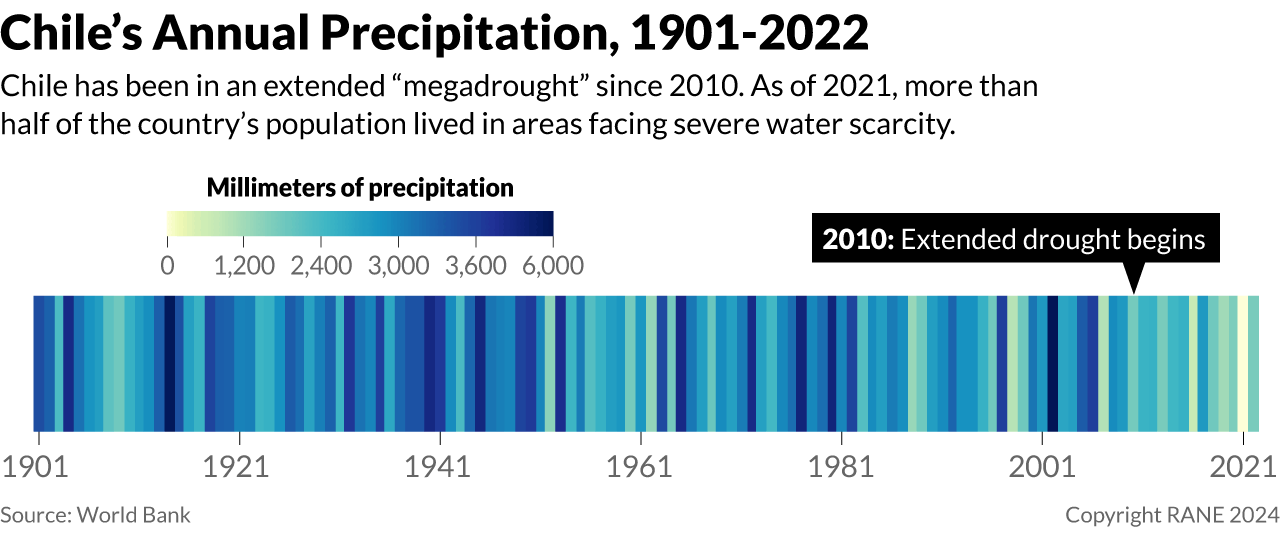
Rising water stress in Chile is increasing threats to the country's critical agriculture and mining sectors, while also stoking long-standing social tensions, but further successes in constructing desalination plants would bode well for the country's ability to stave off the most severe impacts of water insecurity. Over the last fifteen years, water scarcity in Chile has escalated dramatically, with a prolonged dry period known as a "megadrought" starting in 2010 and persisting as of 2024. The drought has reduced average rainfall across the country, from the northern Atacama Desert to the historically more water-secure southern Patagonia region. As of 2021, over half of the country's population of 19 million lived in areas facing severe water scarcity, and the same year approximately 8% of the population was found not to have access to drinking water, according to the Chilean Ministry of Social Development. These challenges are the result of climate change altering precipitation patterns across South America, with precipitation levels falling by between 20% and 40% in Chile depending on the region, with the most significant changes in the country's more arid northern and central regions. Furthermore, with less snowfall in the mountains during the country's winter months, available fresh water drops drastically in the summer, and surging summer temperatures have led the surface area of twelve of the country's major lakes to decline by between 7% and 25% between 2010 and 2020. In response, authorities have implemented extensive rationing programs, and in 2022, consumer water rationing programs were announced in the capital of Santiago for the first time. Decreased rainfall has also combined with increased summer temperatures to trigger extended wildfire seasons, with catastrophic wildfires across the country's central regions over the last decade killing hundreds of people and destroying thousands of square kilometers of forests, farmland and residential areas. Private sector use and water management policies have exacerbated such challenges, as Chile's business-friendly constitution (implemented in 1980 under the dictatorship of Gen. Augusto Pinochet) recognizes water as private property — the only country in the world to do so. This has led to high use of water resources by agriculture and extractive industries and makes it legally and politically challenging to restrict companies' use of water to which they have purchased the rights. Overall, water scarcity is poised to increase over the coming years, with Chilean authorities predicting in 2022 that by 2060, northern and central regions will see water availability drop by another 50%.
- Chile uses a four-tier water rationing system. In the first stage, "Green Alert," no water rationing occurs and the alert simply advises water conservation. In the "Preventative Early Warning" and "Yellow Alert" stages, consumers see a reduction in water pressure, and in the "Red Alert" stage, water cuts are applied.
- In February 2024, wildfires occurred in Valparaiso, O'Higgins, Biobio and other regions. A severe, fast-moving wildfire in the Valparaiso region (40 miles, or 64 kilometers, west of Santiago) killed over 100 people, making it Chile's worst natural disaster since the country's 2010 earthquake.
- According to the International Trade Administration, as of 2024, Chile's agricultural sector is the largest user of consumptive water at 72%. Meanwhile, the mining sector uses approximately 4% and the industrial sector uses 7%.
- In 2022, 62% of Chilean voters rejected a new constitution that would have provided more social justice and environmental protections. The proposed document included changes that would have made water rights nontransferable and established an agency to regulate water rights, shifting the country away from the current system of considering water as private property.
- Despite water shortages, Chile has had greater success with water management than most of the region and in 2016 became the only country in Latin America to ensure 100% of its population has access to basic water sanitation services, putting its water safety in line with Western countries such as the United States and the United Kingdom, according to the World Health Organization.
Decreased water supplies would be more likely to damage Chile's agricultural sector, reducing exports of key fruit products, raising their global prices, hurting the local economy given the sector's importance, and opening the door to future strains on the government's budget as authorities attempt to support the sector. Given the high use of water by Chile's agriculture sector, the industry is poised to face escalating challenges over the coming years. Chile's agricultural sector has historically been concentrated in central regions, but in recent decades, areas of northern Chile, such as Atacama, have expanded their agricultural production with the use of extensive irrigation to make use of the longer warm season, which is ideal for fruit. This is one of the driving factors of Chile's predominance in the export of fruit during the northern hemisphere winter, making the country one of the largest global producers of pitted fruits, grapes, apples and pears. However, northern Chile is facing among the most severe water shortages in the country, and decreased rainfall is exacerbating challenges for the sector. Demonstrating broader challenges to the agriculture sector, most of the country has been under a state of agricultural emergency since June 2023, which allows authorities to provide financial aid to agricultural producers, including by reducing economic hardship for farmers who have lost their crops. Though the state of emergency was initially declared in response to flooding, in December 2023, authorities extended it for an additional nine months (now set to expire on Sept. 30, 2024) in response to low rainfall during the critical summer growing season. Farmers across the country have reported decreased income and increased irrigation costs, with high temperatures also decreasing crop yields for some. The Intergovernmental Panel on Climate Change reports that this trend is set to continue, predicting wheat and maize yields in Chile will drop by 15% to 20% by 2050. While Chile is not a major global producer of staple grains, such a decline would increase domestic food costs and add to global grain demand. In addition, damage to fruit production would raise costs for food retailers around the world. While areas of southern Chile have adequate rainfall, their colder temperatures make them inappropriate for fruits that require warmer temperatures, meaning there are few alternative regions within Chile to which the farming sector can shift operations. Finally, the increasing economic damage to Chile's domestic agriculture sector will increase the probability of future governments providing more financial aid to farmers with lost crops over the coming decades. While current financial support is relatively small compared with the size of Chile's budget, future increases, especially if accompanied by revenue falls, could add greater pressure.
- According to the Observatory of Economic Complexity, Chile was responsible for 45.3% of global cherry exports in 2022, a large majority of which went to China. Chile was also responsible for 11.2% of grape exports, the majority of which went to the United States and China.
- Agriculture and related sectors accounted for 26.9% of total Chilean exports in 2022 and 8.5% of gross domestic product, according to the International Trade Administration. Agriculture also employs approximately 10% of the labor force, making farmers a sizable portion of the electorate.
- The agricultural state of emergency provided $8.3 million to farmers and infrastructure improvements in its first three months. In May 2024, the Chilean government announced the extension of the "Siembra por Chile" (Sowing in Chile) program, allocating a budget of approximately $130 million (in comparison to a total 2024 government budget of $89 billion), which supports fundings for farmers as well as other development programs.
Water's importance to Chile's mining sector, whose key infrastructure is often in particularly water-stressed areas of the country, means the sector will likely face increased operating costs and production disruptions over the long term, causing downstream repercussions to other industries. Chile is highly important for global precious mineral and metal supplies, as the country is the largest copper producer in the world. Chile is also the second-largest global producer of lithium after Australia and is a major producer of silver, molybdenum, iron and gold. Mining is a water-intensive industry, and as the majority of Chile's mining sector is centered in the north-central areas of the country, including the Atacama Desert, an area with one of the lowest rainfall levels in the world, this means that the industry has long depended on irrigation systems bringing water in from more water-secure parts of the country. As climate change further reduces rainfall in northern Chile over the coming decades and strains water supplies from other regions, the cost of mining operations in Chile will likely increase. In periods of particularly strained water availability, mines without alternative available water sources (such as desalination facilities) may be forced to temporarily suspend operations. Given Chile's importance to copper and lithium supplies, such a development would create downstream supply chain disruptions for the minerals, including price increases, delays and shortages across various sectors, including electronics manufacturing and electric vehicles.
- Chile accounts for 24% of the world's copper production and 30% of the world's lithium production.
The mining sector's high use of water is also poised to become a greater domestic political issue as water stress escalates, but there are major political and legal constraints to adjusting water regulations, which would also harm the country's economy. There is long-standing opposition to extractive industries among left-wing and Indigenous activists across Chile, who accuse mining and other companies of causing environmental damage (in some cases to sensitive ancestral lands) and exploiting cheap labor. The Chilean economy's high reliance on the mining sector (and specifically copper) means there is currently a low likelihood that the government of leftist President Gabriel Boric, who already faces numerous political pressures amid grievances about rising crime and a slowing economy, would seek to reduce water rights for the mining industry. In theory, pressure to reform water regulations would grow in future years, especially under other left-wing administrations, if water insecurity impacts become particularly severe. However, even a future effort to reduce water rights for mining would be challenging and would require reforms to the 1981 Water Code, a lengthy process that would require significant political support, meaning significant restrictions would only be likely if left-wing parties achieve a significant legislative majority. A reduction in profits for the mining sector would also cause economic harm to the country, straining the country's largest source of foreign currency and potentially increasing unemployment, particularly in northern Chile, an area highly dependent on the industry. This would create longer-term economic challenges and, if the government fails to manage such changes effectively, could significantly increase debt levels over the coming decades.
- According to the International Trade Administration, the mining sector accounted for 13.6% of Chile's GDP in 2022, with mining sector exports accounting for 58% of total exports.
- The 1981 Water Code was reformed in 2005 to address environmental and other concerns, but the reforms were the result of a political process lasting over a decade. Chilean lawmakers could also attempt to change the constitution, but given two failed attempts to approve a new constitution since 2019 and the desire among right-wing parties to adhere to the current constitution, this would also be a lengthy and politically challenging process.
- Chile's debt levels are typically well below those of its regional neighbors, but they have been increasing in recent years. In late 2023, the Finance Ministry predicted that public debt would rise to 41.2% of GDP in 2024, up from 38.1% in 2023. This increase is partially due to the country's COVID-19 recovery and an increase in social spending under the Boric government.
Should a more conservative candidate win the late 2025 presidential election, potential rollbacks to environmental protections and the prioritization of industrial water use over consumer use would exacerbate preexisting socioeconomic tensions across Chilean society, raising the probability of unrest over the coming years. While Chile's economic conditions and living standards are significantly better than the majority of its Latin American neighbors, the country has long struggled with severe economic inequality. In the last decade, these issues have come to a head. In 2019, they triggered mass anti-government protests led by left-wing groups. Though they have declined in regularity over the subsequent five years, left-wing activists continue to demonstrate in response to trigger events such as anniversaries of previous protests or unpopular political developments, with a small minority of protesters engaging in violence and vandalism. The results of the November and December 2025 presidential election have the potential to exacerbate these tensions, as low approval for President Gabriel Boric and frustration with the country's worsened security and economic conditions have resulted in an apparent boost in support for right and far-right political parties, including specifically for the Republican Party, which won the highest number of seats in the country's 2023 constitutional council elections. Republican Party leader and likely presidential candidate Jose Antonio Kast, who lost to Boric in the 2021 election, has previously rejected the idea that climate change is a significant issue and that it is human-caused. He has also promised pro-business policies, and together these comments indicate that if he wins the presidential election and secures enough control in the National Congress (which appears likely based on current polling), his government would likely prioritize industry water use over consumer use while potentially also rolling back environmental protections and sustainability efforts. This could also increase rationing for low-income and Indigenous communities, the latter of whom regularly protest against the government and clash with industry groups over land rights and environmental issues. This would escalate anti-government sentiment and increase the likelihood of protests in the coming years, specifically over decreased water availability and related increased food prices. The 2019 protests in Chile were notable for their scale, partly fueled by demands for stronger environmental protections. Thus, if water availability challenges for consumers worsen over the coming decades, alongside persisting economic inequality and long-standing anti-government grievances, they could trigger similarly sized demonstrations, as seen in other Latin American countries in recent years.
- While Chile is wealthier than most Latin American countries, it is the most unequal member country of the Organization for Economic Co-operation and Development (OECD). In 2021, OECD countries had an average income gap between the richest 10% and the poorest 10% of the population of 8.4 to 1, while Chile's gap was over 20 to 1. This, paired with allegations that the Chilean government has done little to reduce inequalities, has been a repeated trigger for unrest.
- The 2019 protests began in response to an increase in the cost of public transportation in Santiago but quickly escalated to include violence, with dozens of people killed during months of unrest as protesters demanded economic reforms. Some marches in Santiago had over a million people participate.
The construction of more desalination facilities would reduce the likelihood of more severe impacts from water stress, but the expansion of desalination facilities will require expanded funding, investment and infrastructure modernization. Given the range of challenges that dwindling rainfall will create as water scarcity worsens over the coming decades, Chilean authorities have repeatedly stated the need to respond to rising water stress and have implemented measures to make up for dwindling water supplies. The country has already ramped up investment in desalination facilities, efforts for which have been largely driven by the need for water at mining facilities in desert areas of northern Chile. The country has over 20 desalination plants operational as of early 2024, the majority of them located in northern Chile. Desalination is set to expand further in the coming years, with the government publishing a tender for a new plant in the north-central region of Coquimbo in March 2024, with plans for the facility to come online by 2029 and provide drinking water for local consumers. These successes in expanding desalination to combat water shortages have been largely possible thanks to Chile's comparatively strong economy, political stability, low corruption and strong investment environment in comparison to neighboring countries and many other copper and lithium-rich nations around the globe. Despite recent political polarization between the country's left- and right-wing, Chile will likely still outperform many regional countries and other major mining-dependent countries on these characteristics in the coming years, meaning Chile will likely continue to see new investment into water infrastructure projects that bolster the country's industry and reduce the likelihood of severe water restrictions for consumers as well as the mining and agriculture sectors. However, this will require continuous efforts. As rainfall drops further over the coming decades, it will require the construction or expansion of desalination facilities to make up for lost supplies, further regulations to ensure water is used efficiently, and the exploration of new technologies to further bolster supplies. If efforts drop off either due to a shift in government policy, increased funding limitations, or political or economic developments that decrease Chile's investment attractiveness, it could undermine previous successes and allow water insecurity to grow to the point of exacerbating the above challenges for industries, global supply chains and local communities.
- Desalination accounts for 30% of the mining industry's water consumption, with some estimates predicting this will increase to 50% by 2030. The largest desalination plant is the facility at the Escondida mine, the largest copper mine in the world, and allows the plant to rely on desalinated water for 100% of its supplies.
- The desalination process is expensive, and most methods cost between two to four times more than sourcing and processing fresh water. This means the increased adoption of this method is unlikely to counteract increased operating costs related to strained water supplies for the mining sector.
