
Editor's Note: This article is the fourth installment in a RANE series on the geopolitical impacts of water stress. The first provides a broad overview of how unequal distribution of freshwater shapes geopolitical patterns. The second examines the risks of water stress destabilizing economies across the globe. The third discusses the impacts of water stress in Europe. The fourth explores China's strategy for addressing water stress.
Environmental conditions in the Sahel are likely to worsen due to desertification, rapid population growth and political instability, which will continue to restrict the region's access to water and resources and exacerbate intercommunal conflict — problems jihadists will continue to exploit. The Sahel is accustomed to dry weather for about eight months each year, but the effects of climate change have now raised high temperatures in the Sahel 1.5% faster than the global average rise. While the region spans several countries from the Atlantic Ocean in West Africa to the Red Sea in the west, desertification in the Sahel has contributed to particularly acute security crises in Chad, Burkina Faso, Mali and Niger. The intertwining of environmental degradation with economic hardship, social tensions and political instability in these countries has seen desertification become a driver of conflict. This has carried severe consequences such as food insecurity, loss of biodiversity and population displacement as communities compete for limited resources. A disproportionate amount of governments' own limited resources are meanwhile dedicated to military struggles against jihadists and other armed groups, particularly in the central Sahel countries of Burkina Faso, Mali and Niger. This has killed or stalled development projects and other initiatives that could mitigate desertification-driven conflicts for years, enabling nonstate actors to exploit these conflicts for territorial gain and attacks.
- Annual rainfall totals in the Sahel have shown significant variability, with some years experiencing notably below-average rainfall. In northern parts of the Sahel, annual rainfall can range from 200-400 millimeters in dry years. This variability has become more pronounced in recent decades. For example, average annual rainfall in Niamey, Niger, from 2000 to 2020 was about 550 millimeters, compared to 700 millimeters between 1960 and 1980. Similarly, in Bamako, Mali, average annual rainfall from 2000 to 2020 was about 900 millimeters, compared to 1,100 millimeters between 1960 and 1980.
- The Komadugu River, also known as the Yobe — which flows through southeastern Niger and forms part of the broader Lake Chad basin region — has experienced significant reductions in water flow. According to estimates, flows have decreased between 35% to 50% in recent decades.
- In parts of Mali, groundwater levels have been declining by approximately 1-2 meters per year driven by increased pumping for agriculture amid growing populations combined with reduced recharge rates from declining rainfall and increased temperatures.
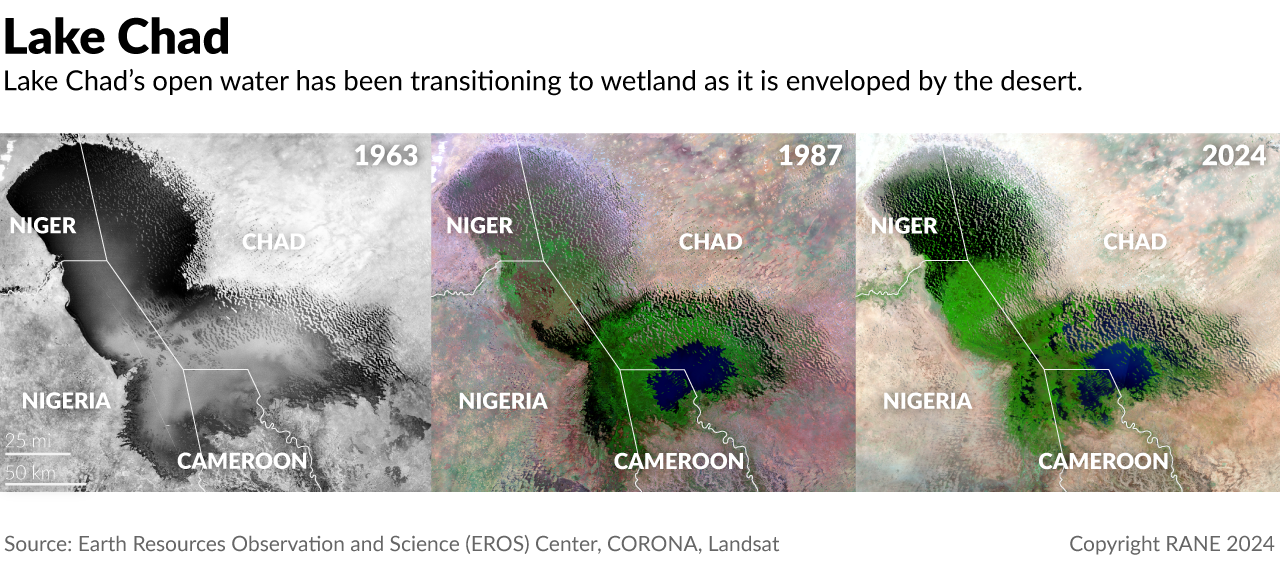
With projected rapid population growth and continued environmental deterioration, competition for arable land and dwindling water resources is likely to intensify, escalating conflicts over these scarce resources, such as Lake Chad. Once one of Africa's largest freshwater lakes, Lake Chad has shrunk by around 90% since the 1960s because of factors including climate change, increased water extraction for irrigation and, most important, population growth. While the lake's water levels have somewhat increased in recent years due to restoration efforts, competition for access to water among communities in Cameroon, Chad, Niger and Nigeria persists due to rapidly growing populations. Population growth combined with the shrinkage of the lake has exacerbated tensions over land disputes and power dynamics, resulting in violent clashes between farmers and herders, mostly along ethnic lines. For example, in February 2021, at least 23 people died in clashes between farming communities and Fulani herders in Mafa and Jere local government areas of Nigeria's Borno state, which are located in the northeastern part of the state near Lake Chad. Diminishing water levels around the lake reduced grazing lands for the Fulani cattle, causing the herders to encroach on farmlands to access water and pasture and triggering the fighting. Meanwhile, in the central Malian region of Mopti, persistent drought since 2015 has resulted in significant losses of farmland, escalating tensions between Fulani herders and Dogon farmers. Years of clashes have resulted in both communities forming armed vigilante groups to defend themselves. Meanwhile, as of 2023, the G5 Sahel region — comprising Burkina Faso, Chad, Mali, Mauritania and Niger — had an estimated population of 92 million people. According to projections, this population could expand to almost 152 million by 2040. The subsequent greatly increased demand for already-stretched resources will worsen conflict. Violence and climate-related factors had increased the number of internally displaced persons from more than 200,000 in 2013 to 2.1 million by early 2021. This increase in IDPs will likely continue, straining resources like housing and water in host communities, heightening social tensions and rivalries, and increasing the risk of violent clashes.
- According to the International Rescue Committee, 78% of the labor force in the central Sahel depends on agriculture and herding.
- Since the 1970s, Niger has lost 100,000 to 120,000 hectares of arable land to soil erosion and desertification annually, in part due to prolonged droughts and increasingly erratic weather patterns associated with climate change.
- The Lake Chad Basin countries, which have a combined population of 246 million people, are expected to double their population within 25 years, rising to 340 million by 2050.
- According to a 2023 report by the Internal Displacement Monitoring Centre, violence and climate change led to the displacement of more than 300,000 Malians, many of whom migrated from rural areas to urban centers such as Bamako and Mopti.
Jihadist groups are likely to exploit the region's water woes by taking control of water sources and water distribution, thereby deepening instability and eroding the already-limited government authority in the Sahel. For more than a decade, jihadist groups have exploited desertification-related vulnerabilities such as increased drought and migration, making the region increasingly unlivable and weakening states' capacity to provide essential services. In the Sahel, a limited state presence — and in some cases, no state presence — has resulted in lawlessness and the rise of nonstate actors. For example, young people in regions such as Mopti in Mali, the Est Region in Burkina Faso and Tillaberi in Niger affected by water shortages have proved susceptible to recruitment by jihadists who offer them resources and protection in exchange for their allegiance. Jihadist groups have in the past targeted water sources such as pumps to gain control over local populations and replace the government as the rulers. This scenario has commonly played out in northern and eastern Burkina Faso, where local populations end up dependent on jihadist groups for access to water, further diminishing central government control and influence. This trend is likely to persist in the medium to long term as jihadist violence in the Sahel worsens. Local groups in the Sahel have also recently been emboldened by the 2022 and 2023 expulsion of French troops from Mali, Burkina Faso, and Niger. The absence of surveillance and intelligence resources previously provided by the French has allowed jihadists to mobilize in large numbers, ambush military posts, and seize more weapons and territories. With increased capabilities, they can launch more extensive attacks on civilians and security forces and recruit more individuals, particularly from marginalized communities whose livelihoods have been affected by water scarcity. Finally, protracted infighting between jihadist groups over supremacy in the Sahel and Lake Chad Basin is likely to continue, resulting in civilian casualties caught in the crossfire, as these groups are unlikely to reconcile — at least not in the medium term. For instance, in 2023, at least 21 civilians, including women and children, were killed when an explosive detonated at a water pump in Tin Rhassane village, Tin-Akoff, Burkina Faso. Jamaat Nusrat al-Islam wal-Muslimin fighters targeting Islamic State Sahel Province militants had placed the explosive. Persistent infighting between the Islamic State West African Province and Jama'atu Ahlis-Sunna Lidda'Awati Wal-Jihad in the localities near Lake Chad will continue to increase the risk of civilian casualties, hindering access to water.
The expulsion of French and U.S. troops by Sahel juntas is likely to hinder future international support in addressing desertification given the risks associated with anti-Western sentiment. Recent coups in central Sahelian states have led France and some other Western countries such as Germany to suspend development aid and budgetary support to these countries. The suspension was initially intended to pressure the juntas to return to civilian rule. But diplomatic relations between France and the junta leaders subsequently deteriorated severely, exacerbated by Mali's deployment of Russian mercenaries in December 2021. This was followed by the expulsion of French troops from Mali in 2022, and later from Burkina Faso and Niger in 2023 amid heightened anti-French sentiment driven by the worsening jihadist insurgency. The loss of significant funding, including for environmental projects, has further worsened socioeconomic conditions, particularly as these projects were crucial for addressing environmental issues like agricultural productivity and water access linked to desertification. This suggests the region will likely struggle to attract similar levels of international support, especially from Western nations given the May 2024 expulsion of U.S. troops from Niger. Increasing anti-Western sentiment leveraged by the juntas to maintain legitimacy will likely limit international aid even further, threatening essential projects. Sahel governments unlikely to return to civilian rule in the medium term will thus lose substantial funding for the development of water management systems and sustainable agriculture practices, as well as the policy and institutional support necessary for combating desertification. This will continue to diminish limited resources, further driving conflict.
- Before suspending aid to Niger in July 2023, Germany had committed about 120 million euros ($132.36 million) from 2021 to transform the country's food and agriculture systems and improve health policies. In parallel, the European Union had allocated 503 million euros for governance, education and sustainable growth in Niger from 2021 to 2024. But like Germany, it also halted all financial and security support to Niger in the same month.
- In 2023, French development aid projects in Burkina Faso represented 482 million euros while the budgetary aid scheduled for 2022 amounted to 13 million euros.
- In November 2022, France suspended its Official Development Assistance projects in Mali aimed at enhancing the agriculture, health, government and education sectors.
- In September 2023, the Malian junta announced the indefinite postponement of elections scheduled for February 2024, while in May 2024, Burkina Faso extended junta rule by five years.
